T_303
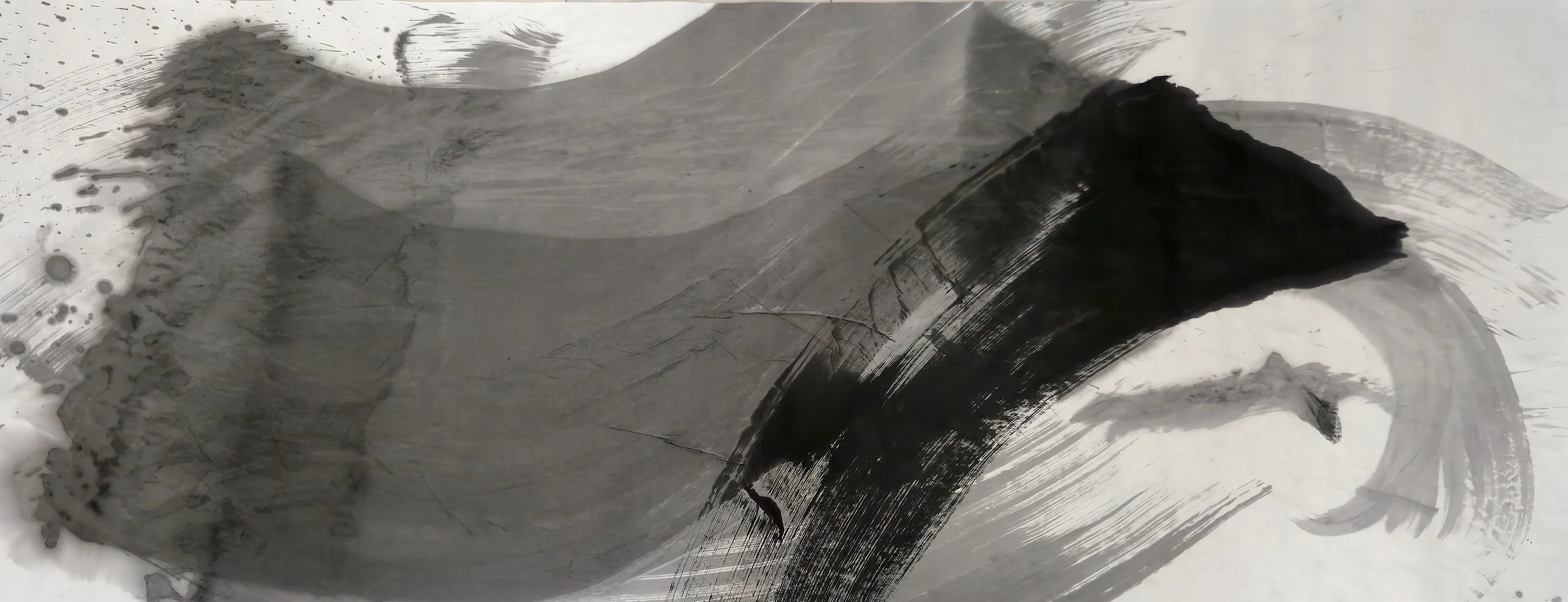
The work as shown. Every value below comes from vae.db, the master database of the Crucible Year.
Recorded
- Date
- 2026.05.14, day 137
- Size
- 70 × 180 cm
- Paper
- S3, Tanxi Jing Pi, raw
- Inks
- MB4, MB5, MB6
- Phase
- P2 The Switch
- Shown on the site
- yes (V23 rating of 5.0 or higher)
- Early storage triage
- SA: save, archive (Peter's early system, since retired)
Measured · V23 (v23.8)
- V23 rating
- 5
- Form
- 2
- Tonal depth
- 2
- Layering
- 2
- Composition
- 2
- Material and surface
- 1
- Ink cover
- 77%
- Dark share
- 21%
- Tonal steps
- 4
- Flaws named by the reads
- bloom 5, water stain 5, other 5
Older engine
- V7
- 8
How the number was made
Read by the Visual Analysis Engine, version 23.8, on 2026.10.06: measured by code, then read 5 times by Claude Opus 5.5 against three reference paintings (R1 to R3), each read independent of the others. How the engine works.
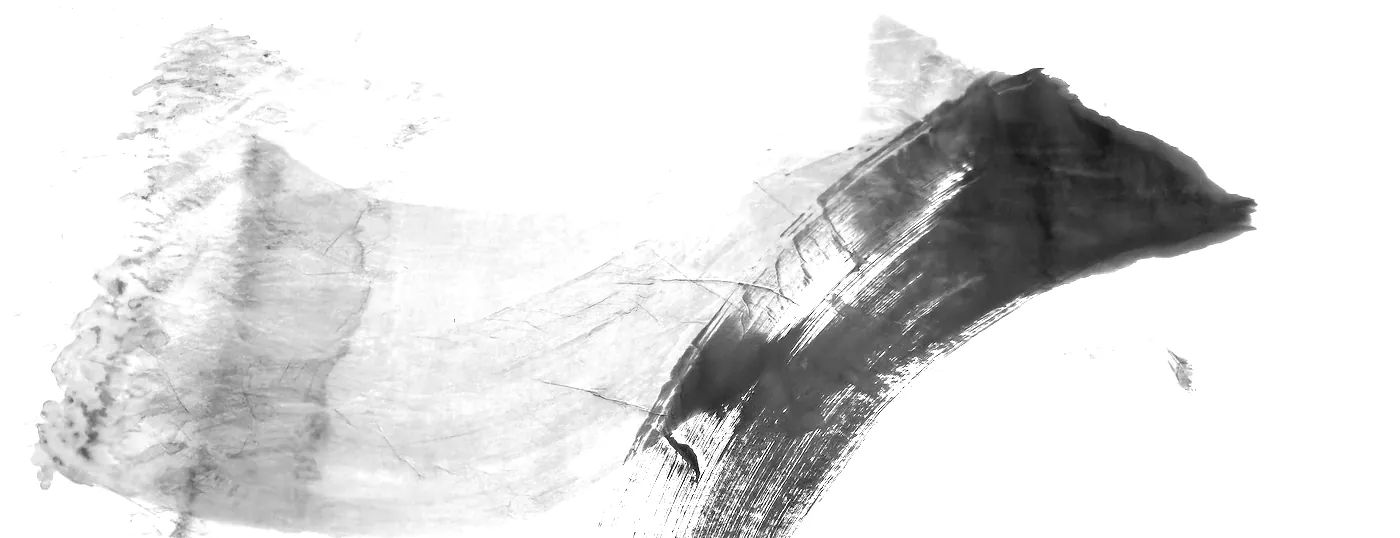
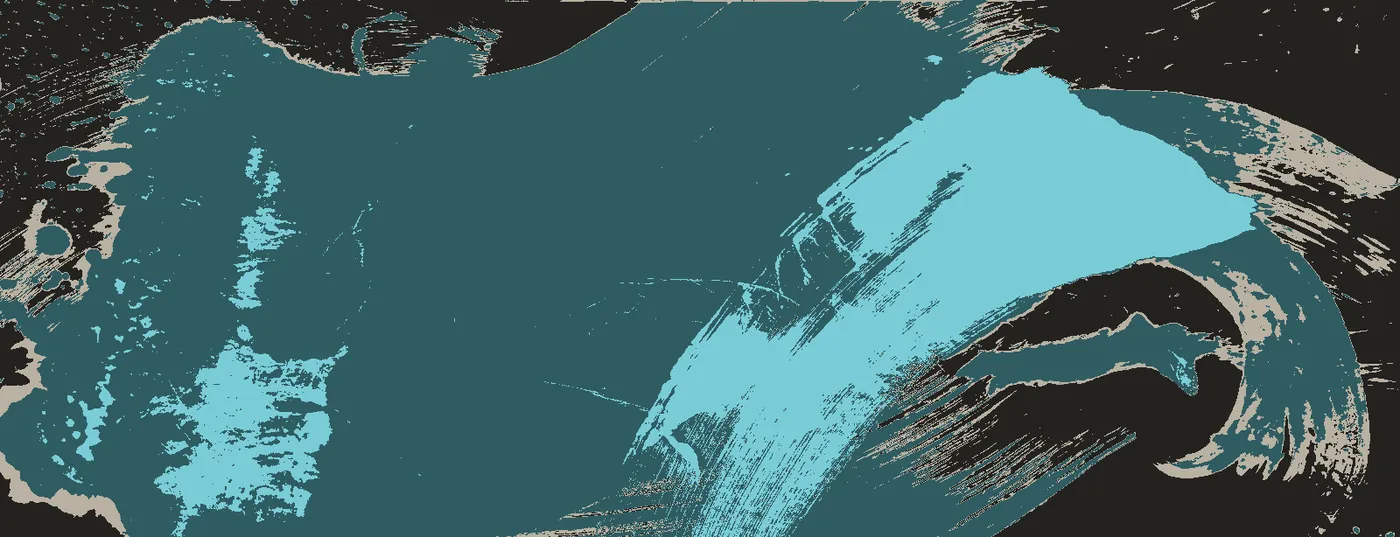
Three views of one sheet.
Left, the photograph. Centre, the tone stretch the model is shown beside it: the darkest 45% of tones spread over the whole range, so flat black, banding and stains show. Right, every pixel as the measuring code classes it: cyan black ink, deep teal translucent grey, stone the palest ink, near black bare paper.
4 families of tone.
Every inked pixel's brightness in 64 bins, smoothed; each circled peak holds at least 4% of the ink. Life inside the black: 0.048 (under 0.045 reads as flat).
Five reads, one answer.
Each quality placed on its ladder by each read, and the mean the engine keeps.
READ 1, IN ITS OWN WORDS
“A confident dark arc and a pale sweep give the sheet direction, but the big grey slab is bulky and mostly flat, and blooms mar its left edge. An ordinary sheet, near R2.”
Dark arcing stroke follows brush travel with split dry-brush bristle edges; large grey wash is a heavy slab with a ragged, undefined left wall.
WEAKEST Bulky grey slab spanning left and centre
STRONGEST Dark curved stroke with dry-brush tail, right-centre
Dark mass shows bristle streaks and grading toward its lower tail (modulation 0.048, barely above flat); big grey wash is mostly even, with some vertical banding at left.
WEAKEST Grey slab interior largely flat mid-grey
STRONGEST Dark stroke's streaked, graded interior
Three passes: a grey wash, a dark stroke over it and a light arc at right. The overlaps can be read but build little depth; four tonal steps.
WEAKEST Dark stroke covers grey without much translucency
STRONGEST Pale grey arc legible over paper, right
A clear left-to-right sweep ending in the dark head and the arc. Ink covers 77% of the sheet, so the empty paper is mostly the top-right and bottom-right corners; the left reads as dense and static.
WEAKEST Heavy grey slab crowds left half
STRONGEST Sweep from dark stroke into right arc
The left edge of the grey slab shows blotchy blooms and cloudy pooling that are visible in the colour view, with scattered drips nearby; the grey wash interior is slightly cloudy.
WEAKEST Mottled, bloomed left edge of grey wash
STRONGEST Dry-brush bristle texture in dark stroke
4 distinct places, 1 major.
Each read must name every flaw and where it is, in a ninth of the sheet. Here the reads named flaws in 4 distinct places, 15 mentions in all across 5 reads; the number in each ninth is how many times a flaw was named there. Reads agreeing on a place strengthen the evidence for one flaw; they do not multiply it. A major flaw holds Material and surface at rung 1.
Measured from the 16-bit master.
The previous engine (V22) measured this sheet's master file: 2 principal ink masses traced (cyan), 5 enclosed voids at true size in their grid cells (amber), the main gesture from start to end (red). Of 18 edge segments, 39% crisp, 50% soft or bloomed, 11% broken.
Tonal depth held at rung 1.
4 steps: not appliedMaterial held at rung 1. Mild waves in the unmounted paper are never a flaw.
4 major flaws: appliedThe rating cannot exceed 4.
lowest 1.0A read that breaks the reply format is discarded.
5 of 5 validV23 rating 5.0.
Engine v23.8, 5 reads. Fixed arithmetic, the same for every painting; the constants were set on 24 randomly chosen paintings so the median sheet scores 5. The scale is relative to this archive, not to painting in general, and a difference of less than half a point between two paintings is noise.