Crucible Year Peter Yuill
Method

How a painting is analysed.

V23 measures studio photographs by code, takes five independent model readings on five fixed ladders, checks them against rules, and computes a rating by plain arithmetic. Early phone photographs are read once by V23 lite, a separate instrument. V23 is the twenty-third full rebuild since the year began. This page follows one painting, T_359, through every stage, with the engine's own images and numbers.

T_359
FormBUILT
Tonal depthMODELLED
LayeringORDERED
CompositionWORKING
Material and surfaceSOUND
RULES, THEN ARITHMETIC6.7
T_359 on the five ladders, and the number that follows · this page shows how each step was reached
252paintings rated by the current engine
1,253independent model reads
1,205distinct flaws located, from 3,788 mentions across the reads
0.95rank agreement with Peter on 10 held-back paintings (tested on version 23.6; promising, on a small test)

Six stages, two kinds of work.

Code does everything that can be measured. A model judges only what measurement cannot reach, and its judgement is constrained on both sides by code. Cyan marks what is measured; amber what is written.

THE ENGINE

From photograph to number.

VAE V23 (Visual Analysis Engine), version 23.8, the reference engine since 6 October 2026. One command rates one painting.

01 Photograph16-bit master fromthe camera RAWONE PAINTING, ONEFILE 02 MeasurePython, no modelEVERY PIXEL, ABOUT0.3 S 03 Analysefive independentmodel readsFIVE LADDERS EACH 04 Rulescode checks everyreadMEASUREMENT OUTRANKSTHE MODEL 05 Ratefixed arithmetic1 TO 9, 5 IS THEMEDIAN 06 ExplainThe reading, writtenlastMAY NOT CHANGE ANUMBER MEASURED: CODE ONLYJUDGEDCODE ONLYWRITTEN
  1. 01Photograph16-bit master from the camera RAW. One painting, one file.
  2. 02MeasurePython, no model. Every pixel, about 0.3 s.
  3. 03AnalyseFive independent model reads. Five ladders each.
  4. 04RulesCode checks every read. Measurement outranks the model.
  5. 05RateFixed arithmetic. 1 to 9, 5 is the median.
  6. 06ExplainThe reading, written last. May not change a number.
1

The photograph.

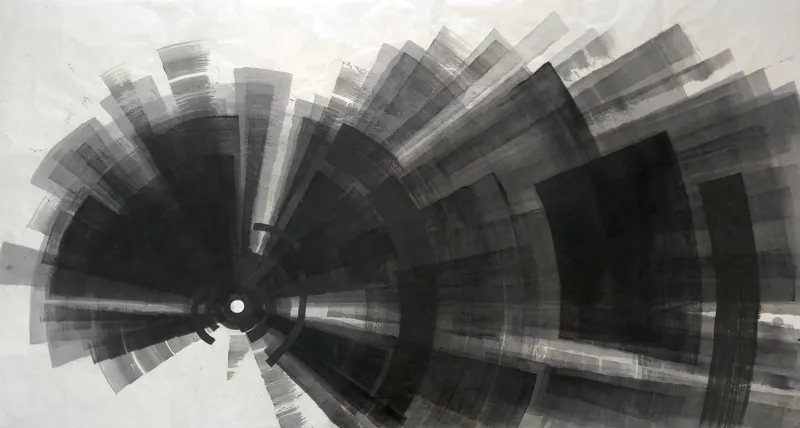
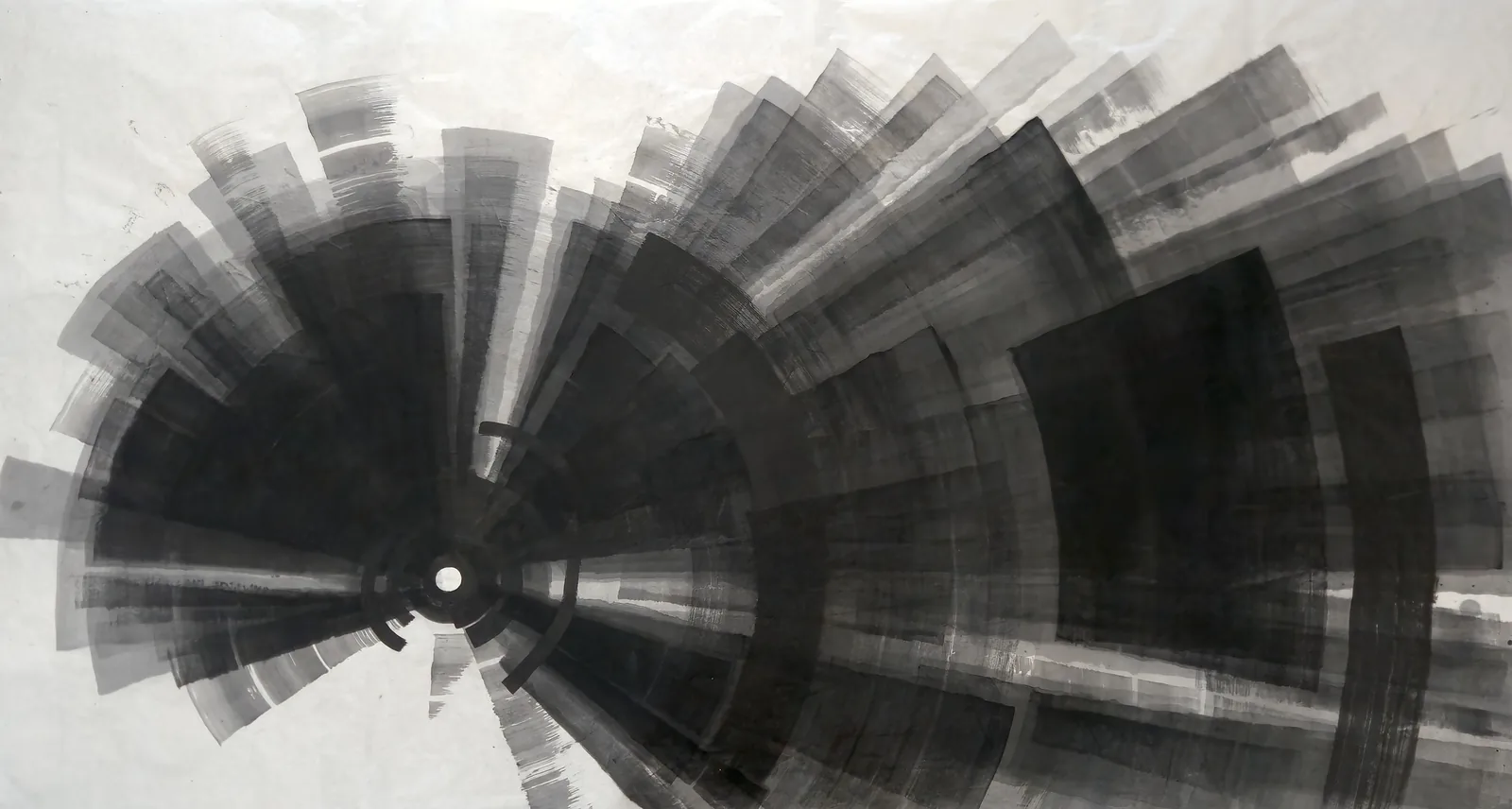
Each painting is photographed flat in the studio and kept as a 16-bit TIFF master. From it the archive makes a family of views, each built to make one kind of truth easier to see. These are the real files for T_359.

T_359, the analysis view
The analysis viewThe colour photograph, 2,576 pixels on its long side. The only image the current engine measures and reads.
T_359, tone-stretched
Tone-stretchedThe darkest 45% of the tones spread across the whole range. Dead flat black, banding inside the black, tide lines and milky patches become visible. The model sees this beside the colour view.
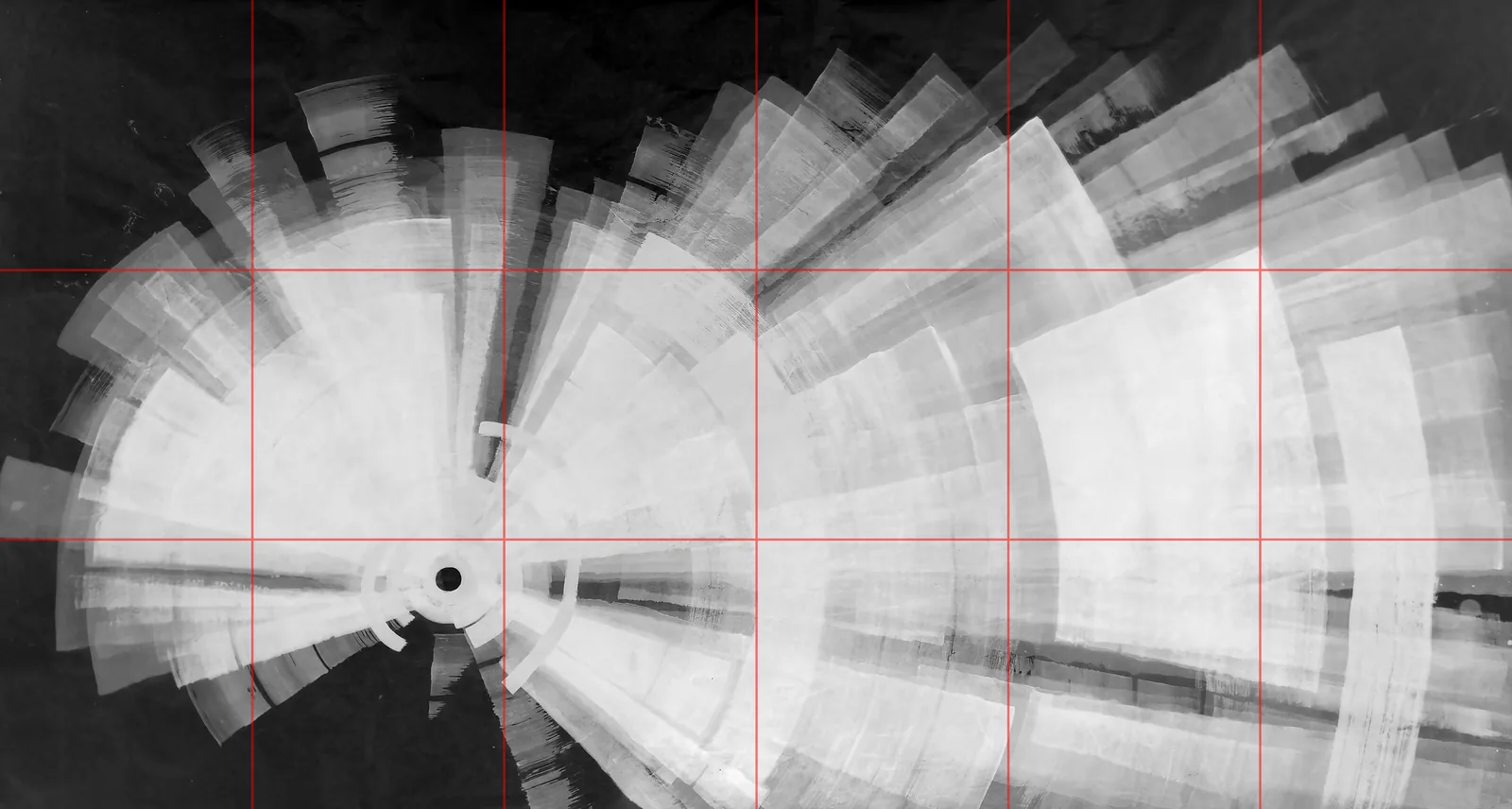
T_359, black and white
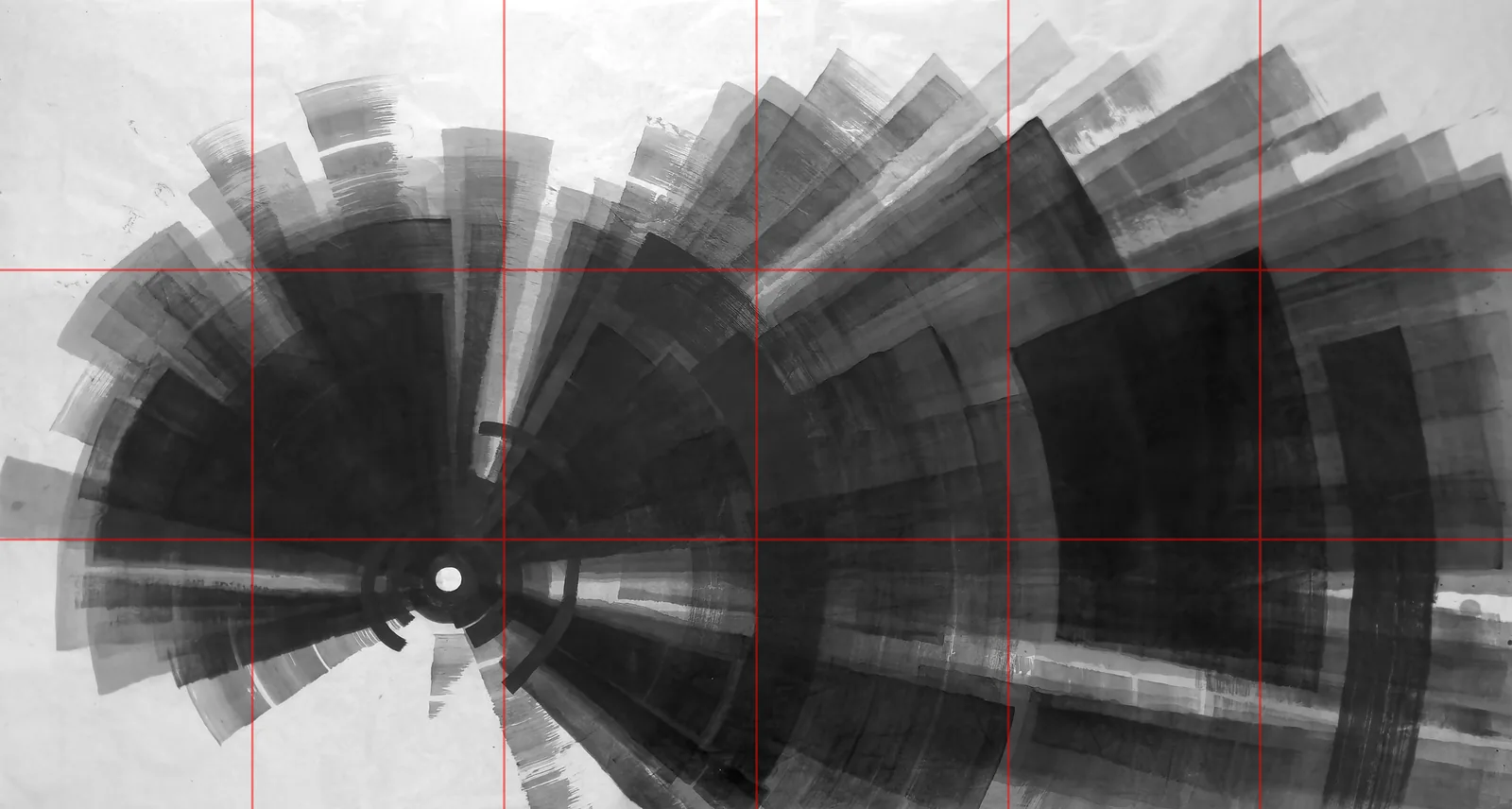
Black and whiteColour removed so value alone is judged. A reference grid divides the sheet for locating things.
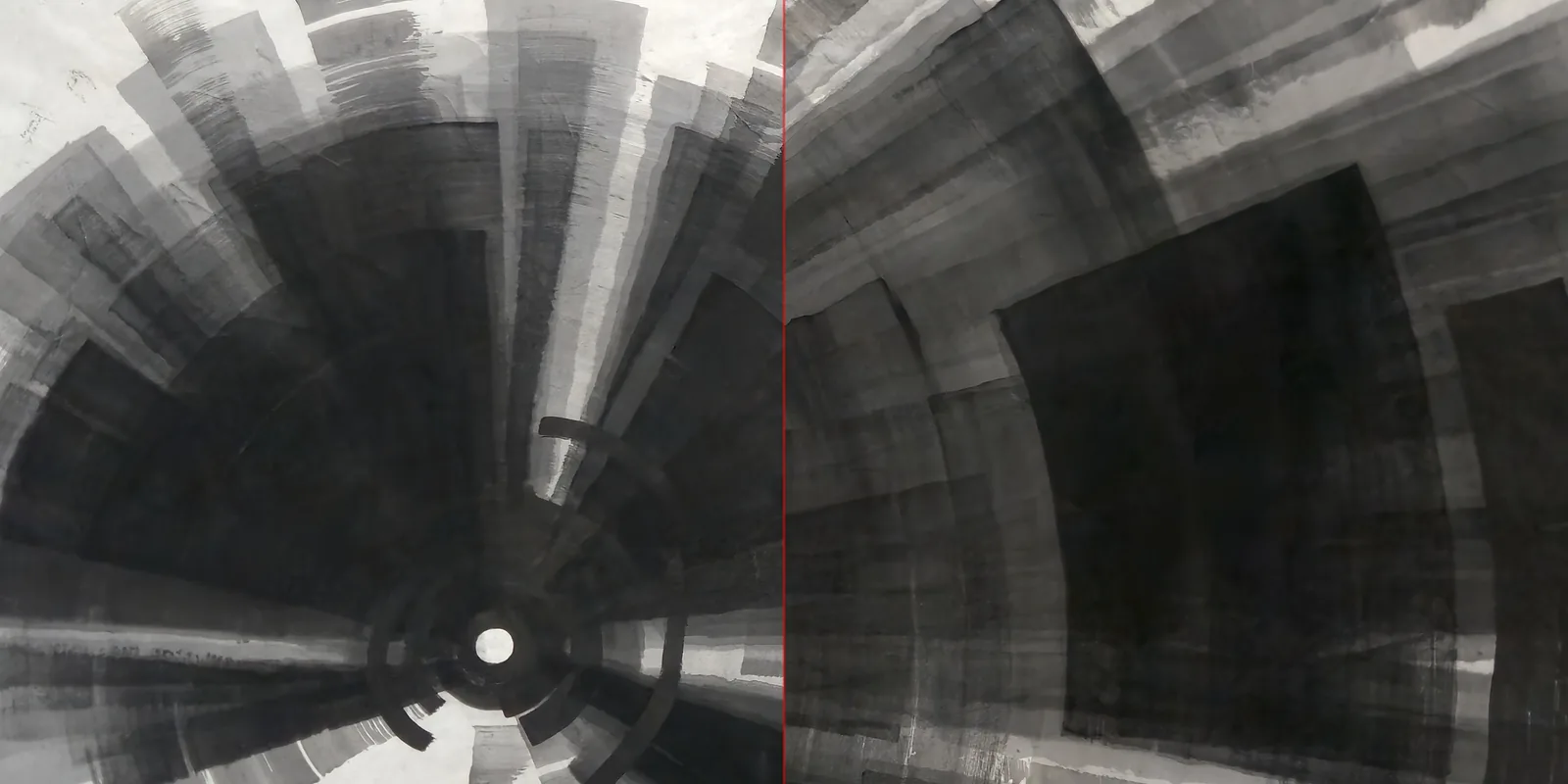
T_359, inverted
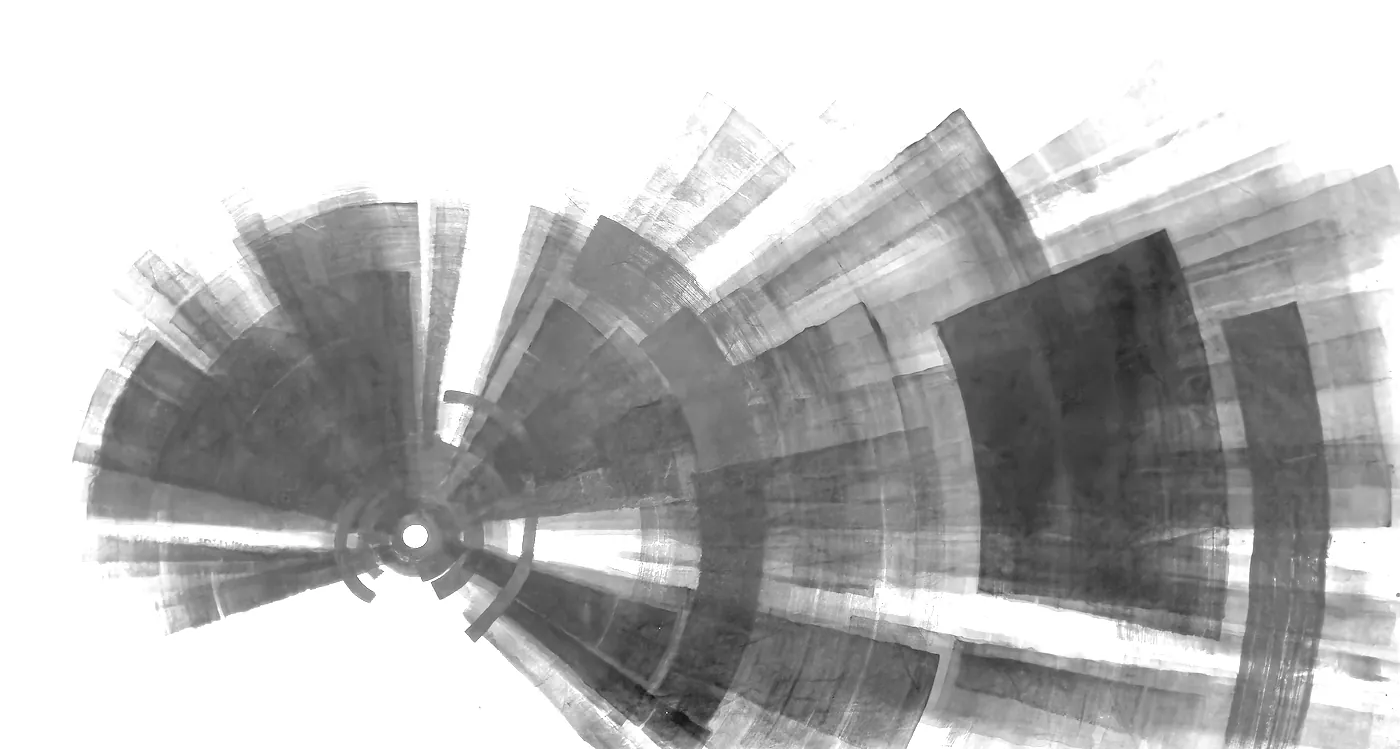
InvertedInk becomes light. The eye stops reading shapes as objects and sees the white of the paper as the structure it is.
T_359, low-pass
Low-passFine detail blurred away (the strength was tuned on the archive itself). What remains is the composition: the big masses and how they balance.
T_359, close crop
Close cropA detail Peter chose from the 16-bit master, at full resolution: brush hair, dry-brush, the edge where ink meets fibre.

The earlier engine, V22, looked at five of these views and measured the 16-bit master directly. The current engine needs only the colour view and its tone stretch: that is cheaper, and the validation below shows it is no less accurate.

2

Measured first.

Before any model looks, Python measures the sheet. The photograph is converted to brightness, scaled so the paper reads as pure white, and every pixel is classed by fixed thresholds. The same code, the same numbers, every time.

EVERY PIXEL

What the code sees.

Left: T_359. Right: the same sheet as the code classes it. Cyan is black ink (below 0.30 brightness), deep teal translucent grey (0.30 to 0.75), stone the palest ink, near black is bare paper (above 0.88).

T_359T_359 classified by brightness
80%of the sheet carries ink
Black 59%Grey 33% SHARE OF THE INK, NOT OF THE SHEET
TONAL STEPS

3 families of tone.

Every inked pixel's brightness, counted into 64 bins and smoothed. A family of tone is a peak holding at least 4% of the ink. T_359 has 3: a black, a mid grey and a pale wash. A sheet with two or fewer cannot be rated above the bottom rungs for tonal depth or layering, whatever the model thinks.

0.300.75123 BLACK INK TRANSLUCENT GREYS PALEST INK, 0.88 LUMINANCE OF EVERY INKED PIXEL, 64 BINS. PAPER (ABOVE 0.88) IS LEFT OUT.
INK COVERAGE80%

How much of the sheet carries ink.

BLACK59%

Of the ink, the share that is solid black.

TRANSLUCENT GREY33%

Of the ink, the share that is layered grey.

TONAL STEPS3

Distinct families of tone, counted as above.

LIFE INSIDE THE BLACK0.047

Broad gradation inside the solid black. Under 0.045 reads as flat, dead black; T_359 sits just above it.

FRAME CONTACT100%

Of the right edge, where ink runs off the sheet (top 17%, bottom 73%, left 48%). Recorded for the written reading; never shown to the model.

These five facts go to the model labelled as true. Each was tested against Peter's own ratings before it was kept: the count of tonal steps tracks his eye most closely (rank correlation 0.55 on the 13 development works). Two candidate measures were dropped because they did not: one read JPEG noise as texture, the other fired on good sheets.

GEOMETRY

The previous engine went further.

V22 measured the 16-bit master itself, and its records remain in the archive for 232 works: 557 ink masses traced to their outlines, 1,194 enclosed voids, 4,215 edge segments classed. Here, on T_359: the outline of its one principal mass (cyan), the 5 voids it encloses (amber circles of their true area, placed in their grid cells), and the path of its main gesture from start to end (red, 13 turns). Of 17 edge segments, 47% are crisp, 41% soft or bloomed, 12% broken.

A1B1C1D1E1F1A2B2C2D2E2F2A3B3C3D3E3F3H1H2H3H4H5
3

Read five times.

A vision model (Claude Opus 5.5) is shown two images and the measured facts, and places the painting on five ladders. It never gives a rating, and never sees one. It does this five times, independently, and every read is checked by code.

WHAT THE MODEL SEES

The painting, and three fixed points.

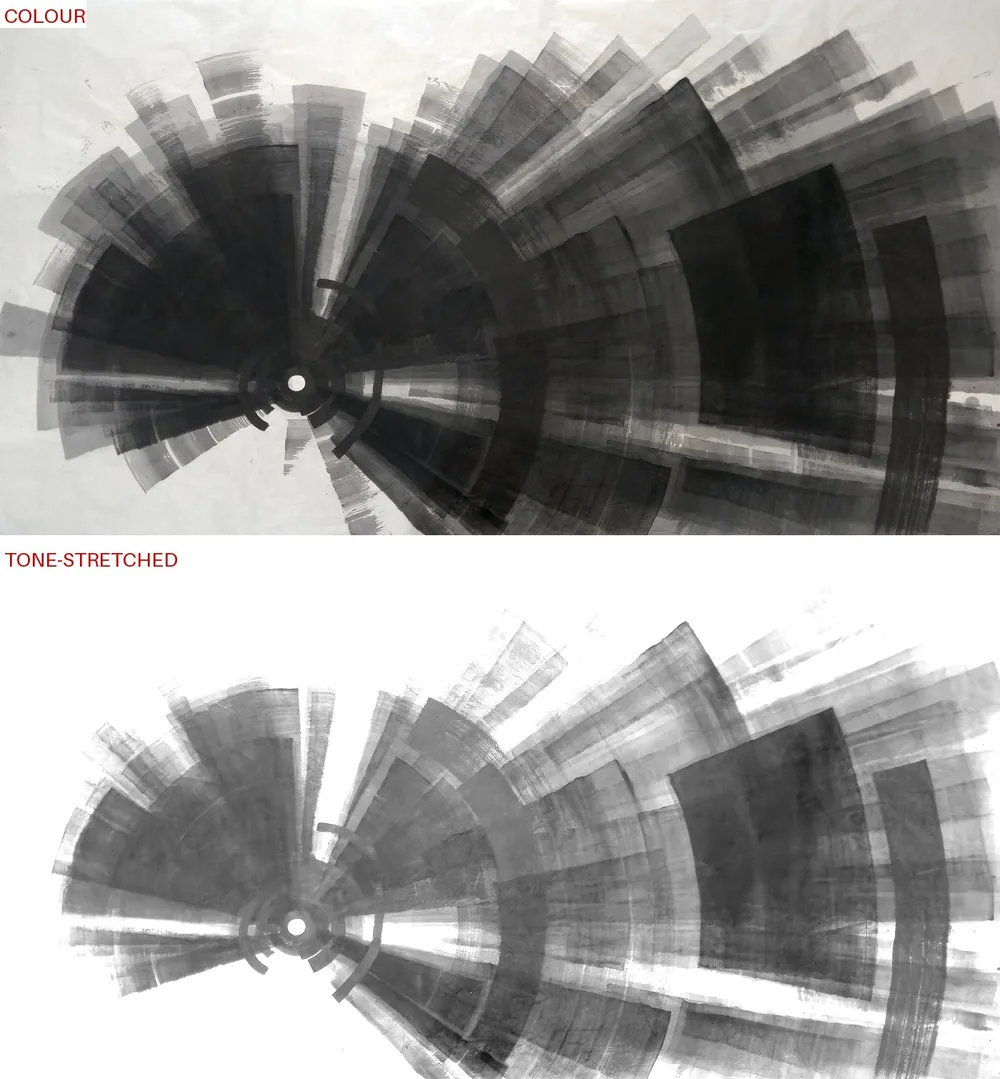
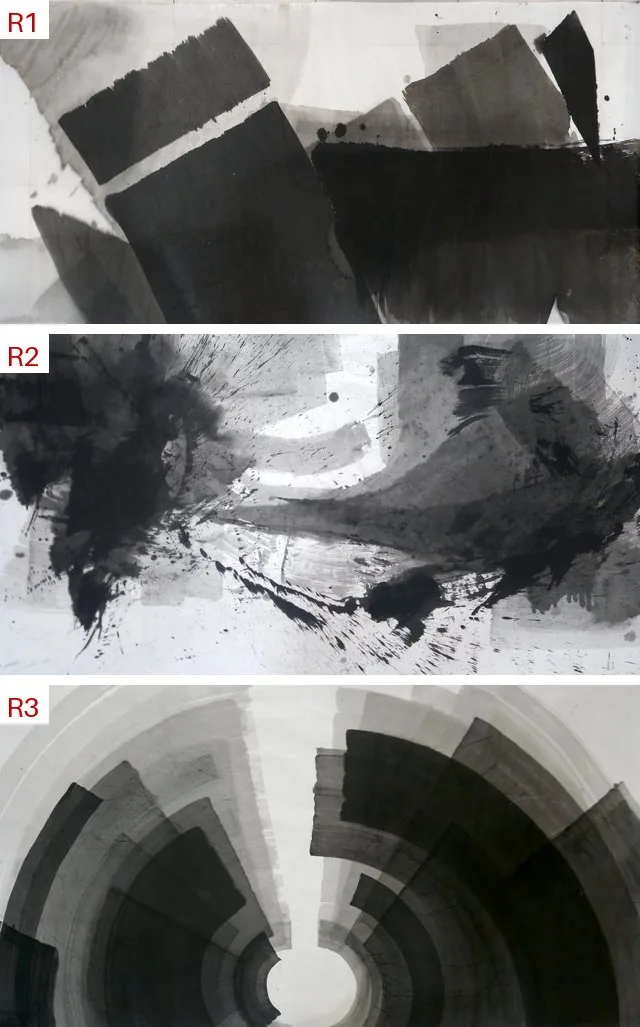
Left, the target board: T_359 in colour above its tone stretch. Right, the reference board: three paintings Peter rated, the same three for nearly every painting the engine reads (R1 T_140, a weak sheet; R2 T_206, a middling one; R3 T_334, one of the strongest). The model judges against these three sheets. That is how the scale stays anchored to this body of work.

Target board: T_359 in colour and tone-stretchedReference board: R1, R2, R3
FIVE LADDERS

Five questions, five rungs each.

Every rung has a name and a written definition. Rung 2 is what the median sheet in this archive does; rungs 3 and 4 need evidence that is rare here. Close calls resolve down. Highlighted: where T_359 landed. Form, Tonal depth, Layering and Composition are the critical axes; Material records how ink and paper behaved.

012 · the median sheet34
Formthe shapes the brush makes FORMLESSBLUNTBUILTFLUENTMASTERED
Tonal depthhow much life the blacks and greys hold FLATTHINMODELLEDDEEPLUMINOUS
Layeringwhether passes of ink stay legible over each other MUDDIEDSINGLELEGIBLEORDEREDORCHESTRATED
Compositionhow the sheet is held as a whole BROKENINERTWORKINGCOMMANDINGINEVITABLE
Material and surfacehow ink and paper behaved, flaws included DAMAGEDFLAWEDSOUNDFINEMASTERED
FIVE READS

T_359: five reads, one answer.

Each read is a separate call with no memory of the others: a first impression in one read cannot bend the next. On T_359 the five agreed on every axis. Across all 252 paintings, the five reads put an axis on the same rung 79% of the time, were one rung apart on the rest, and never further apart than that.

READ 1READ 2READ 3READ 4READ 5MEAN
Form2BUILT2BUILT2BUILT2BUILT2BUILT2.0
Tonal depth2MODELLED2MODELLED2MODELLED2MODELLED2MODELLED2.0
Layering3ORDERED3ORDERED3ORDERED3ORDERED3ORDERED3.0
Composition2WORKING2WORKING2WORKING2WORKING2WORKING2.0
Material and surface2SOUND2SOUND2SOUND2SOUND2SOUND2.0

READ 1, IN ITS OWN WORDS

Form

Radial arc bands follow brush travel with dry-brush ends; the big dark block right of centre and the tall right bar read bulky and slab-like.

WEAKEST Large dark slab-like rectangle right of centre

STRONGEST Curved arc bands around the left radial hub

Tonal depth

Three tonal plateaus; dark interior modulation 0.047, barely above flat. Fan greys are stepped and grained, but the main dark masses stay fairly uniform inside.

WEAKEST Dark rectangle right-centre, nearly flat interior

STRONGEST Stepped translucent greys in upper-right fan

Layering

Many translucent passes fan out from two hubs, each blade still readable where it overlaps; the sequence builds depth from pale outer blades to dark inner masses.

WEAKEST Dense dark overlap near the left hub

STRONGEST Overlapping translucent fan blades, upper right

Composition

Two radial centres drive a clear left-to-right sweep. Ink covers 80% of the sheet and the right half is jammed with dark blocks, so the empty paper is mostly leftover corners.

WEAKEST Crowded, heavy right half with little breathing space

STRONGEST Rotating sweep from left hub toward upper right

Material and surface

Ink is controlled and the dry-brush edges are clean. There is a small round spot at the right edge and faint specks on the left paper; nothing damages a principal mass.

WEAKEST Small dark drop at the right edge

STRONGEST Dry-brush streaked blade ends, upper left

FLAWS

Every flaw has a place.

Each read must name every flaw and where it is, in a ninth of the sheet. Across five reads of T_359: 2 distinct places, named 10 times in all, 0 of them major. Five reads agreeing on a flaw is stronger evidence of one flaw, not five flaws. A major flaw holds Material at rung 1. Across the archive: 1,205 distinct places from 3,788 mentions.

5 × OTHER“faint grey specks on bare paper, upper left”5 × OTHER, RING, WATER STAIN“small round dark drop at right edge, mid-heig…”WATER STAINRINGOTHER
4

Rules, then arithmetic.

The model's answers pass through code that it cannot argue with. Measured facts outrank its reading. Then the number is computed by fixed arithmetic.

RULE 1Two tonal steps or fewer

Tonal depth held at rung 1.

T_359: 3 steps, rule not applied
RULE 2A major flaw

Material held at rung 1. Mild waves in the unmounted paper are never a flaw.

T_359: no major flaw named
RULE 3Any axis below 0.5

The rating cannot exceed 4.

T_359: lowest axis 2.0
RULE 4At least two valid reads

Any read that breaks the strict reply format is discarded.

T_359: 5 of 5 valid
THE ARITHMETIC

T_359: 6.7.

The scale was set on 24 paintings chosen at random from the archive, before Peter rated them, so that the median sheet scores 5, the tenth percentile 3 and the ninetieth 7. No constant was fitted to Peter's ratings. A 10 is never awarded: the top of the scale is left open.

MEAN RUNG2.20(2.0 + 2.0 + 3.0 + 2.0 + 2.0) ÷ 5
→
RAW5.401 + 2 × 2.20
→
RATING6.75 + 2.086 × (5.40 − 4.60)

The whole run for T_359 took 11,169 tokens and about a minute and a half. The previous engine spent about 90,000 tokens per painting and agreed with Peter less well. Every run is stored with its prompt fingerprint, its five replies, the reasons for each rung and every flaw, so any number on this site can be traced back to what produced it.

5

Is it right?

An engine that agrees with itself is not enough. It has to agree with the eye that made the work, on paintings it was never tuned on, and it has to say the same thing twice.

HELD OUT

Ten paintings, rated blind: 0.95. The previous engine: 0.76.

Left: Ten works across the engine's range were set aside, scored by the engine (version 23.6) and sealed. Peter then rated each by eye, wrote his reasons, and registered both (2026.09.30) before the seal was opened. Rank agreement 0.95; average miss 0.76 of a point; average lean −0.13. No sheet Peter rated 4 or below scored above 5. Shaded: within one point. Read this as promising on a small test: ten paintings, one rater, on engine version 23.6 (since then, 23.7 began reading colour ink as deliberate material, which touches one of the ten, T_310, and 23.8 changed only what is recorded), and the average miss of 0.76 is just outside the 0.75 bar set beforehand. This measures agreement with Peter; repeatability, below, is a separate question. Right: The 13 development paintings, V22 (hollow) against Peter: average miss 1.39, a lean of +1.18 (it flattered), and it rated dark, clean, lifeless sheets 6.8 to 8.1 that Peter rates 2 to 5. On the same 13, V23 misses by 0.92 on average with rank agreement 0.86. Each mark sits at Peter's rating across and the engine's up; the line under it is the miss.

V23, held out · 0.95 1133557799 PETER'S EYE ENGINE T_136 V22, before · 0.76 1133557799 PETER'S EYE ENGINE T_140T_192T_314
REPEATABILITY0.98

Two complete passes over the 13 development works, rank against rank. Average change 0.22 of a point; 6 of 13 identical. A difference under half a point between two works is noise.

DEVELOPMENT SET13

Paintings Peter rated, used to choose between designs. Every design was scored on them and is logged, including the ones that failed.

HELD-OUT SET10

Never seen during development. Peter's ratings registered before the engine's were revealed.

DESIGNS TRIED9

Versions 23.0 to 23.8, each a single change, kept or rejected on the numbers.

DEVELOPMENT

Each change, kept or rejected on the numbers.

Average miss against Peter on the 13 development works for each design in turn (the path; lower is better), with rank agreement beneath each. The honest caveat, recorded at the time: the prompt was revised once after seeing these results, so they are development figures. The held-out ten above are the real test.

0.81.01.21.4THE BAR SET BEFOREHAND: 0.751.44V23.0RANK 0.79Five ladders; one readTOO HARSH AT THE TOP1.25V23.1RANK 0.87The model is told whateach reference sheetstands forNOT MEASUREDV23.3RANK 0.90Three reads averagedUNSTABLE ON A REPEAT(0.827)1.30V23.4RANK 0.86Five reads averagedREADS KEPT1.21V23.5Offset so the mediansheet is 5SPREAD STILL TOO NARROW0.92V23.6RANK 0.86Scale stretched aboutthe medianSHIPPED; A REPEAT PASSGAVE 0.86AVERAGE MISS AGAINST PETER, 13 DEVELOPMENT WORKS · LOWER IS BETTER
6

How it got here.

V23 is a count: the twenty-third full rebuild of the engine. It was never designed in one sitting. It has been under construction for as long as the paintings have, from the first reader in the opening weeks of the year to the version running now, and most rebuilds went through many variants of their own before they were replaced.

23 REBUILDS

Rebuilt from the start, twenty-three times.

Each cell is one full rebuild of the engine, in order. A rebuild began from what the last one got wrong; inside each, variants were tried and discarded, sometimes by the dozen. Where the record keeps their names they show the depth: version 9 ran to 9.2.4, version 16 to its eighth lettered variant, version 18 through four variants on two models, version 23 to 23.8. More than forty named versions and variants survive in the record, each with what failed. Hover or tap a cell.

FIRST READERSearly 2026PROMPT ENGINESV1 to V10, March to JuneTHE PIPELINEV11 to V20, late June to early SeptemberMEASURE FIRSTV21 and V22, SeptemberTHE REFERENCEV23, since 30 September·1234567891011121314151617181920212223The first production promptFloor and ceiling splitTaken apart by an outside critiqueCode measures firstFive ladders, five reads

These are the turns that mattered.

  1. MarV1First production prompt

    Descriptions drifted generous: the model admired instead of judging.

  2. AprV3 to V4Verdict before prose

    A firewall between the judgement and the description, so praise cannot raise a number.

  3. MayV7Five forensic tests, 1 to 10

    Fourteen gates proved too many; five sequenced tests replaced them.

  4. JunV9 to V10Floor and ceiling

    Three models compared on the same works. The engine measures the floor reliably and cannot honestly reach the ceiling.

  5. Augv14c to v19Forensic dimensions at scale

    Twenty-plus versions on three models, logged failure by failure. The basis of the FINDINGS report.

  6. SepV20 to V21Four research domains

    An outside critique of V20's fourteen categories rebuilt the frame: material, motion, structure, perception.

  7. SepV22Measure first, then judge

    Python measures the 16-bit master before any model looks; 14 axes, code ceilings.

  8. Sep 30V23Five ladders, five reads

    One eighth of V22's cost, and agreement with Peter's held-out ratings at 0.95.

  9. Oct 6v23.7 to v23.8The reference

    Colour ink read as deliberate (23.7); every read records its strongest part and each flaw's place (23.8).

  10. Oct 26v23.9 to v23.11Calibrated by eye

    The tonal-step rule had held down dense, many-layered sheets; it now limits Tonal depth only, chosen on eight paintings Peter rated blind (average miss 0.55). Mildly wavy unmounted paper is never a flaw.

7

The research underneath.

Seven reports sit behind the ladders, the rules and the way the model is asked. Some were commissioned syntheses of the literature on ink, brush and abstraction; one was written from the engine's own failures. All are kept in full in the archive.

FINDINGS: model behaviour and engine design

Written from twenty-plus engine versions tested live on Gemini and Claude

Why the engine is built the way it is. A model's first impression bends everything after it, including its own self-checks, so the engine takes five separate reads instead of asking one read to doubt itself. Three-level scales collapse competent work into the top level, so the ladders have five rungs. The model never sees a score, so it cannot aim at one.

V20 framework critique

A stress test of the fourteen categories V20 used

Rated each category for validity, merged the ones that measured the same thing, and grouped what remained into four domains: Material and rheology, Kinematic and temporal, Spatio-structural, Perceptual and contingent. V21 was built on it.

Forensic diagnostics of Chinese brushwork

Material mechanics, kinematics, a seven-level execution hierarchy

How a mark is read: brush loading, speed, pressure, dry-brush (feibai) against exhaustion, and a seven-level hierarchy of execution. The vocabulary for reading a single mark.

A forensic framework for abstract ink painting

An operational method written for an image-analysis system

Edges read relative to the paper's absorbency; a five-level evidence scale (observed, technically inferred, process-inferred, interpretive, speculative); criteria for overwork and for the stopping point.

The structural anatomy of abstraction

A critique methodology for non-representational painting

Composition without subject matter: balance, tension, figure and ground, the role of the void. The vocabulary for reading a whole sheet.

The architecture of the ineffable

An independent report on the same question

Arnheim's perceptual dynamics and other ways of naming what makes an abstract sheet hold. A second, separately written answer, kept as a check on the first.

Material physics reference

Paper fibre, sizing, ink chemistry, brushes

What each paper and ink in the archive physically does, written for the engine with every rating removed, so the model learns materials without learning preferences.

8

What it cannot do.

Stated plainly, because an instrument is only as credible as its declared limits.

It reads photographs, not paintings. Scale, sheen and the physical presence of a two-metre sheet do not reach the camera.

It measures the floor better than the ceiling. It reliably separates a failed sheet from a sound one. What makes the very best work exceptional is, by design, left open: no painting is ever given a 10.

It disagrees with Peter on some works, consistently. A few strong sheets it reads as blunt or flat inside, pass after pass. That is a real disagreement, and it stays in the record.

The earliest works are read differently. The 143 works with no high-resolution master exist only as older phone photographs. They were read once each by a lighter version of the same engine (V23 lite). Its numbers are kept as their own series and never averaged with these.

Peter's own ratings never set the number. He rates privately, before he sees the engine, so any gap is honest. The engine is the reference; his eye is how the engine was tested.