T_305
The work as shown. Every value below comes from vae.db, the master database of the Crucible Year.
Recorded
- Date
- 2026.05.14, day 137
- Size
- 70 × 180 cm
- Paper
- S3, Tanxi Jing Pi, raw
- Inks
- MB4, MB5, MB6
- Phase
- P2 The Switch
- Shown on the site
- yes (V23 rating of 5.0 or higher)
- Early storage triage
- SA: save, archive (Peter's early system, since retired)
Measured · V23 (v23.8)
- V23 rating
- 5
- Form
- 2
- Tonal depth
- 1
- Layering
- 2.2
- Composition
- 2
- Material and surface
- 1.8
- Ink cover
- 79%
- Dark share
- 35%
- Tonal steps
- 2
- Flaws named by the reads
- water stain 5, other 5, tide line 2
Older engine
- V7
- 8
How the number was made
Read by the Visual Analysis Engine, version 23.8, on 2026.10.06: measured by code, then read 5 times by Claude Opus 5.5 against three reference paintings (R1 to R3), each read independent of the others. How the engine works.
Three views of one sheet.
Left, the photograph. Centre, the tone stretch the model is shown beside it: the darkest 45% of tones spread over the whole range, so flat black, banding and stains show. Right, every pixel as the measuring code classes it: cyan black ink, deep teal translucent grey, stone the palest ink, near black bare paper.
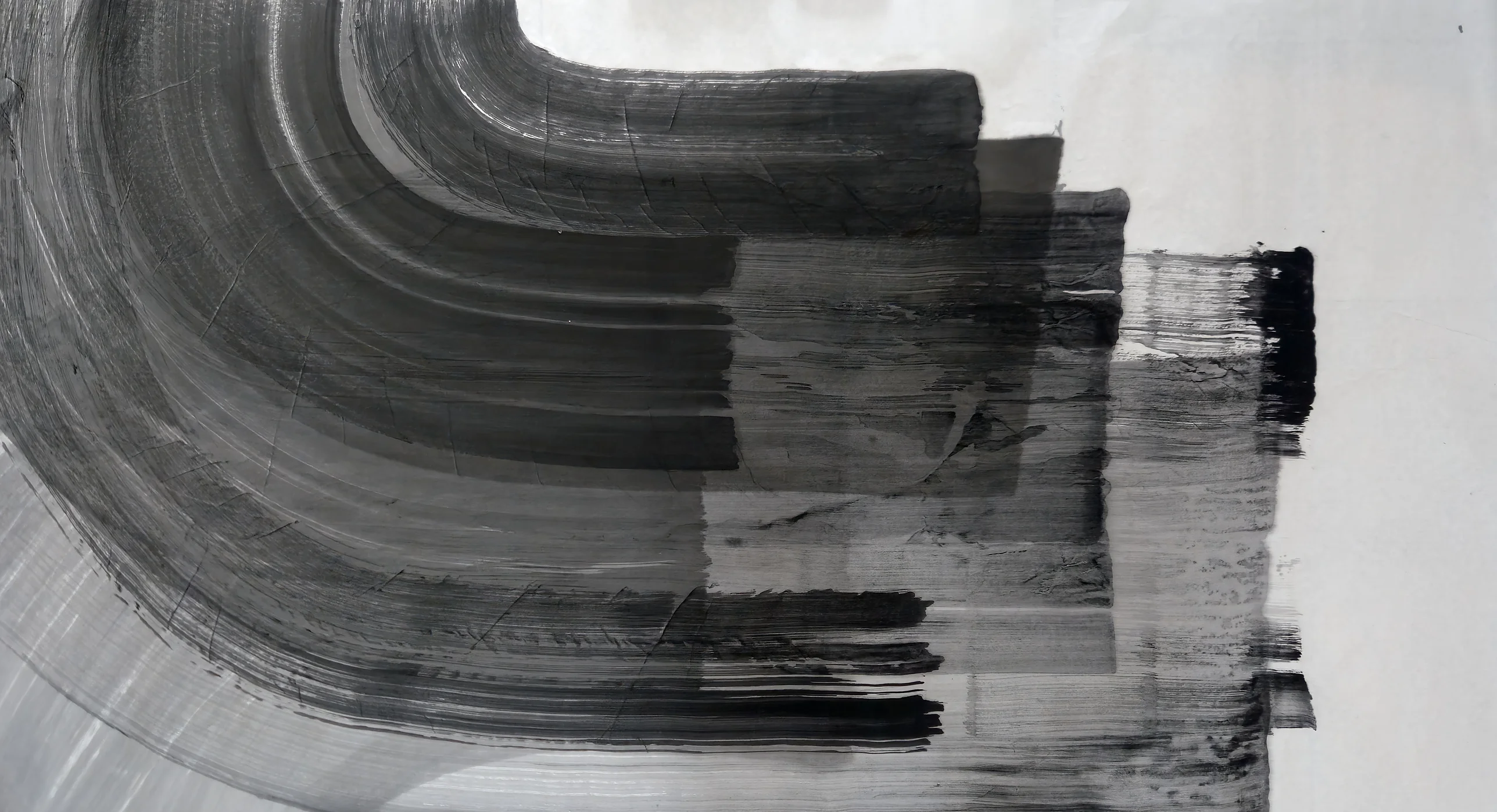
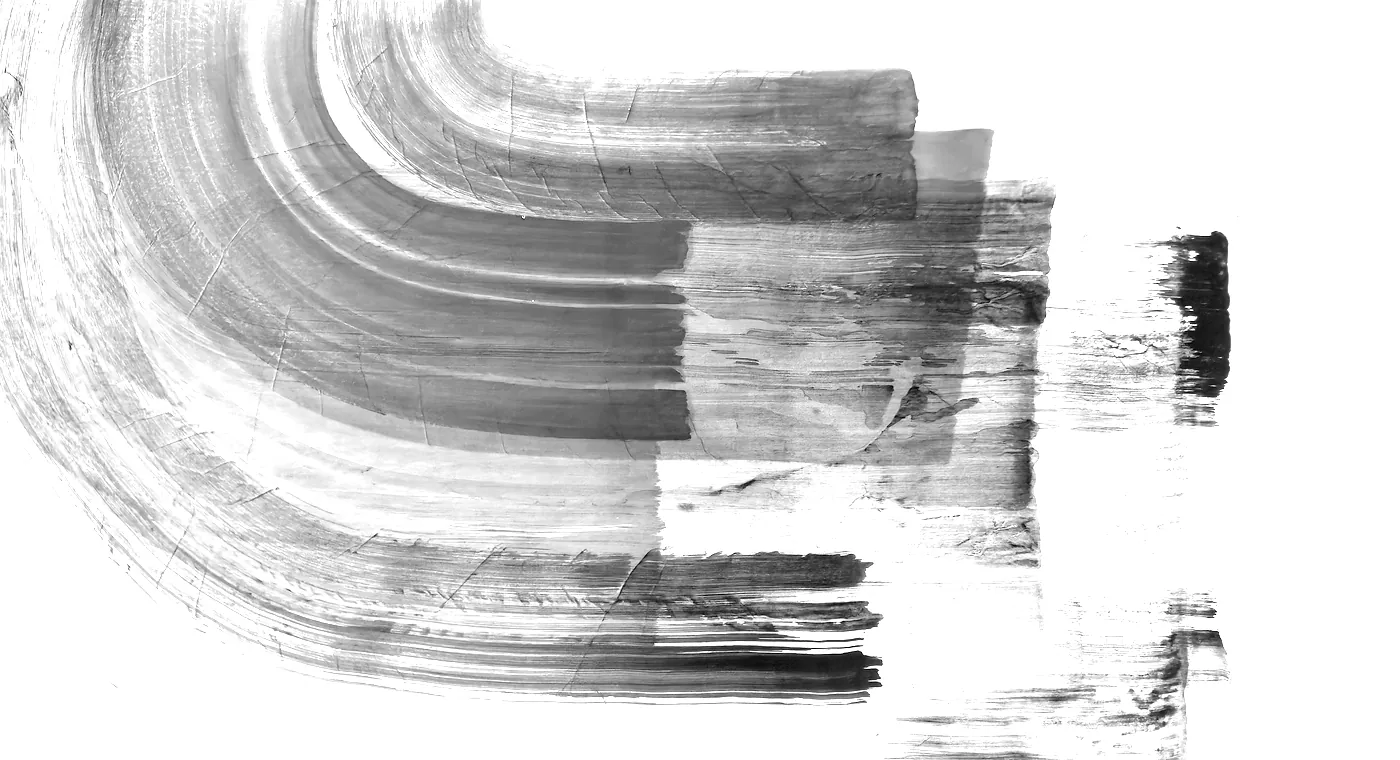
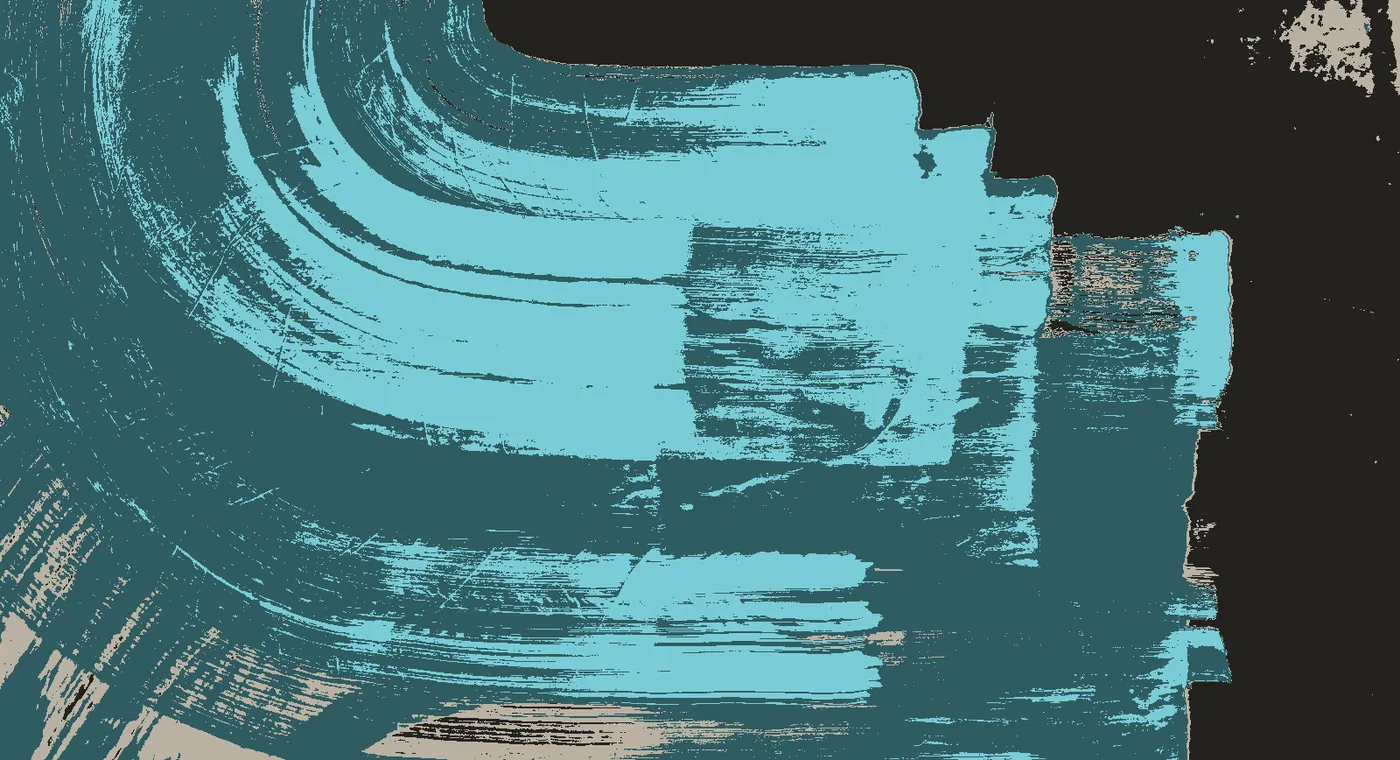
2 families of tone.
Every inked pixel's brightness in 64 bins, smoothed; each circled peak holds at least 4% of the ink. Two or fewer: Tonal depth is held at the bottom rung whatever the model reads. A dense sheet of many translucent passes can count low here, so Layering is left to the reads. Life inside the black: 0.050 (under 0.045 reads as flat).
Five reads, agreeing on 3 of 5 qualities.
Each quality placed on its ladder by each read, and the mean the engine keeps. Where reads differ, they differ by one rung; close calls resolve down.
READ 1, IN ITS OWN WORDS
“A quarter-arc study in the manner of R3: legible layered passes and banded arcs, but crowded, blocky in the centre-right, tonally narrow, and with milky patches inside the central grey mass.”
Left arcs bend fluently with the brush travel; centre-right passes end in squared, slab-like blocks with stiff, stacked terminations.
WEAKEST Stacked rectangular slab passes, centre-right, blunt and blocky
STRONGEST Large upper arc stroke following the brush's turn
Arcs carry bristle banding and grain; tonal_steps 2 and modulation 0.0495, just above flat; the mid-grey rectangles read as one even tone.
WEAKEST Centre grey slabs, nearly uniform inside
STRONGEST Banded dry-brush striations through the upper arc
Several translucent passes: pale under-arc, darker arcs and stepped grey blocks overlapping to the right. The order reads clearly across most of the sheet.
WEAKEST Dense overlaps centre-right become hard to separate
STRONGEST Translucent stepped rectangles overlapping the arcs, centre
The arc sweep gives direction from top-left to the right-hand ends, but ink covers 79% of the sheet; the mass is heavy and the right margin is only partly shaped.
WEAKEST Crowded centre mass; right paper strip leftover
STRONGEST Sweeping arc carrying eye from top to right
Dry-brush edges are well used, but pale milky patches and a curved scrape mark sit inside the central grey mass, visible in colour; crease lines cross the sheet.
WEAKEST Milky cloudy patches inside centre grey slabs
STRONGEST Dry-brush grain at stroke ends, right
3 distinct places, 1 major.
Each read must name every flaw and where it is, in a ninth of the sheet. Here the reads named flaws in 3 distinct places, 12 mentions in all across 5 reads; the number in each ninth is how many times a flaw was named there. Reads agreeing on a place strengthen the evidence for one flaw; they do not multiply it. A major flaw holds Material and surface at rung 1.
Measured from the 16-bit master.
The previous engine (V22) measured this sheet's master file: 2 principal ink masses traced (cyan), 4 enclosed voids at true size in their grid cells (amber), the main gesture from start to end (red). Of 17 edge segments, 59% crisp, 24% soft or bloomed, 18% broken.
Tonal depth held at rung 1.
2 steps: appliedMaterial held at rung 1. Mild waves in the unmounted paper are never a flaw.
1 major flaw: appliedThe rating cannot exceed 4.
lowest 1.8A read that breaks the reply format is discarded.
5 of 5 validCaps the code applied: {"run_id":"T_305","cap_no":1,"read_no":1,"cap_text":"sample 1: T 2->1: tonal_steps=2 (<=2)"}; {"run_id":"T_305","cap_no":2,"read_no":2,"cap_text":"sample 2: T 2->1: tonal_steps=2 (<=2)"}; {"run_id":"T_305","cap_no":3,"read_no":3,"cap_text":"sample 3: T 2->1: tonal_steps=2 (<=2)"}; {"run_id":"T_305","cap_no":4,"read_no":4,"cap_text":"sample 4: T 2->1: tonal_steps=2 (<=2)"}; {"run_id":"T_305","cap_no":5,"read_no":5,"cap_text":"sample 5: T 2->1: tonal_steps=2 (<=2)"}.
V23 rating 5.0.
Engine v23.8, 5 reads. Fixed arithmetic, the same for every painting; the constants were set on 24 randomly chosen paintings so the median sheet scores 5. The scale is relative to this archive, not to painting in general, and a difference of less than half a point between two paintings is noise.