T_348
The work as shown. Every value below comes from vae.db, the master database of the Crucible Year.
Recorded
- Date
- 2026.06.06, day 160
- Size
- 70 × 140 cm
- Paper
- S7, Qing Yi cooked
- Inks
- MB4, MB5, MB6
- Phase
- P3 The Floor Rises
- Shown on the site
- yes (V23 rating of 5.0 or higher)
- Early storage triage
- SA: save, archive (Peter's early system, since retired)
Measured · V23 (v23.8)
- V23 rating
- 5.7
- Form
- 2.2
- Tonal depth
- 1
- Layering
- 2.4
- Composition
- 2.2
- Material and surface
- 2
- Ink cover
- 85%
- Dark share
- 55%
- Tonal steps
- 2
- Flaws named by the reads
- other 11, water stain 4, dead ink 1, tide line 1
Peter's own rating
- Rating
- 7
“There is always something that can be done better.”Peter Yuill · 2026.07.02
Older engine
- V10C
- 9
How the number was made
Read by the Visual Analysis Engine, version 23.8, on 2026.10.06: measured by code, then read 5 times by Claude Opus 5.5 against three reference paintings (R1 to R3), each read independent of the others. How the engine works.
Three views of one sheet.
Left, the photograph. Centre, the tone stretch the model is shown beside it: the darkest 45% of tones spread over the whole range, so flat black, banding and stains show. Right, every pixel as the measuring code classes it: cyan black ink, deep teal translucent grey, stone the palest ink, near black bare paper.
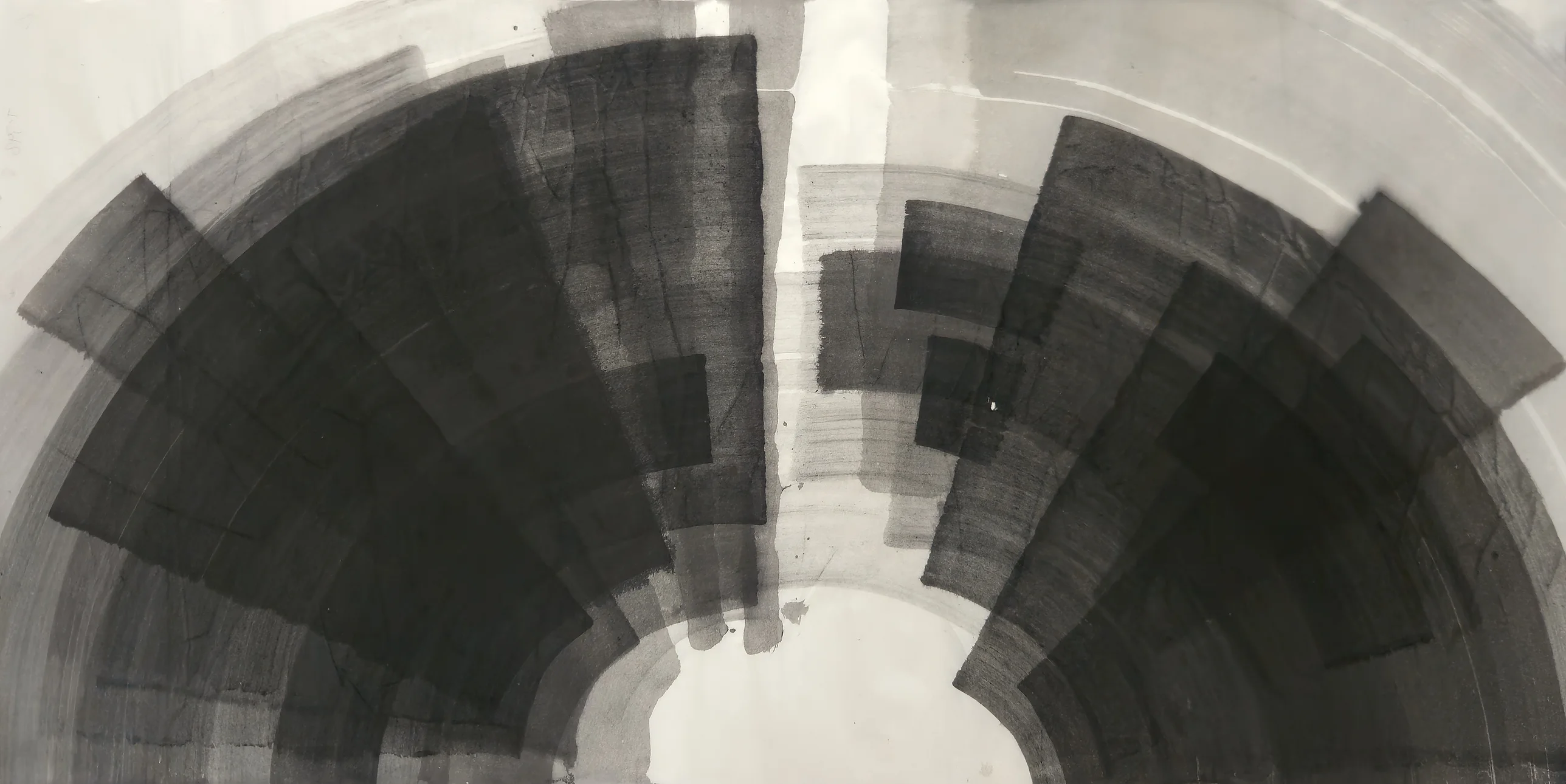
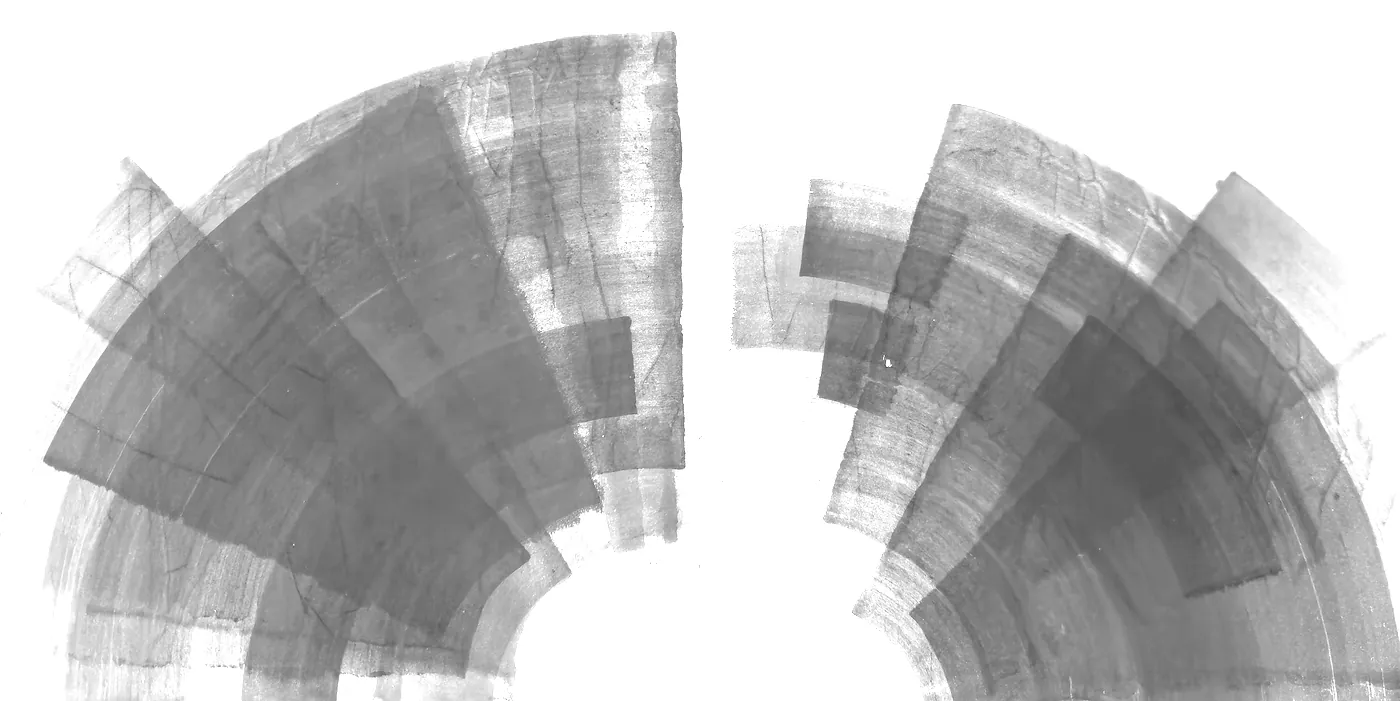
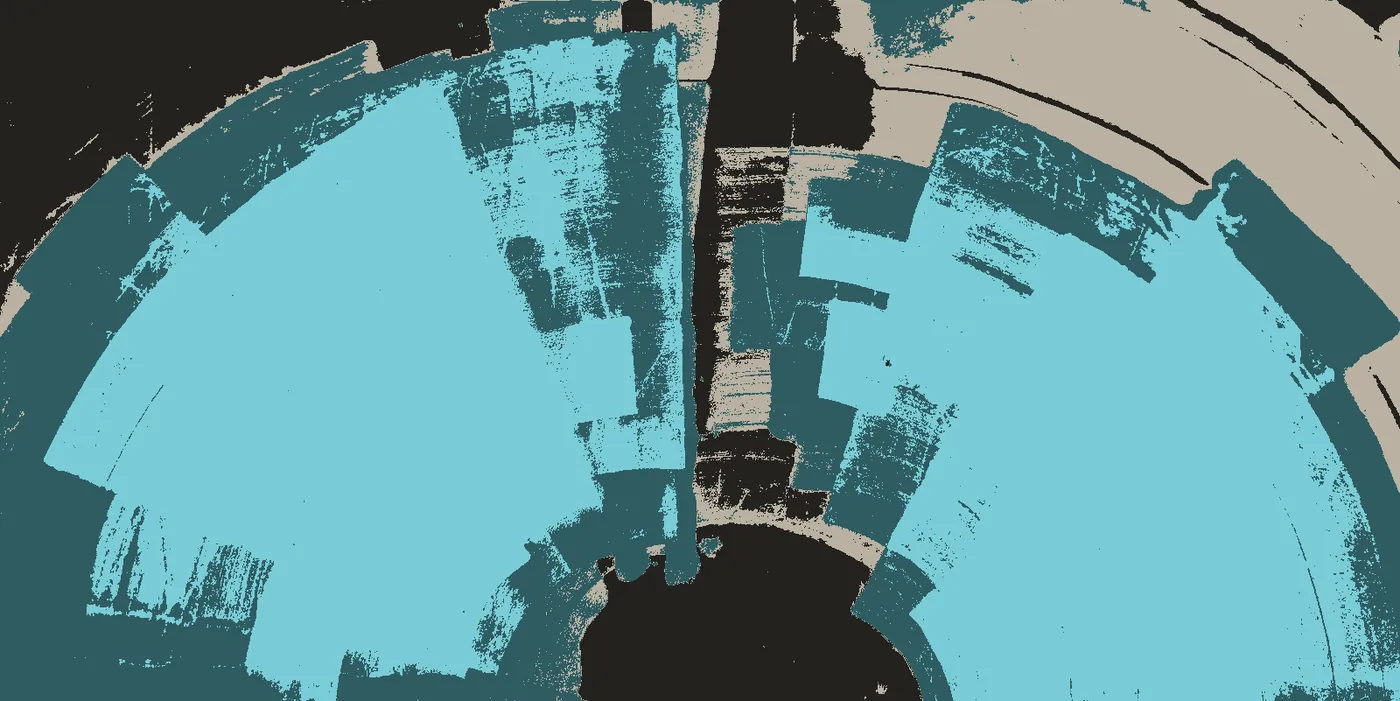
2 families of tone.
Every inked pixel's brightness in 64 bins, smoothed; each circled peak holds at least 4% of the ink. Two or fewer: Tonal depth is held at the bottom rung whatever the model reads. A dense sheet of many translucent passes can count low here, so Layering is left to the reads. Life inside the black: 0.030 (under 0.045 reads as flat).
Five reads, agreeing on 2 of 5 qualities.
Each quality placed on its ladder by each read, and the mean the engine keeps. Where reads differ, they differ by one rung; close calls resolve down.
READ 1, IN ITS OWN WORDS
“A radial double-fan sheet close to R3 in structure and layering, with fluent arcs and a strong central void. The dark interiors are measured as flat and the coverage is heavy, so it sits below R3.”
Radial wedges and arc bands follow the brush's curved travel and the walls hold. The small rectangular blocks near the centre-right are a little slab-like but minor.
WEAKEST Small stacked rectangles left of the right fan
STRONGEST Outer curved arc bands sweeping round both fans
The tone-stretched view shows grain in the paler wedges, but dark interior modulation is 0.030 with only two tonal steps, so the main black masses are flat inside.
WEAKEST Central black interiors of both fans
STRONGEST Dry-brush grain in the upper left wedge
Several translucent passes overlap in a readable order, with grey arcs under darker wedges in both fans. The overlap edges stay crisp and build depth outward.
WEAKEST Dense core where the darkest passes merge
STRONGEST Translucent grey wedges overlapping the outer arcs
Two radial fans open around a white central void and a vertical channel, with a strong arch movement. Coverage of 0.85 leaves the paper with little room except the centre.
WEAKEST Heavy coverage crowding the lower corners
STRONGEST Central vertical gap opening into the pale arch
The ink is controlled and the edges are clean. There is a small white speck in the right fan and fine crease lines across the darks; the faint top-right grey haze is minor.
WEAKEST White speck in the right dark mass
STRONGEST Dry-brush streaking at the wedge edges
6 distinct places, 0 major.
Each read must name every flaw and where it is, in a ninth of the sheet. Here the reads named flaws in 6 distinct places, 17 mentions in all across 5 reads; the number in each ninth is how many times a flaw was named there. Reads agreeing on a place strengthen the evidence for one flaw; they do not multiply it.
Measured from the 16-bit master.
The previous engine (V22) measured this sheet's master file: 2 principal ink masses traced (cyan), 3 enclosed voids at true size in their grid cells (amber), the main gesture from start to end (red). Of 16 edge segments, 38% crisp, 56% soft or bloomed, 6% broken.
Tonal depth held at rung 1.
2 steps: appliedMaterial held at rung 1. Mild waves in the unmounted paper are never a flaw.
none namedThe rating cannot exceed 4.
lowest 1.0A read that breaks the reply format is discarded.
5 of 5 validV23 rating 5.7.
Engine v23.8, 5 reads. Fixed arithmetic, the same for every painting; the constants were set on 24 randomly chosen paintings so the median sheet scores 5. The scale is relative to this archive, not to painting in general, and a difference of less than half a point between two paintings is noise.