T_413
The work as shown. Every value below comes from vae.db, the master database of the Crucible Year.
Recorded
- Date
- 2026.11.03, day 310
- Size
- 97 × 180 cm
- Paper
- S14, Half-Cooked Red Star Mo She 6-Foot Bark Xuan Paper, self-sized
- Inks
- MB6, MB8, MB9, MB10, MC
- Phase
- P4 S14
- Shown on the site
- yes (combined score of 5.0 or more)
The combined score
- Combined score
- 6.18
- Read half
- 25
- Measured half
- 36.8
Read · V23 (v23.13)
- V23 rating
- 5
- Form
- 2
- Tonal depth
- 1
- Layering
- 2
- Composition
- 2
- Material and surface
- 2
- Ink cover
- 88%
- Dark share
- 78%
- Tonal steps
- 2
- Flaws named by the reads
- other 10, mud 2, dead ink 1
Measured · V24, from the 16-bit TIFF
- Mass
- 9.4 of 10
- Tone
- 6.6 of 14
- Void
- 6.4 of 8
- Flow
- 6.4 of 10
- Balance
- 8 of 8
- Measured half
- 36.8 of 50
- Mass width in mm
- rung 5 of 5
- Mass width against the sheet
- rung 5 of 5
- Evenness of that width
- rung 4 of 5
- Depth of the darks
- rung 4 of 5
- Black plateau
- rung 1 of 5
- Step from mid to dark
- rung 0 of 5
- Evenness inside the darks
- rung 3 of 5
- Spread across tonal bands
- rung 2 of 5
- Voids gathered, not scattered
- rung 4 of 5
- Directions across the sheet
- rung 2 of 5
- Local gesture and edge
- rung 5 of 5
- Balance on the sheet
- rung 5 of 5
- Mass width
- 207 mm
- Depth of the darks (p75 density)
- 1.68
- Largest void, radius
- 109 mm
- Direction alignment
- 0.30
- Left and right asymmetry
- 0.41
- Resolution
- 3.90 px per mm
How the number was made
Read by the Visual Analysis Engine, version 23.13, on 2026.11.03: measured by code, then read 5 times by Claude Opus 5.5 against three reference paintings (R1 to R3), each read independent of the others. How the engine works.
Three views of one sheet.
Left, the photograph. Centre, the tone stretch the model is shown beside it: the darkest 45% of tones spread over the whole range, so flat black, banding and stains show. Right, every pixel as the measuring code classes it: cyan black ink, deep teal translucent grey, stone the palest ink, near black bare paper.
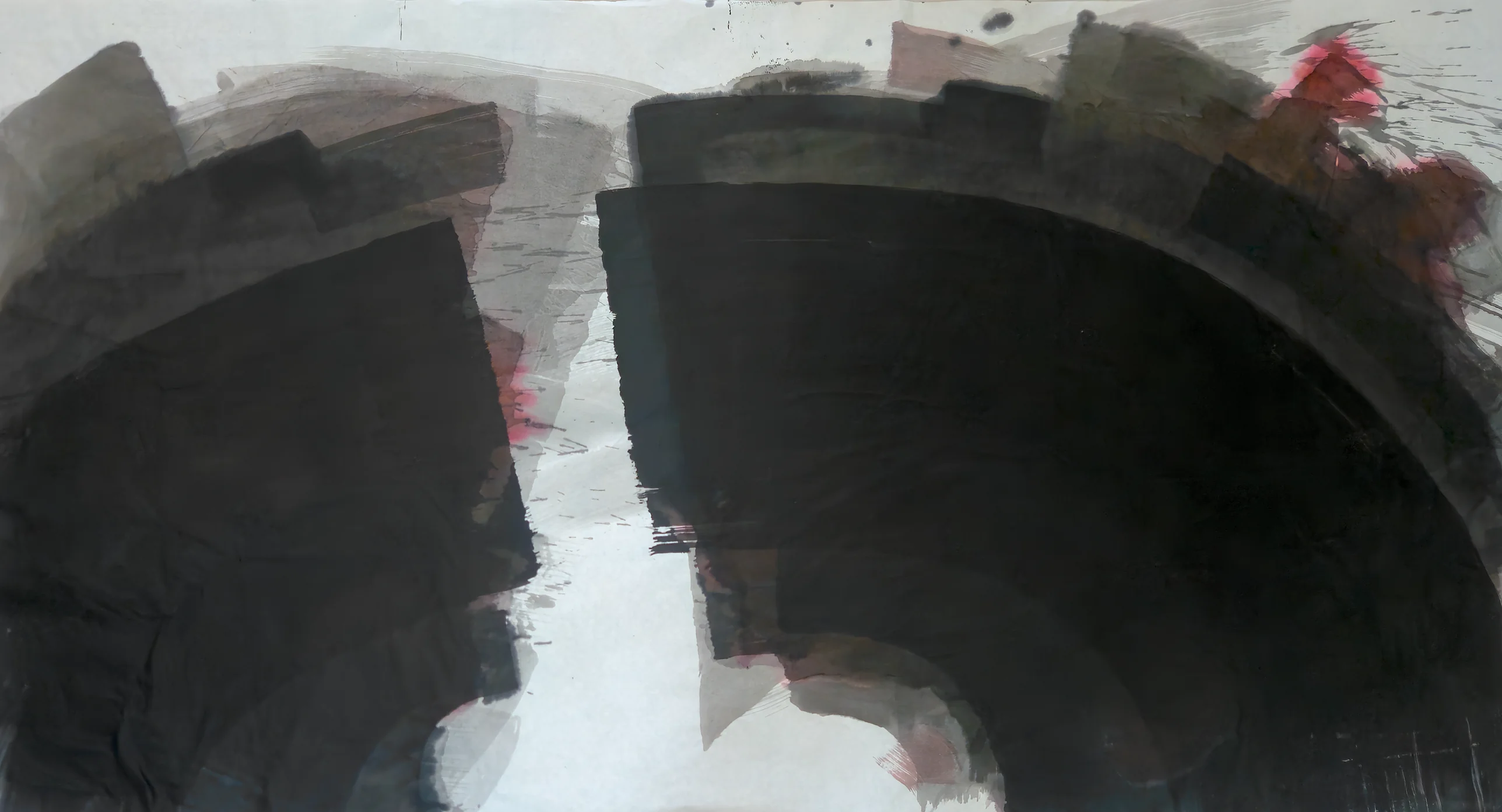
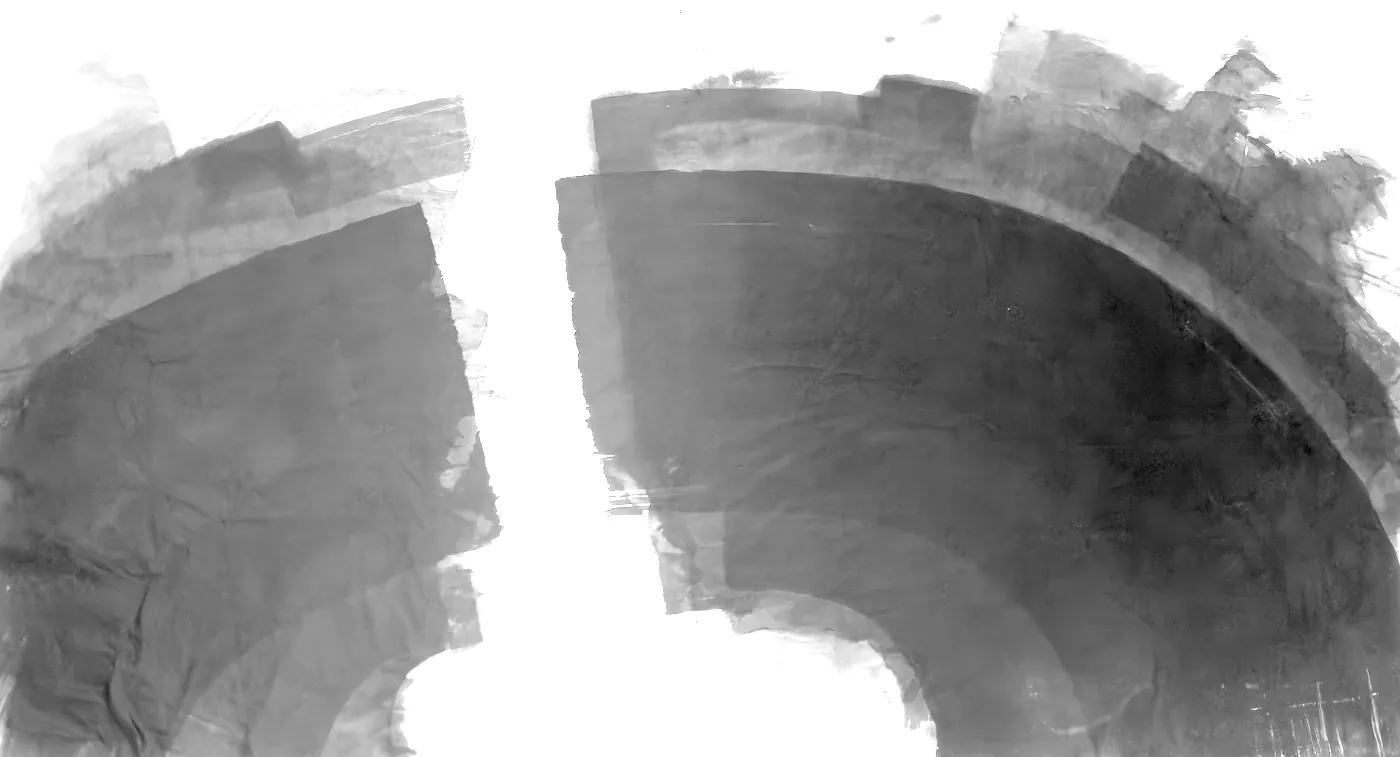
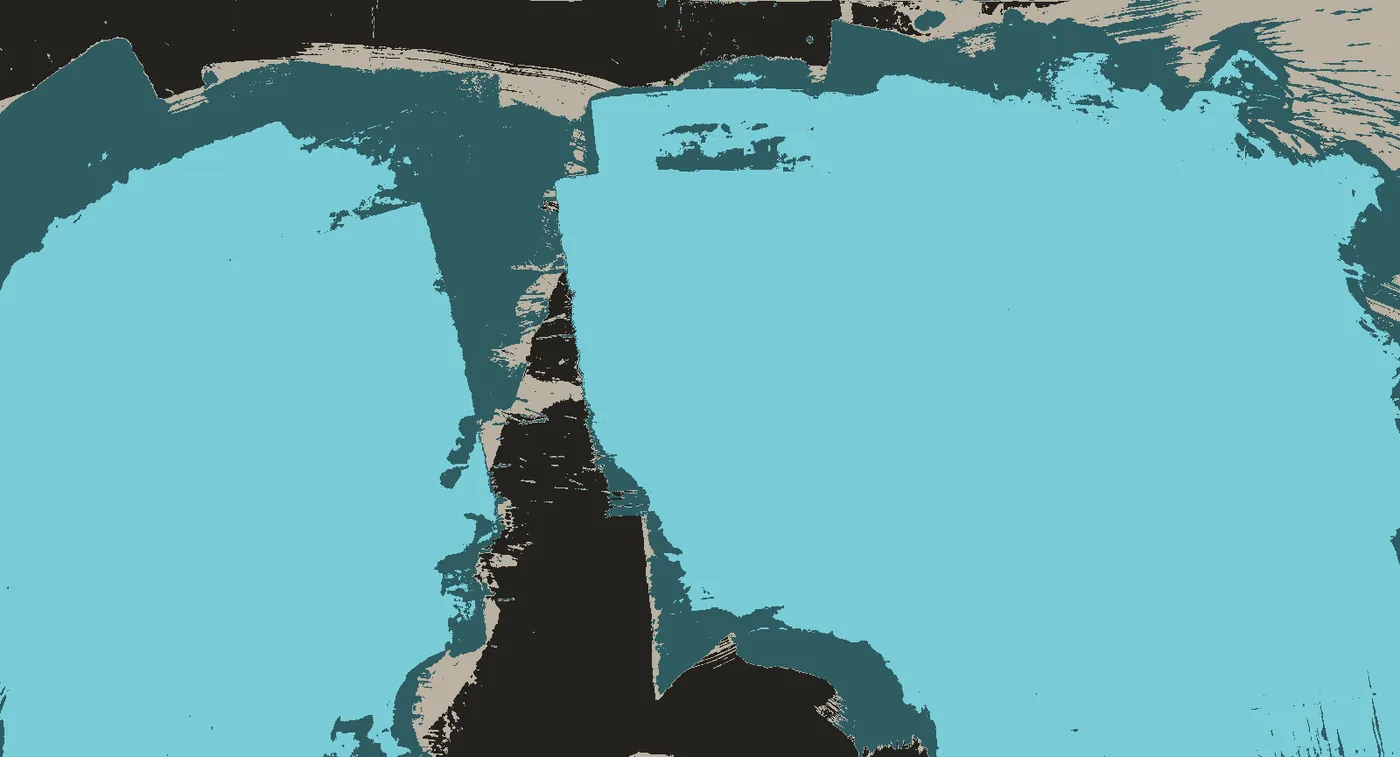
2 families of tone.
Every inked pixel's brightness in 64 bins, smoothed; each circled peak holds at least 4% of the ink. Two or fewer: Tonal depth is held at the bottom rung whatever the model reads. A dense sheet of many translucent passes can count low here, so Layering is left to the reads. Life inside the black: 0.058 (under 0.045 reads as flat).
Five reads, agreeing on 4 of 5 qualities.
Each quality placed on its ladder by each read, and the mean the engine keeps. Where reads differ, they differ by one rung; close calls resolve down.
READ 1, IN ITS OWN WORDS
“A strong arc structure around a pale central channel, but two heavy, nearly flat black masses dominate. Layering and colour stay legible mainly at the upper edges, leaving an ordinary sheet with thin tonal life.”
Concentric arcs hold as nameable forms with firm walls, especially the right curve; left and right black masses stay bulky, and upper-right patches break into stepped blocks.
WEAKEST Left black mass, a bulky slab with a blunt inner edge
STRONGEST Right mass's long outer arc following the brush's sweep
Two huge black masses dominate, reading flat in colour; modulation of 0.058 is barely above flat. Only faint stretched-view gradients and inner arcs; life stays in upper bands and edges.
WEAKEST Left black mass, nearly uniform in the colour view
STRONGEST Upper grey arc bands with visible banding and stepped density
Translucent grey arcs, darker bands and colour read in order along the upper edges and lower inner arcs, but the blacks swallow most overlaps across the sheet's centre.
WEAKEST Black centres, where later passes largely cover earlier ones
STRONGEST Upper-right stepped grey and colour passes overlapping legibly
Two arcs turn around a shaped pale channel and open circle, giving direction, but massive blacks fill most of the frame and movement stalls inside them.
WEAKEST Heavy lower masses crowd the sheet; large areas sit dead
STRONGEST Pale central channel opening into the lower-centre arc
Ink is controlled with firm edges and deliberate colour; small scratch-like marks at bottom right and brown fused colour at upper right stay peripheral. Black interiors show little material behaviour.
WEAKEST Inert black surface across the big masses
STRONGEST Dry-brushed ragged edges along the central channel
5 distinct places, 0 major.
Each read must name every flaw and where it is, in a ninth of the sheet. Here the reads named flaws in 5 distinct places, 13 mentions in all across 5 reads; the number in each ninth is how many times a flaw was named there. Reads agreeing on a place strengthen the evidence for one flaw; they do not multiply it.
Tonal depth held at rung 1.
2 steps: appliedMaterial held at rung 1. Mild waves in the unmounted paper are never a flaw.
none namedThe rating cannot exceed 4.
lowest 1.8A read that breaks the reply format is discarded.
5 of 5 validCaps the code applied: {"run_id":"T_413","cap_no":1,"read_no":2,"cap_text":"sample 2: T 2->1: tonal_steps=2 (<=2)"}; {"run_id":"T_413","cap_no":2,"read_no":3,"cap_text":"sample 3: T 2->1: tonal_steps=2 (<=2)"}; {"run_id":"T_413","cap_no":3,"read_no":4,"cap_text":"sample 4: T 2->1: tonal_steps=2 (<=2)"}; {"run_id":"T_413","cap_no":4,"read_no":5,"cap_text":"sample 5: T 2->1: tonal_steps=2 (<=2)"}.
V23 rating 5.0.
Engine v23.13, 5 reads. Fixed arithmetic, the same for every painting; the constants were set on a stratified sample of 24 paintings so the median sheet scores 5. The scale is relative to this archive, not to painting in general, and a difference of less than half a point between two paintings is noise.