T_079
Record- Date
- 2026.03.14
- Dimensions
- 70 × 140 cm
- Rating
- 5.3
- Paper
- Qing Yi Half-Raw Xuan
- Ink
- Kuretake Shogei Kiwami, Yi De Ge Zhonghua, Boku-Undo Bokkou
The rating
T_079, rated 5.3
The combined score, out of 10: V23's reading of the photograph as the read half and V24's twelve tests on the 16-bit file as the measured half, added and divided by 10. The scale is relative to this archive. How each half is made is on the Method page.
- Form
- 2.0 · built
- Tonal depth
- 1.2 · thin
- Layering
- 2.4 · legible
- Composition
- 2.0 · working
- Material and surface
- 1.0 · flawed
- Mass
- 7.3 of 10
- Tone
- 3.2 of 14
- Void
- 4.8 of 8
- Flow
- 6.0 of 10
- Balance
- 8.0 of 8
How it was measured
What V24 measured.
Plain physical facts with no model involved. Across the year they track how the practice changes. On one sheet they cannot say whether a mark is any good. Millimetres read a few percent high, because the photographs are cropped just inside the paper's edge.
The width of the ink mask along its medial axis.
Optical density at the 75th percentile of the sheet.
The radius of the largest circle of open paper.
How far the marks align across the sheet. Lower means they run several ways.
Left and right asymmetry of the ink. Lower is more even.
Pixels to the millimetre in the TIFF these were measured from, with the studio light removed.
Read by the Visual Analysis Engine, version 23.13, on 2026.11.04: measured by code, then read 5 times by Claude Opus 5.5 against three reference paintings (R1 to R3), each read independent of the others. How the engine works.
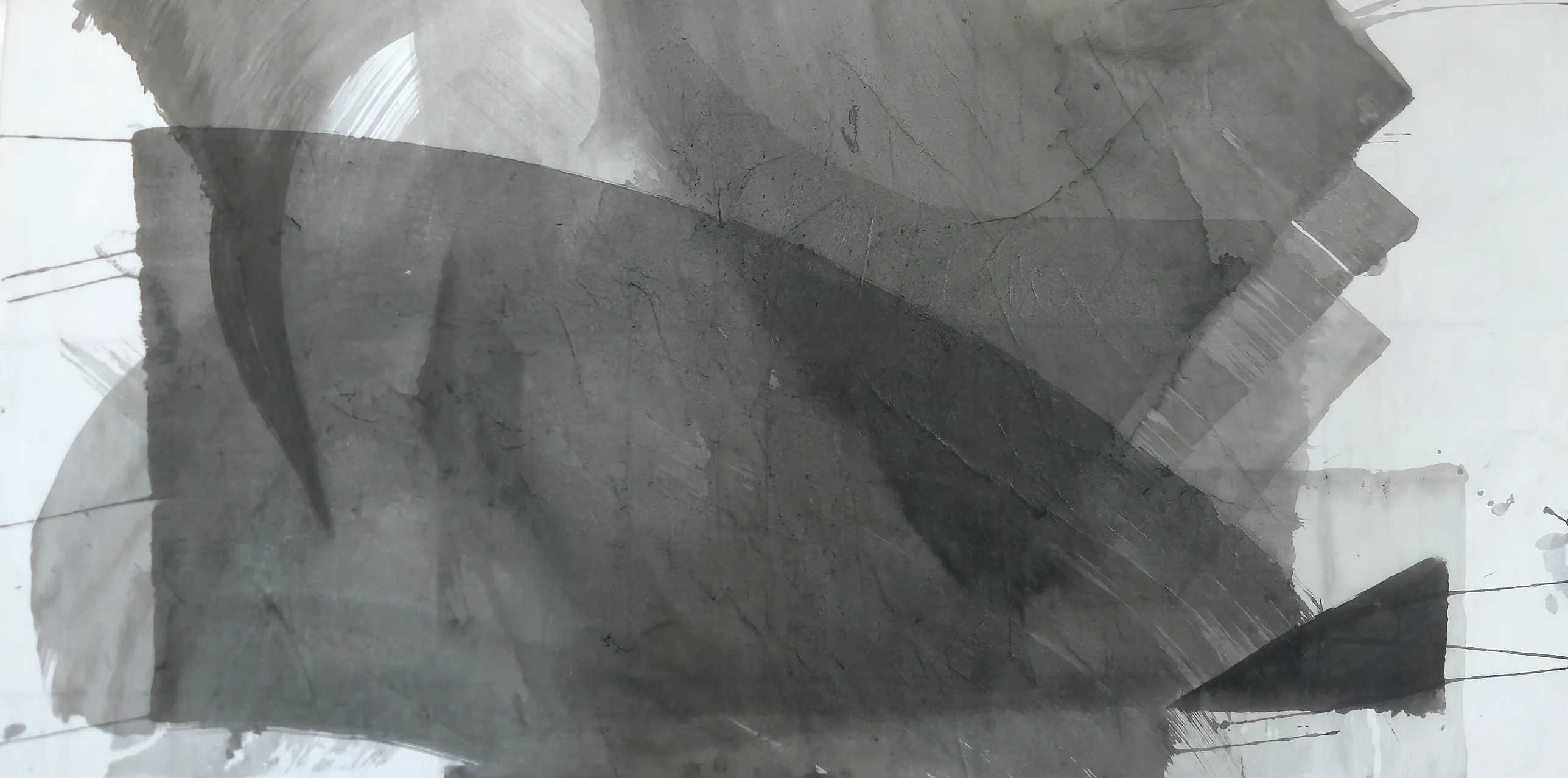
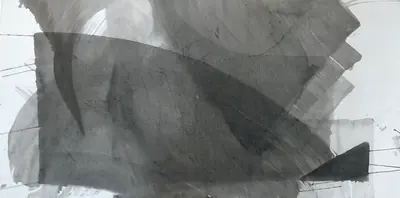
Three views of one sheet.
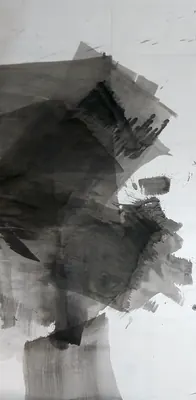
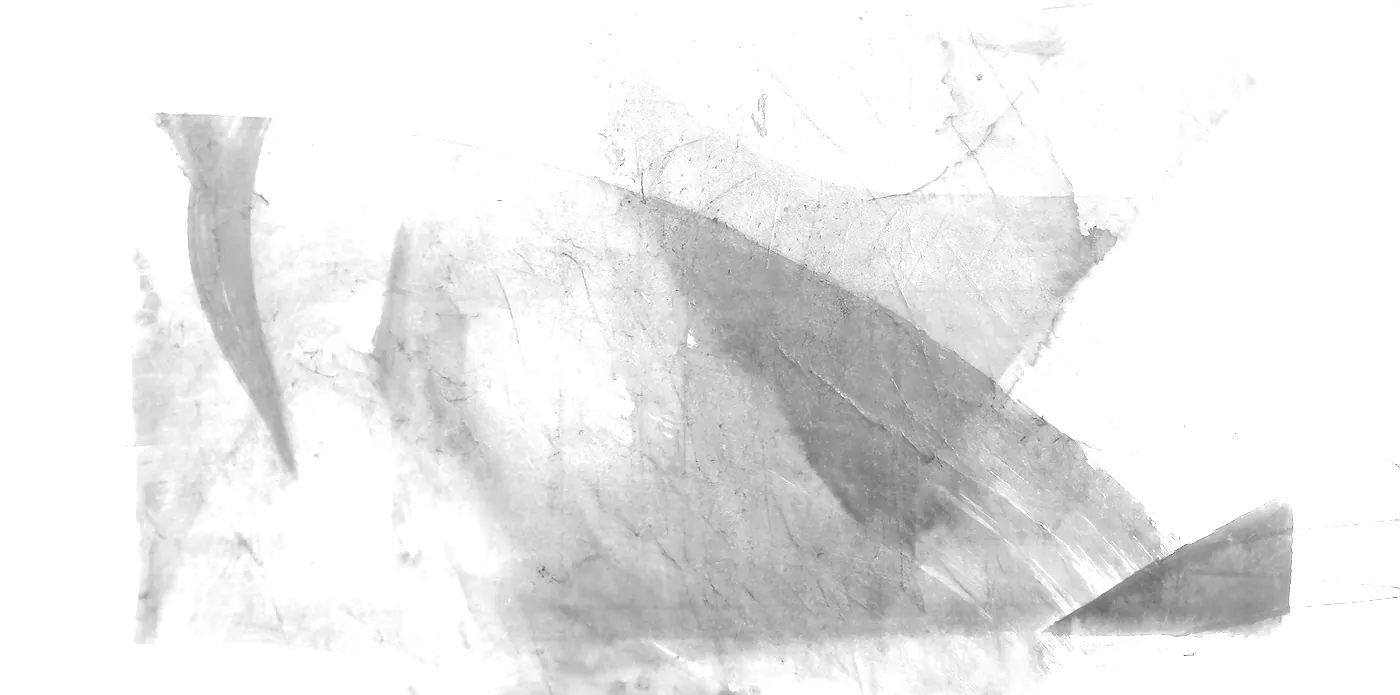
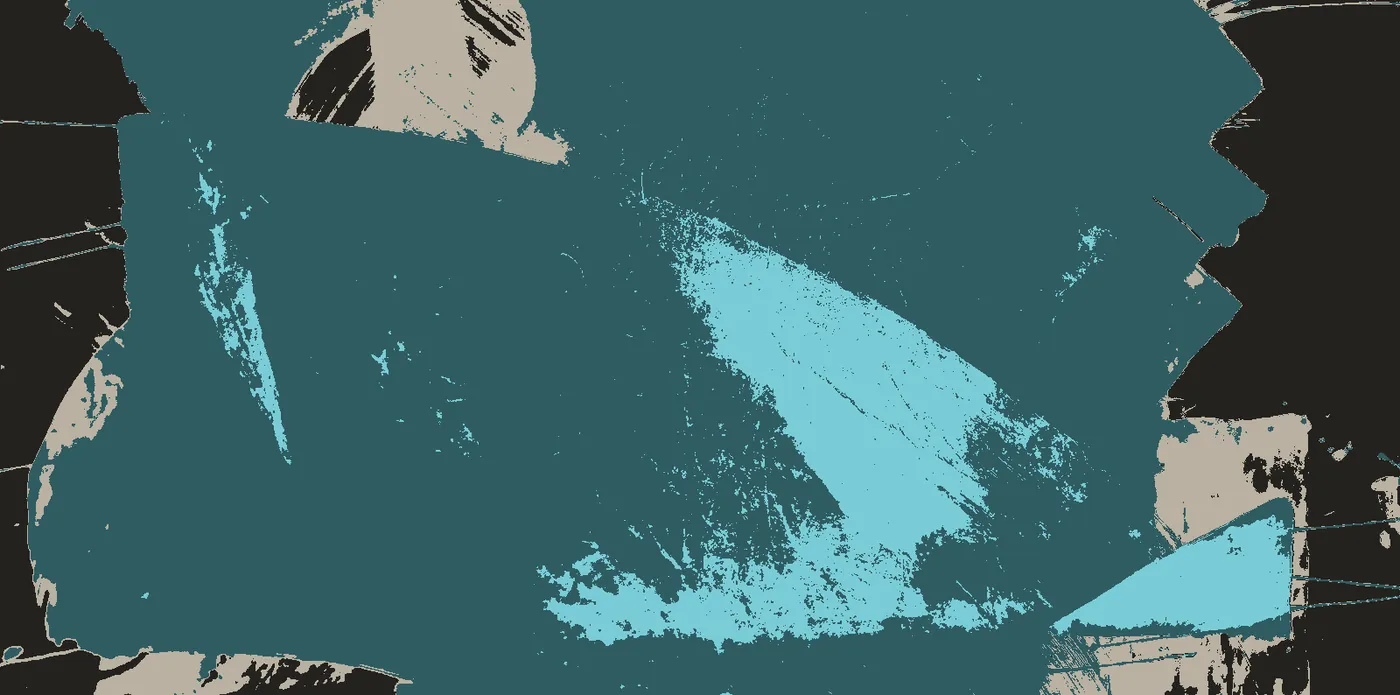
Left, the photograph. Centre, the tone stretch the model is shown beside it: the darkest 45% of tones spread over the whole range, so flat black, banding and stains show. Right, every pixel as the measuring code classes it: cyan black ink, deep teal translucent grey, stone the palest ink, near black bare paper.
3 families of tone.
Every inked pixel's brightness in 64 bins, smoothed; each circled peak holds at least 4% of the ink. Life inside the black: 0.020 (under 0.045 reads as flat).
Five reads, agreeing on 3 of 5 qualities.
Each quality placed on its ladder by each read, and the mean the engine keeps. Where reads differ, they differ by one rung; close calls resolve down.
READ 1, IN ITS OWN WORDS
“Translucent layers read clearly and a strong diagonal gives direction, but the bulky central slab dominates, its interiors stay flat and cloudy, and cracks web the principal masses. Layering outperforms form, tone and surface.”
Horn, dark diagonal wedge and bottom-right triangle hold as nameable forms; the dominant central slab stays bulky and filled-in, with a stiff left wall, despite its curved top edge.
WEAKEST Huge central slab with stiff, straight left edge
STRONGEST Tapered curved horn stroke at upper left
Measured dark modulation 0.020 is flat; wedge and triangle read as even dark planes, the slab as cloudy mid-grey. Tone mostly steps at overlaps; surface grain adds little depth.
WEAKEST Central slab interior: cloudy mid-grey with little real change
STRONGEST Dark diagonal wedge with mottled density at centre right
Left semicircle, top arc, upper-right fan, central slab, wedge and horn stay translucent and in readable order across the sheet; only the lower centre grows murky.
WEAKEST Cloudy lower centre where passes blur into each other
STRONGEST Upper-right slab and arc reading through the central slab
The curved diagonal carries the eye from upper left to the dark triangle, and right-side paper is shaped; but 82% ink coverage leaves the heavy lower-centre block static.
WEAKEST Massive central slab crowds the sheet; its lower half is dead
STRONGEST Long diagonal edge running down to the bottom-right triangle
Fine dark cracks and crease lines web the central and upper-right masses, visible in the colour view; milky cloudy patches sit in the slab's lower left and centre.
WEAKEST Cracks and cloudy wash inside the central slab
STRONGEST Dry-brush streaks at the slab's lower-right end
6 distinct places, 2 major.
Each read must name every flaw and where it is, in a ninth of the sheet. Here the reads named flaws in 6 distinct places, 24 mentions in all across 5 reads; the number in each ninth is how many times a flaw was named there. Reads agreeing on a place strengthen the evidence for one flaw; they do not multiply it. A major flaw holds Material and surface at rung 1.
V23's rules and arithmetic, and every figure under its own name, are in the Archive record.
Date
2026.03.14, day 76 of the Crucible Year, one of 28 paintings from that date (1 shown). 0 works were registered in the fourteen days before. Paintings are dated by the day their batch was registered and photographed; each was finished that day or within the few days before. Phase: P1 Warm-up (working title).
T_079 among all 419
Every painting of the year by date; this one is outlined.
Materials
- Paper
- Qing Yi Half-Raw Xuan, Jingxian Sichijian Xuan Paper Arts & Crafts Co., Ltd., made unknown
- Ink MB1
- Kuretake Shogei Kiwami, Kuretake
- Ink MB2
- Yi De Ge Zhonghua, Yi De Ge (Beijing)
- Ink MB3
- Boku-Undo Bokkou, Boku-Undo
Related