
T_346
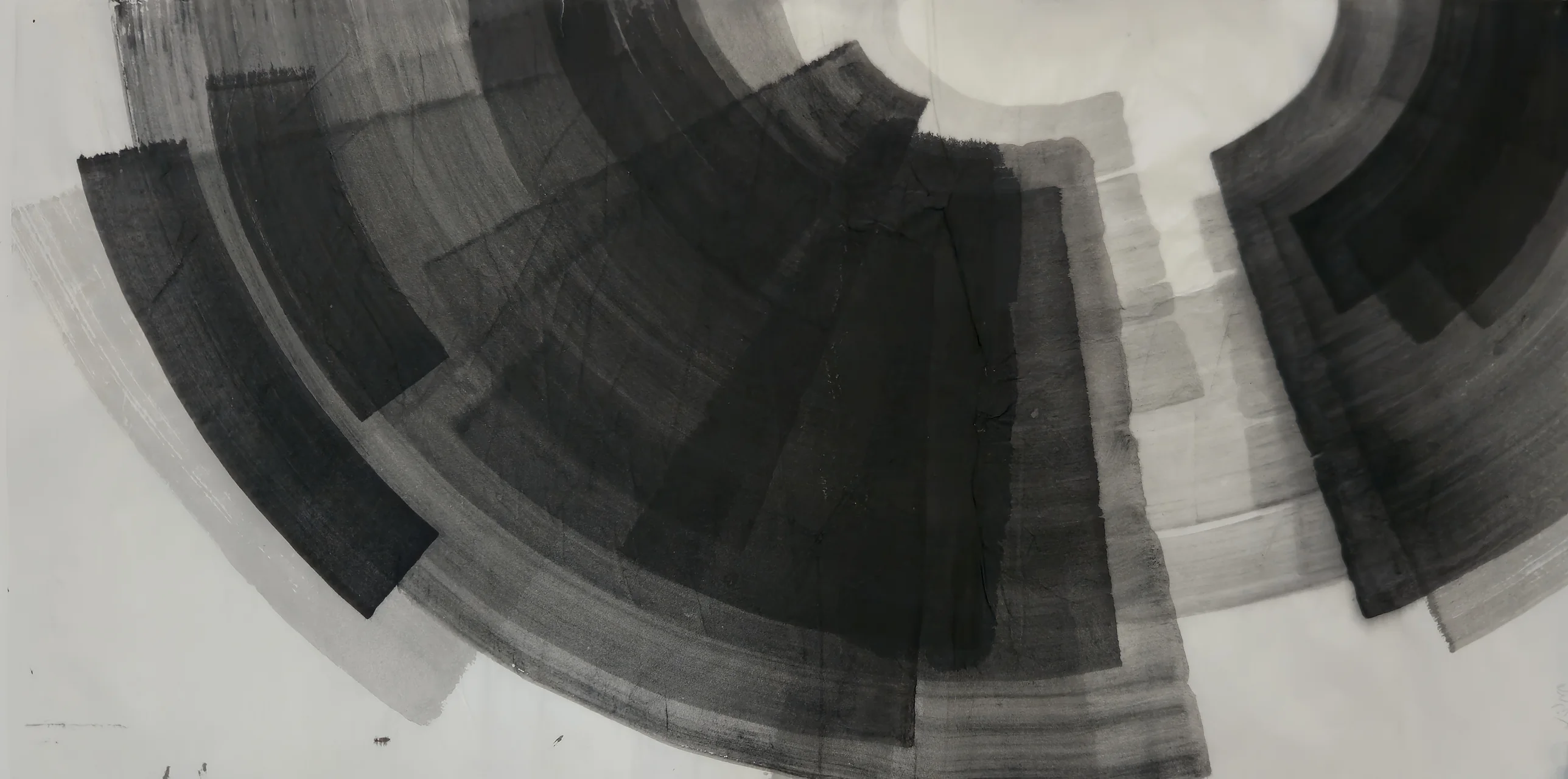
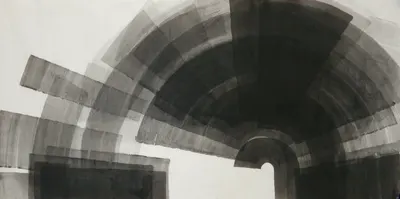
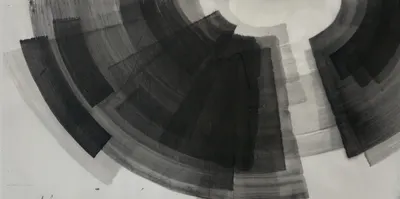
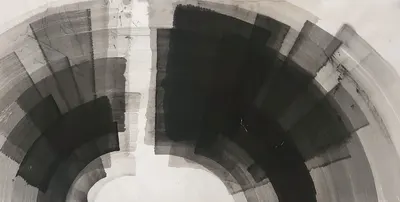
The engine's readingA wide fan of grey and black ink bands wheels across the paper from the top edge, with a smaller arc answering it at right.
Record- Date
- 2026.06.06
- Dimensions
- 70 × 140 cm
- Paper
- Qing Yi Cooked Xuan
- Ink
- Yi De Ge Refined Ink Juice, Boku-Undo Genso, Yi De Ge Yun Tou Yan
Past the top edge, the hub of that wheel is a throne left empty since the old queen died, and every band is a road the old queen ordered paved in a different darkness. The roads still turn for her. The black one in the middle was the royal road, and it was folded so often by messengers that the creases now show through the ink, and travellers swear they are rivers. They are not rivers. Out on the far left the palest road is fraying into bare paper, the way a spell frays when the last person who knew it starts to forget. Past the right arc there is a white bay that no map has named. Ships go in. The sails come back blank.
The reading
Written by the engine after the painting was rated, from the settled findings, and checked by hand before approval. It explains the numbers; it may not change them.
- Structure
- large radial fan of arc bands at left, separate smaller arc at right
- Movement
- sweep wheeling around a hub above the top edge; square band ends check it
- Coverage
- ink on about three quarters of the paper
- Tone
- three tonal steps, weighted dark
- Layering
- translucent pale passes under darker ones, readable across the left fan and right arc
- Edges
- crisp band walls throughout; dry, broken trailing edges on the outer arcs
- Feibai
- present along the pale outer arc at the left edge
- Open paper
- rounded white bay between fan and right arc, opening downward from the top
- Chance marks
- crease lines inside the central black; small specks at bottom left
- Frame
- ink runs off the top; left, right and bottom stay open
A great fan of ink wheels across the paper, band after band turning around a hub that sits just above the top edge. On the right a smaller arc answers it. Between them the paper opens into a white bay with a rounded head, cut so cleanly that it reads as a shape in its own right.
The sheet is best at its outer reach. Along the lower left the pale grey bands run long, and the brush has dragged their grain into fine parallel streaks. Cooked xuan is sized and barely drinks. Each pass sits on the one below without bleeding, so pale arcs show through darker ones and the order of laying holds from across the room. You can read how the fan was built.
The centre is where it thickens. A black wedge with a blunt, square end fills the middle of the fan, flat inside, and the overlaps around it darken toward a single tone. Fine crease lines cross the black where the ink sits on the surface.
The sweep still wins. The movement is clear, the layering is plain to read, and the heavy middle is a cost the sheet can afford.
How it was read
Read by the Visual Analysis Engine, version 23.8, on 2026.10.06: measured by code, then read 5 times by Claude Opus 5.5 against three reference paintings (R1 to R3), each read independent of the others. How the engine works.
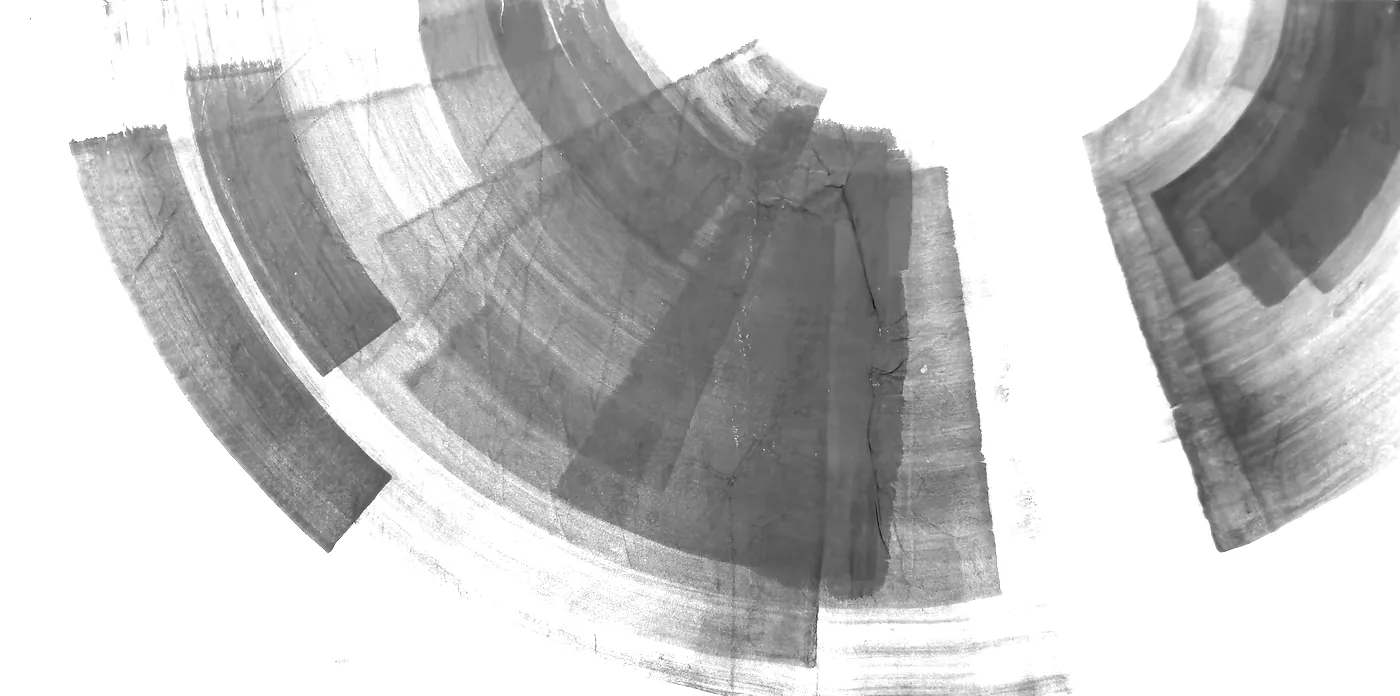
Three views of one sheet.
Left, the photograph. Centre, the tone stretch the model is shown beside it: the darkest 45% of tones spread over the whole range, so flat black, banding and stains show. Right, every pixel as the measuring code classes it: cyan black ink, deep teal translucent grey, stone the palest ink, near black bare paper.
3 families of tone.
Every inked pixel's brightness in 64 bins, smoothed; each circled peak holds at least 4% of the ink. Life inside the black: 0.037 (under 0.045 reads as flat).
Five reads, agreeing on 4 of 5 qualities.
Each quality placed on its ladder by each read, and the mean the engine keeps. Where reads differ, they differ by one rung; close calls resolve down.
READ 1, IN ITS OWN WORDS
“A layered arc structure related to R3, with legible translucent passes. The darks are flat inside, the centre is crowded and the central wedge is blocky, so it falls short of R3's depth and command.”
Arc bands follow the brush's travel and their walls hold, but the central black wedge and the square-cut band ends read as stiff, slab-like blocks.
WEAKEST Bulky dark central wedge with blunt rectangular end
STRONGEST Outer grey arc band sweeping along lower left
The grey arcs show banding and grain. The central and right darks are flat inside (modulation 0.037, under the 0.045 line). There are three tonal steps.
WEAKEST Central black wedge interior flat
STRONGEST Lower arc with banded dry-brush grain
Several translucent arc passes overlap in a readable order across the left fan and right arc. Each band stays legible where the passes cross.
WEAKEST Dense centre where overlaps darken toward uniformity
STRONGEST Stacked translucent arcs in the left fan
The radial fan gives a clear direction and the top-right void is shaped. With 76% coverage the centre feels heavy and crowded, and the lower left is leftover paper.
WEAKEST Crowded dense centre-left mass
STRONGEST Shaped white void between fan and right arc
The ink is controlled and the dry-brush edges are used. Crease or crackle lines run through the central dark, and there are small spatter spots at the bottom left. No tide lines.
WEAKEST Crease lines crossing central dark mass
STRONGEST Dry-brush grain on lower arc edges
2 distinct places, 0 major.
Each read must name every flaw and where it is, in a ninth of the sheet. Here the reads named flaws in 2 distinct places, 10 mentions in all across 5 reads; the number in each ninth is how many times a flaw was named there. Reads agreeing on a place strengthen the evidence for one flaw; they do not multiply it.
Measured from the 16-bit master.
The previous engine (V22) measured this sheet's master file: 2 principal ink masses traced (cyan), 1 enclosed void at true size in its grid cells (amber), the main gesture from start to end (red). Of 18 edge segments, 56% crisp, 28% soft or bloomed, 17% broken.
The rating these readings produce, the rules applied and the arithmetic, with Peter's own rating where he gave one, are in the Archive record.
Date
2026.06.06, day 160 of the Crucible Year, one of 11 paintings from that date. 30 works were registered in the fourteen days before. Paintings are dated by the day their batch was registered and photographed; each was finished that day or within the few days before. Phase: P3 The Floor Rises (working title).
T_346 among all 402
Every painting of the year by date; this one is outlined.
Materials
- Paper
- Qing Yi Cooked Xuan, Jingxian Sichijian Xuan Paper Arts & Crafts Co., Ltd., made unknown
- Ink MB4
- Yi De Ge Refined Ink Juice, Yi De Ge (Beijing)
- Ink MB5
- Boku-Undo Genso, Boku-Undo
- Ink MB6
- Yi De Ge Yun Tou Yan, Yi De Ge (Beijing)
Related