T_378
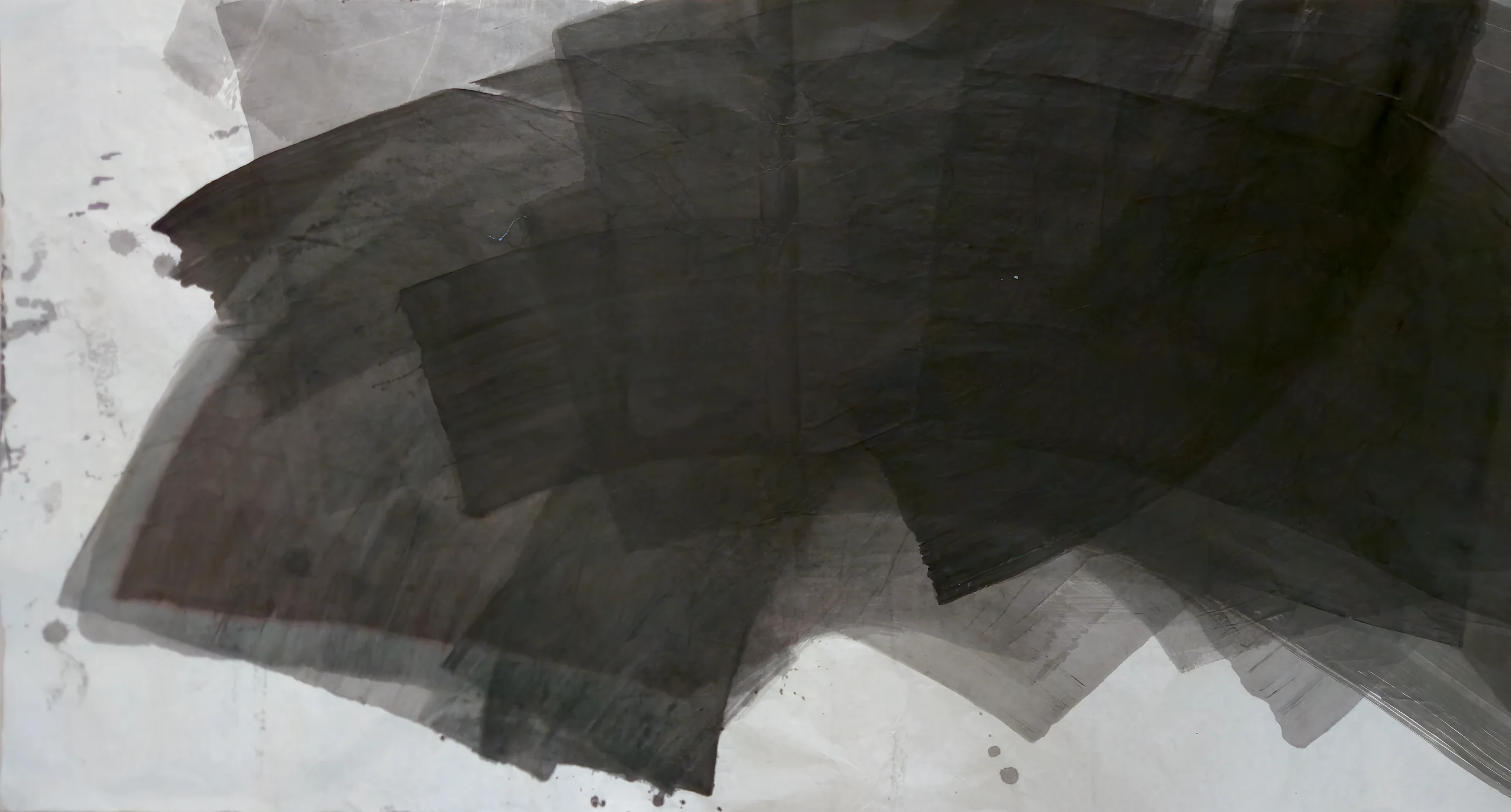
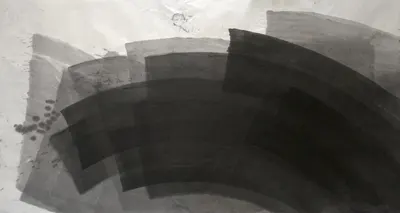
The engine's readingBroad translucent slabs of black fan out from a point at the left and thicken into one dark mass against the upper right corner.
Record- Date
- 2026.09.23
- Dimensions
- 97 × 180 cm
- Rating
- 5.3
- Paper
- Half-Cooked Red Star Mo She 6-Foot Bark Xuan Paper
- Ink
- Yi De Ge Yun Tou Yan, Boku-Undo Gentoku Super Concentrated, Yi De Ge Pine Soot Ink, colour inks
In this country the law says every new king must lay his map over the last one, in smoked glass, so that the old borders show through and nothing is forgotten. It works for a while. At the western point you can still read who owned the river. Go east and the glass thickens. By the far corner the whole kingdom is a single black pane, and the current king rules it with total confidence, issuing decrees about a province he cannot locate. He is quite happy. I poured his tea, and he asked me the way to his own capital. West of the first pane, past the edge of the surveyed world, a few dark drops lead away across the white: a cartographer, leaving on foot, sleeve still dripping.
The reading
Written by the engine after V23's reads, from the settled findings, and checked by hand before approval. It explains V23's numbers and may not change them.
- Structure
- broad flat slabs overlapping along one arc, joined into a single fan
- Movement
- rising left to right along the arc, nothing running against it
- Coverage
- ink on about four fifths of the paper
- Tone
- two tonal steps, weighted dark
- Layering
- pale grey passes under dark translucent slabs, readable at left, centre and lower edge
- Edges
- crisp at squared slab ends, soft around lower left, broken at lower right
- Feibai
- none
- Open paper
- pale band wrapping from top left down the margin, along a stepped lower edge
- Colour
- faint warm reddish brown in the lower-left slab
- Chance marks
- spatter at left margin and bottom centre, grey stains at left, round spot lower left
- Frame
- ink runs off top and right; left and bottom stay open
A wide fan of black swings up from a sharp point at the left and travels right, slab over slab, until it jams against the top corner. The direction is clear from across a room, and so is the weight: the heaviest ink sits high on the right.
The interest lies left of centre, where each flat pass lands over the last and its wall stays visible through the new layer. Half-sized paper softens an edge without losing it, so the order of building stays legible. The faint red in the lower-left slab is paint, and it lifts that corner from its cool grey border. At lower right the strokes thin into dry, streaked ends, the liveliest surface on the sheet.
Upper right, the passes stack until their order is gone. Every added layer brings density and takes away information, leaving a squared, stiff block that barely shifts inside. A fold and crumple lines cross it without much harm. The smears and drips in the left margin belong to no form and are simply accidents.
An average sheet, then, competently built. It rewards a slow look on the left and shuts that look down on the right.
The rating
T_378, rated 5.3
The combined score, out of 10: V23's reading of the photograph as the read half and V24's twelve tests on the 16-bit file as the measured half, added and divided by 10. The scale is relative to this archive. How each half is made is on the Method page.
- Form
- 2.0 · built
- Tonal depth
- 1.0 · thin
- Layering
- 2.0 · legible
- Composition
- 2.0 · working
- Material and surface
- 1.4 · flawed
- Mass
- 8.8 of 10
- Tone
- 7.0 of 14
- Void
- 8.0 of 8
- Flow
- 3.6 of 10
- Balance
- 3.2 of 8
How it was measured
What V24 measured.
Plain physical facts with no model involved. Across the year they track how the practice changes. On one sheet they cannot say whether a mark is any good. Millimetres read a few percent high, because the photographs are cropped just inside the paper's edge.
The width of the ink mask along its medial axis.
Optical density at the 75th percentile of the sheet.
The radius of the largest circle of open paper.
How far the marks align across the sheet. Lower means they run several ways.
Left and right asymmetry of the ink. Lower is more even.
Pixels to the millimetre in the TIFF these were measured from, with the studio light removed.
Read by the Visual Analysis Engine, version 23.8, on 2026.10.06: measured by code, then read 5 times by Claude Opus 5.5 against three reference paintings (R1 to R3), each read independent of the others. How the engine works.
Three views of one sheet.
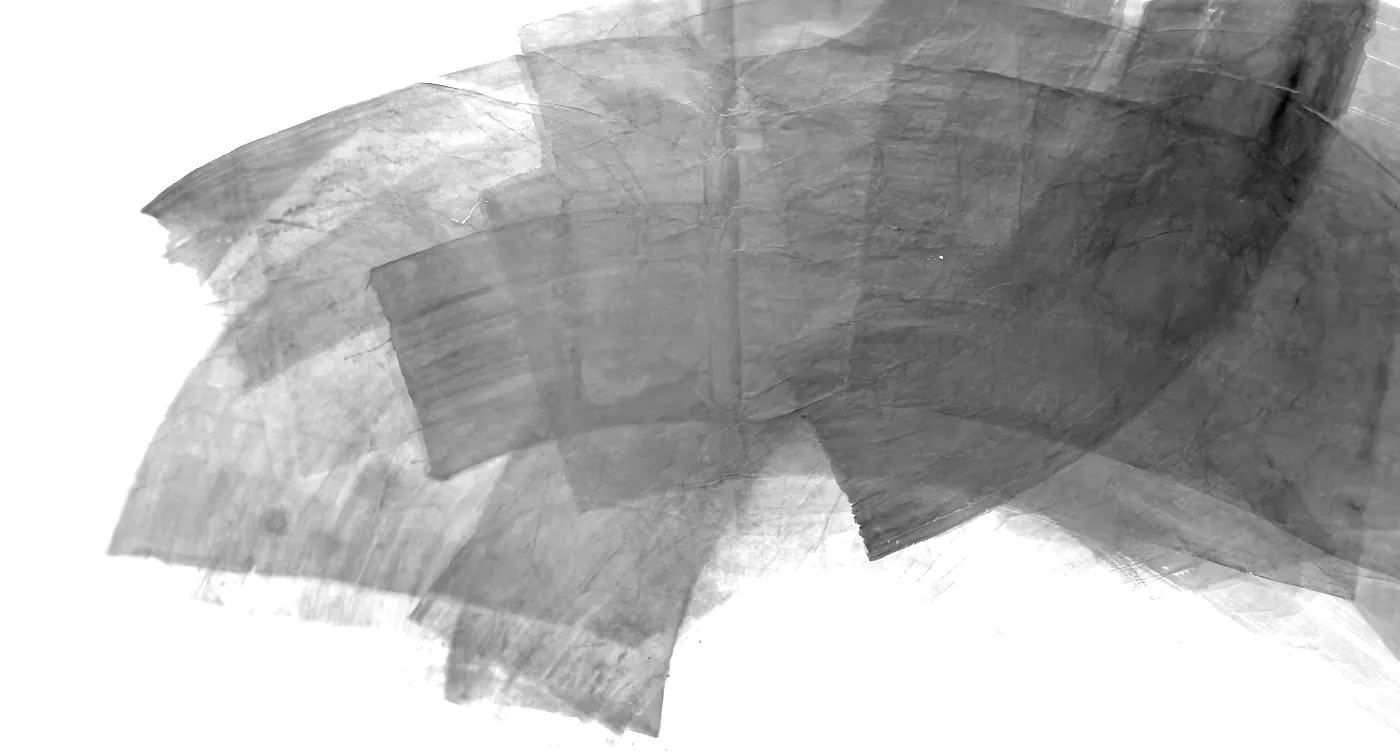
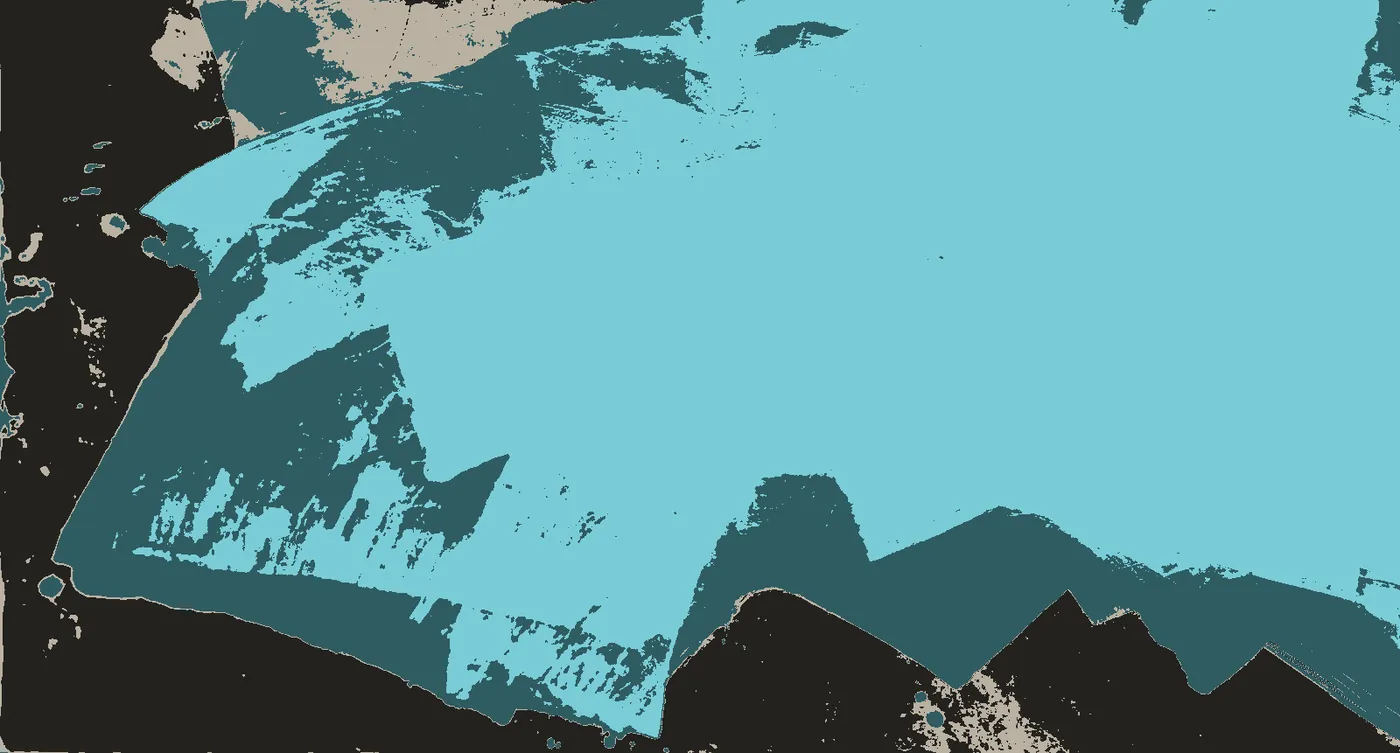
Left, the photograph. Centre, the tone stretch the model is shown beside it: the darkest 45% of tones spread over the whole range, so flat black, banding and stains show. Right, every pixel as the measuring code classes it: cyan black ink, deep teal translucent grey, stone the palest ink, near black bare paper.
2 families of tone.
Every inked pixel's brightness in 64 bins, smoothed; each circled peak holds at least 4% of the ink. Two or fewer: Tonal depth is held at the bottom rung whatever the model reads. A dense sheet of many translucent passes can count low here, so Layering is left to the reads. Life inside the black: 0.053 (under 0.045 reads as flat).
Five reads, agreeing on 4 of 5 qualities.
Each quality placed on its ladder by each read, and the mean the engine keeps. Where reads differ, they differ by one rung; close calls resolve down.
READ 1, IN ITS OWN WORDS
“A fan of overlapping slabs related to R3, but heavier and more crowded. The upper-right dark fuses into one flat field, and creases plus margin stains weaken the surface. An ordinary sheet.”
Broad arc slabs fan from the left point with holding walls and dry-brush ends at the lower right; the upper-right slabs fuse into one bulky block.
WEAKEST Bulky dark slab block filling upper right
STRONGEST Tapered arc stroke sweeping from left tip
The stretched view shows grain and stepped density in the centre and left slabs. Only two tonal steps; in the colour view the upper-right dark reads as a flat surface.
WEAKEST Dense near-uniform dark in upper right mass
STRONGEST Banded, grained centre slab with brush striations
Several overlapping slabs can be read at the left and centre edges. On the right, the later dark passes bury the earlier ones, so the order of passes is lost there.
WEAKEST Upper-right passes merged into one dark field
STRONGEST Translucent slab edges overlapping at left and centre
A fan-shaped arc carries the eye from left to right. Ink covers 80% of the sheet, so the mass crowds the top and right edges and the leftover paper at bottom left is weakly shaped.
WEAKEST Crowded, heavy upper-right mass presses on edges
STRONGEST Fan arc rising from left point
A vertical fold and crumple creases run through the central dark mass. Grey blotches and drips mark the left margin, and a round spot sits inside the lower-left slab.
WEAKEST Crease lines and fold through central dark mass
STRONGEST Dry-brush trailing ends at lower right
7 distinct places, 1 major.
Each read must name every flaw and where it is, in a ninth of the sheet. Here the reads named flaws in 7 distinct places, 17 mentions in all across 5 reads; the number in each ninth is how many times a flaw was named there. Reads agreeing on a place strengthen the evidence for one flaw; they do not multiply it. A major flaw holds Material and surface at rung 1.
V23's rules and arithmetic, and every figure under its own name, are in the Archive record.
Date
2026.09.23, day 269 of the Crucible Year, one of 2 paintings from that date. 11 works were registered in the fourteen days before. Paintings are dated by the day their batch was registered and photographed; each was finished that day or within the few days before. Phase: P4 S14 (working title).
T_378 among all 419
Every painting of the year by date; this one is outlined.
Materials
- Paper
- Half-Cooked Red Star Mo She 6-Foot Bark Xuan Paper, China Xuan Paper Co., Ltd., made 2026.04.08
- Ink MB6
- Yi De Ge Yun Tou Yan, Yi De Ge (Beijing)
- Ink MB8
- Boku-Undo Gentoku Super Concentrated, Boku-Undo
- Ink MB9
- Yi De Ge Pine Soot Ink, Yi De Ge (Beijing)
- Colour
- colour inks, recorded together
Related