T_384
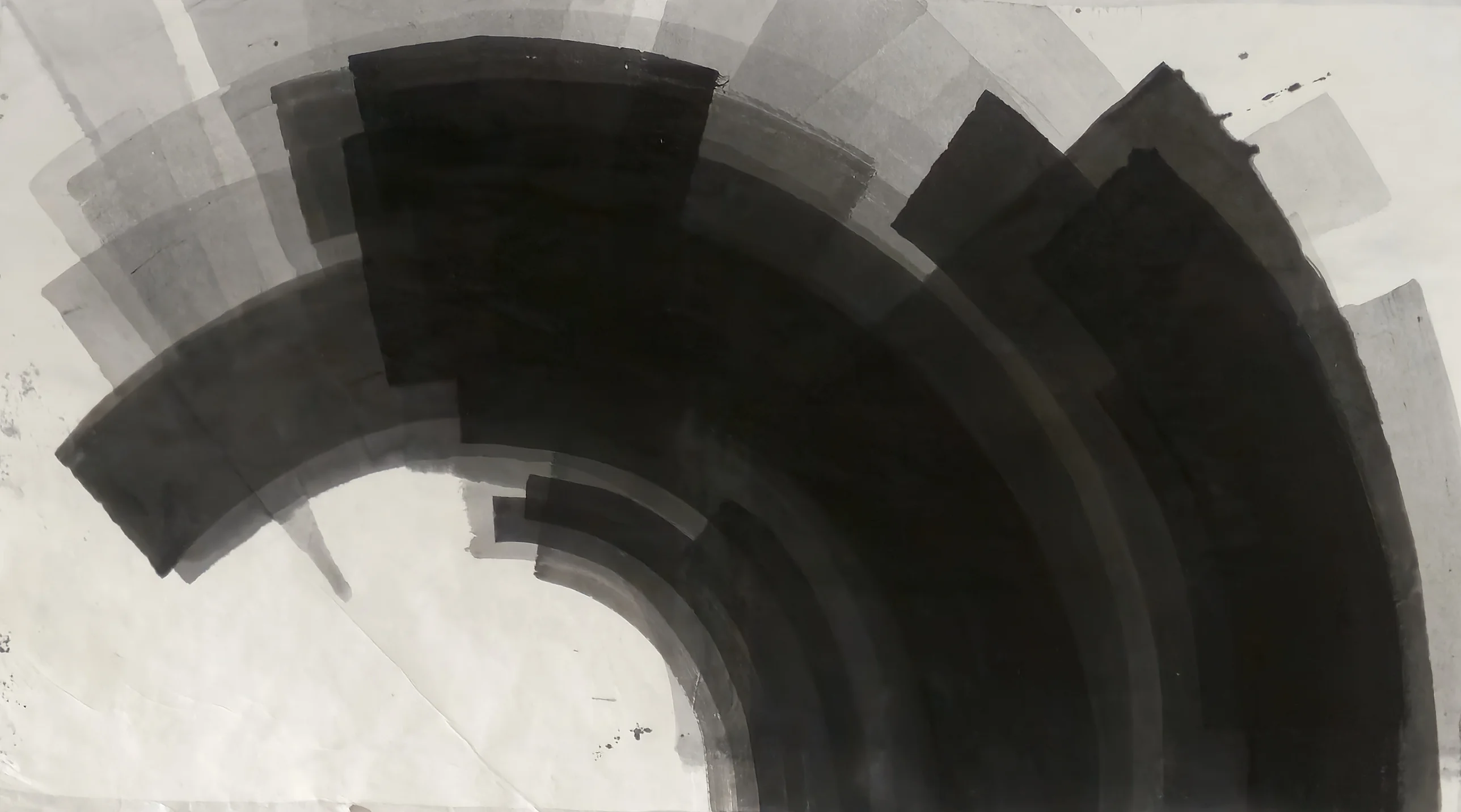
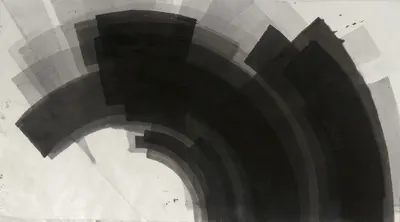
The engine's readingA wheel of black and grey ink bands swings in from the left edge, over the top of the paper, and down into the bottom right.
Record- Date
- 2026.09.20
- Dimensions
- 50 × 100 cm
- Paper
- Half-Cooked Red Star Mo She 6-Foot Bark Xuan Paper, self-sized from October 2026
- Ink
- Yi De Ge Yun Tou Yan, Boku-Undo Gentoku Super Concentrated, Yi De Ge Pine Soot Ink
The colony ships were built like this in the old drawings: a ring with no finish, bolted on one segment at a time, each plate darker than the last because they ran the furnaces hotter the further out they got. A ring was never finished. You built what you could, turned the open side toward the dark, and waited. I had the night shift when the first answer came. It was not words. It was a quarter of white, exactly the size of the hole we had left, folded neatly and set down where the hull did not reach, with a little dust spilled along its edge, as if whoever carried it had run the last of the way.
The reading
Written by the engine after the painting was rated, from the settled findings, and checked by hand before approval. It explains the numbers; it may not change them.
- Structure
- concentric quarter-arc bands round one centre, stepped blocks along the outer rim
- Movement
- clockwise sweep from left arm to bottom right; upper wedges step against it
- Coverage
- ink on about three quarters of the paper
- Tone
- five tonal steps, weighted dark
- Layering
- translucent grey passes and dense black passes; readable upper left and right rim
- Edges
- crisp band walls on arcs; dry-brush ends on top blocks; soft grey fans
- Feibai
- none
- Open paper
- quarter-disc of white lower left, bounded by the inner arc
- Chance marks
- specks along left edge and lower left; drips top right; creases lower left
- Frame
- runs off top, bottom and right edges; left edge and lower-left corner open
A great black wheel turns across the paper: in at the left edge as one dark arm, over the top, and down hard at the bottom right. Inside its curve the paper stays a clean quarter of white, drawn as firmly as anything inked.
The lighter work is the strength. At the bottom centre the inner arcs nest one inside the next, each band following the brush and holding its wall. At the upper left, pale grey fans overlap in plain order. The half-sized paper keeps each pass on its own surface, so the eye can count them back like pages.
The cost sits in the middle. There the late black seals over what lies beneath, and the core reads as one flat dark. The top-centre block and the upper-right wedges are rectangles in a sheet of curves, stiff where the rest travels, and the black packs the right half until it has little air. Specks and creases on the lower left stay small.
Still, the wheel turns with real authority. The sheet justifies its scale, and its quietest bands are what make it.
How it was read
Read by the Visual Analysis Engine, version 23.8, on 2026.10.06: measured by code, then read 5 times by Claude Opus 5.5 against three reference paintings (R1 to R3), each read independent of the others. How the engine works.
Three views of one sheet.
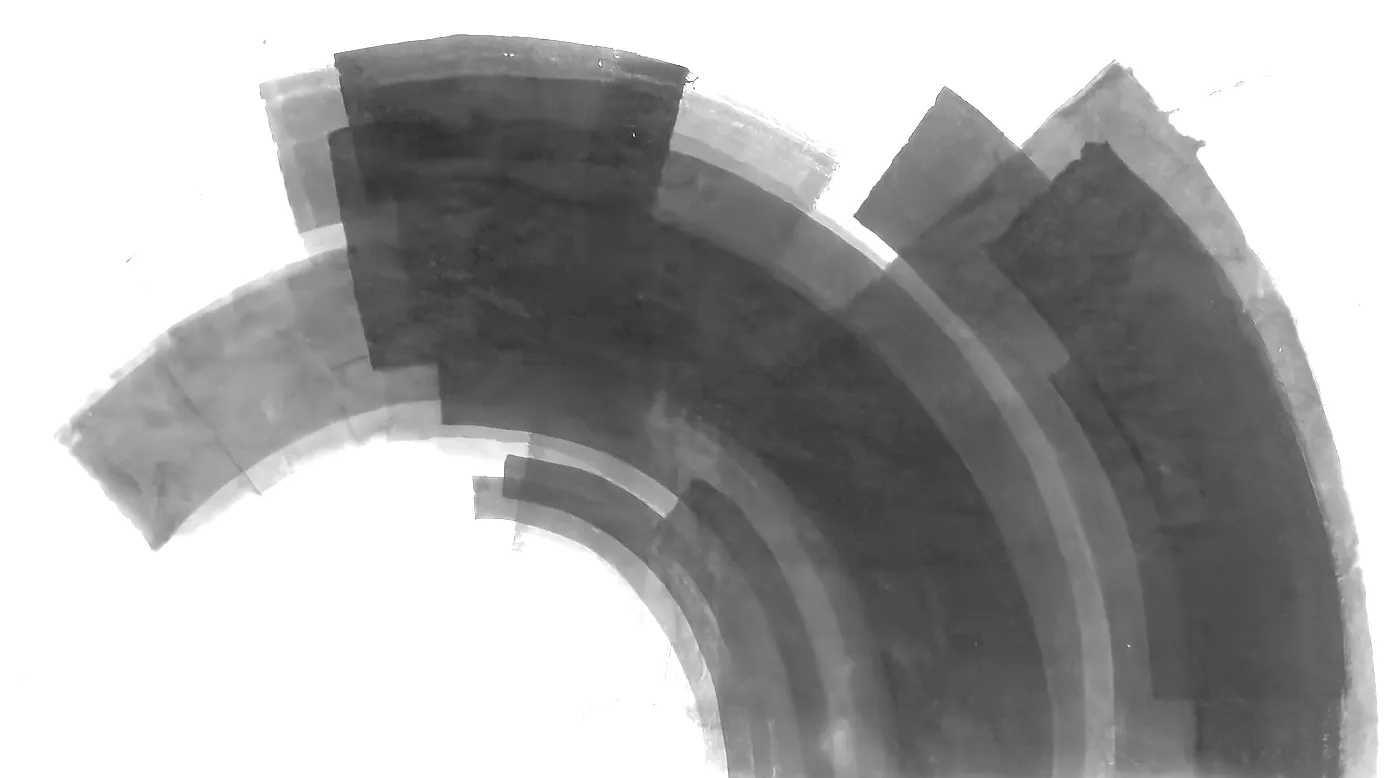
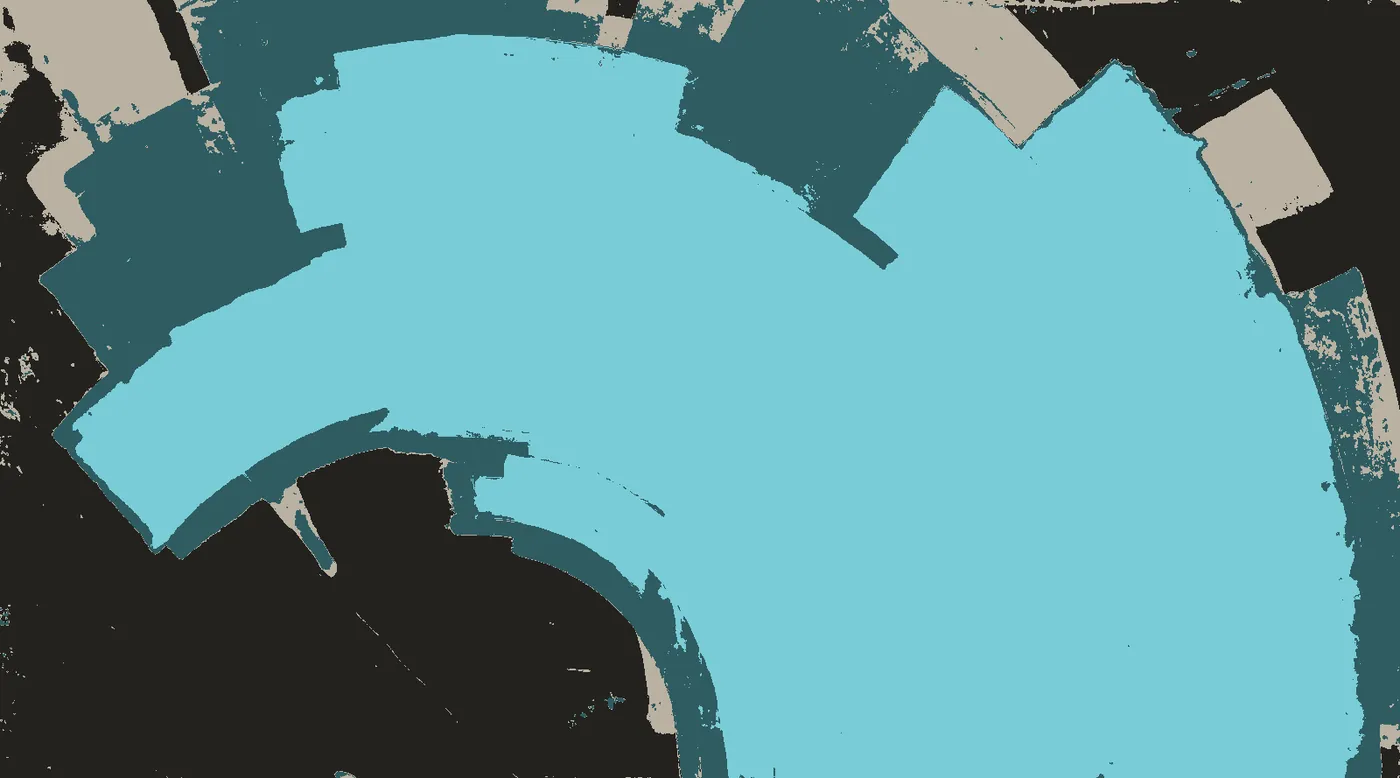
Left, the photograph. Centre, the tone stretch the model is shown beside it: the darkest 45% of tones spread over the whole range, so flat black, banding and stains show. Right, every pixel as the measuring code classes it: cyan black ink, deep teal translucent grey, stone the palest ink, near black bare paper.
5 families of tone.
Every inked pixel's brightness in 64 bins, smoothed; each circled peak holds at least 4% of the ink. Life inside the black: 0.052 (under 0.045 reads as flat).
Five reads, agreeing on 3 of 5 qualities.
Each quality placed on its ladder by each read, and the mean the engine keeps. Where reads differ, they differ by one rung; close calls resolve down.
READ 1, IN ITS OWN WORDS
“A concentric-arc sheet like R3 but heavier: a large, mostly flat black centre swallows the layered passes. Grey fans and the arc's sweep work, though slab blocks and crowding on the right hold it to ordinary.”
Concentric arc bands hold their walls and follow the sweep; the top-centre black block and the upper-right wedges read as filled slabs rather than travelled strokes.
WEAKEST Rectangular dark slab at top centre, blunt and stiff
STRONGEST Inner concentric arcs bottom centre follow brush travel
Grey arcs on left and outer right show stepped densities; the dominant central black (71% dark share) is mostly flat, with only grain visible when tone-stretched.
WEAKEST Central black mass, near-uniform in colour view
STRONGEST Left grey fan bands with stepped translucent density
Pale fans upper left and outer right rings stack in readable order; in the centre the dark passes merge so the sequence is lost.
WEAKEST Centre passes fused into one black
STRONGEST Translucent grey fans at upper left overlap legibly
The arc gives clear rotational movement and shapes the white bottom-left void; the right half is jammed with dark, leaving little air there.
WEAKEST Heavy black mass crowding the right half
STRONGEST Sweeping quarter-circle carrying the eye down-right
Ink is controlled and edges crisp; small spatter specks at left edge and lower left, drips top right, and crease lines in bottom-left paper sit away from principal masses.
WEAKEST Stray specks and paper creases bottom left
STRONGEST Dry-brush grain at edges of top-centre block
4 distinct places, 0 major.
Each read must name every flaw and where it is, in a ninth of the sheet. Here the reads named flaws in 4 distinct places, 17 mentions in all across 5 reads; the number in each ninth is how many times a flaw was named there. Reads agreeing on a place strengthen the evidence for one flaw; they do not multiply it.
The rating these readings produce, the rules applied and the arithmetic, with Peter's own rating where he gave one, are in the Archive record.
Date
2026.09.20, day 266 of the Crucible Year, one of 3 paintings from that date (2 shown). 8 works were registered in the fourteen days before. Paintings are dated by the day their batch was registered and photographed; each was finished that day or within the few days before. Phase: P4 S14 (working title).
T_384 among all 402
Every painting of the year by date; this one is outlined.
Materials
- Paper
- Half-Cooked Red Star Mo She 6-Foot Bark Xuan Paper, self-sized from October 2026, China Xuan Paper Co., Ltd., made 2026.04.08
- Ink MB6
- Yi De Ge Yun Tou Yan, Yi De Ge (Beijing)
- Ink MB8
- Boku-Undo Gentoku Super Concentrated, Boku-Undo
- Ink MB9
- Yi De Ge Pine Soot Ink, Yi De Ge (Beijing)
Related