T_128
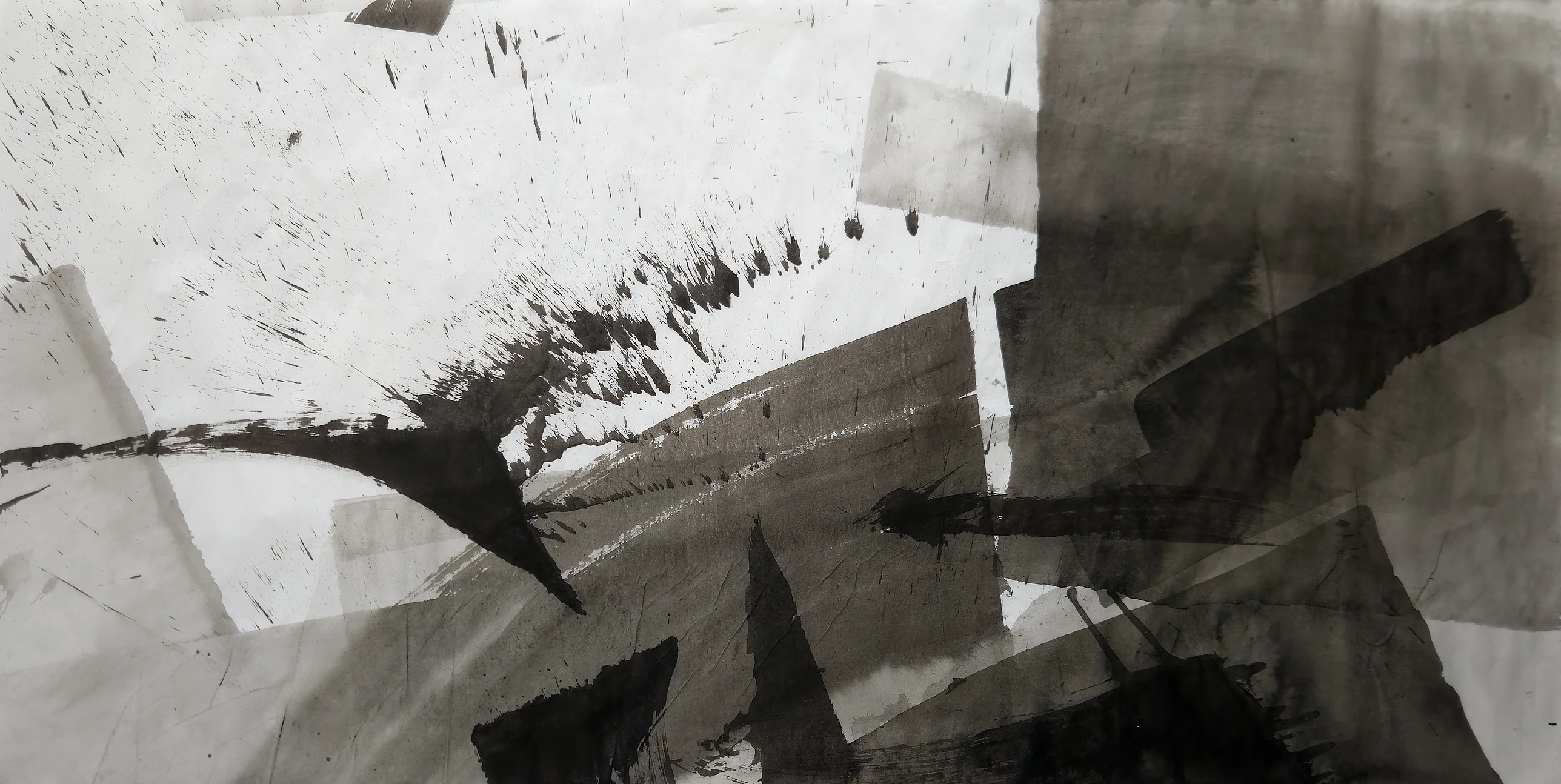
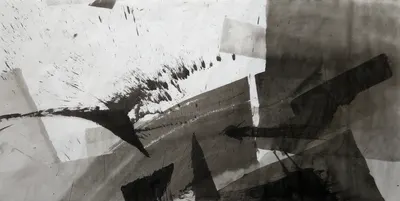
The engine's readingA black hooked stroke bows in from the left edge and throws its spatter into open white paper, with grey rectangles stacked toward the right.
Record- Date
- 2026.03.22
- Dimensions
- 70 × 140 cm
- Paper
- Qing Yi Half-Raw Xuan
- Ink
- Kuretake Shogei Kiwami, Yi De Ge Zhonghua, Boku-Undo Bokkou
The drops above the long curve all have their tails pointed back at where they left from, and that is how you tell a launch from a fall. I count them the way a colony counts its outbound ships: a few already clear in the open white, most still burning off the hull. Down below, the heavy dark blocks are ground crew, too many of them, parked too close, engines idling into one grey fog. Fine. Somebody has to stay. Up top the white is cold and huge and lightly freckled. Every fleck is a small craft with its nose up, a pinch of soot that decided to leave the planet anyway, trailing one thin line of exhaust behind it.
The reading
Written by the engine after the painting was rated, from the settled findings, and checked by hand before approval. It explains the numbers; it may not change them.
- Structure
- curved hooked stroke at left, tilted grey slabs centre, banded grey block right
- Movement
- diagonal along the arc, with spatter flying back up toward the upper left
- Coverage
- ink on about three quarters of the paper
- Tone
- six tonal steps, spread across the range
- Layering
- pale rectangles, mid-grey slabs, black strokes; readable centre and right, lost bottom right
- Edges
- crisp rectangle corners; tapered hook point; broken, grainy edge along the hook's back
- Feibai
- none
- Open paper
- broad spattered wedge in the upper left, above the arc
- Chance marks
- spatter across the upper left; cloudy patch upper right; crease lines lower left
- Frame
- ink runs off all four edges; upper-left corner open except for spatter
A long black stroke enters at the left edge, bows across the paper and stops in a hooked point short of the centre. Spatter flies off its back into the open top left. The eye rides that spray, then returns down the arc to the grey blocks massed at right. One diagonal, clearly stated.
The hook is the reason to stand here. It tapers cleanly, its upper edge breaks into grain and droplets, and the spray above it gives the empty paper a shape. Under it, pale and mid-grey rectangles overlap and stay translucent. Half-sized paper holds a wash to a hard corner, so each pass keeps its place. The tall grey block at right is banded and grained from top to bottom.
The bottom is weaker. The slab left of centre, the wedge beside it and the dark stack at bottom right are flat inside. Where the greys pile up at right, they sink toward one heavy dark. That corner is jammed. Faint creases in the lower left and a cloudy patch in the upper-right wash are minor.
The top half is fine painting. The bottom takes real weight off it without sinking it. The result is a solid sheet, clearly above the common run, held back by its own floor.
How it was read
Read by the Visual Analysis Engine, version 23.8, on 2026.10.06: measured by code, then read 5 times by Claude Opus 5.5 against three reference paintings (R1 to R3), each read independent of the others. How the engine works.
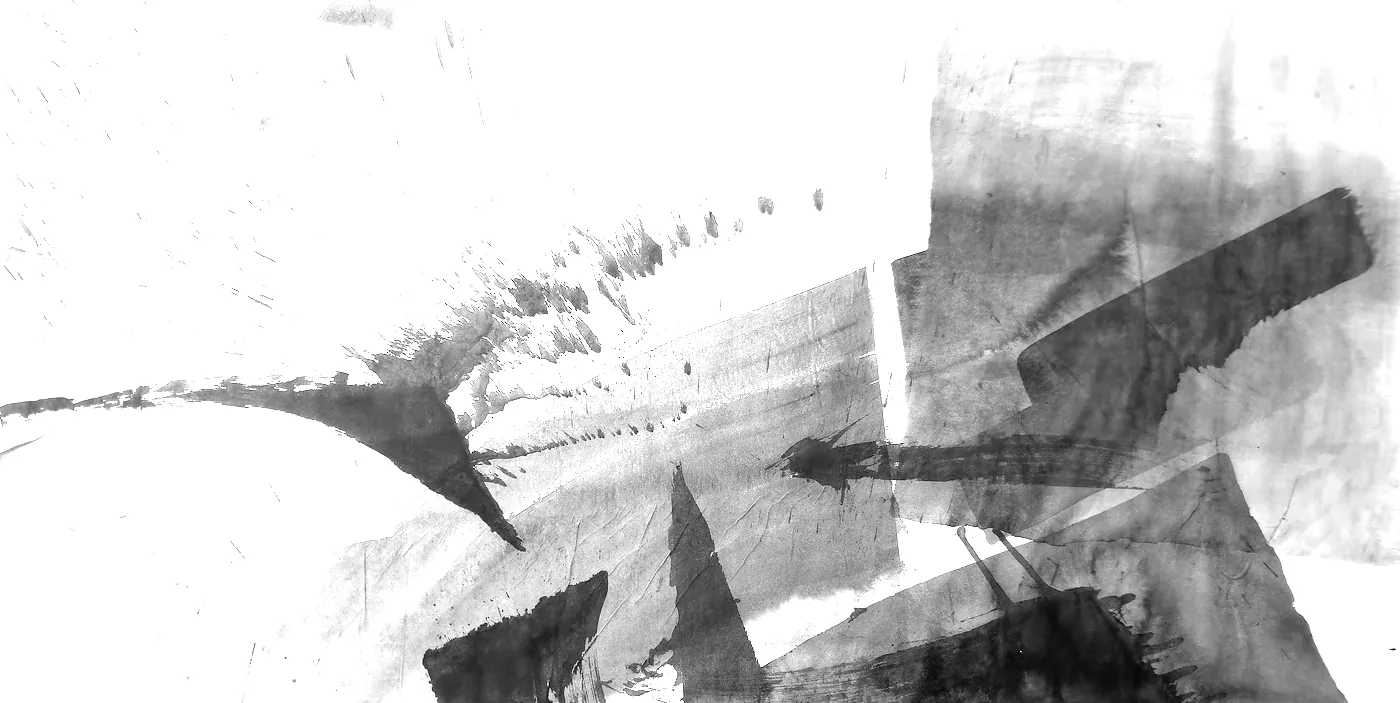
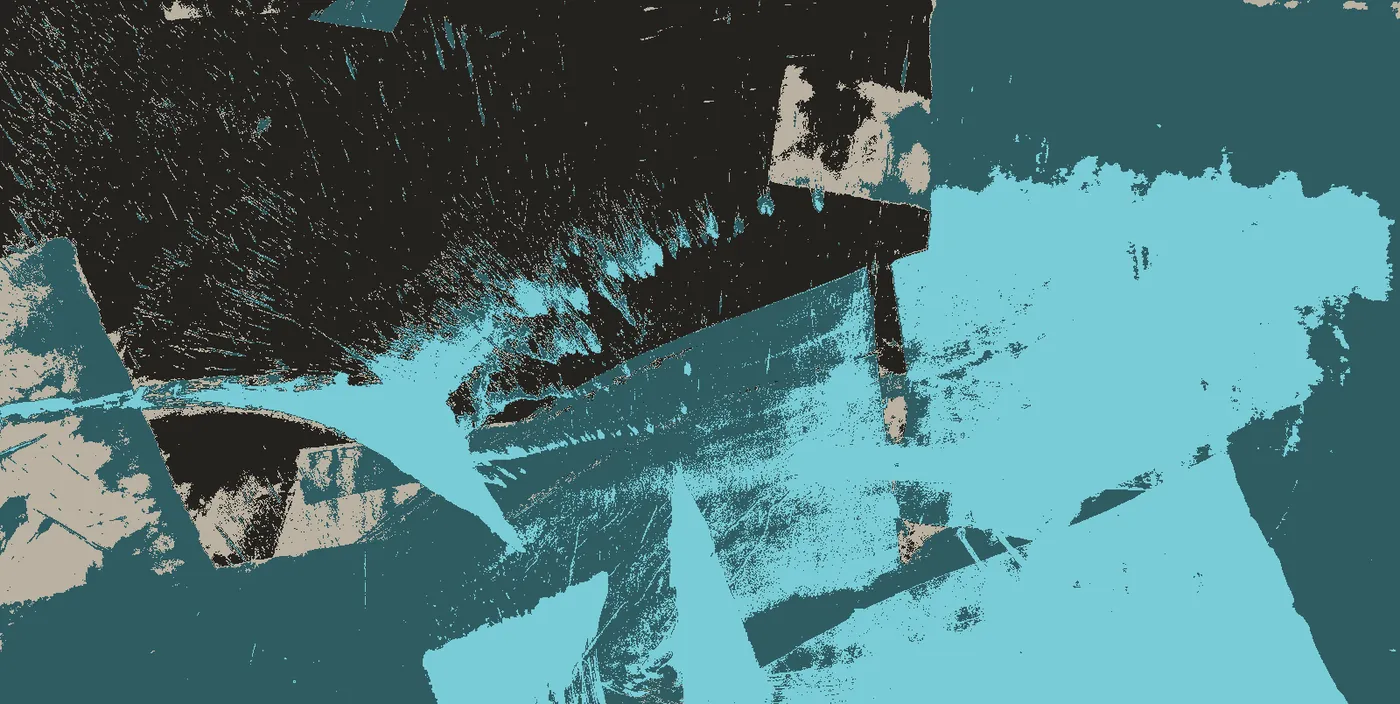
Three views of one sheet.
Left, the photograph. Centre, the tone stretch the model is shown beside it: the darkest 45% of tones spread over the whole range, so flat black, banding and stains show. Right, every pixel as the measuring code classes it: cyan black ink, deep teal translucent grey, stone the palest ink, near black bare paper.
6 families of tone.
Every inked pixel's brightness in 64 bins, smoothed; each circled peak holds at least 4% of the ink. Life inside the black: 0.060 (under 0.045 reads as flat).
Five reads, agreeing on 4 of 5 qualities.
Each quality placed on its ladder by each read, and the mean the engine keeps. Where reads differ, they differ by one rung; close calls resolve down.
READ 1, IN ITS OWN WORDS
“An energetic sheet like R2. The translucent rectangles are legibly layered and a fluent arc leads the eye, but the dark wedges are bulky and flat and the bottom right is crowded. The surface has minor creases and mottling.”
Left arc stroke tapers fluently to its hooked point; the right black bar and bottom dark wedges are bulky, slab-like fills with stiff rectangular ends.
WEAKEST Blunt dark slab bottom centre-left, filled-in wedge
STRONGEST Curved hooked stroke sweeping left to centre
Grey slabs show grain and graded density, and the top-right mass bands well; the bottom black wedges stay mostly uniform inside. Modulation 0.060 with six tonal steps.
WEAKEST Bottom dark masses largely flat inside
STRONGEST Right grey mass with graded vertical banding
Pale slabs, then mid-grey rectangles, then black strokes and spatter. Overlaps stay translucent and you can read the order across the centre and right.
WEAKEST Bottom-right overlaps thicken toward heavy dark
STRONGEST Translucent grey rectangles stacked under black strokes
Diagonal flow from the left arc through spatter into the right masses; the open top-left paper is shaped by the spray. Bottom right is jammed with stacked blocks.
WEAKEST Crowded bottom-right cluster of overlapping slabs
STRONGEST Diagonal arc carrying eye from left to right
Ink is controlled and spatter is deliberate. Crease lines run through the lower-left greys and there is mild cloudy mottling in the top-right wash, both minor.
WEAKEST Cloudy mottling inside top-right grey mass
STRONGEST Dry-brush spatter and grainy grey wash edges
5 distinct places, 0 major.
Each read must name every flaw and where it is, in a ninth of the sheet. Here the reads named flaws in 5 distinct places, 12 mentions in all across 5 reads; the number in each ninth is how many times a flaw was named there. Reads agreeing on a place strengthen the evidence for one flaw; they do not multiply it.
Measured from the 16-bit master.
The previous engine (V22) measured this sheet's master file: 1 principal ink mass traced (cyan), 5 enclosed voids at true size in their grid cells (amber), the main gesture from start to end (red). Of 14 edge segments, 29% crisp, 43% soft or bloomed, 29% broken.
The rating these readings produce, the rules applied and the arithmetic, with Peter's own rating where he gave one, are in the Archive record.
Date
2026.03.22, day 84 of the Crucible Year, one of 7 paintings from that date (5 shown). 51 works were registered in the fourteen days before. Paintings are dated by the day their batch was registered and photographed; each was finished that day or within the few days before. Phase: P1 Warm-up (working title).
T_128 among all 402
Every painting of the year by date; this one is outlined.
Materials
- Paper
- Qing Yi Half-Raw Xuan, Jingxian Sichijian Xuan Paper Arts & Crafts Co., Ltd., made unknown
- Ink MB1
- Kuretake Shogei Kiwami, Kuretake
- Ink MB2
- Yi De Ge Zhonghua, Yi De Ge (Beijing)
- Ink MB3
- Boku-Undo Bokkou, Boku-Undo
Related