T_130
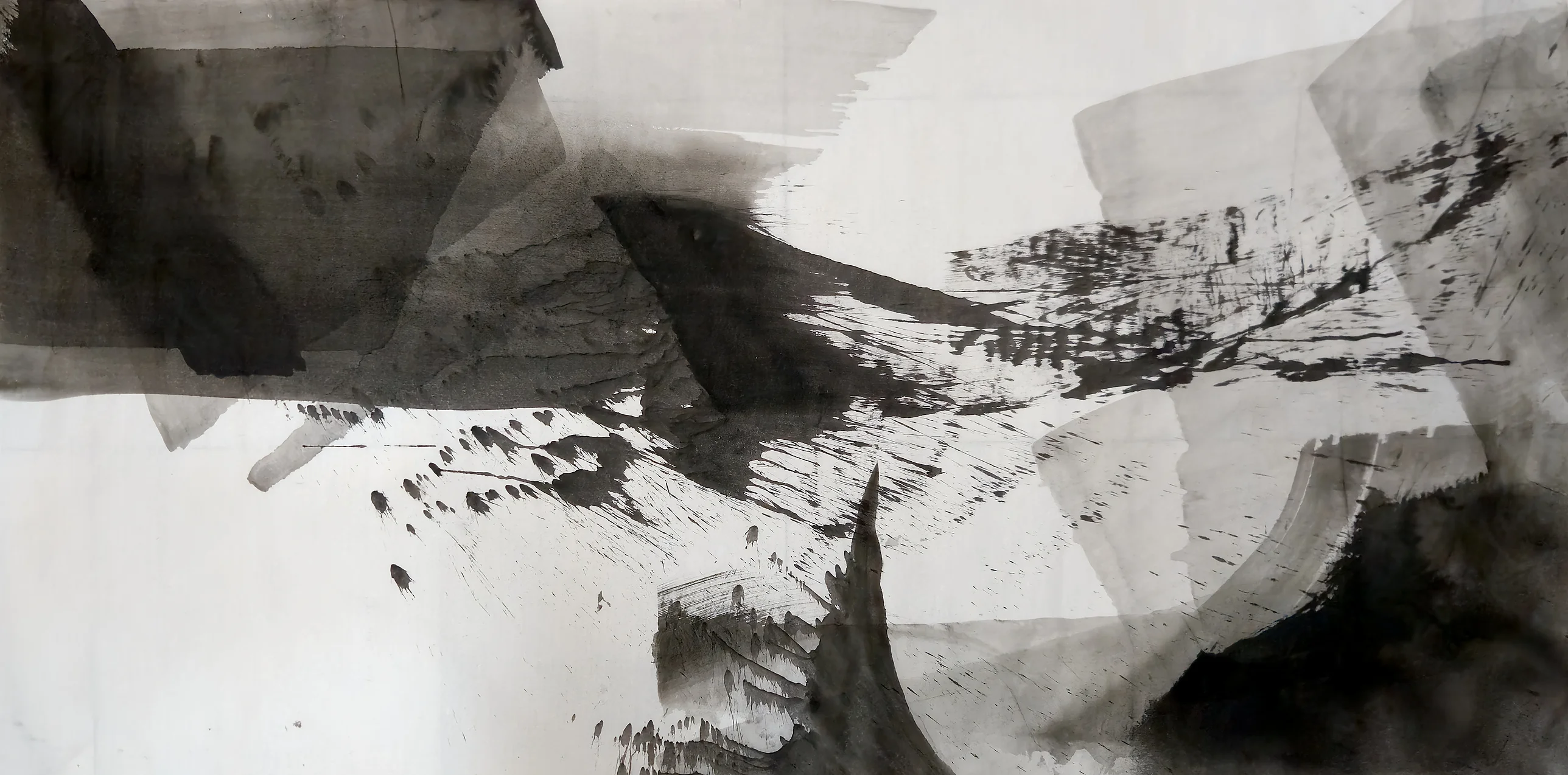
The engine's readingA black wedge driven across a long grey sheet, trailing dry streaks and flung drops between a dark trapezoid and a cloud of black.
Record- Date
- 2026.03.22
- Dimensions
- 70 × 140 cm
- Paper
- Qing Yi Half-Raw Xuan
- Ink
- Kuretake Shogei Kiwami, Yi De Ge Zhonghua, Boku-Undo Bokkou
In the kingdom on this paper, the black wedge is a beast that flies one way only, and it sheds as it goes. The teeth it lost fell south-west, into the country left off the map, and they lie there in a loose arc, small and dark, spaced like someone walking. I asked the court cartographer about that country. She said there was nothing in it worth a name. I said the beast dropped its teeth there, which ought to count for something. She did not look up. She rolled the map, and the corner she never inked curled over her wrist like a sleeping animal.
The reading
Written by the engine after the painting was rated, from the settled findings, and checked by hand before approval. It explains the numbers; it may not change them.
- Structure
- grey trapezoid upper left, black wedge centre, pale planes right, spike, mass below
- Movement
- left to right diagonal; spike rises against it at bottom centre
- Coverage
- ink on about two thirds of the paper
- Tone
- six tonal steps, spread across the range
- Layering
- pale washes under dark passes; readable upper left and right
- Edges
- crisp on trapezoid and wedge walls; soft on bottom-right mass
- Feibai
- trailing edge of central wedge; ends of pale top-centre stroke
- Open paper
- broad lower-left field, curving up to the centre
- Chance marks
- bloom in bottom-right mass; dabs and scratch lines in upper-left grey
- Frame
- ink runs off top, both sides, bottom centre; lower-left corner open
A dark diagonal crosses the sheet from top left to right. It starts as a heavy trapezoid of graded grey, hardens into a black wedge at the centre, and frays into dry strokes and flung drops among pale planes at the right edge.
The wedge is the best thing here. Its point is dense and sealed; its trailing edge drags across the half-sized paper, which catches a dry brush just enough to leave grain and parallel streaks while the shape holds. Above it, the trapezoid keeps its walls and steps from grey to a black base, with earlier pale planes still legible beneath.
The bottom right is where it gives way. The dark mass there has no edge: it swells in soft lobes, and its interior went cloudy and mottled as the wet ink settled, burying the grey planes it covers. The lower left is the other cost, blank paper with drops that never become a shape. Dabs and a scratch line in the upper grey are small, and absorbed.
That leaves one clear movement, one passage worth standing in front of, and two corners nobody claimed. Typical work, plain and uneven.
How it was read
Read by the Visual Analysis Engine, version 23.8, on 2026.10.06: measured by code, then read 5 times by Claude Opus 5.5 against three reference paintings (R1 to R3), each read independent of the others. How the engine works.
Three views of one sheet.
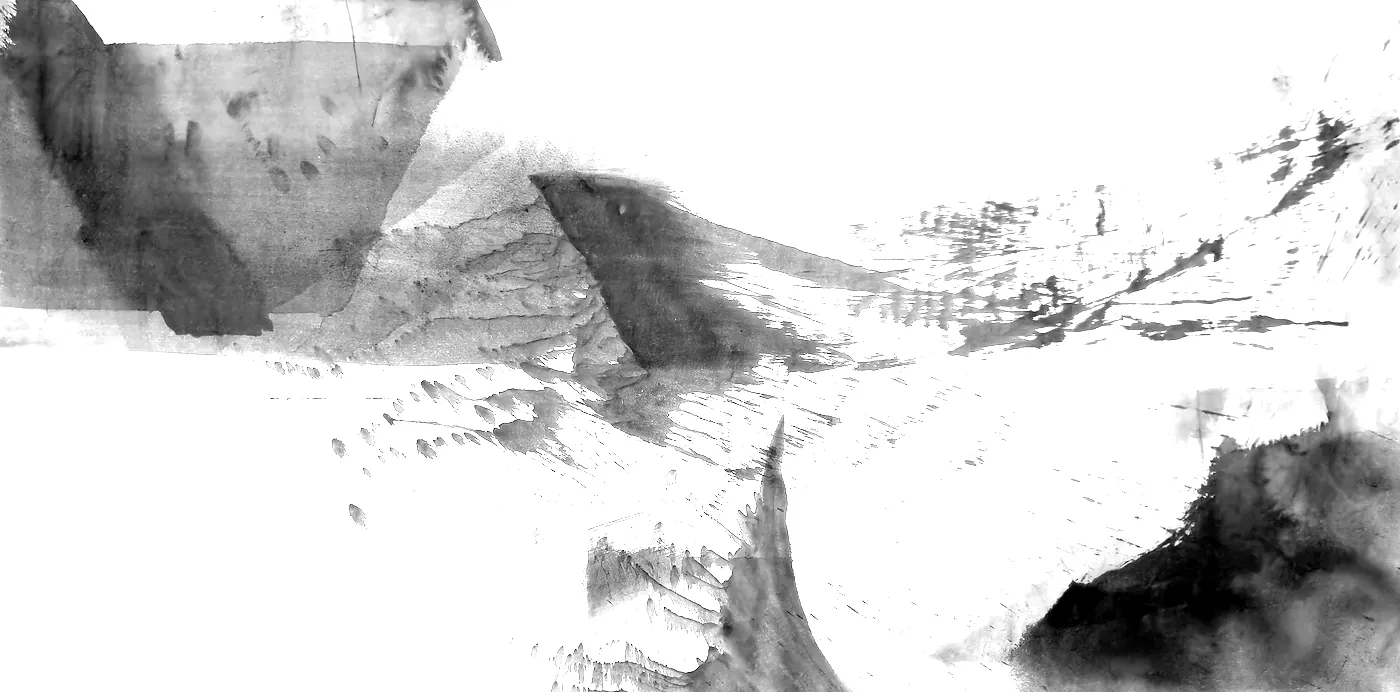
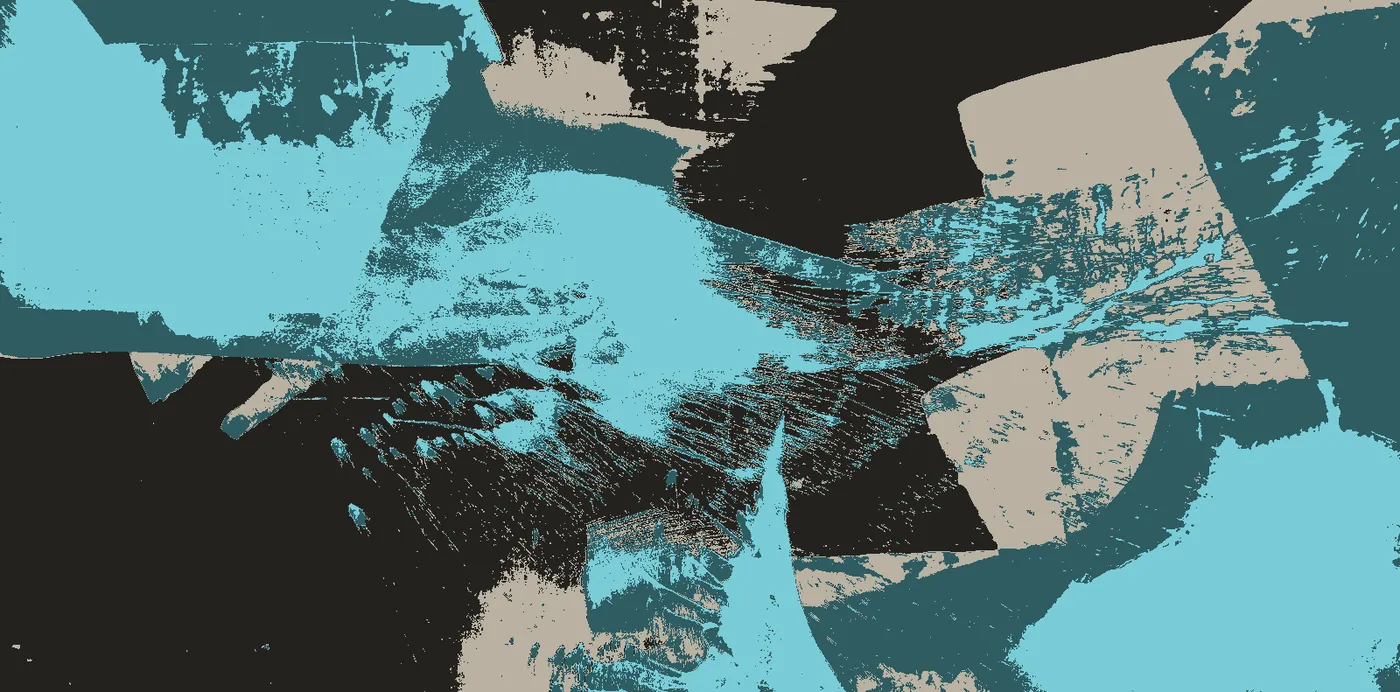
Left, the photograph. Centre, the tone stretch the model is shown beside it: the darkest 45% of tones spread over the whole range, so flat black, banding and stains show. Right, every pixel as the measuring code classes it: cyan black ink, deep teal translucent grey, stone the palest ink, near black bare paper.
6 families of tone.
Every inked pixel's brightness in 64 bins, smoothed; each circled peak holds at least 4% of the ink. Life inside the black: 0.066 (under 0.045 reads as flat).
Five reads, one answer.
Each quality placed on its ladder by each read, and the mean the engine keeps.
READ 1, IN ITS OWN WORDS
“An R2-type gestural sheet with translucent planes, a strong central wedge and spatter. The diagonal flow works and the layers stay legible. The cloudy, blotchy bottom-right black mass weakens form, tone and surface.”
Upper-left trapezoid and central wedge are coherent, walls hold; bottom-right mass dissolves into cloud and the left trapezoid stays slab-like, as in R2.
WEAKEST Bottom-right dark mass, soft-edged and shapeless
STRONGEST Central dark wedge with dry-brush trailing edge
Left trapezoid and central wedge show graded density and grain; bottom-right black is cloudy and blotchy, not structured tone. Six tonal steps, modulation 0.066.
WEAKEST Bottom-right mass: cloudy, mottled rather than modelled
STRONGEST Upper-left trapezoid graded grey into black base
Pale translucent planes top-right and left stay legible under darker wedges and spatter; two to three passes, sequence not clearly built across the sheet.
WEAKEST Spatter and drybrush laid over greys without order
STRONGEST Translucent grey planes overlapping at right edge
Diagonal movement from upper left to right carries the eye; bottom-centre spike and bottom-right mass anchor it, but lower-left paper is inert and right side busy.
WEAKEST Empty lower-left paper, leftover rather than shaped
STRONGEST Diagonal sweep from left trapezoid through centre wedge
Bottom-right black mass is mottled with cloudy pale blooms visible in colour view; drip spots dot the upper-left trapezoid grey. Dry-brush elsewhere is controlled.
WEAKEST Cloudy blotchy interior of bottom-right dark mass
STRONGEST Dry-brush grain on central wedge's trailing edge
4 distinct places, 1 major.
Each read must name every flaw and where it is, in a ninth of the sheet. Here the reads named flaws in 4 distinct places, 14 mentions in all across 5 reads; the number in each ninth is how many times a flaw was named there. Reads agreeing on a place strengthen the evidence for one flaw; they do not multiply it. A major flaw holds Material and surface at rung 1.
Measured from the 16-bit master.
The previous engine (V22) measured this sheet's master file: 1 principal ink mass traced (cyan), 8 enclosed voids at true size in their grid cells (amber), the main gesture from start to end (red). Of 16 edge segments, 19% crisp, 19% soft or bloomed, 63% broken.
The rating these readings produce, the rules applied and the arithmetic, with Peter's own rating where he gave one, are in the Archive record.
Date
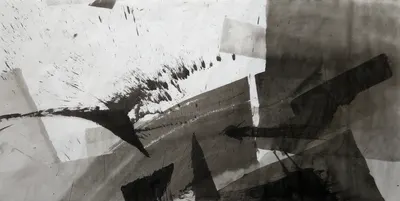
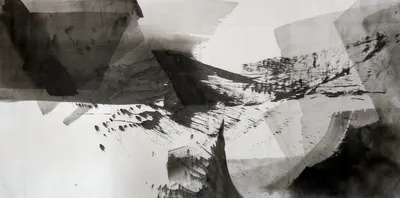
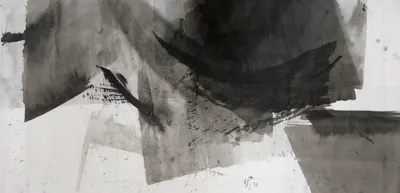
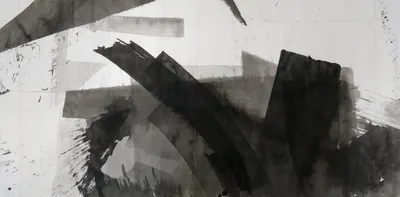
2026.03.22, day 84 of the Crucible Year, one of 7 paintings from that date (5 shown). 51 works were registered in the fourteen days before. Paintings are dated by the day their batch was registered and photographed; each was finished that day or within the few days before. Phase: P1 Warm-up (working title).
T_130 among all 402
Every painting of the year by date; this one is outlined.
Materials
- Paper
- Qing Yi Half-Raw Xuan, Jingxian Sichijian Xuan Paper Arts & Crafts Co., Ltd., made unknown
- Ink MB1
- Kuretake Shogei Kiwami, Kuretake
- Ink MB2
- Yi De Ge Zhonghua, Yi De Ge (Beijing)
- Ink MB3
- Boku-Undo Bokkou, Boku-Undo
Related