T_166
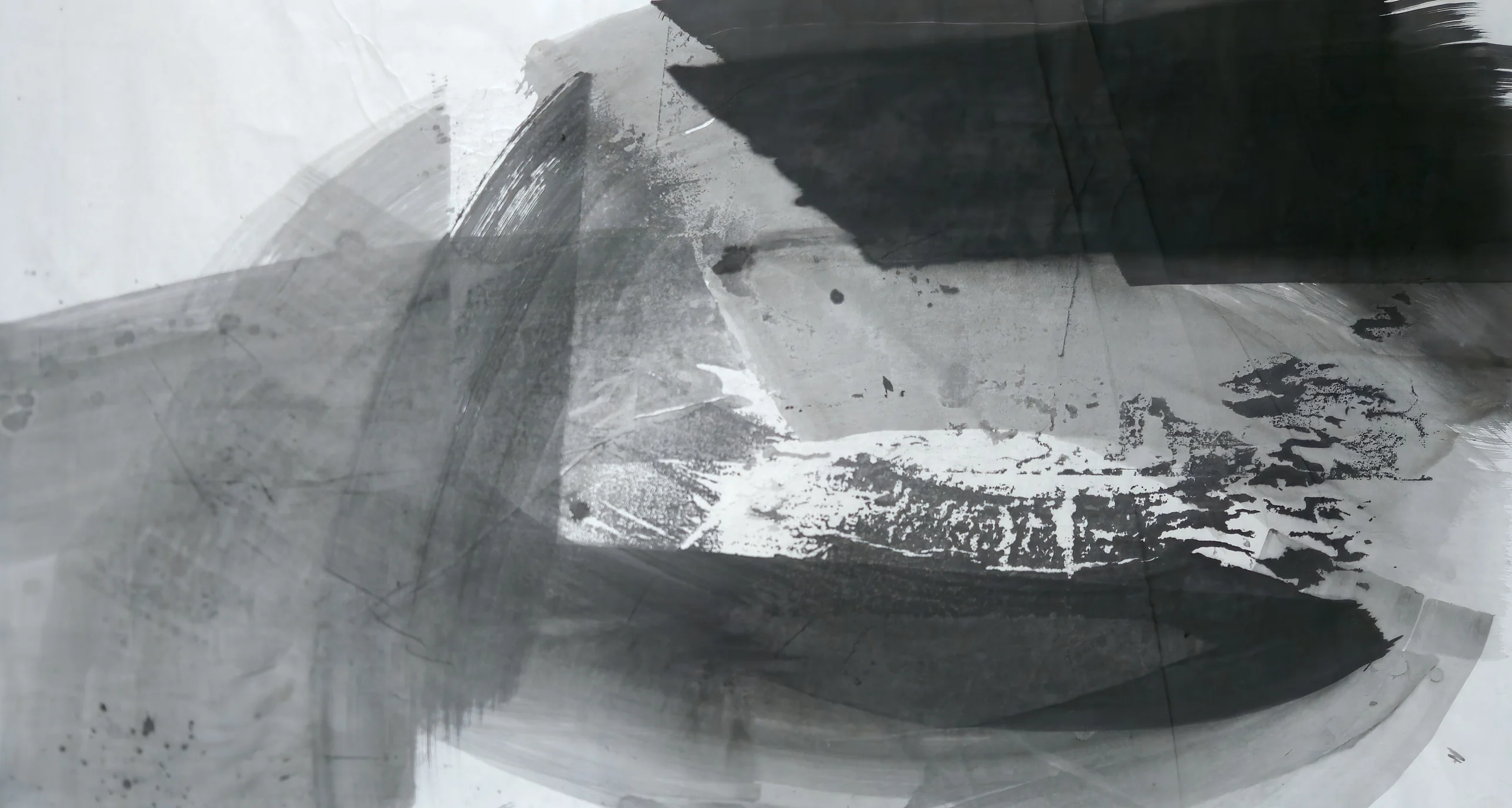
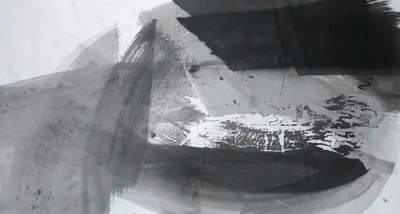
The engine's readingA black slab pressed down from the top edge, a dark crescent swept in beneath it, a flaking pale band between, grey washes crossing on the left.
Record- Date
- 2026.04.03
- Dimensions
- 97 × 180 cm
- Paper
- Tanxi Thickened Grade A Half-Raw 6-Foot
- Ink
- Kuretake Shogei Kiwami, Yi De Ge Zhonghua, Boku-Undo Bokkou
The creases read like a tablecloth's, quartered and then quartered again, kept in the drawer with the good spoons. The black at the top is the wine that went over when the argument started. The long dark curve beneath it is an arm across the table, catching the bottle before it rolls off. The flakes in between are crumbs, a whole evening of bread pushed into the weave. I would wash it. The black would not come out. You fold it anyway, stain turned inward, because Sunday is coming and there will be people, and you spread it with the creases still standing up like small roofs and set the plates down on top.
The reading
Written by the engine after the painting was rated, from the settled findings, and checked by hand before approval. It explains the numbers; it may not change them.
- Structure
- top-right black slab, lower dark crescent, left grey slabs, broken band between
- Movement
- rightward sweep along the bottom; left grey verticals stand against it
- Coverage
- ink on about nine tenths of the paper
- Tone
- five tonal steps, weighted to the middle greys
- Layering
- translucent grey passes under dark passes; readable at the left overlaps
- Edges
- crisp straight underside of the slab; bristled fringe top right; soft cloudy greys
- Feibai
- present in the dark rising arc left of centre, toward its top
- Open paper
- pale wedge in the top-left corner, opening down to the left grey
- Chance marks
- fold creases through both darks; blots beside the light band; spatter lower left
- Frame
- ink runs off left, top right and bottom left; top left and lower right open
Two darks pinch the right half of the paper. A black slab presses down from the top edge, a long crescent swings in beneath it from the left, and between them a pale band breaks into flakes. Broad grey washes cross each other over the whole left side.
The crescent is where the sheet comes alive. It follows the brush the whole way, its walls stay firm, and it thins to a clean point at the right. The half-raw paper lets grain and banding show inside it, so the dark keeps grading as it travels. The flaking band above is real texture, ink broken over the paper's surface, and on the left the grey passes stay translucent where they cross.
The slab costs most. Its underside is ruled straight and its inside is close to flat, so it covers what lies beneath it rather than building on it. The left grey field is heavy and points nowhere. Creases run through both darks and stray blots dot the light band; the sheet absorbs them.
That leaves a sheet from the middle of the run: one fine sweep and a live patch of broken texture, set among blocks that mostly fill space. It holds together. It does not rise.
How it was read
Read by the Visual Analysis Engine, version 23.8, on 2026.10.06: measured by code, then read 5 times by Claude Opus 5.5 against three reference paintings (R1 to R3), each read independent of the others. How the engine works.
Three views of one sheet.
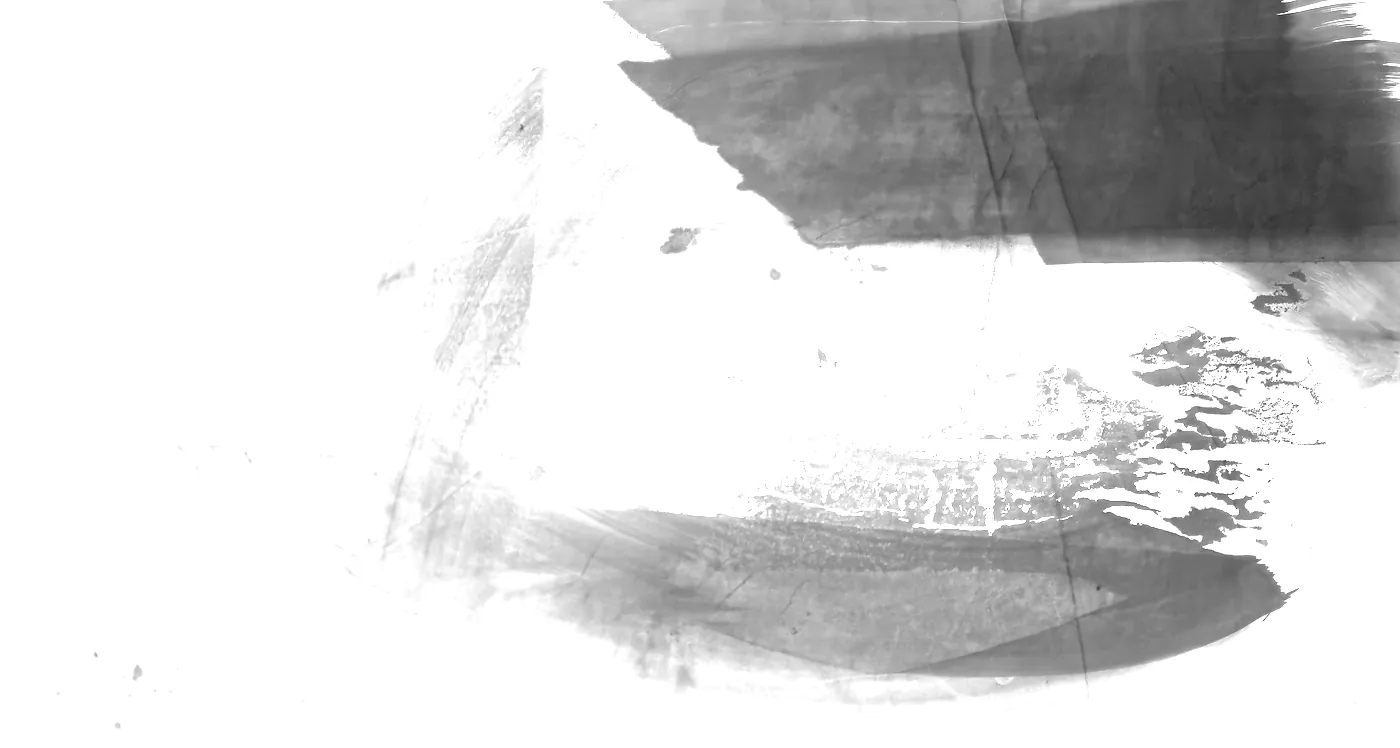
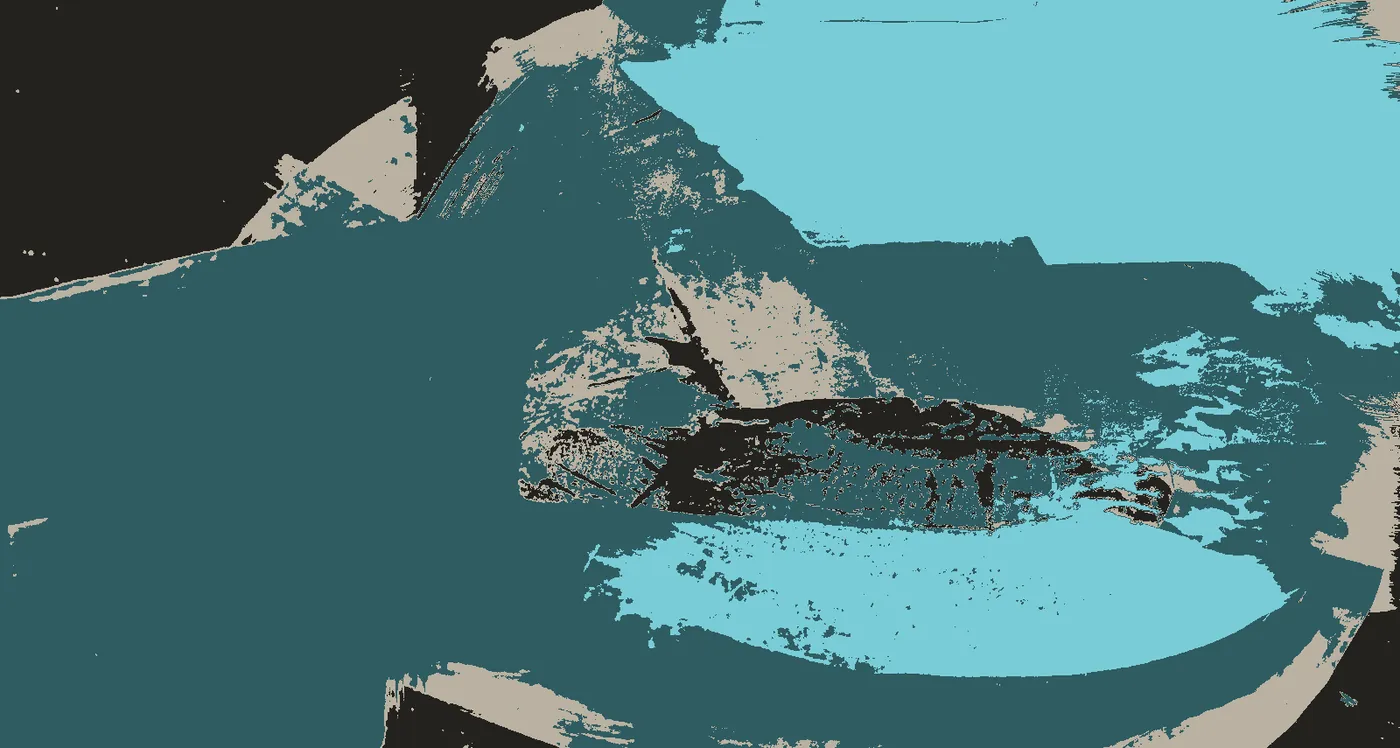
Left, the photograph. Centre, the tone stretch the model is shown beside it: the darkest 45% of tones spread over the whole range, so flat black, banding and stains show. Right, every pixel as the measuring code classes it: cyan black ink, deep teal translucent grey, stone the palest ink, near black bare paper.
5 families of tone.
Every inked pixel's brightness in 64 bins, smoothed; each circled peak holds at least 4% of the ink. Life inside the black: 0.058 (under 0.045 reads as flat).
Five reads, one answer.
Each quality placed on its ladder by each read, and the mean the engine keeps.
READ 1, IN ITS OWN WORDS
“A working sheet: a strong bottom sweep and a textured central band, but a slab-like top block, a cloudy left grey field, and creases and blots on the surface keep it at an ordinary level.”
Bottom stroke follows brush travel to a tapered tip; top-right block is a bulky rectangle; left grey washes are broad, loosely edged slabs.
WEAKEST Top-right black block: blunt slab with stiff edges
STRONGEST Bottom dark sweep tapering to a point at right
Five tonal steps; dark interiors show grain and banding (modulation 0.058); top block has streaking; left grey field reads as one flat cloudy tone.
WEAKEST Left grey washes, cloudy and near-uniform
STRONGEST Bottom sweep graded from black to grey
Grey vertical and horizontal washes overlap translucently, black passes sit on top readably; left overlaps lose clarity and order.
WEAKEST Left overlapping greys merge into cloudy field
STRONGEST Black block laid legibly over pale grey wash
Two dark masses at right converge around a lit mottled band, giving direction; left grey field is heavy and static, upper-left paper leftover.
WEAKEST Left half: large undirected grey expanse
STRONGEST Top block and bottom sweep bracketing central light
Fold creases cut through top black block and bottom sweep; stray blots centre; speckled spots and cloudy wash in left grey field, visible in colour view.
WEAKEST Crease lines and blots across principal masses
STRONGEST Reticulated dry-brush texture in centre-right band
7 distinct places, 2 major.
Each read must name every flaw and where it is, in a ninth of the sheet. Here the reads named flaws in 7 distinct places, 20 mentions in all across 5 reads; the number in each ninth is how many times a flaw was named there. Reads agreeing on a place strengthen the evidence for one flaw; they do not multiply it. A major flaw holds Material and surface at rung 1.
Measured from the 16-bit master.
The previous engine (V22) measured this sheet's master file: 1 principal ink mass traced (cyan), 8 enclosed voids at true size in their grid cells (amber), the main gesture from start to end (red). Of 14 edge segments, 43% crisp, 57% soft or bloomed, 0% broken.
The rating these readings produce, the rules applied and the arithmetic, with Peter's own rating where he gave one, are in the Archive record.
Date
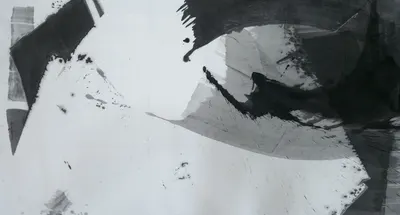
2026.04.03, day 96 of the Crucible Year, one of 13 paintings from that date (3 shown). 33 works were registered in the fourteen days before. Paintings are dated by the day their batch was registered and photographed; each was finished that day or within the few days before. Phase: P1 Warm-up (working title).
T_166 among all 402
Every painting of the year by date; this one is outlined.
Materials
- Paper
- Tanxi Thickened Grade A Half-Raw 6-Foot, Anhui Jingxian Tanxi Xuan Paper Art Products Co., Ltd., made 2024
- Ink MB1
- Kuretake Shogei Kiwami, Kuretake
- Ink MB2
- Yi De Ge Zhonghua, Yi De Ge (Beijing)
- Ink MB3
- Boku-Undo Bokkou, Boku-Undo
Related