T_271
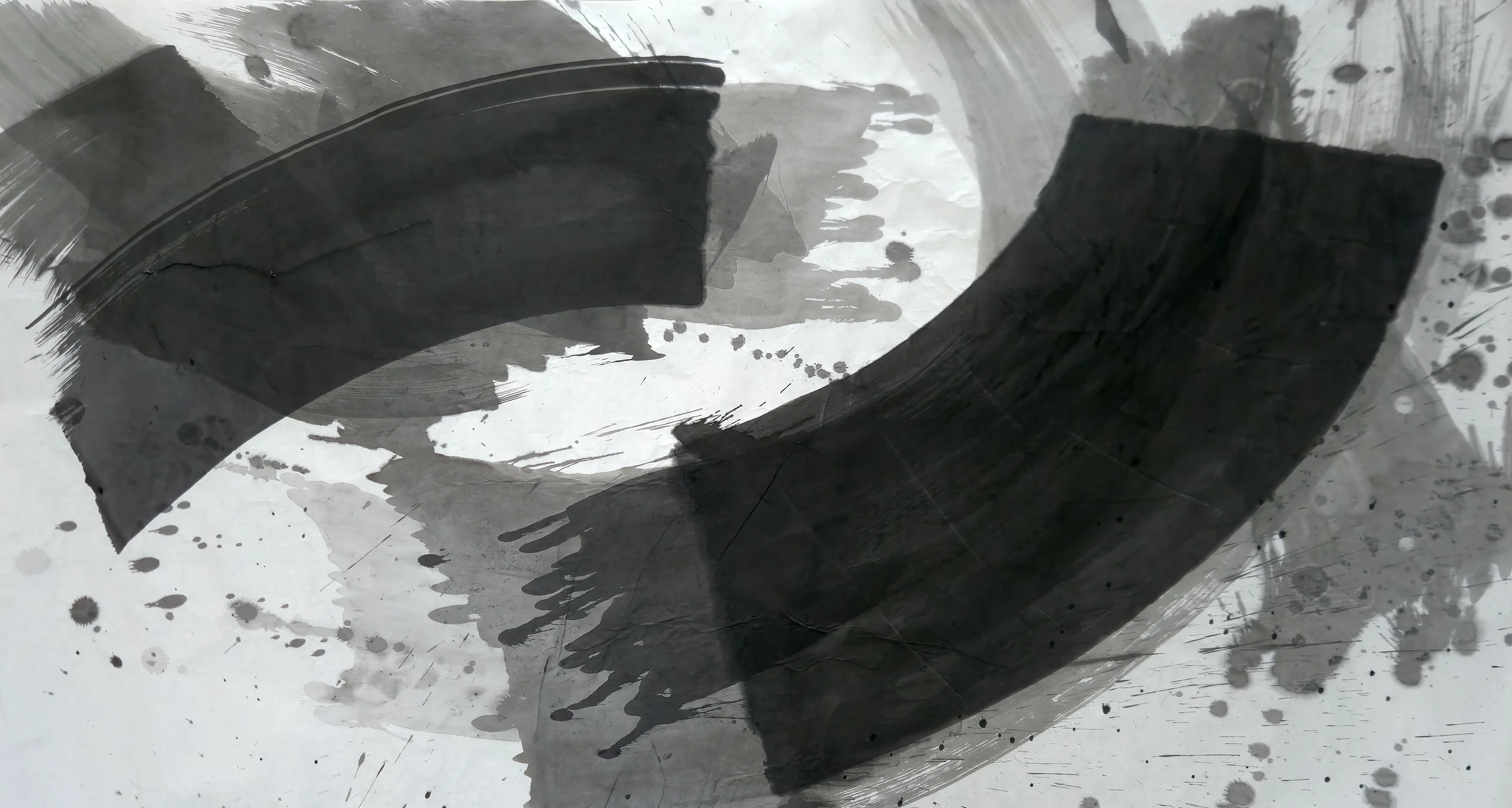
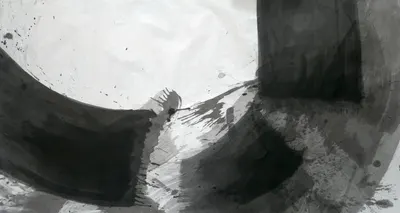
The engine's readingTwo broad black arcs, one rising from the lower left and one falling from the upper right, swing around a pocket of white paper over grey wash.
Record- Date
- 2026.04.26
- Dimensions
- 97 × 180 cm
- Paper
- Tanxi Thickened Grade A Half-Raw 6-Foot
- Ink
- Yi De Ge Refined Ink Juice, Boku-Undo Genso, Yi De Ge Yun Tou Yan
Two black arcs facing each other round a pocket of white: a revolving door, seen from above, caught mid-turn. Theophilus Van Kannel patented the thing and called it a storm door, because it never lets the street all the way in. I like standing outside one in a busy lobby, watching the city sort itself into turns. Somebody pushes too hard and the panel ahead catches a stranger's heel. A courier goes round twice for fun. The spatter on the right is the rain they bring through on their coats, shaken onto the marble. In the middle the pale air turns over and over, a pocket of weather that belongs to the street and the lobby at once.
The reading
Written by the engine after the painting was rated, from the settled findings, and checked by hand before approval. It explains the numbers; it may not change them.
- Structure
- two curved dark bands, opposed, implying one circle around a pale centre
- Movement
- clockwise rotation on the diagonal; drips at right band's foot run against it
- Coverage
- ink on about four fifths of the paper
- Tone
- four tonal steps, weighted dark
- Layering
- grey washes then dark bands; readable at band edges and right band's foot
- Edges
- crisp on band walls; broken and dripping at right band's foot; soft in washes
- Feibai
- present along the upper rim of the left band
- Open paper
- shaped white lens at centre, between the arcs; leftover paper lower left
- Chance marks
- spatter at right edge and lower left; drips at right band's foot; creases in bands
- Frame
- ink runs off top, left and right edges; lower left stays open
Two black arcs face each other across a pocket of white paper, and the eye closes the circle they leave open. One climbs from the lower left, the other drops from the upper right, and the whole sheet turns clockwise around that pale centre.
The right band holds the most. Its curve follows the travel of the brush, and inside the black the hairs have left streaks and a darker inner arc, so the mass reads as one pulled stroke. Along the top of the left band, flying white splits the rim into fine parallel lines that keep the arc's direction. Beneath both, grey washes show at the edges, a lower step of tone for the black to stand on.
The costs are plain. The left band is an even mid-dark slab with little moving inside, and both bands stop in square, cut-off ends. The dense black lies flat enough to record every crease in the paper. Spatter crowds the right edge, and the drips at the right band's foot are clumsy.
The rotation is real and the right arc is a fine passage. The blunt ends, the flat left mass and the noisy margin keep this a sound, reliable sheet rather than a remarkable one.
How it was read
Read by the Visual Analysis Engine, version 23.8, on 2026.10.06: measured by code, then read 5 times by Claude Opus 5.5 against three reference paintings (R1 to R3), each read independent of the others. How the engine works.
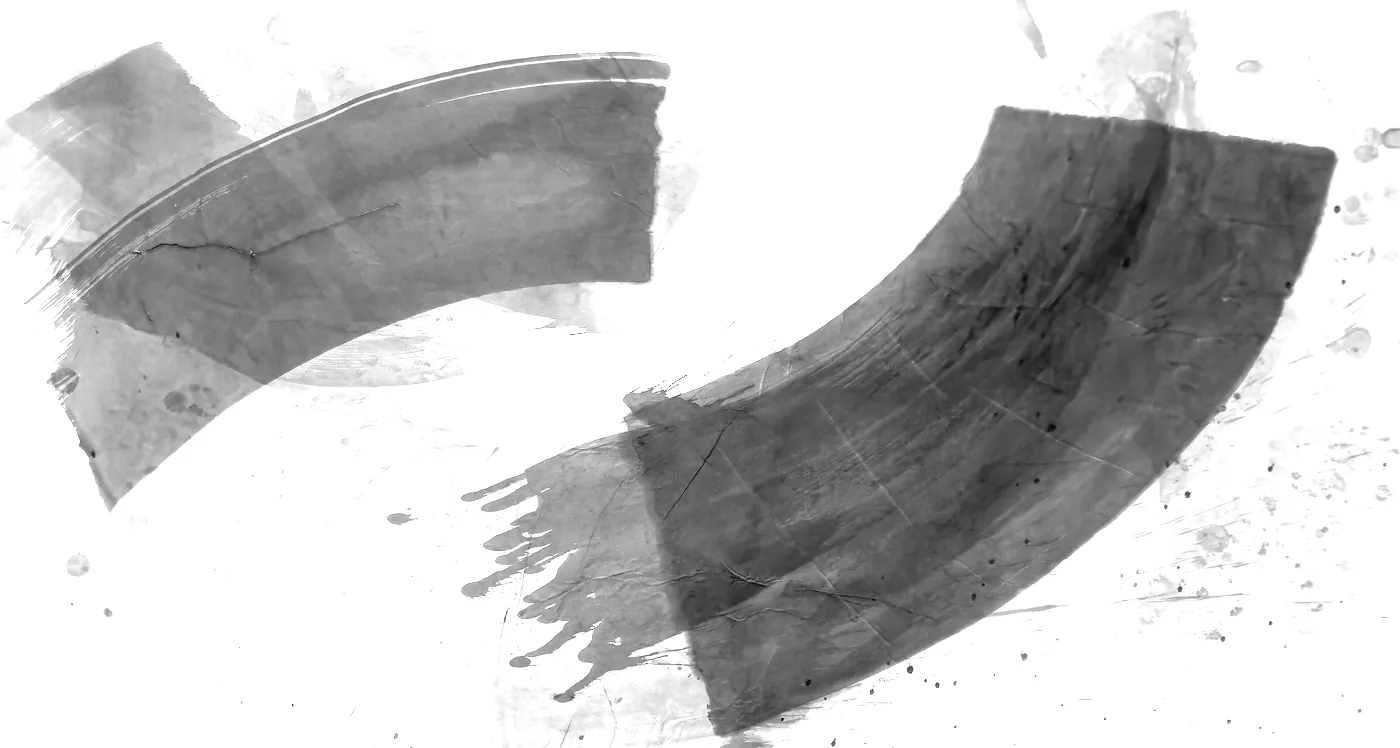
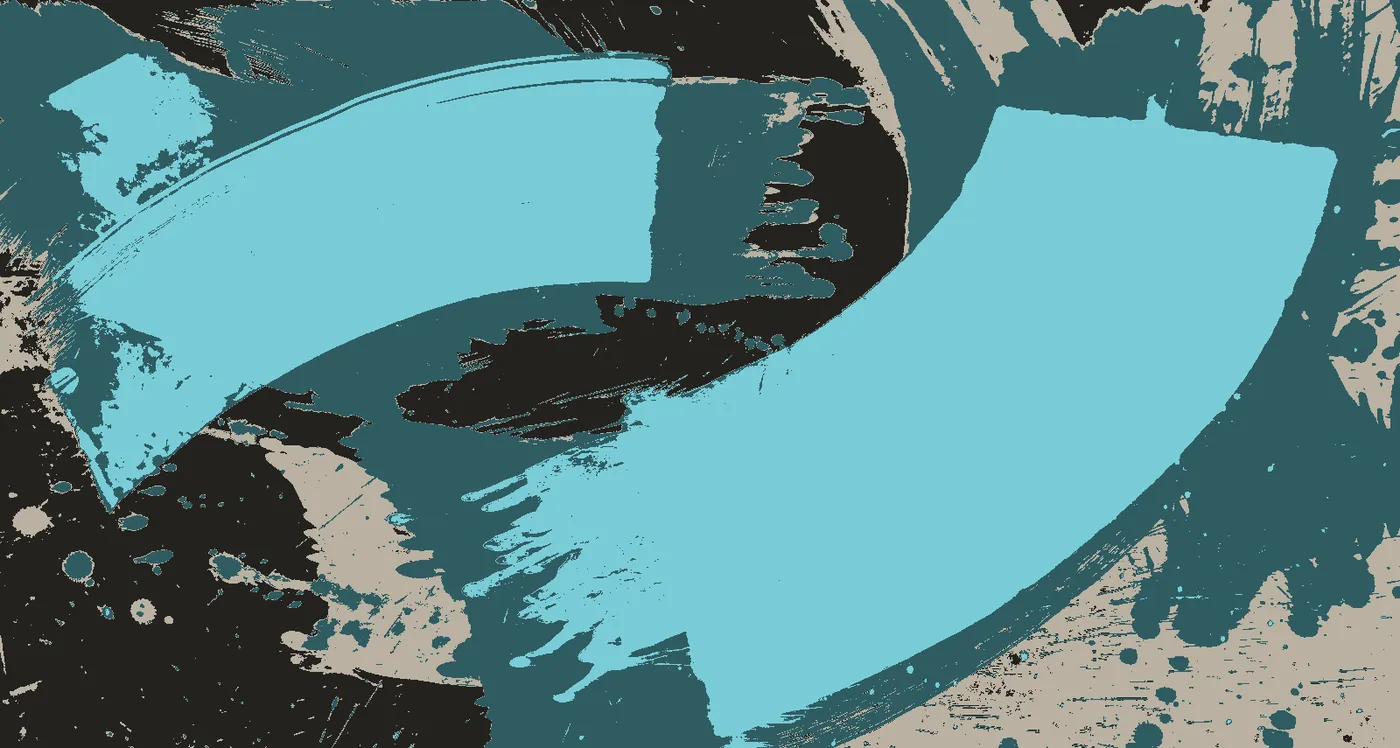
Three views of one sheet.
Left, the photograph. Centre, the tone stretch the model is shown beside it: the darkest 45% of tones spread over the whole range, so flat black, banding and stains show. Right, every pixel as the measuring code classes it: cyan black ink, deep teal translucent grey, stone the palest ink, near black bare paper.
4 families of tone.
Every inked pixel's brightness in 64 bins, smoothed; each circled peak holds at least 4% of the ink. Life inside the black: 0.051 (under 0.045 reads as flat).
Five reads, agreeing on 4 of 5 qualities.
Each quality placed on its ladder by each read, and the mean the engine keeps. Where reads differ, they differ by one rung; close calls resolve down.
READ 1, IN ITS OWN WORDS
“Two bold curved bands set up a circular movement over grey washes; forms coherent but blunt-ended, modest interior modelling, and visible creasing plus cloudy washes mar the surface. An ordinary sheet near R2.”
Two large curved bands hold their walls and follow an arc; ends are squared and slab-like, with bulk especially in the left band's cut-off end.
WEAKEST Blunt squared ends of left upper band
STRONGEST Right curved band following brush arc
Tone-stretched view shows brush streaks and banding inside right band; left band shows a soft band but is largely even. Modulation 0.051 just above flat.
WEAKEST Left band interior fairly even mid-dark
STRONGEST Right band with streaked dry-brush grain
Grey washes and a pale arc sit under the two dark bands; overlaps readable at band edges, about two to three passes.
WEAKEST Lower-centre grey wash cloudy beneath right band
STRONGEST Translucent grey arcs under dark bands
Opposed curved bands set up a circular diagonal movement with shaped white centre; right edge spatter and lower-left drips feel busy and scattered.
WEAKEST Crowded spatter field at right edge
STRONGEST Two opposed arcs implying a circle
Crease and crack lines visible in colour view across both dark bands; cloudy blotchy grey wash and water spots at lower centre and upper right.
WEAKEST Crackle creases through right dark band
STRONGEST Dry-brush streaks within right band
7 distinct places, 1 major.
Each read must name every flaw and where it is, in a ninth of the sheet. Here the reads named flaws in 7 distinct places, 17 mentions in all across 5 reads; the number in each ninth is how many times a flaw was named there. Reads agreeing on a place strengthen the evidence for one flaw; they do not multiply it. A major flaw holds Material and surface at rung 1.
Measured from the 16-bit master.
The previous engine (V22) measured this sheet's master file: 1 principal ink mass traced (cyan), 8 enclosed voids at true size in their grid cells (amber), the main gesture from start to end (red). Of 17 edge segments, 47% crisp, 29% soft or bloomed, 24% broken.
The rating these readings produce, the rules applied and the arithmetic, with Peter's own rating where he gave one, are in the Archive record.
Date
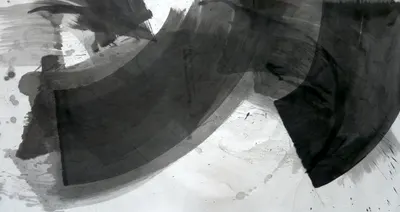
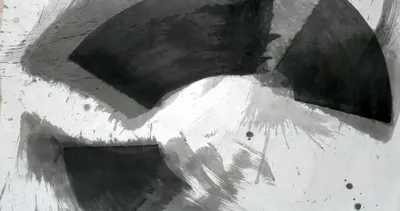
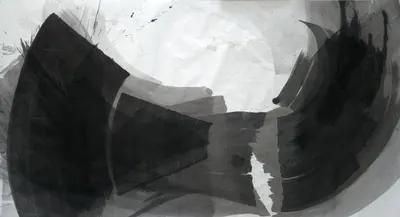
2026.04.26, day 119 of the Crucible Year, one of 13 paintings from that date (10 shown). 55 works were registered in the fourteen days before. Paintings are dated by the day their batch was registered and photographed; each was finished that day or within the few days before. Phase: P2 The Switch (working title).
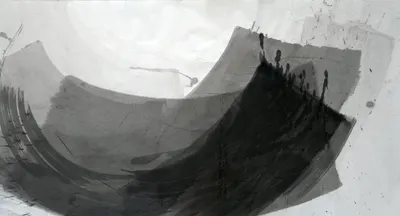
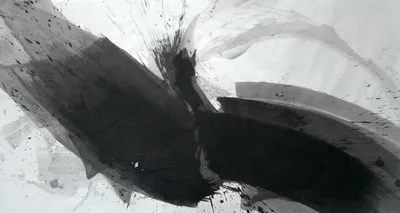

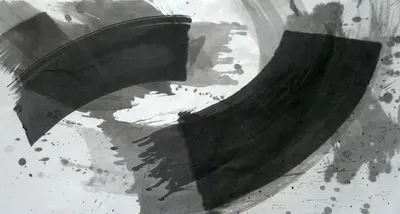
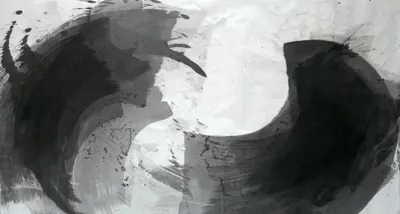
T_271 among all 402
Every painting of the year by date; this one is outlined.
Materials
- Paper
- Tanxi Thickened Grade A Half-Raw 6-Foot, Anhui Jingxian Tanxi Xuan Paper Art Products Co., Ltd., made 2024
- Ink MB4
- Yi De Ge Refined Ink Juice, Yi De Ge (Beijing)
- Ink MB5
- Boku-Undo Genso, Boku-Undo
- Ink MB6
- Yi De Ge Yun Tou Yan, Yi De Ge (Beijing)
Related