T_382
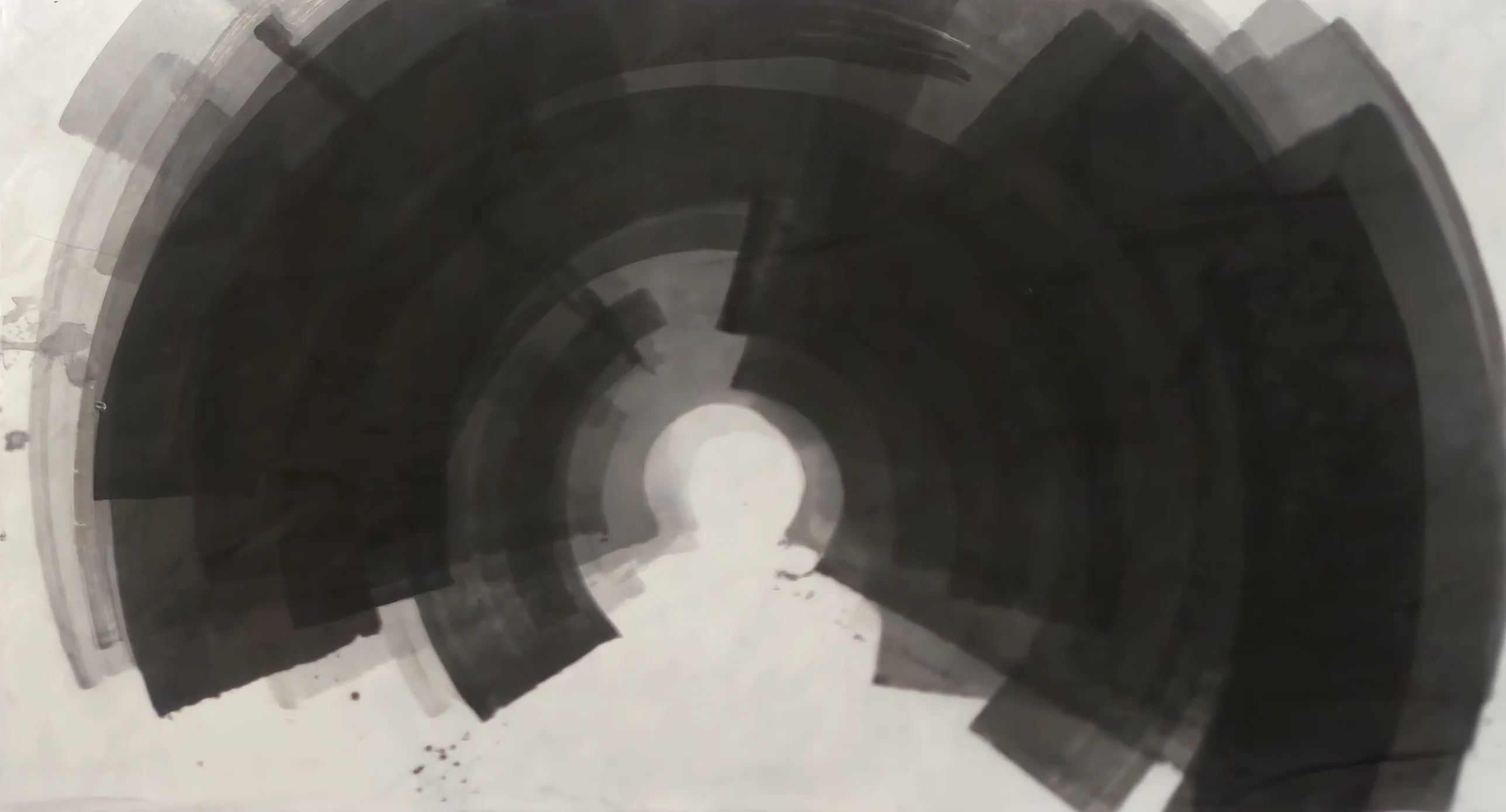
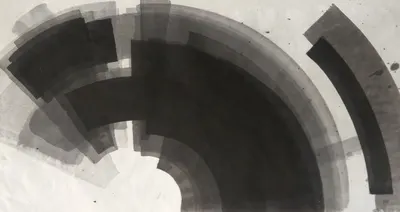
The engine's readingBroad black arcs stack into a wheel around a round white opening, with pale grey rims at left and bare paper falling to the bottom edge.
Record- Date
- 2026.09.20
- Dimensions
- 50 × 100 cm
- Rating
- 5.8
- Paper
- Half-Cooked Red Star Mo She 6-Foot Bark Xuan Paper
- Ink
- Yi De Ge Yun Tou Yan, Boku-Undo Gentoku Super Concentrated, Yi De Ge Pine Soot Ink
The white shape at the bottom has a head and shoulders. I have lived with that shape. It gets up in the small hours without saying why, walks the cold tiles, opens the fridge and stands there, lit up, looking at half a lemon. I lie in the dark with the blanket still warm on its side and I do not call out. We have both agreed this is not insomnia. Some nights I hear the butter dish move. Some nights a glass gets filled and then just held. The whole house goes black and heavy around that one door. Then the seal sucks shut, the feet come back along the hall, and a cold foot finds my calf under the covers.
The reading
Written by the engine after V23's reads, from the settled findings, and checked by hand before approval. It explains V23's numbers and may not change them.
- Structure
- concentric arc bands stepped outward, joined by overlap around a round central opening
- Movement
- radial sweep circling the white core; short crossing strokes and squared ends cut against it
- Coverage
- ink on about four fifths of the paper
- Tone
- two tonal steps, weighted dark
- Layering
- pale grey and dark passes; readable at left rim and inner rings
- Edges
- crisp on inner arcs and band ends; soft on pale rims; broken at lower-left ends
- Feibai
- none
- Open paper
- white keyhole, round head widening down to the bottom edge; paler margin at left
- Chance marks
- reddish-brown drops at bottom left; grey blots at left edge; creases through darks
- Frame
- ink runs off top and lower right; left, lower left and upper corners stay open
A big wheel of black arcs turns over a white opening low in the middle of the paper, and the eye falls down the bands toward it as water finds a drain. The sweep is clear at once. Wide brush passes step outward from the centre and break off in blunt square ends at lower left and lower right.
The life sits at the centre and the rim. Around the opening, the inner arcs run through graded greys, with clean walls and a little grain. At the left edge, pale translucent bands overlap, and the half-sized bark paper keeps each pass readable through its neighbour. High on the top arc, a dry brush drags out a few dark striations, the quickest thing on the sheet.
Between these, the ink turns to slab. Across the top and right, dark passes bury the earlier ones, and the black stays flat and cloudy inside, changing only at its edges. Creases show through it. That mass crowds the frame. Reddish-brown stains below the lower-left arcs are a small distraction.
The result is competent and legible, and not much more: a clear wheel with good edges and a dull, heavy middle. The centre and the rim repay a look. The rest is weight.
The rating
T_382, rated 5.8
The combined score, out of 10: V23's reading of the photograph as the read half and V24's twelve tests on the 16-bit file as the measured half, added and divided by 10. The scale is relative to this archive. How each half is made is on the Method page.
- Form
- 2.0 · built
- Tonal depth
- 1.0 · thin
- Layering
- 2.0 · legible
- Composition
- 2.0 · working
- Material and surface
- 1.0 · flawed
- Mass
- 9.3 of 10
- Tone
- 7.2 of 14
- Void
- 4.8 of 8
- Flow
- 7.6 of 10
- Balance
- 8.0 of 8
How it was measured
What V24 measured.
Plain physical facts with no model involved. Across the year they track how the practice changes. On one sheet they cannot say whether a mark is any good. Millimetres read a few percent high, because the photographs are cropped just inside the paper's edge.
The width of the ink mask along its medial axis.
Optical density at the 75th percentile of the sheet.
The radius of the largest circle of open paper.
How far the marks align across the sheet. Lower means they run several ways.
Left and right asymmetry of the ink. Lower is more even.
Pixels to the millimetre in the TIFF these were measured from, with the studio light removed.
Read by the Visual Analysis Engine, version 23.8, on 2026.10.06: measured by code, then read 5 times by Claude Opus 5.5 against three reference paintings (R1 to R3), each read independent of the others. How the engine works.
Three views of one sheet.
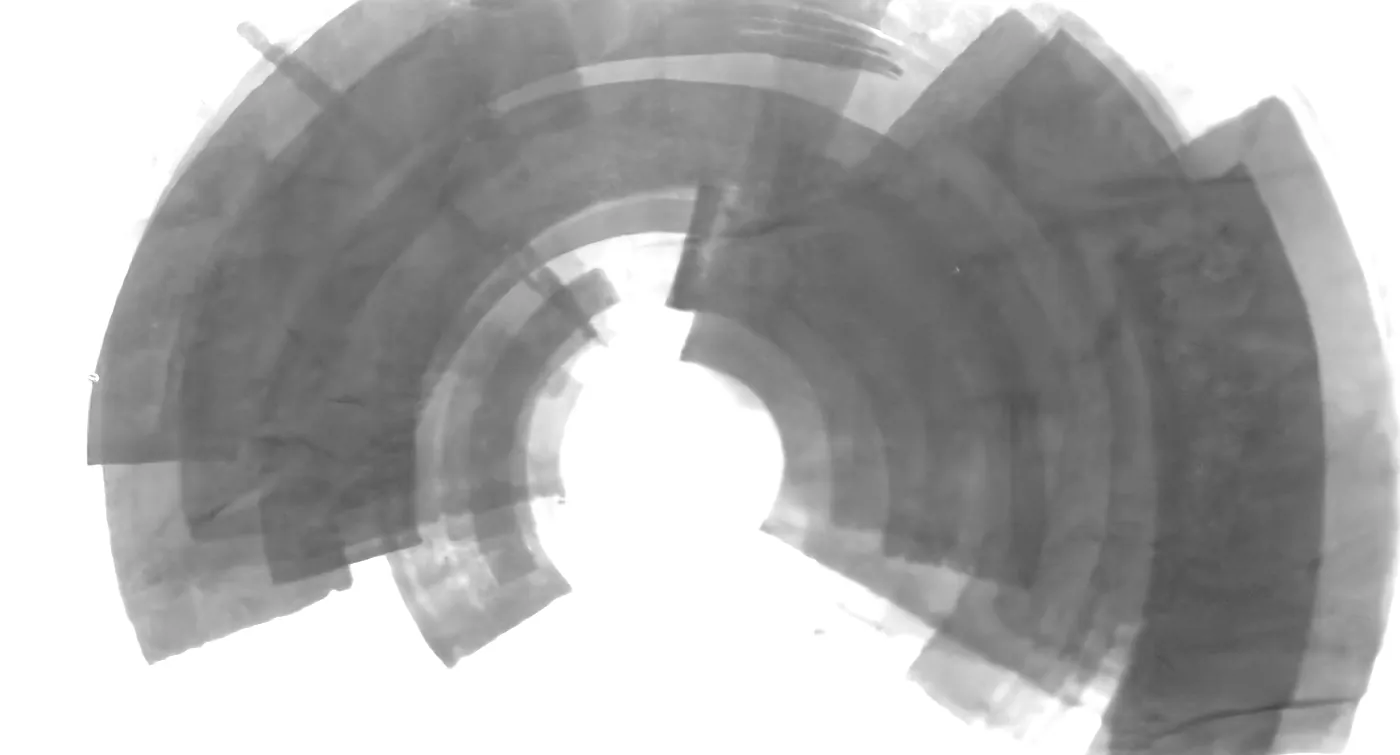
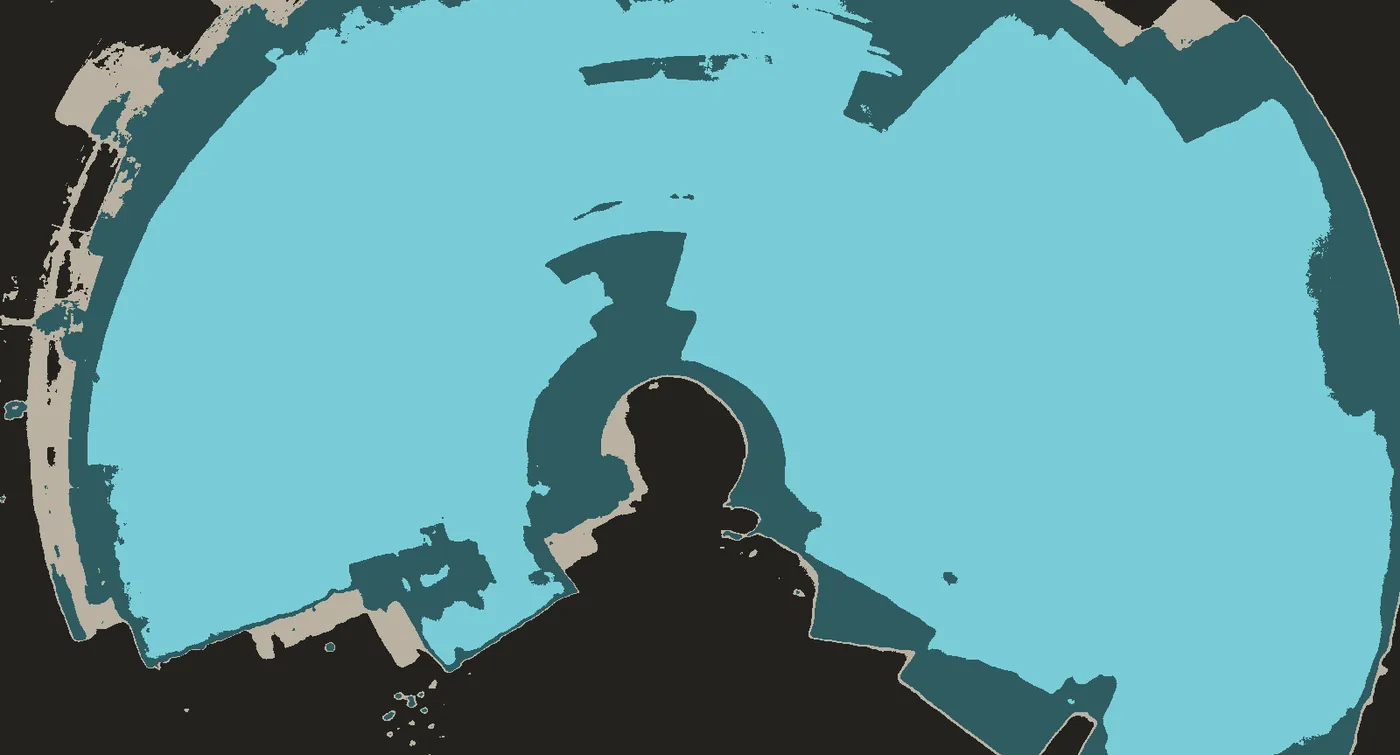
Left, the photograph. Centre, the tone stretch the model is shown beside it: the darkest 45% of tones spread over the whole range, so flat black, banding and stains show. Right, every pixel as the measuring code classes it: cyan black ink, deep teal translucent grey, stone the palest ink, near black bare paper.
2 families of tone.
Every inked pixel's brightness in 64 bins, smoothed; each circled peak holds at least 4% of the ink. Two or fewer: Tonal depth is held at the bottom rung whatever the model reads. A dense sheet of many translucent passes can count low here, so Layering is left to the reads. Life inside the black: 0.039 (under 0.045 reads as flat).
Five reads, one answer.
Each quality placed on its ladder by each read, and the mean the engine keeps.
READ 1, IN ITS OWN WORDS
“The structure echoes R3's concentric arcs, but it is heavier and flatter: dark masses are uniform, with only two tone families and crowded coverage. Brown spot stains at the lower left mark the surface.”
Concentric arc bands are coherent, with walls that hold, but the large dark outer arcs read as bulky filled slabs with blunt squared ends.
WEAKEST Heavy dark slab block, upper-left quadrant arcs
STRONGEST Inner grey arc segments around the white opening
Dark interior modulation is 0.039, which counts as flat, and there are only 2 tonal steps. The big dark masses are uniform inside, so tone changes mostly at the band edges.
WEAKEST Uniform dark interior of the large right-hand arcs
STRONGEST Graded greys of the inner arcs near the centre
In the tone-stretched view the overlapping arc passes stay readable, but the sheet is essentially two tone families, and the later dark passes mostly cover the earlier ones.
WEAKEST Dense black outer bands obscure the earlier passes
STRONGEST Overlapping translucent arc edges at the left rim
The radial arcs give a clear movement toward the white centre, but ink covers 80% of the sheet. The heavy dark top-right crowds the frame and leaves little shaped paper.
WEAKEST Crowded dark mass filling the top and right
STRONGEST Radiating arcs around the white central opening
Reddish-brown droplet stains below the lower-left arcs and grey blots on the left edge are visible in the colour view. Creases show through the dark interiors.
WEAKEST Red-brown spots on the paper at the bottom left
STRONGEST Clean edges of the inner grey arcs
7 distinct places, 1 major.
Each read must name every flaw and where it is, in a ninth of the sheet. Here the reads named flaws in 7 distinct places, 16 mentions in all across 5 reads; the number in each ninth is how many times a flaw was named there. Reads agreeing on a place strengthen the evidence for one flaw; they do not multiply it. A major flaw holds Material and surface at rung 1.
V23's rules and arithmetic, and every figure under its own name, are in the Archive record.
Date
2026.09.20, day 266 of the Crucible Year, one of 3 paintings from that date. 8 works were registered in the fourteen days before. Paintings are dated by the day their batch was registered and photographed; each was finished that day or within the few days before. Phase: P4 S14 (working title).
T_382 among all 419
Every painting of the year by date; this one is outlined.
Materials
- Paper
- Half-Cooked Red Star Mo She 6-Foot Bark Xuan Paper, China Xuan Paper Co., Ltd., made 2026.04.08
- Ink MB6
- Yi De Ge Yun Tou Yan, Yi De Ge (Beijing)
- Ink MB8
- Boku-Undo Gentoku Super Concentrated, Boku-Undo
- Ink MB9
- Yi De Ge Pine Soot Ink, Yi De Ge (Beijing)
Related