T_251
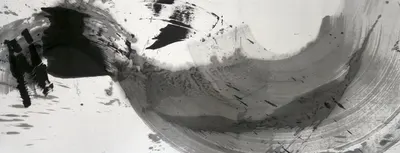
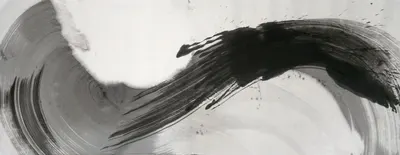
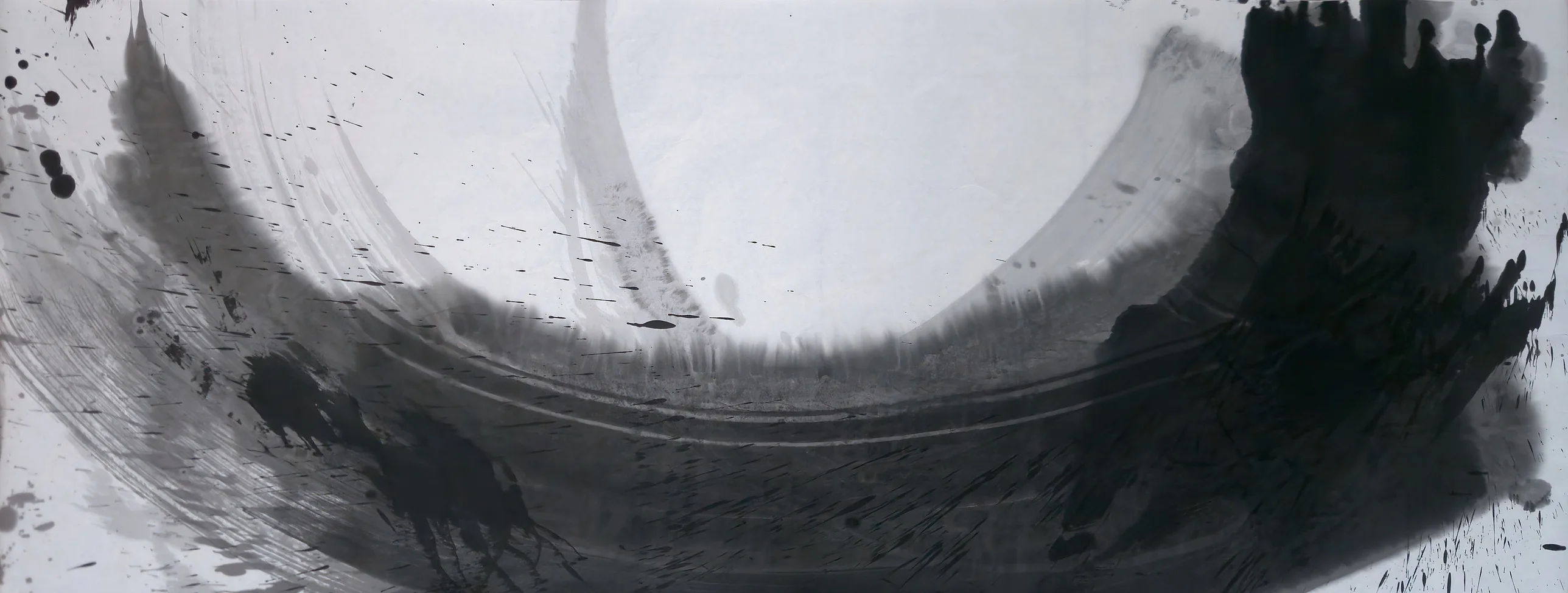
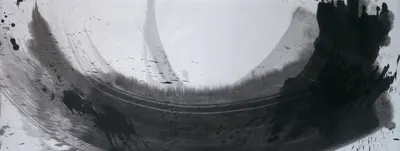
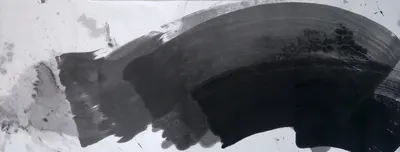
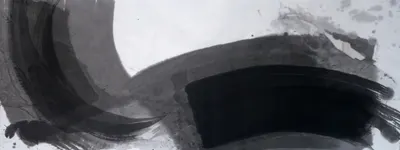
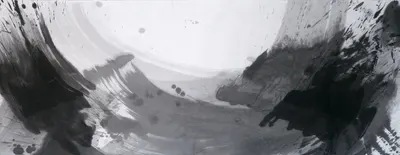
The engine's readingA long bowl of ink, grey at the left and black at the right, swings across raw paper and cups a wide field of bare white above it.
Record- Date
- 2026.04.21
- Dimensions
- 70 × 180 cm
- Paper
- Tanxi Thickened Grade A Special Jing Pi Small 6-Foot (raw)
- Ink
- Yi De Ge Refined Ink Juice, Boku-Undo Genso, Yi De Ge Yun Tou Yan
Two pale lines run along the floor of the bowl, parallel and patient, the tracks of something that went round and round long before anyone kept count. Corals from the Devonian kept a growth line for every day, and their years hold more days than ours: the Earth spun faster then, and the Moon has been braking it ever since. The black at the right end has the manners of a collapsed star: it took what came near and gave none of it back. The spatter to the left is newer than everything and falling. I stood beside this one for an afternoon, which in the time of rock is the same as never. The basin in the middle stays open, a clean dish of light waiting for an ocean.
The reading
Written by the engine after the painting was rated, from the settled findings, and checked by hand before approval. It explains the numbers; it may not change them.
- Structure
- one bowl-shaped arc, grey left arm running into a black right mass
- Movement
- down from top left, along the bottom, up the right; nothing runs against it
- Coverage
- ink on about three quarters of the paper
- Tone
- five tonal steps, weighted dark
- Layering
- three kinds of pass, pale grey, mid-grey, black; readable at left and top centre
- Edges
- crisp grooves along the bottom; soft feathered inner rim; broken lobes atop right mass
- Feibai
- present along the left arm and the lower arc
- Open paper
- broad rounded field in the upper centre, cupped by the arc
- Chance marks
- spatter across left and centre; dots at top left; drips atop right mass; bloom along inner rim
- Frame
- ink runs off left, bottom and right edges and top right; top left and centre stay open
A single bowl of ink spans the sheet. It drops from the top left as a grey arm, runs heavy along the bottom and climbs the right side into black, and the eye rides it the whole way. What it leaves matters as much as what it marks: a broad shape of bare paper in the upper centre, held like water in a cup.
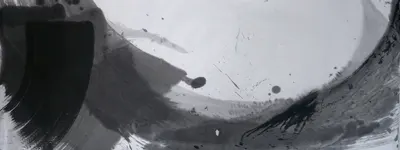
The bottom of the bowl carries the sheet. The brush has split into streaks that follow its travel, and two pale grooves run the length of the band through greys that thicken and thin. On the left, a translucent grey sweep and a pale stroke near the top stay visible under later passes. The raw paper keeps each layer apart.
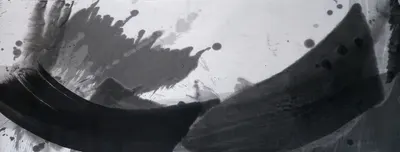
The right end is where it costs. The black climbs into a slab, lobed and dripping at the top, nearly flat inside, and it buries the greys it lands on and crowds the edge. Along the inner rim the same raw paper pulls the wet ink into a cloudy, feathered fringe.
One great gesture, carried from end to end with real control, and an emptiness shaped well enough to work as hard as the ink. The heavy end is a real price. The arc pays it and has plenty left.
How it was read
Read by the Visual Analysis Engine, version 23.8, on 2026.10.06: measured by code, then read 5 times by Claude Opus 5.5 against three reference paintings (R1 to R3), each read independent of the others. How the engine works.
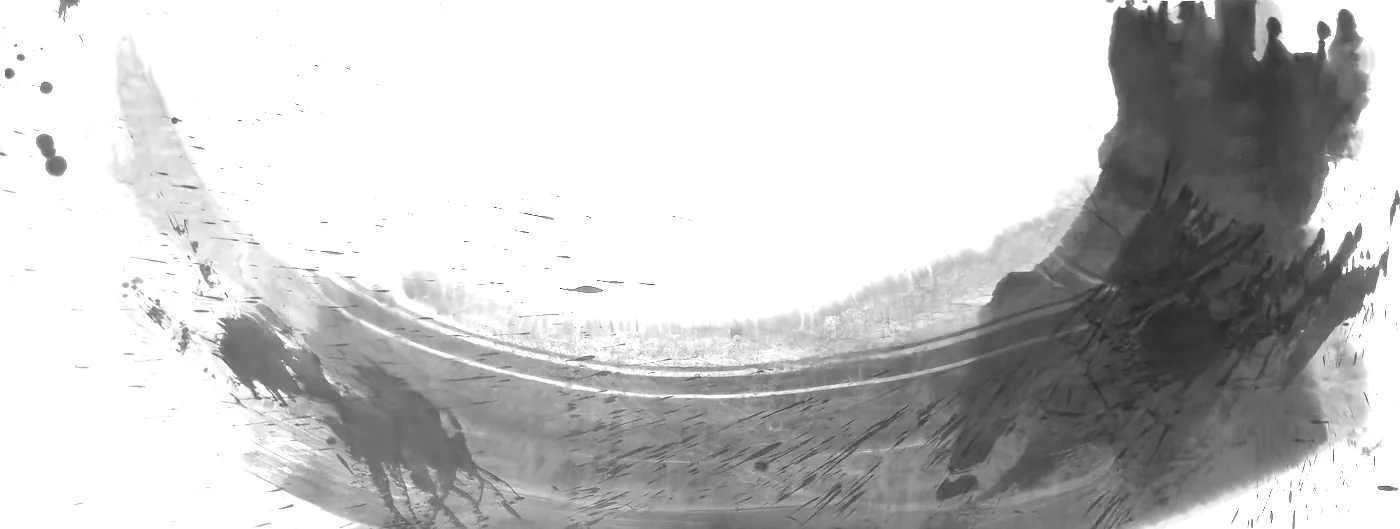
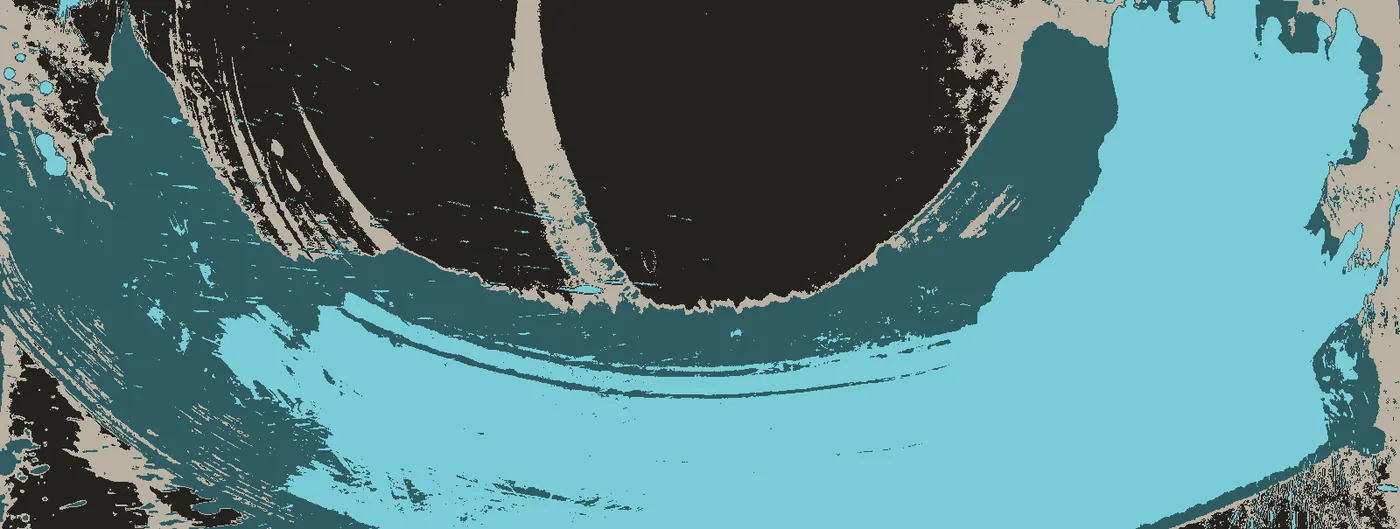
Three views of one sheet.
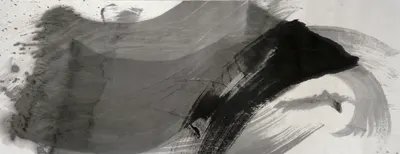
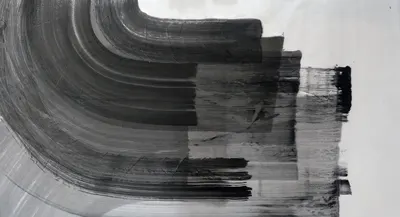
Left, the photograph. Centre, the tone stretch the model is shown beside it: the darkest 45% of tones spread over the whole range, so flat black, banding and stains show. Right, every pixel as the measuring code classes it: cyan black ink, deep teal translucent grey, stone the palest ink, near black bare paper.
5 families of tone.
Every inked pixel's brightness in 64 bins, smoothed; each circled peak holds at least 4% of the ink. Life inside the black: 0.054 (under 0.045 reads as flat).
Five reads, agreeing on 4 of 5 qualities.
Each quality placed on its ladder by each read, and the mean the engine keeps. Where reads differ, they differ by one rung; close calls resolve down.
READ 1, IN ITS OWN WORDS
“A strong sweeping bowl composition with legible pale, mid and dark passes. The bulky, largely flat black mass at the right holds back form and tone. The surface is mostly sound, with minor rim mottling.”
The main arc follows the brush's travel and its walls hold, with grooves tracking it. The right-hand black mass is slab-like and lobed at the top edge, not shaped by a stroke.
WEAKEST Bulky, lobed dark mass at right edge
STRONGEST Sweeping bowl arc with parallel groove lines
Modulation 0.054. The bottom of the bowl shows streaks, grain and arcs. The left arm grades from grey to dark. The top of the right mass reads as near-uniform black.
WEAKEST Upper right black mass largely flat
STRONGEST Bottom band with streaks, grooves and graded greys
There are three passes: the pale arc, the mid-grey sweep and the black pass. They stay legible on the left and at the top. On the right the black largely covers what lies beneath.
WEAKEST Dark right mass covers earlier passes
STRONGEST Pale grey arc in the top centre over mid-grey left arm
One continuous sweep carries the eye from top left down through the bowl to the right. The empty upper centre is a shaped void that works with the ink. The weight on the right presses against the edge.
WEAKEST Right edge heavy and crowded by black mass
STRONGEST Bowl arc framing the empty upper-centre paper
The ink is controlled and the groove lines are crisp. There is mottled, cloudy granulation along the inner rim at the centre and some drips at the top right. All are minor, and none is a large stain.
WEAKEST Cloudy, mottled fringe along the inner rim of the bowl
STRONGEST Dry-brush streaks and grooves in the bottom band
4 distinct places, 0 major.
Each read must name every flaw and where it is, in a ninth of the sheet. Here the reads named flaws in 4 distinct places, 10 mentions in all across 5 reads; the number in each ninth is how many times a flaw was named there. Reads agreeing on a place strengthen the evidence for one flaw; they do not multiply it.
Measured from the 16-bit master.
The previous engine (V22) measured this sheet's master file: 1 principal ink mass traced (cyan), 5 enclosed voids at true size in their grid cells (amber), the main gesture from start to end (red). Of 15 edge segments, 7% crisp, 67% soft or bloomed, 27% broken.
The rating these readings produce, the rules applied and the arithmetic, with Peter's own rating where he gave one, are in the Archive record.
Date
2026.04.21, day 114 of the Crucible Year, one of 14 paintings from that date (10 shown). 63 works were registered in the fourteen days before. Paintings are dated by the day their batch was registered and photographed; each was finished that day or within the few days before. Phase: P2 The Switch (working title).
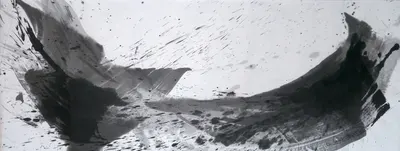
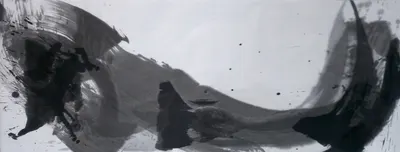
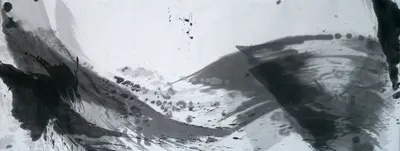
T_251 among all 402
Every painting of the year by date; this one is outlined.
Materials
- Paper
- Tanxi Thickened Grade A Special Jing Pi Small 6-Foot (raw), Anhui Jingxian Tanxi Xuan Paper Art Products Co., Ltd., made 2015.11.19
- Ink MB4
- Yi De Ge Refined Ink Juice, Yi De Ge (Beijing)
- Ink MB5
- Boku-Undo Genso, Boku-Undo
- Ink MB6
- Yi De Ge Yun Tou Yan, Yi De Ge (Beijing)
Related