T_308
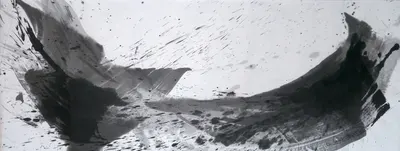
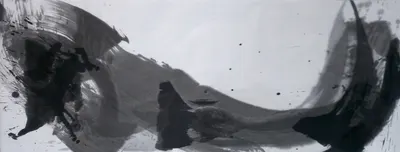
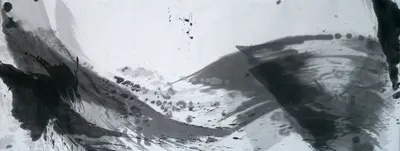
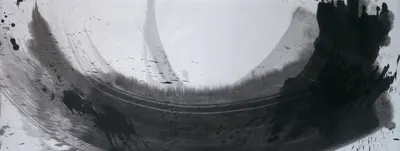
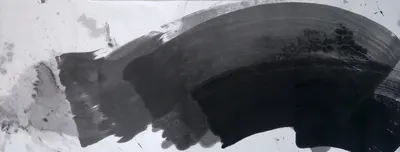
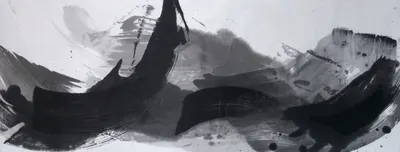
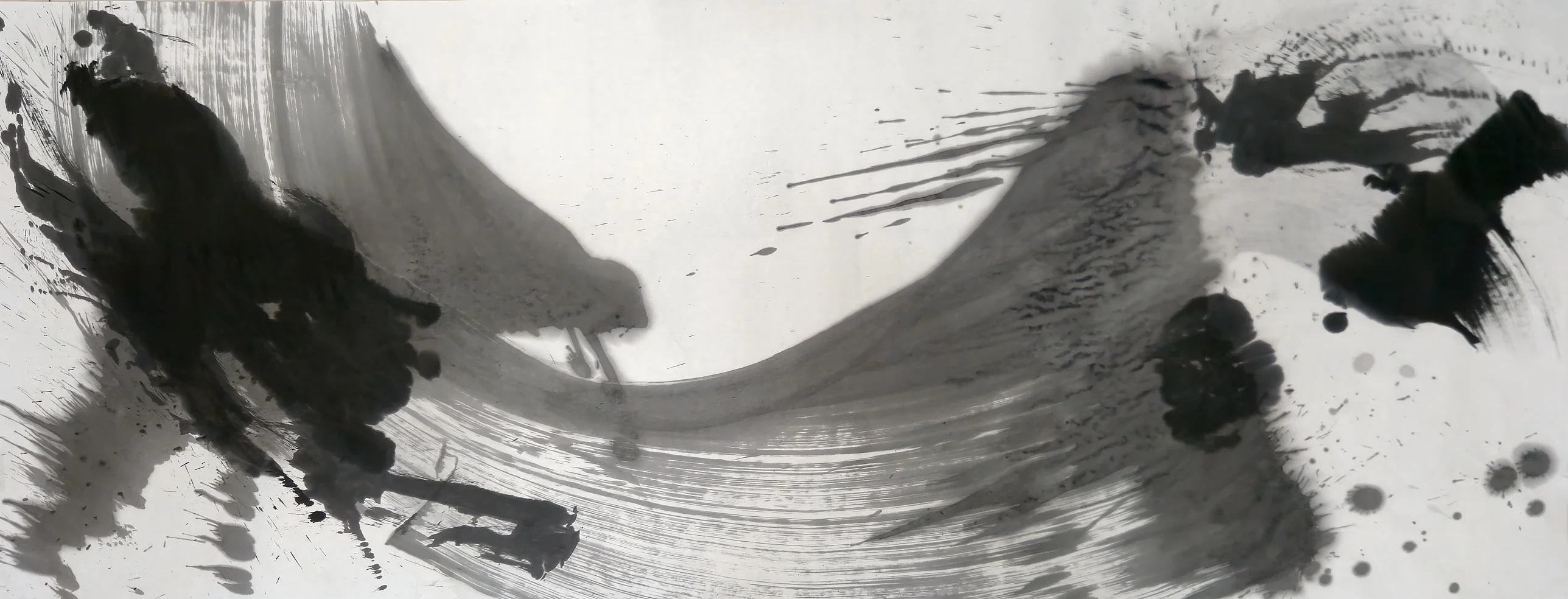
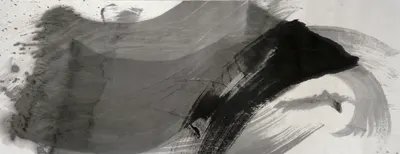
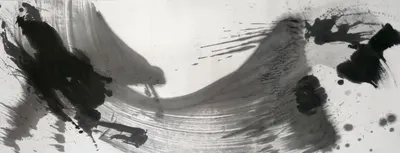
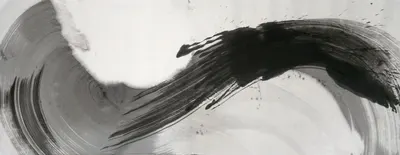
The engine's readingA long grey stroke swings down across a wide sheet and climbs again, with a black mass at one end and a crest throwing spray at the other.
Record- Date
- 2026.05.14
- Dimensions
- 70 × 180 cm
- Paper
- Tanxi Thickened Grade A Special Jing Pi Small 6-Foot (raw)
- Ink
- Yi De Ge Refined Ink Juice, Boku-Undo Genso, Yi De Ge Yun Tou Yan
A wave does not ask to be watched. It lifts out of grey water, gets its shoulder up, and at the very top flings a handful of spray forward into the wind, and then it is done, because that was the whole job. I stood on a cold March beach once and watched them come in all afternoon, each one certain it was the first. Behind me the rocks sat in their black coats, heavy and unimpressed, and the gulls chose the darkest ones to stand on. The spray went where spray goes: into my collar, across my knuckles, a beaded line on the sand that dried before I could read it.
The reading
Written by the engine after the painting was rated, from the settled findings, and checked by hand before approval. It explains the numbers; it may not change them.
- Structure
- left black mass, U-shaped grey arc, right cluster of dark blots, joined by the arc
- Movement
- down from upper left, along the bottom, rising to upper right; crest spray flies back leftward
- Coverage
- ink on about two thirds of the paper
- Tone
- five tonal steps, weighted to the middle greys
- Layering
- two kinds of pass, grey arc then black masses; readable at right, buried at left
- Edges
- crisp at the black masses, streaked and broken along the arc, soft at the crest
- Feibai
- present, through the arc's lower curve and its descending stroke at upper left
- Open paper
- a bowl of empty paper above the arc, top centre
- Chance marks
- bloom halo at the arc's crest; flung spatter at centre; pale ringed drops lower right
- Frame
- ink runs off the left and bottom edges; top centre and right edge stay mostly open
A grey stroke falls from the upper left, bottoms out along the lower edge and climbs to a dark crest at the upper right. That long swing holds a bowl of empty paper above it, and a black mass anchors each end.
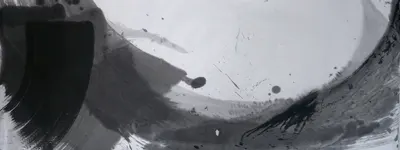
The arc is where the sheet comes alive. Through its lower curve the hairs parted at speed and left long parallel streaks of bare paper, and inside a single pass the grey steps from near white to charcoal. Raw, thickened paper grips a drying brush and keeps every split. The tone is made by the stroke itself, never laid over it. As the arc rises, the streaks tighten into a dark, rippled grain, and at the crest wet ink met fast paper and softened into a halo.
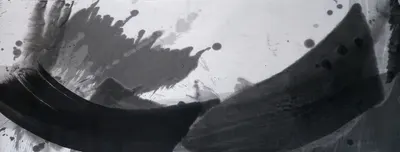
The ends are weaker. At the left the black gathers in lobes and clots, nearly uniform inside, and it buries the grey beneath. The round blot right of centre is a lump without a shape, and the far right fills with rival blots and scattered drops.
Still, the arc spans the full width and ties both ends to it. One fine, sure passage, held between two heavy ends that never match it.
How it was read
Read by the Visual Analysis Engine, version 23.8, on 2026.10.06: measured by code, then read 5 times by Claude Opus 5.5 against three reference paintings (R1 to R3), each read independent of the others. How the engine works.
Three views of one sheet.
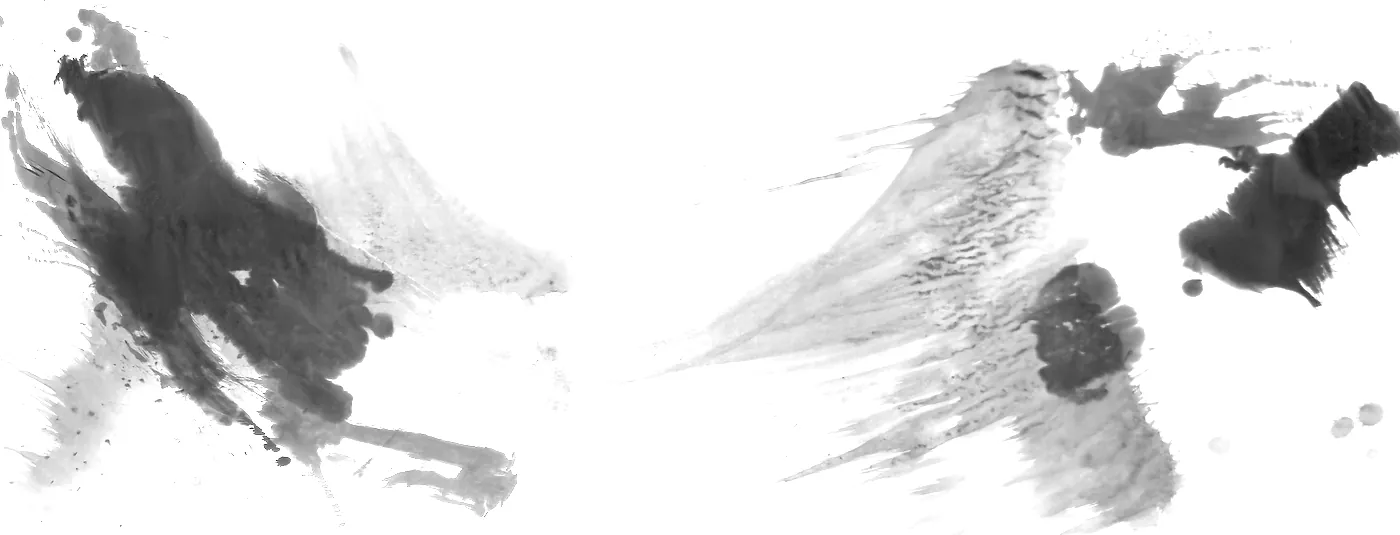
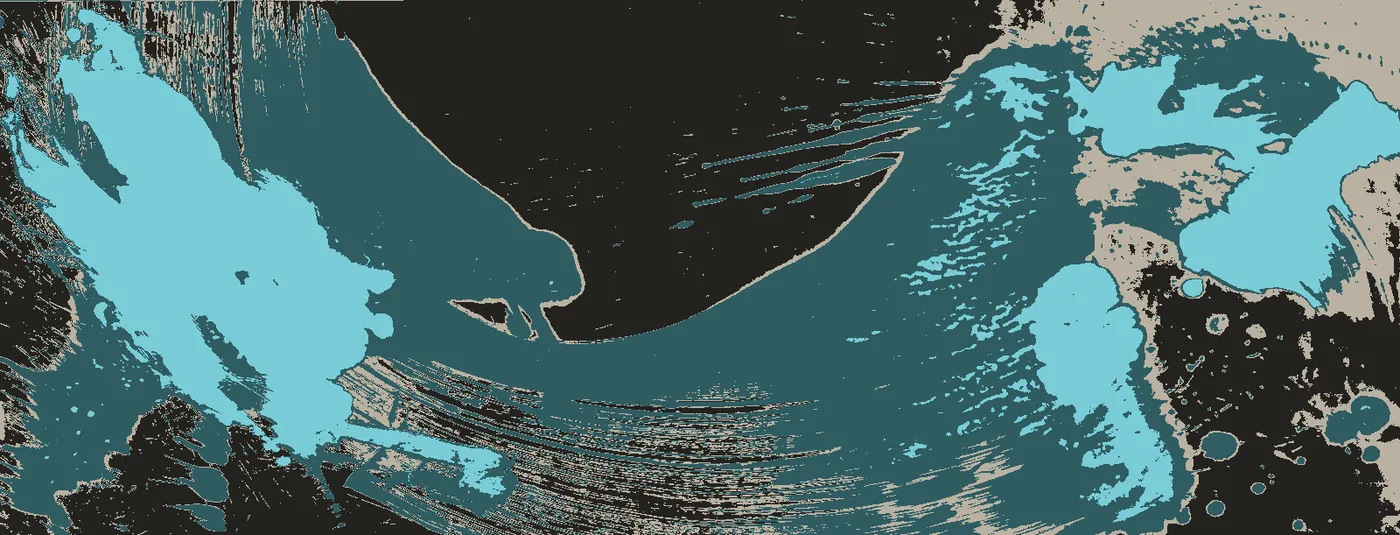
Left, the photograph. Centre, the tone stretch the model is shown beside it: the darkest 45% of tones spread over the whole range, so flat black, banding and stains show. Right, every pixel as the measuring code classes it: cyan black ink, deep teal translucent grey, stone the palest ink, near black bare paper.
5 families of tone.
Every inked pixel's brightness in 64 bins, smoothed; each circled peak holds at least 4% of the ink. Life inside the black: 0.047 (under 0.045 reads as flat).
Five reads, one answer.
Each quality placed on its ladder by each read, and the mean the engine keeps.
READ 1, IN ITS OWN WORDS
“An ordinary gestural sheet close to R2. The sweeping dry-brush arc gives flow and modelled greys, but the left dark mass and the right blob are bulky and fairly flat. One soft bleed sits near the top right.”
The central swinging arc is fluent, with its outline following the stroke. The left dark mass is bulky and lobed, and the right-centre blob is a lump.
WEAKEST Right-centre round dark blob, lumpy and unshaped
STRONGEST Central grey arc following the brush's sweep
The arc has streaked, stepped greys and the left mass shows some density shifts. The right blob and the top-right dark are fairly flat. Modulation 0.047 is barely above flat.
WEAKEST Right-centre dark blob, flat inside
STRONGEST Dry-brush graded greys in the central arc
Two or three passes: the grey arc goes down first, then the dark masses and spatter. The overlaps on the right stay legible, but the left dark mostly hides what lies beneath it.
WEAKEST Left dark mass covers the earlier grey
STRONGEST Dark marks laid over the grey arc on the right
A U-shaped sweep carries the eye from left to right, and the paper above the arc is shaped. The left mass is congested and the right cluster is scattered.
WEAKEST Crowded, heavy left mass
STRONGEST Arc spanning the sheet, linking the left and right masses
The ink is controlled and the dry-brush streaks are well used. There is a soft bleed halo at the top of the right arc, and pale cloudy spatter at the far left.
WEAKEST Diffuse halo at the dark spot, top centre-right
STRONGEST Dry-brush texture in the arc
5 distinct places, 0 major.
Each read must name every flaw and where it is, in a ninth of the sheet. Here the reads named flaws in 5 distinct places, 10 mentions in all across 5 reads; the number in each ninth is how many times a flaw was named there. Reads agreeing on a place strengthen the evidence for one flaw; they do not multiply it.
Measured from the 16-bit master.
The previous engine (V22) measured this sheet's master file: 3 principal ink masses traced (cyan), 12 enclosed voids at true size in their grid cells (amber), the main gesture from start to end (red). Of 21 edge segments, 19% crisp, 48% soft or bloomed, 33% broken.
The rating these readings produce, the rules applied and the arithmetic, with Peter's own rating where he gave one, are in the Archive record.
Date
2026.05.14, day 137 of the Crucible Year, one of 9 paintings from that date (6 shown). 28 works were registered in the fourteen days before. Paintings are dated by the day their batch was registered and photographed; each was finished that day or within the few days before. Phase: P2 The Switch (working title).
T_308 among all 402
Every painting of the year by date; this one is outlined.
Materials
- Paper
- Tanxi Thickened Grade A Special Jing Pi Small 6-Foot (raw), Anhui Jingxian Tanxi Xuan Paper Art Products Co., Ltd., made 2015.11.19
- Ink MB4
- Yi De Ge Refined Ink Juice, Yi De Ge (Beijing)
- Ink MB5
- Boku-Undo Genso, Boku-Undo
- Ink MB6
- Yi De Ge Yun Tou Yan, Yi De Ge (Beijing)
Related