T_374
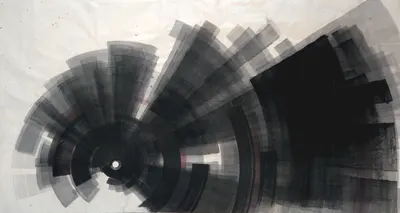
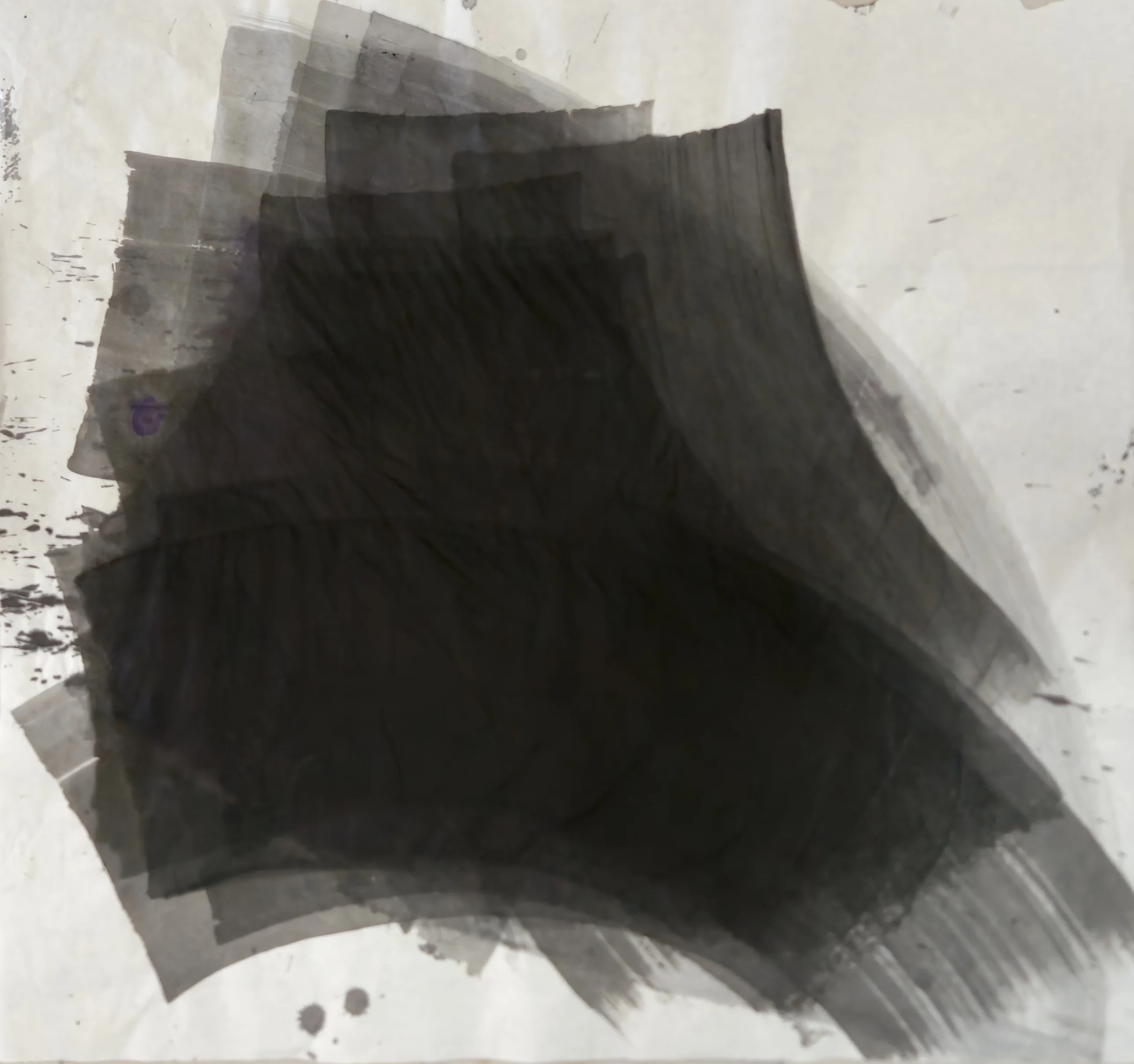
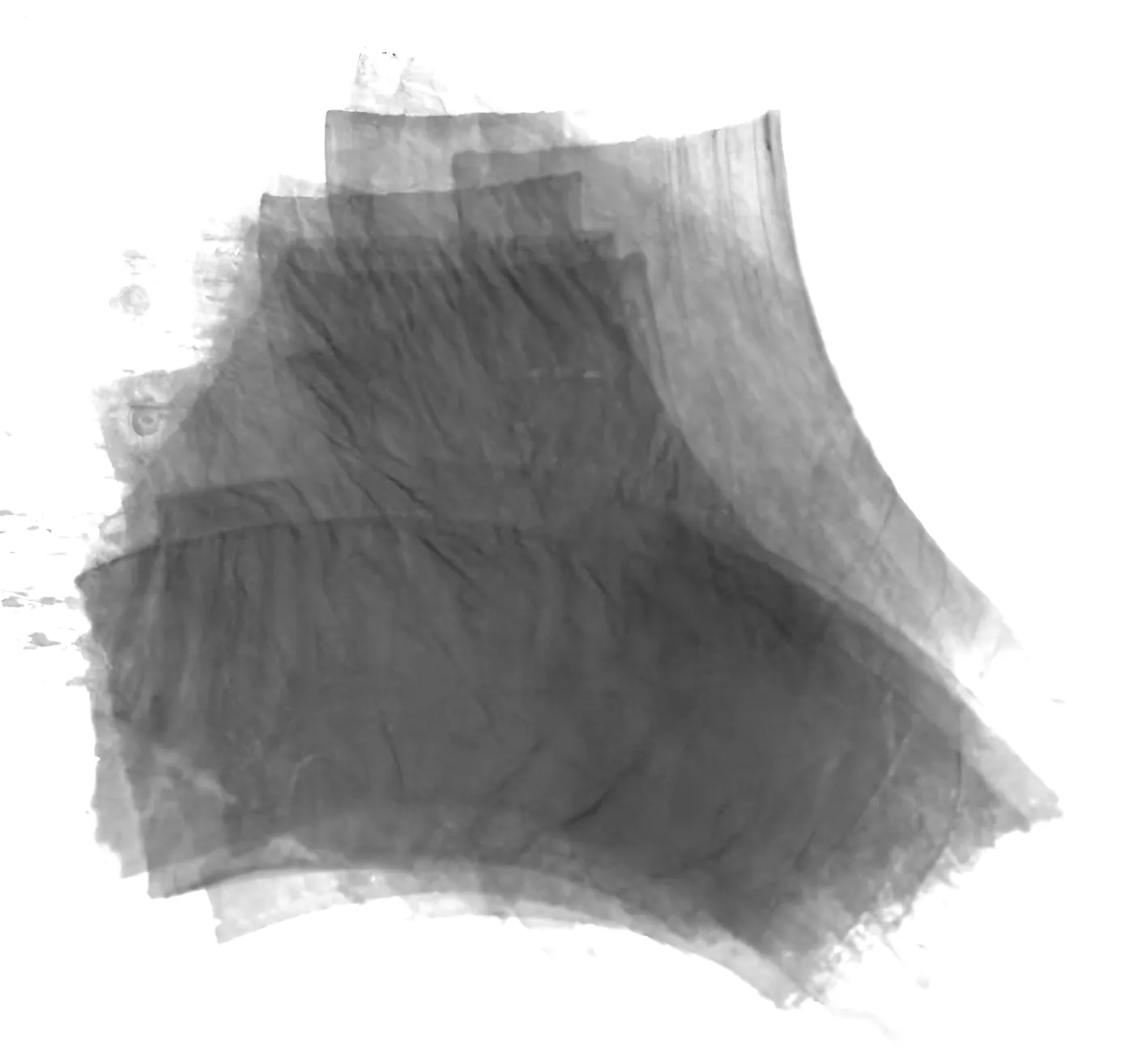
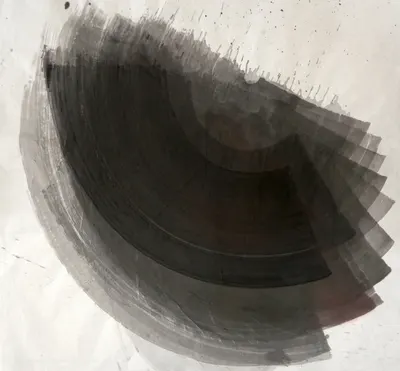
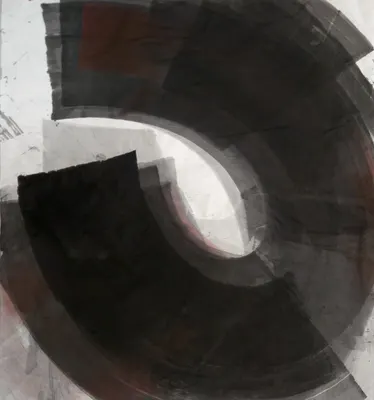
The engine's readingWide curved passes of ink stacked into one black mass, grey edges stepping out at top and left, its tail combed into streaks at lower right.
Record- Date
- 2026.09.12
- Dimensions
- 100 × 90 cm
- Paper
- Half-Cooked Red Star Mo She 6-Foot Bark Xuan Paper, self-sized from October 2026
- Ink
- Yi De Ge Yun Tou Yan, Kuretake Shogei Purple-Navy Black, Boku-Undo Gentoku Super Concentrated, colour inks
Every winter the blankets go on one at a time. The thin grey one in October, the wool in November, then the one from your mother that smells of her cupboard. By February you sleep under a black weight and cannot say which layer is keeping you warm. Only at the edge of the mattress, where they hang unevenly, can you count them, a staircase of hems. Someone spilled something purple years ago, and the stain travels to whichever blanket ends up on top. I love a bed like that, too heavy to turn over in. Morning comes, and the two of us lie flat beneath it, each waiting for the other to get up, while the frost draws ferns on the window.
The reading
Written by the engine after the painting was rated, from the settled findings, and checked by hand before approval. It explains the numbers; it may not change them.
- Structure
- stacked curved slabs fused into one central black mass
- Movement
- fanning arc down toward the lower right, nothing running against it
- Coverage
- ink on about two thirds of the paper
- Tone
- four tonal steps, weighted dark
- Layering
- many translucent passes, readable at top, left and lower-right edges only
- Edges
- crisp stepped walls at top and left, combed and broken at lower right
- Feibai
- present at the lower-right slab end and the upper-right curved band
- Open paper
- L-shaped margin along the right side and bottom
- Colour
- small violet dot at the left of the mass
- Chance marks
- spatter along left edge, drops below the mass at bottom left
- Frame
- grey passes come close to the top and left edges, right side and bottom stay open
A dark mass fills the middle of the paper. It is built from wide curved passes laid one over another, and the whole stack swings down toward the lower right. The eye meets the black first, then finds the greys stepping out from behind it.
The edges are where the sheet lives. At top and left each pass stops on its own clean wall, a shade paler than the next, so the order of laying can still be read. At the upper right a band bends down the sheet with the brush's travel still in it, and at the lower right the slab ends in parallel streaks of bare paper. The half-sized paper holds those walls firm.
The centre is another matter. There the passes pile into a single black that is barely modulated, with only the crinkle of the paper showing through. The order the edges lay out is lost, and the block sits like a filled slab, blunt at its lower-left corner, crowding the sheet. A violet dot at the left does little as paint. The paper around the mass is margin, not space.
Good rims around a closed heart make a capable, everyday sheet. It is worth reading at its borders and not worth standing in front of for long.
How it was read
Read by the Visual Analysis Engine, version 23.8, on 2026.10.06: measured by code, then read 5 times by Claude Opus 5.5 against three reference paintings (R1 to R3), each read independent of the others. How the engine works.
Three views of one sheet.
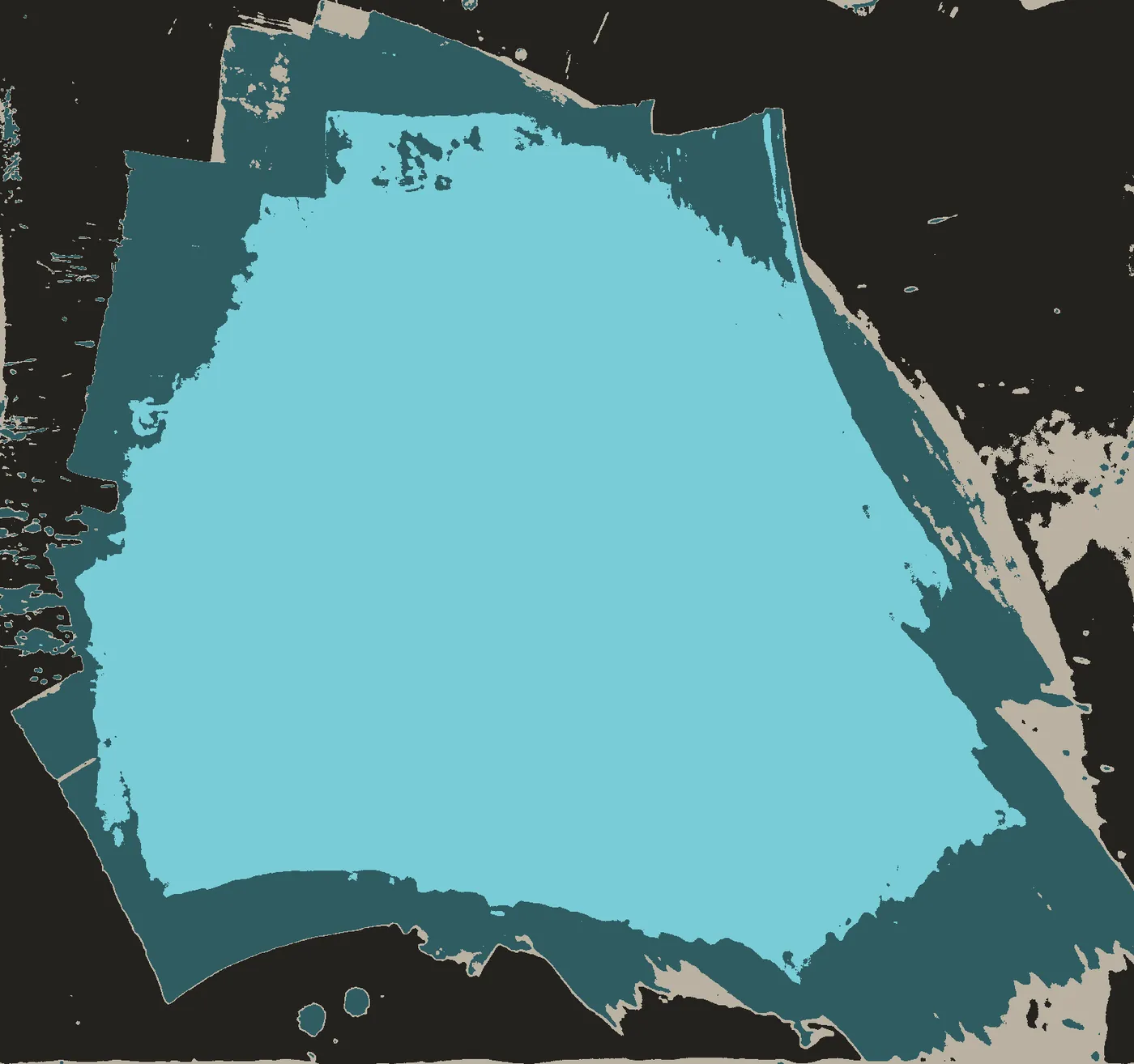
Left, the photograph. Centre, the tone stretch the model is shown beside it: the darkest 45% of tones spread over the whole range, so flat black, banding and stains show. Right, every pixel as the measuring code classes it: cyan black ink, deep teal translucent grey, stone the palest ink, near black bare paper.
4 families of tone.
Every inked pixel's brightness in 64 bins, smoothed; each circled peak holds at least 4% of the ink. Life inside the black: 0.049 (under 0.045 reads as flat).
Five reads, agreeing on 4 of 5 qualities.
Each quality placed on its ladder by each read, and the mean the engine keeps. Where reads differ, they differ by one rung; close calls resolve down.
READ 1, IN ITS OWN WORDS
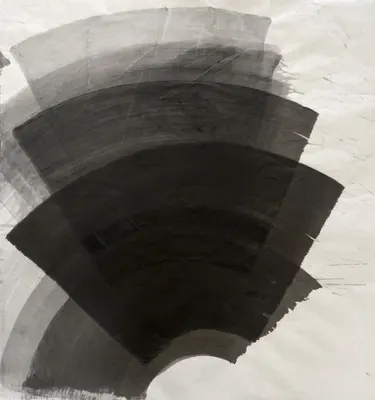
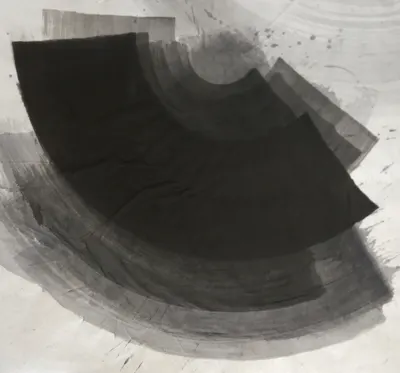
“Stacked translucent curved slabs in the manner of R3, but they merge into a heavy, crowded black core. The layering is legible only at the edges. Composition is inert and centralised, with minor drips.”
Stacked curved slabs hold their walls and the right edge follows the brush's arc, but the central black mass is bulky, filled-in and stiff.
WEAKEST Bulky central black slab with blunt lower-left corner
STRONGEST Curved right-hand slab edge sweeping down to the bottom right
Grey slabs step clearly at top and right; stretched view shows crinkle grain inside the core, but in the colour view the centre reads flat black (modulation 0.049).
WEAKEST Central black core, nearly uniform in colour view
STRONGEST Stepped grey slab edges at top and right
Several translucent passes are legible where their edges step at the top and left, but in the centre they merge, so the order is lost.
WEAKEST Centre where the passes fuse into one black
STRONGEST Translucent stacked slab edges at top centre
One huge mass fills about 70% of the sheet and sits centrally. The empty paper is leftover margin; the bottom-right arc only hints at movement.
WEAKEST Massive central block crowding the sheet
STRONGEST Arc sweeping down toward the bottom right
Ink is controlled, with dry-brush streaks at lower right. Drips at bottom left and mottled pale patches at the left edge are small and away from the core. The violet dot is colour ink.
WEAKEST Mottled grey wash patches at left edge
STRONGEST Dry-brush streaks at lower right slab end
5 distinct places, 0 major.
Each read must name every flaw and where it is, in a ninth of the sheet. Here the reads named flaws in 5 distinct places, 11 mentions in all across 5 reads; the number in each ninth is how many times a flaw was named there. Reads agreeing on a place strengthen the evidence for one flaw; they do not multiply it.
Measured from the 16-bit master.
The previous engine (V22) measured this sheet's master file: 1 principal ink mass traced (cyan), 3 enclosed voids at true size in their grid cells (amber), the main gesture from start to end (red). Of 14 edge segments, 43% crisp, 57% soft or bloomed, 0% broken.
The rating these readings produce, the rules applied and the arithmetic, with Peter's own rating where he gave one, are in the Archive record.
Date
2026.09.12, day 258 of the Crucible Year, one of 8 paintings from that date. 0 works were registered in the fourteen days before. Paintings are dated by the day their batch was registered and photographed; each was finished that day or within the few days before. Phase: P4 S14 (working title).
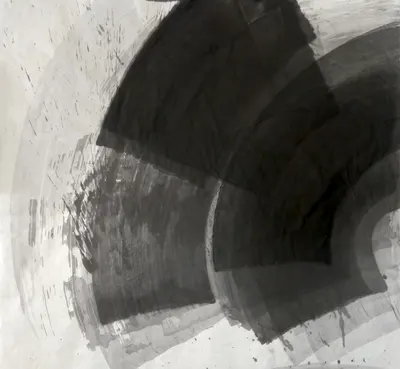
T_374 among all 402
Every painting of the year by date; this one is outlined.
Materials
- Paper
- Half-Cooked Red Star Mo She 6-Foot Bark Xuan Paper, self-sized from October 2026, China Xuan Paper Co., Ltd., made 2026.04.08
- Ink MB6
- Yi De Ge Yun Tou Yan, Yi De Ge (Beijing)
- Ink MB7
- Kuretake Shogei Purple-Navy Black, Kuretake
- Ink MB8
- Boku-Undo Gentoku Super Concentrated, Boku-Undo
- Colour
- colour inks, recorded together
Related