T_363
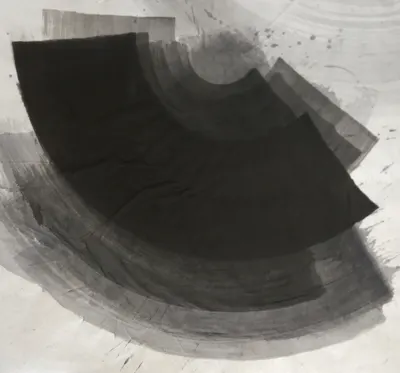
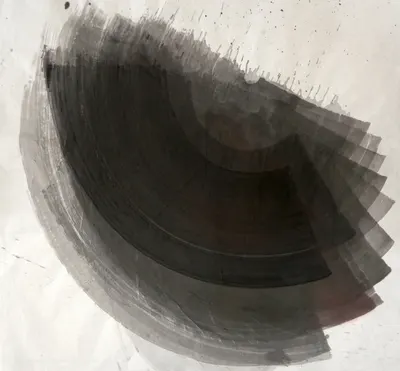
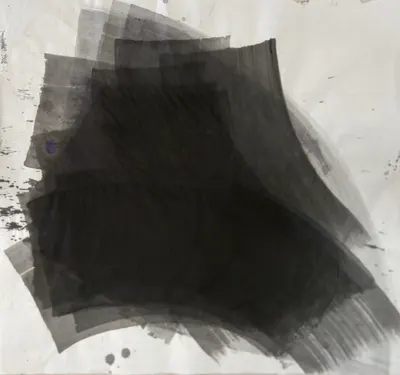
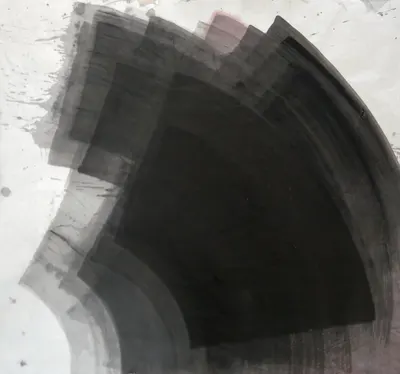
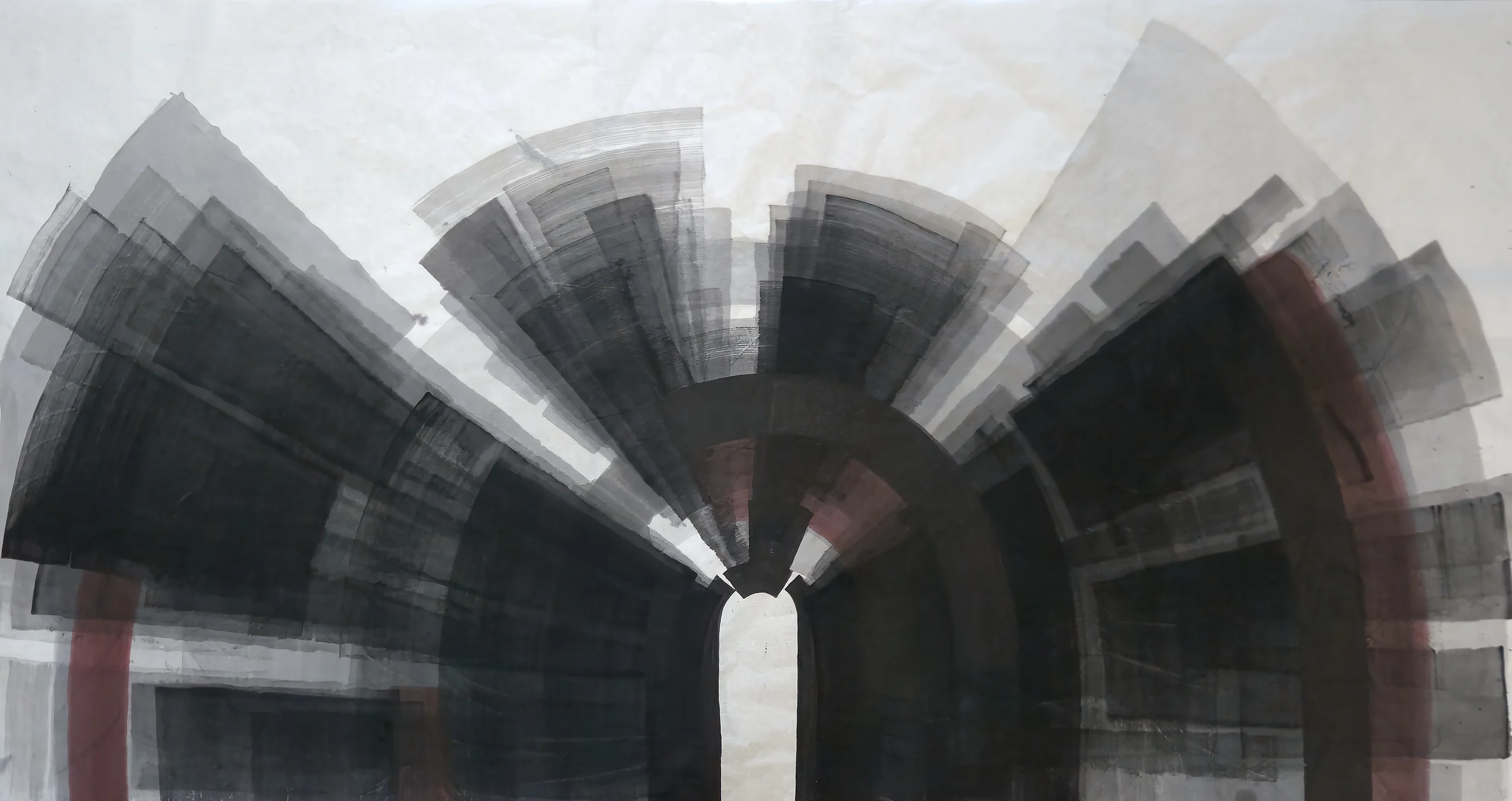
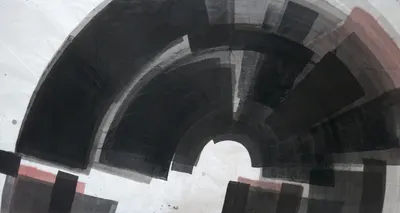
The engine's readingTranslucent grey blades fan out around a dark ink horseshoe above a narrow white slot of bare paper, with red bands standing at either side.
Record- Date
- 2026.07.28
- Dimensions
- 97 × 180 cm
- Paper
- Half-Cooked Red Star Mo She 6-Foot Bark Xuan Paper, self-sized from October 2026
- Ink
- Yi De Ge Yun Tou Yan, Kuretake Shogei Purple-Navy Black, Boku-Undo Gentoku Super Concentrated, colour inks
The white slot at the bottom is where it started. I am as sure of that as you can be of a crater. Everything after it is outflow: grey blades pushed off that point in rings, the faint ones at the rim older than the dark ones near home, the way light gets old crossing nothing. The black horseshoe is the part that couldn't leave. It sits there, heavy, a little stupid, holding the door shut on the first moment. Above it the paper is plain paper, clean as the dark between galaxies, and the outermost blade is still going, thinning, into a sky with no far wall.
The reading
Written by the engine after the painting was rated, from the settled findings, and checked by hand before approval. It explains the numbers; it may not change them.
- Structure
- three radiating fans, left, top and right, joined at a dark horseshoe arch
- Movement
- outward from the central opening; the lower band and red verticals pull downward against it
- Coverage
- ink on about four fifths of the paper
- Tone
- five tonal steps, weighted dark
- Layering
- thin grey passes, dense dark passes, a red pass; readable at fan edges
- Edges
- crisp translucent blade ends in the fans; soft edges on red bands and dark slabs
- Feibai
- present at the tips of the top centre blades
- Open paper
- stepped skyline across the top; narrow white slot at bottom centre
- Colour
- red bands at lower left and around the right fan; pink patches beside the arch
- Chance marks
- paper creases across the grey blades; small specks and blots at right
- Frame
- ink runs off the bottom, left and right edges; the top stays open
A fan of grey blades opens from one small point above a white slot of paper. The blades climb out to the left, rise at the centre and swing out to the right, and every one leads the eye back down to the opening.
The upper fans carry it. At top left and top centre each blade is a thin grey pass laid over the last. The half-raw bark paper lets each pass dry with its edge intact, so the order of laying reads as stepped greys. At the tips of the top centre blades the brush split into flying white, and those tips cut the paper above into a stepped skyline. The red bands at lower left and right sit as their own clear pass.
The cost is below. The dark horseshoe around the opening, bulkiest right of the slot, is dense ink laid flat and sealed. Under it the lower band crowds the bottom edge and buries the earlier greys. Paper creases cross the blades, and the sheet absorbs them.
The plan reads from across a room. The upper blades repay standing close. The heavy base weighs on both without breaking them, and the sheet stands well above the archive's run, lifted by its top.
How it was read
Read by the Visual Analysis Engine, version 23.8, on 2026.10.06: measured by code, then read 5 times by Claude Opus 5.5 against three reference paintings (R1 to R3), each read independent of the others. How the engine works.
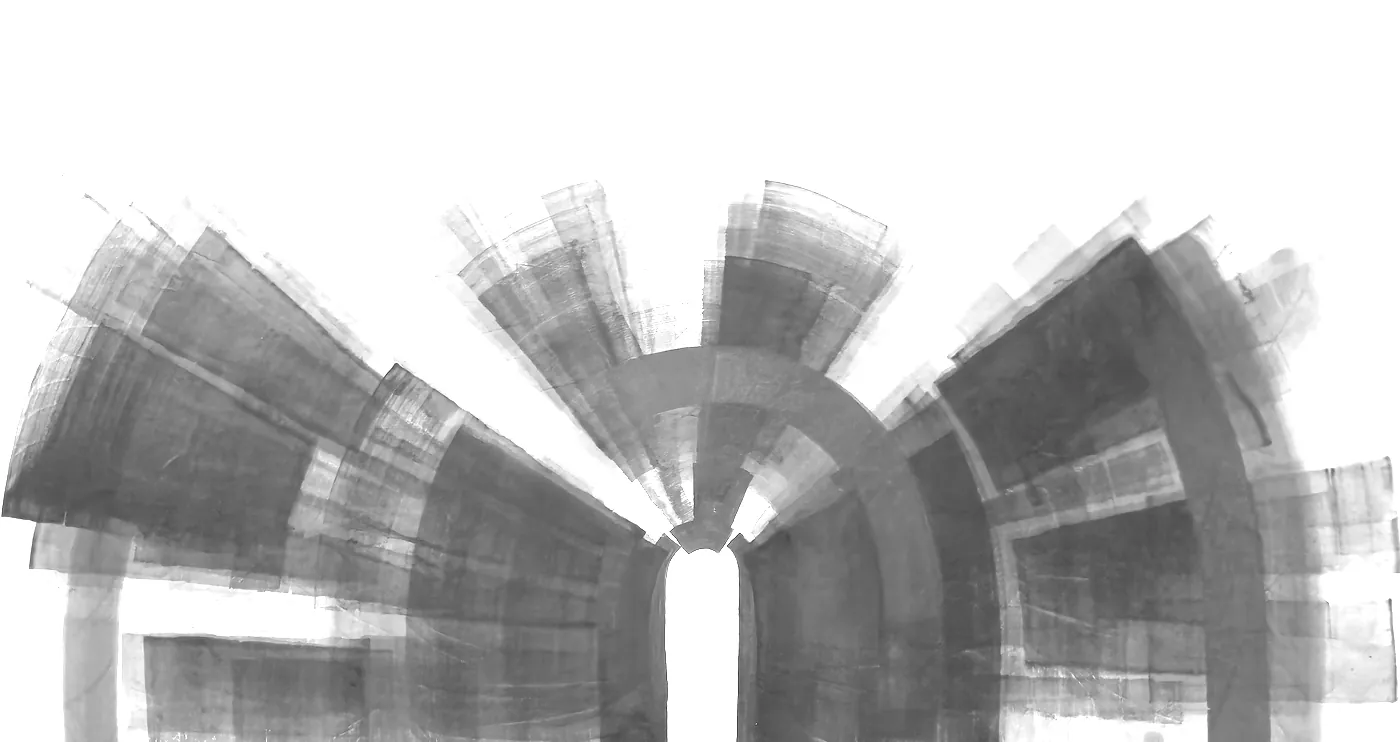
Three views of one sheet.
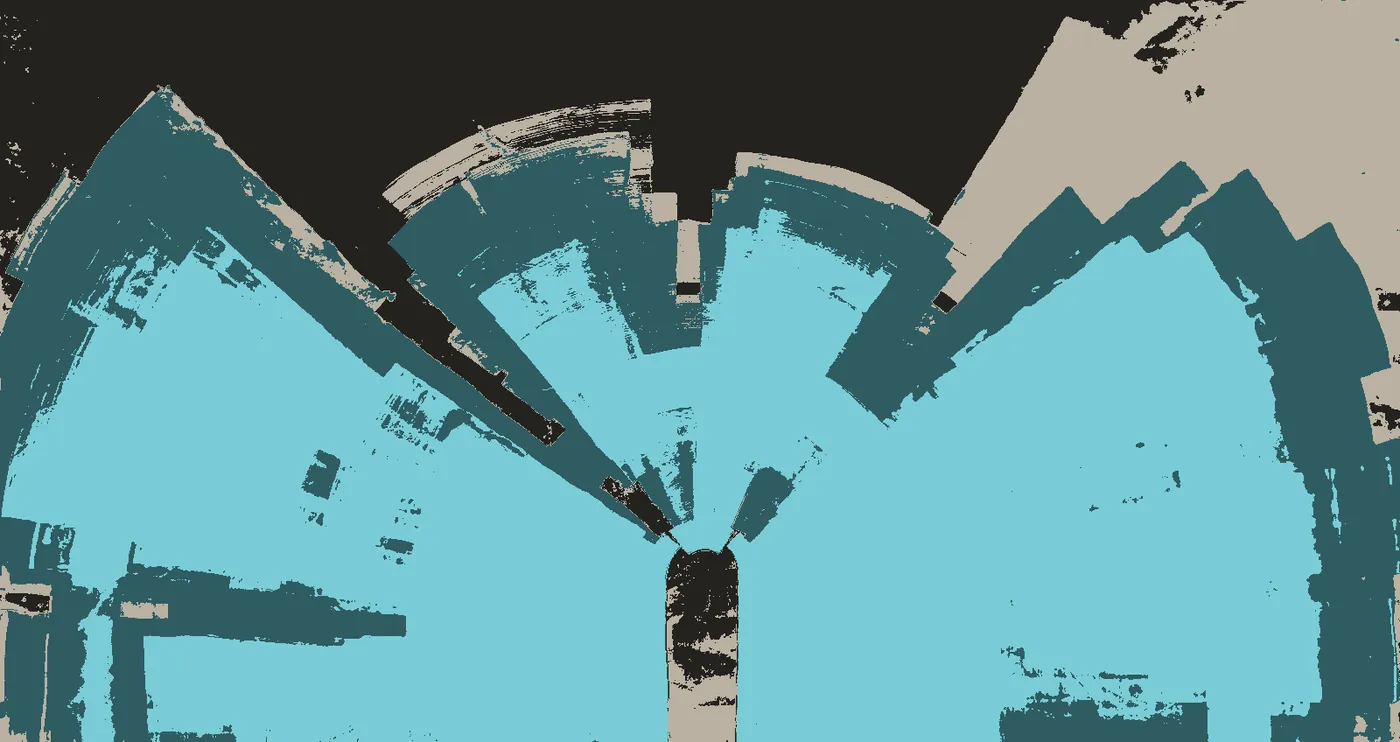
Left, the photograph. Centre, the tone stretch the model is shown beside it: the darkest 45% of tones spread over the whole range, so flat black, banding and stains show. Right, every pixel as the measuring code classes it: cyan black ink, deep teal translucent grey, stone the palest ink, near black bare paper.
5 families of tone.
Every inked pixel's brightness in 64 bins, smoothed; each circled peak holds at least 4% of the ink. Life inside the black: 0.037 (under 0.045 reads as flat).
Five reads, one answer.
Each quality placed on its ladder by each read, and the mean the engine keeps.
READ 1, IN ITS OWN WORDS
“This sheet is related to R3: radial translucent layering around an arch opening, with good legible passes. It falls short because the darks are flat inside, the arch is slab-like and the bottom is crowded by near-total coverage.”
Radial wedges and arch bands hold their walls and follow the brush's sweep, but the heavy central arch and the lower-left rectangles stay slab-like and filled in.
WEAKEST Bulky dark arch band right of central opening
STRONGEST Radial fan blocks along the upper left arm
The fan blades step through about five grey plateaus with dry-brush grain, but the dark arch and the lower-centre masses are flat inside (modulation 0.037).
WEAKEST Flat black arch around central opening
STRONGEST Graded translucent greys in the upper fan blades
Many translucent overlapping blades stay legible at their edges and build depth. The red bands sit as a clear separate pass beside the black.
WEAKEST Dense overlaps in the lower-centre darks lose some order
STRONGEST Stacked translucent blades in the left and right fans
A strong radial arrangement leads to the white arch, and the empty paper at the top is shaped. But 81% coverage makes the lower half jammed and heavy.
WEAKEST Crowded, heavy lower band across the bottom edge
STRONGEST Radial fan converging on the central white opening
The ink is controlled and the dry-brush edges are used well. The paper has faint creases, and the pale top-right wedge reads slightly cloudy. Nothing major sits in the principal darks.
WEAKEST Pale cloudy wash in the top-right triangle
STRONGEST Dry-brush edges on the fan blades
4 distinct places, 0 major.
Each read must name every flaw and where it is, in a ninth of the sheet. Here the reads named flaws in 4 distinct places, 10 mentions in all across 5 reads; the number in each ninth is how many times a flaw was named there. Reads agreeing on a place strengthen the evidence for one flaw; they do not multiply it.
Measured from the 16-bit master.
The previous engine (V22) measured this sheet's master file: 1 principal ink mass traced (cyan), 6 enclosed voids at true size in their grid cells (amber), the main gesture from start to end (red). Of 18 edge segments, 72% crisp, 28% soft or bloomed, 0% broken.
The rating these readings produce, the rules applied and the arithmetic, with Peter's own rating where he gave one, are in the Archive record.
Date
2026.07.28, day 212 of the Crucible Year, one of 11 paintings from that date (10 shown). 0 works were registered in the fourteen days before. Paintings are dated by the day their batch was registered and photographed; each was finished that day or within the few days before. Phase: P3 The Floor Rises (working title).
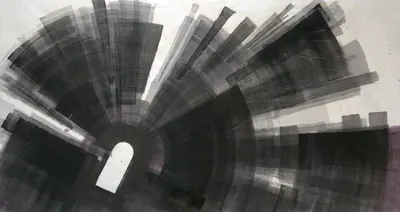
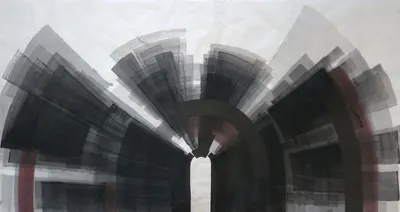
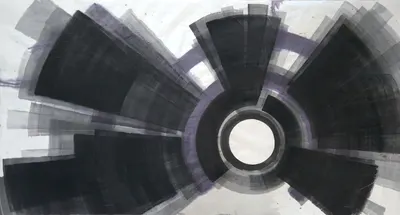
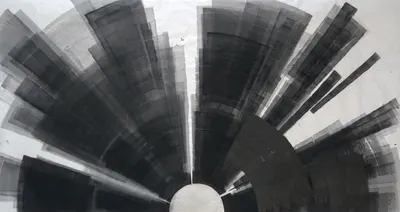
T_363 among all 402
Every painting of the year by date; this one is outlined.
Materials
- Paper
- Half-Cooked Red Star Mo She 6-Foot Bark Xuan Paper, self-sized from October 2026, China Xuan Paper Co., Ltd., made 2026.04.08
- Ink MB6
- Yi De Ge Yun Tou Yan, Yi De Ge (Beijing)
- Ink MB7
- Kuretake Shogei Purple-Navy Black, Kuretake
- Ink MB8
- Boku-Undo Gentoku Super Concentrated, Boku-Undo
- Colour
- colour inks, recorded together
Related