T_365
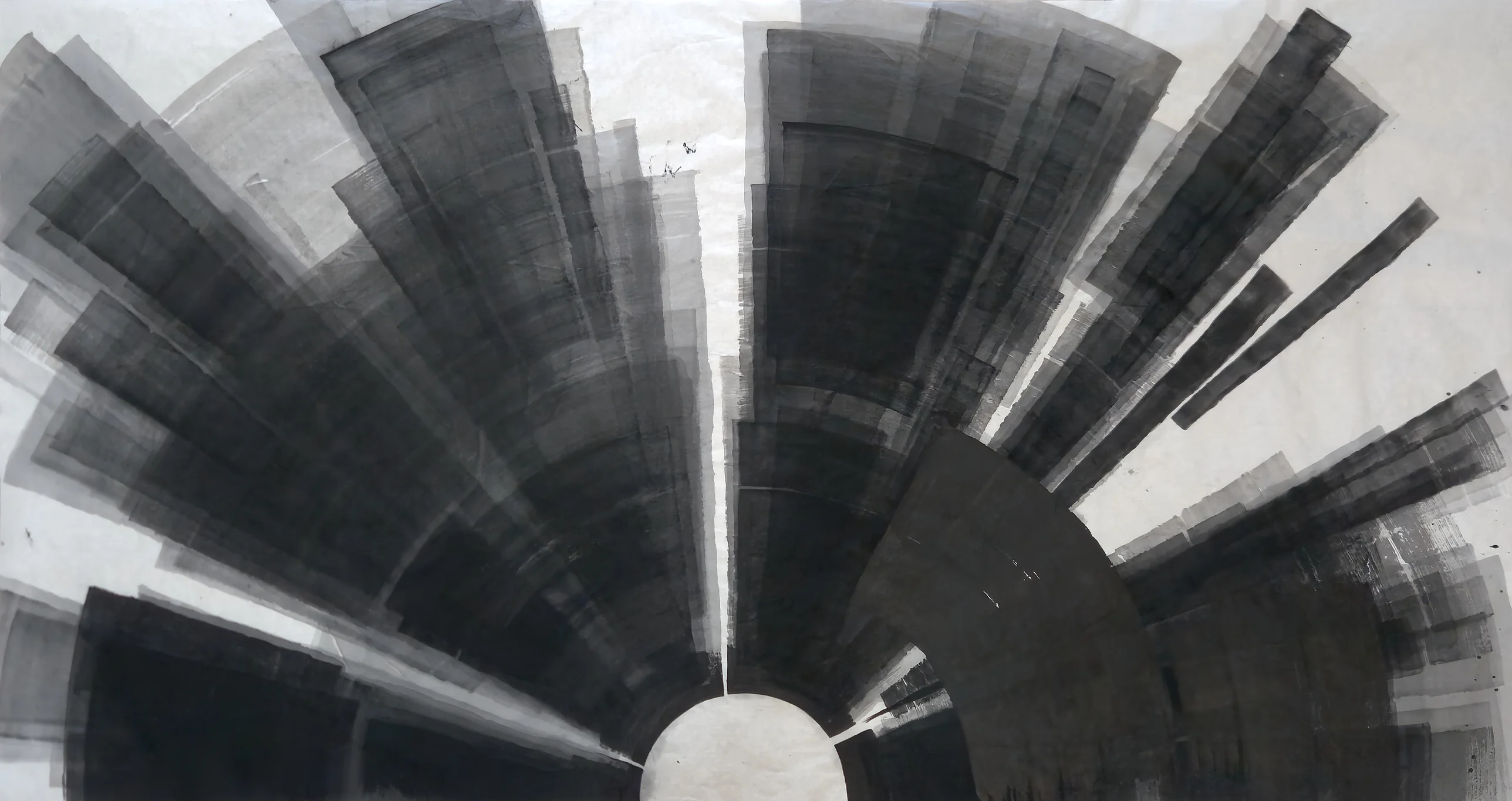
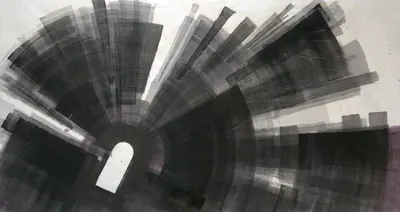
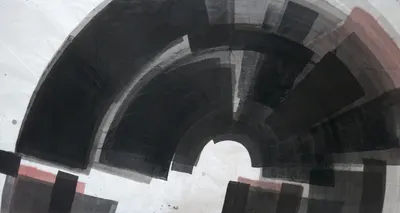
The engine's readingBroad ink bands fan out from a white half-moon at the foot of a six-foot sheet and split into two wings around a thin rising spoke of paper.
Record- Date
- 2026.07.28
- Dimensions
- 97 × 180 cm
- Paper
- Half-Cooked Red Star Mo She 6-Foot Bark Xuan Paper, self-sized from October 2026
- Ink
- Yi De Ge Yun Tou Yan, Kuretake Shogei Purple-Navy Black, Boku-Undo Gentoku Super Concentrated
The white half-moon at the bottom is a lunula, the pale crescent at the root of a thumbnail. My grandmother had big ones. She said that was where the nail remembers being new. She pressed that thumb into bread dough, into the soil round the tomatoes, once into my palm to stop me crying, and the little moon stayed white while the rest of the hand went brown and creased and freckled with work. A hand keeps one clean place and grows away from it. The small white scars from a paring knife came later, a short row of them across her left knuckle, pale as rice, laid down neat as stitches.
The reading
Written by the engine after the painting was rated, from the settled findings, and checked by hand before approval. It explains the numbers; it may not change them.
- Structure
- two radial fans of broad bands, joined at a bottom-centre hub
- Movement
- outward from the hub, up and sideways; nothing runs against it
- Coverage
- ink on about nine tenths of the paper
- Tone
- four tonal steps, weighted dark
- Layering
- many translucent passes plus late opaque fills; readable in both upper fans
- Edges
- crisp band walls throughout; soft spread at band tops; broken ends upper right
- Feibai
- present, streaked band ends at the upper right and along the right edge
- Open paper
- white half-moon at bottom centre, thin spoke rising to the top
- Chance marks
- white flecks in the right-centre arc; dark specks near the top-centre gap
- Frame
- runs off left, bottom, right and most of top; top centre and top right stay open
A fan of broad grey bands opens from a small white half-moon at the foot of the paper and drives outward, up and to both sides, until it runs off three edges. A thin white spoke climbs from that hub to the top and splits the burst into two wings.
Look first at the upper left wing. Each band went down as a translucent pass, and the half-raw bark paper kept the passes apart, so every wall shows through the one laid over it. The greys climb from pale to near black in clean steps, and the order of the strokes reads by eye. At the upper right, short bands break loose into open paper, their ends streaked with flying white.
The trouble sits right of centre. A wide arc of dark ink, faintly brown, lies dull and flat as a slab, nicked with small white flecks, and it buries the passes beneath it. The blocks at lower left and the jammed lower right repeat that weight in smaller doses.
Those darks anchor the base and cost it air. Above them the burst is fully built, ordered pass by pass and fast at its ends. It holds its whole width with authority.
How it was read
Read by the Visual Analysis Engine, version 23.8, on 2026.10.06: measured by code, then read 5 times by Claude Opus 5.5 against three reference paintings (R1 to R3), each read independent of the others. How the engine works.
Three views of one sheet.
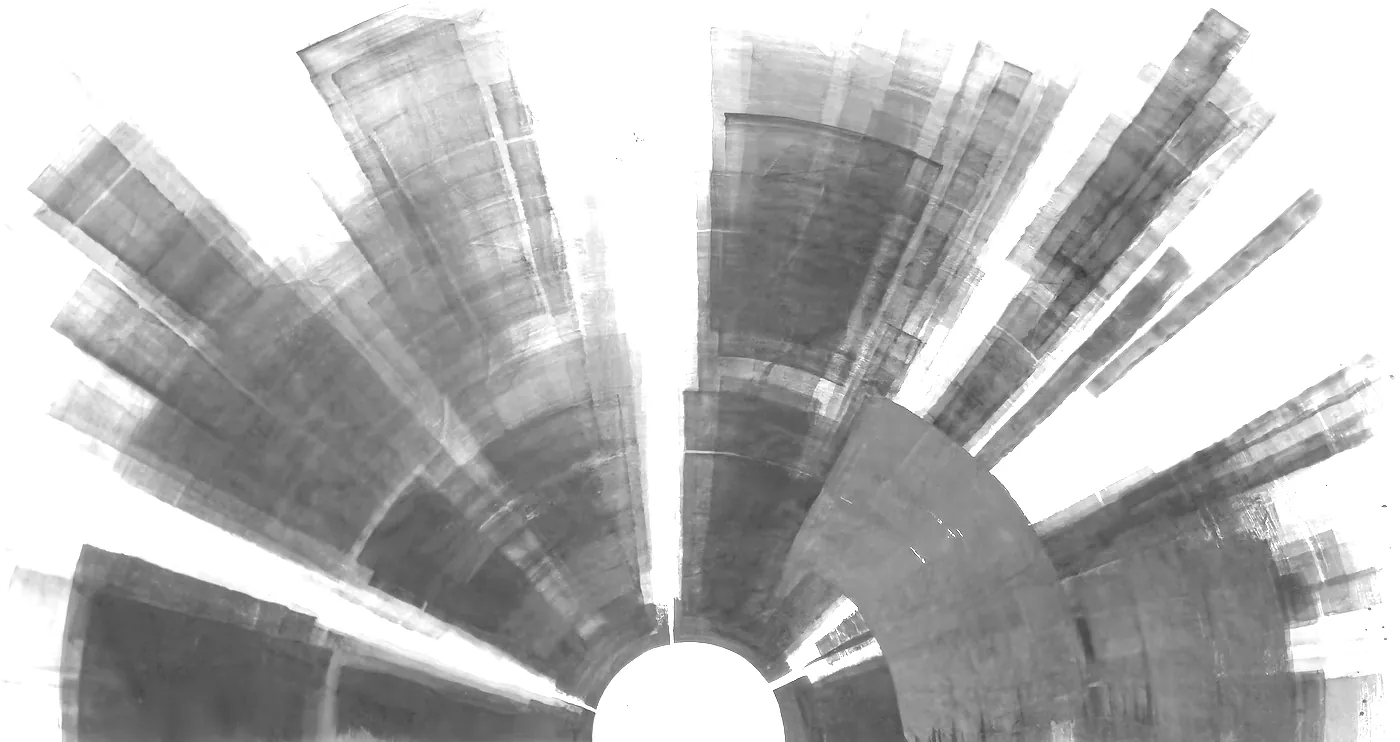
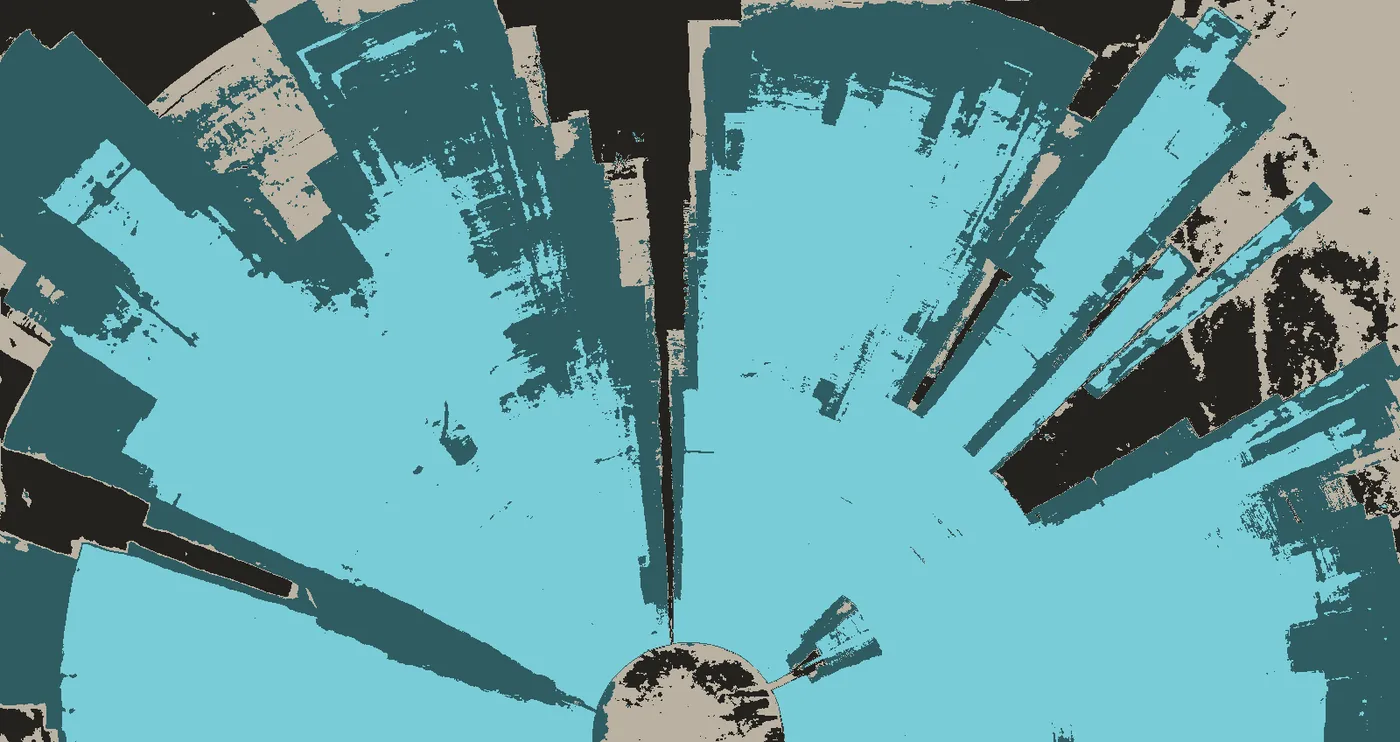
Left, the photograph. Centre, the tone stretch the model is shown beside it: the darkest 45% of tones spread over the whole range, so flat black, banding and stains show. Right, every pixel as the measuring code classes it: cyan black ink, deep teal translucent grey, stone the palest ink, near black bare paper.
4 families of tone.
Every inked pixel's brightness in 64 bins, smoothed; each circled peak holds at least 4% of the ink. Life inside the black: 0.036 (under 0.045 reads as flat).
Five reads, one answer.
Each quality placed on its ladder by each read, and the mean the engine keeps.
READ 1, IN ITS OWN WORDS
“A radial fan of layered translucent bands, similar to R3 in its layering. The flat dark right sector, the flat dark interiors and the heavy coverage keep form, tone and composition ordinary.”
The radial bands follow the brush's travel and their edges hold. The large right-centre sector is a bulky filled wedge, stiffer than the rest.
WEAKEST Flat, slab-like dark sector at right-centre
STRONGEST Radiating tapered bands in the left half
The overlapping bands give stepped greys and grain, but the measured dark modulation of 0.036 is flat. The right sector and the bottom-left black are flat inside.
WEAKEST Uniform dark interior of the right-centre sector
STRONGEST Stepped translucent greys in the upper-left bands
Many translucent passes overlap in a readable order across both fans. Their edges stay visible and build depth, much as in R3.
WEAKEST The right sector covers the passes beneath it
STRONGEST Stacked translucent band edges, upper left and right
The radial fan drives the eye outward from the bottom-centre void, and the top-right paper is shaped. Ink coverage of 0.89 crowds the sheet, and the right slab is heavy.
WEAKEST Dense, crowded lower right and lower left
STRONGEST Radial burst around the white semicircular void
The ink is controlled and the dry-brush ends are used well. Small white scratches or flecks sit inside the right-centre sector, with stray specks near the top centre. All are minor.
WEAKEST White flecks inside the flat right sector
STRONGEST Dry-brush band ends and grain, upper right
4 distinct places, 0 major.
Each read must name every flaw and where it is, in a ninth of the sheet. Here the reads named flaws in 4 distinct places, 13 mentions in all across 5 reads; the number in each ninth is how many times a flaw was named there. Reads agreeing on a place strengthen the evidence for one flaw; they do not multiply it.
Measured from the 16-bit master.
The previous engine (V22) measured this sheet's master file: 3 principal ink masses traced (cyan), 8 enclosed voids at true size in their grid cells (amber), the main gesture from start to end (red). Of 24 edge segments, 83% crisp, 17% soft or bloomed, 0% broken.
The rating these readings produce, the rules applied and the arithmetic, with Peter's own rating where he gave one, are in the Archive record.
Date
2026.07.28, day 212 of the Crucible Year, one of 11 paintings from that date (10 shown). 0 works were registered in the fourteen days before. Paintings are dated by the day their batch was registered and photographed; each was finished that day or within the few days before. Phase: P3 The Floor Rises (working title).
T_365 among all 402
Every painting of the year by date; this one is outlined.
Materials
- Paper
- Half-Cooked Red Star Mo She 6-Foot Bark Xuan Paper, self-sized from October 2026, China Xuan Paper Co., Ltd., made 2026.04.08
- Ink MB6
- Yi De Ge Yun Tou Yan, Yi De Ge (Beijing)
- Ink MB7
- Kuretake Shogei Purple-Navy Black, Kuretake
- Ink MB8
- Boku-Undo Gentoku Super Concentrated, Boku-Undo
Related