T_150
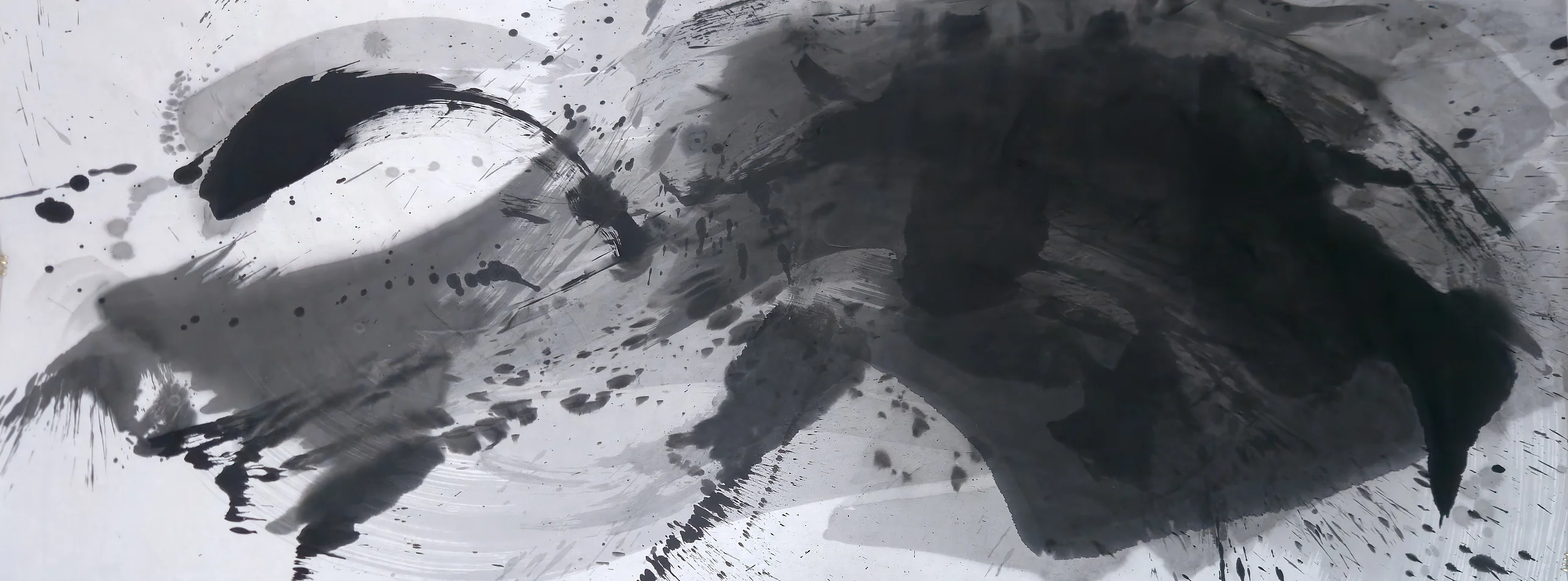
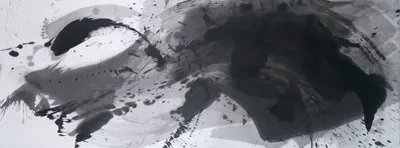
The engine's readingA black ink hook at upper left throws its dry tail across pale grey arcs into a dark, lobed mass filling the right half.
Record- Date
- 2026.03.27
- Dimensions
- 70 × 180 cm
- Paper
- Tanxi Thickened Grade A Special Jing Pi Small 6-Foot (raw)
- Ink
- Kuretake Shogei Kiwami, Yi De Ge Zhonghua, Boku-Undo Bokkou
The big dark round on the right is the cast-iron pan, black from years of oil and no soap, and the hook at the upper left is an arm swinging the spatula through the air like a conductor's baton. Everything between is fat spitting. You cook in a kitchen like that with your sleeves pushed up and your face turned away, flinching at every egg. The pan is older than its cooks, and it gets the big ring by right. The grey sweeps are smoke going up toward an extractor fan that has never worked. Then breakfast is on the plates, the window is fogged, and the pan sits on the cold ring, smoking gently, like an old dog after a run.
The reading
Written by the engine after the painting was rated, from the settled findings, and checked by hand before approval. It explains the numbers; it may not change them.
- Structure
- black crescent hook upper left, joined by grey arcs to large lobed mass right
- Movement
- left-to-right circling sweep; lower-left fragments scatter against it
- Coverage
- ink on about four fifths of the paper
- Tone
- six tonal steps, weighted dark
- Layering
- pale grey arcs, mid-grey wash, black; readable at the right mass's edges
- Edges
- crisp at crescent rim; soft in grey washes; broken along dry tails, lower left
- Feibai
- present, along the crescent's tail sweeping right across upper centre
- Open paper
- pale curving band beneath the crescent from left edge; lower-right corner
- Chance marks
- spatter around crescent, centre, lower right; water blotches in right mass; yellow-brown mark, left edge
- Frame
- ink runs off left, bottom and upper right; upper-left and lower-right corners open
The eye lands first on a black hook at the top left, one loaded stroke curling back on itself, and follows its frayed tail into a dark mass that fills most of the right half. Under both, pale grey arcs swing through the middle like a wheel still turning. The sheet travels left to right and settles heavily.
The hook is the best thing here. It holds its arc and tapers cleanly, and as the brush runs dry the hairs part into streaks of bare paper that throw the motion out into spatter. The raw paper keeps the early greys apart, so at the edges of the right mass the passes can be counted: pale wash, mid-grey, black, in stepped planes.
The cost sits in that mass. Its outline is a bulky lobe ending in a dropped point, and at its core the black covers the greys rather than building on them. Pale water blotches cloud the interior. Even the hook is flat black inside, and the lower left breaks into scattered fragments.
That leaves a well-built sheet with one stroke worth crossing the room for. The sweep from hook to mass is clear and it holds. The right half is heavier than it needs to be, and that weight keeps the sheet steady and good rather than better.
How it was read
Read by the Visual Analysis Engine, version 23.8, on 2026.10.06: measured by code, then read 5 times by Claude Opus 5.5 against three reference paintings (R1 to R3), each read independent of the others. How the engine works.
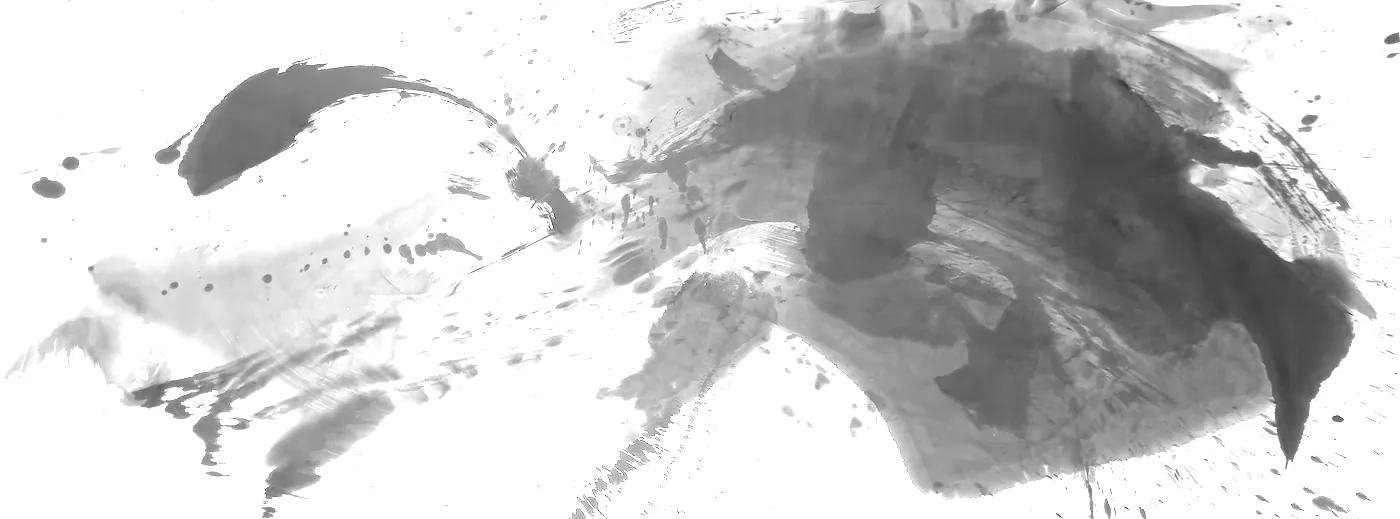
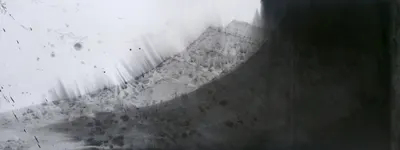
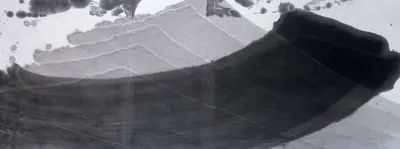
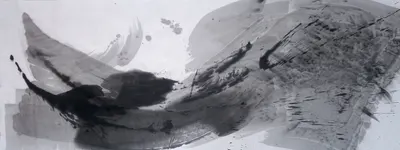
Three views of one sheet.
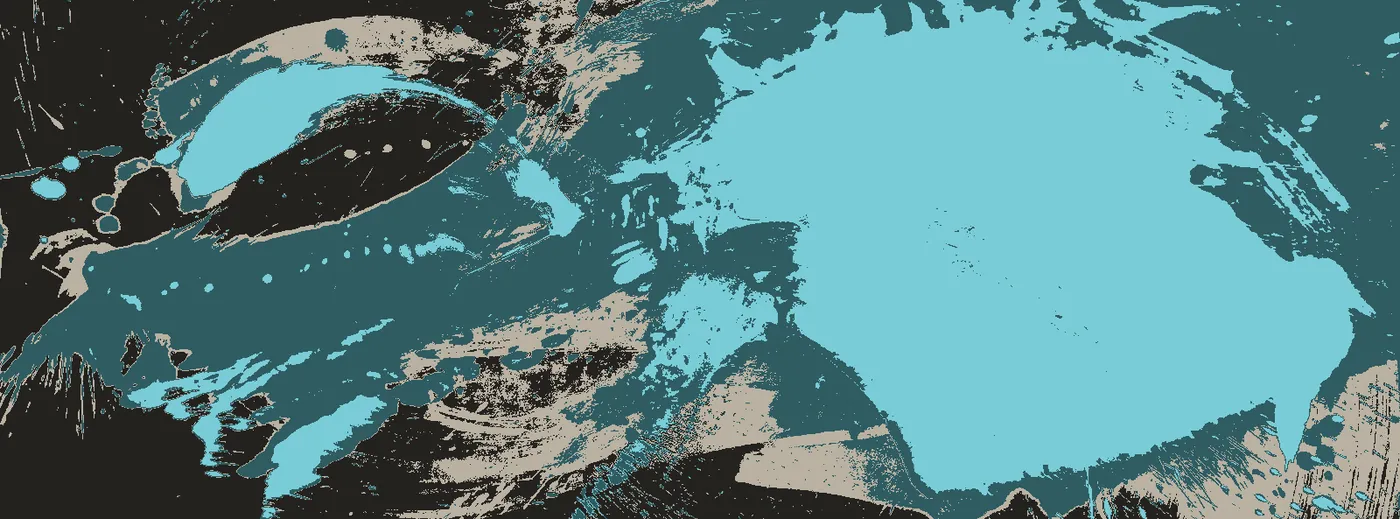
Left, the photograph. Centre, the tone stretch the model is shown beside it: the darkest 45% of tones spread over the whole range, so flat black, banding and stains show. Right, every pixel as the measuring code classes it: cyan black ink, deep teal translucent grey, stone the palest ink, near black bare paper.
6 families of tone.
Every inked pixel's brightness in 64 bins, smoothed; each circled peak holds at least 4% of the ink. Life inside the black: 0.046 (under 0.045 reads as flat).
Five reads, agreeing on 4 of 5 qualities.
Each quality placed on its ladder by each read, and the mean the engine keeps. Where reads differ, they differ by one rung; close calls resolve down.
READ 1, IN ITS OWN WORDS
“An energetic, gestural sheet like R2: a fluent crescent and a heavy, modelled right mass in a sweeping arc. The bulk, the crowded centre and the partly flat darks keep it ordinary across all five ladders.”
Top-left crescent holds a fluent arc; large right mass is a broad, bulky lobe ending in a drip point; lower-left strokes are fragmented.
WEAKEST Large right dark mass is bulky, lobed outline
STRONGEST Upper-left black crescent stroke with dry-brush tail
Tone-stretched view shows stepped density and brush arcs inside the right mass; crescent is flat; modulation 0.046 is just above the flat threshold.
WEAKEST Upper-left crescent nearly flat black inside
STRONGEST Right mass with stepped greys and darker sub-shapes
Pale grey arcs, mid-grey wash and darker overlay in the right mass remain legible; centre spatter partly obscures pass order.
WEAKEST Centre overlap of mass with spatter gets busy
STRONGEST Grey sweep under darker right mass, readable overlap
Circular movement from top-left crescent to the heavy right mass gives direction; ink covers 79%, so empty paper is squeezed and the centre is cluttered.
WEAKEST Crowded centre spatter zone between the two masses
STRONGEST Sweeping arc from crescent into right mass
Ink is controlled; splashes look intended; the right mass shows faint patchy pale areas in the stretched view, though there is no clear tide line at viewing distance.
WEAKEST Cloudy uneven grey interiors in the right mass
STRONGEST Dry-brush streaks at the crescent tail and lower arcs
4 distinct places, 0 major.
Each read must name every flaw and where it is, in a ninth of the sheet. Here the reads named flaws in 4 distinct places, 11 mentions in all across 5 reads; the number in each ninth is how many times a flaw was named there. Reads agreeing on a place strengthen the evidence for one flaw; they do not multiply it.
Measured from the 16-bit master.
The previous engine (V22) measured this sheet's master file: 1 principal ink mass traced (cyan), 8 enclosed voids at true size in their grid cells (amber), the main gesture from start to end (red). Of 17 edge segments, 41% crisp, 24% soft or bloomed, 35% broken.
The rating these readings produce, the rules applied and the arithmetic, with Peter's own rating where he gave one, are in the Archive record.
Date
2026.03.27, day 89 of the Crucible Year, one of 10 paintings from that date (6 shown). 70 works were registered in the fourteen days before. Paintings are dated by the day their batch was registered and photographed; each was finished that day or within the few days before. Phase: P1 Warm-up (working title).
T_150 among all 402
Every painting of the year by date; this one is outlined.
Materials
- Paper
- Tanxi Thickened Grade A Special Jing Pi Small 6-Foot (raw), Anhui Jingxian Tanxi Xuan Paper Art Products Co., Ltd., made 2015.11.19
- Ink MB1
- Kuretake Shogei Kiwami, Kuretake
- Ink MB2
- Yi De Ge Zhonghua, Yi De Ge (Beijing)
- Ink MB3
- Boku-Undo Bokkou, Boku-Undo
Related