T_154
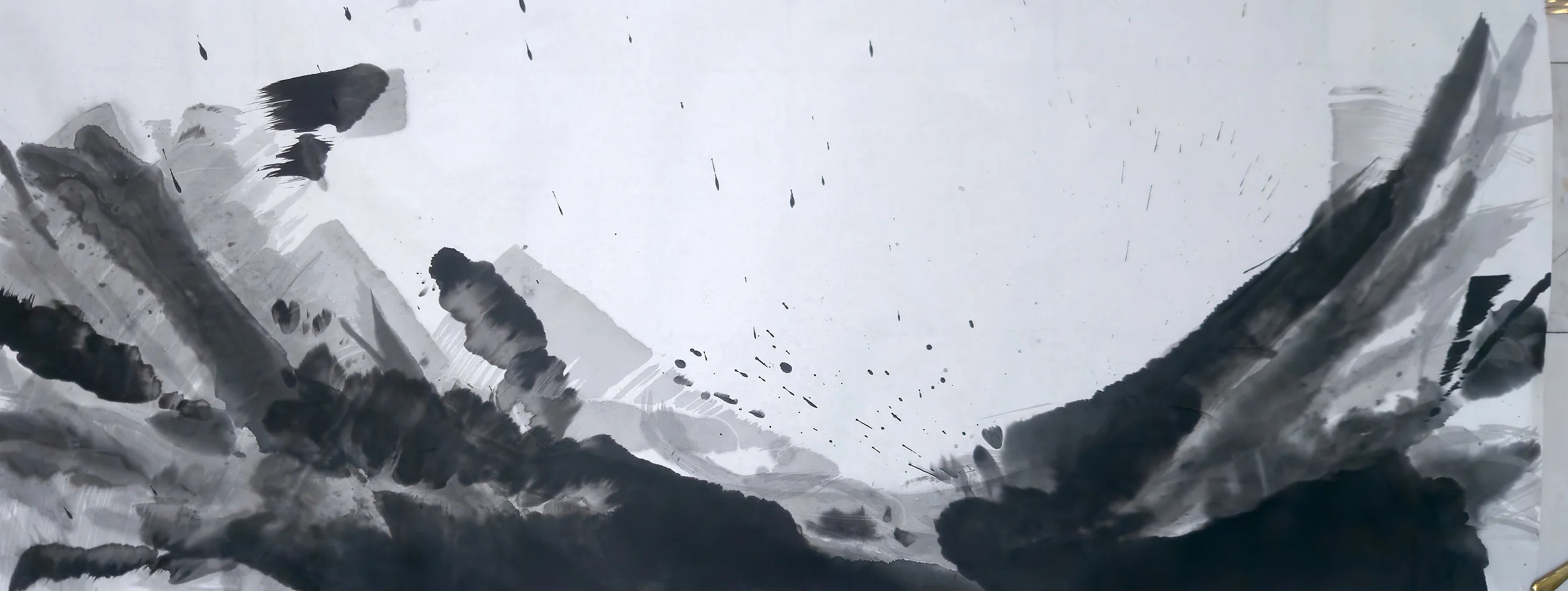
The engine's readingTwo dark slopes of ink rise from the lower corners of a long sheet, holding a bowl of open sky crossed by falling drops and spatter.
Record- Date
- 2026.03.27
- Dimensions
- 70 × 180 cm
- Paper
- Tanxi Thickened Grade A Special Jing Pi Small 6-Foot (raw)
- Ink
- Kuretake Shogei Kiwami, Yi De Ge Zhonghua, Boku-Undo Bokkou
In the valley kingdom it rains ink once a year, and I was out in it. The drops fall with tails, small black comets, and the law says each one that lands becomes a citizen. Most land on the low ground and vanish into the general dark, which is how the valley got so heavy at the bottom. The right-hand mountain has been trying to leave for centuries. It leans like a horse that heard its name. I gave it a saddle. I gave the left slope a broom. The sky I left alone, because empty air is crown land here, and in the evenings the queen walks across it without leaving a single footprint.
The reading
Written by the engine after the painting was rated, from the settled findings, and checked by hand before approval. It explains the numbers; it may not change them.
- Structure
- two dark masses rising from both lower corners, joined by a heavy bottom band
- Movement
- rising diagonals, left slanting up-left, right sweeping up-right; spatter crosses the centre
- Coverage
- ink on about two thirds of the paper
- Tone
- three tonal steps, spread across the range
- Layering
- pale washes, mid greys, blacks; readable at left and in right arc
- Edges
- crisp at right arc stroke ends; soft, lobed and bloomed in centre-left masses
- Feibai
- none
- Open paper
- broad bowl-shaped sky, upper centre, opening toward the top edge
- Chance marks
- tailed drops upper centre; spatter centre; fine streaks upper right; blooms centre-left
- Frame
- ink runs off left, bottom and lower right edges; top edge stays open
A valley opens across the long paper. Dark ground climbs from both lower corners, and the empty sky between them takes its shape from what rises around it. A trail of spatter crosses the bowl from left of centre and pulls the eye over the gap.
The right side holds the most. Its curved strokes lean up and outward in single travels of the brush, and where the hairs ran drier the raw paper keeps their streaks, so each stroke shows its speed. At far left the long grey diagonals do quieter work. Pale washes sit under mid greys and blacks with every pass still legible, because thick unsized paper takes a layer and lets the next lie over it without merging.
The trouble sits low. Across the bottom the blacks seal over the earlier greys, and the great dark at lower right is nearly flat inside. Left of centre a column of dabbed lobes blooms at its rims where wet ink spread into wet paper, and the left third crowds itself.
So the sheet stands on its arc and its open sky. It is a good landscape in ink, firmly built, weighed down by a floor it never quite lifts.
How it was read
Read by the Visual Analysis Engine, version 23.8, on 2026.10.06: measured by code, then read 5 times by Claude Opus 5.5 against three reference paintings (R1 to R3), each read independent of the others. How the engine works.
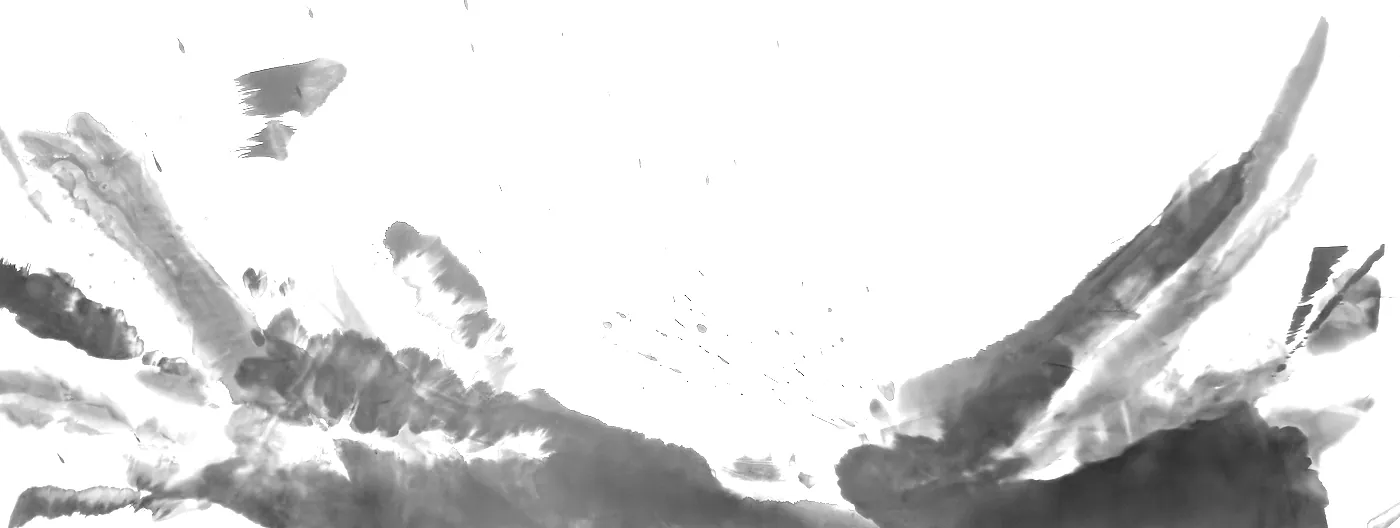
Three views of one sheet.
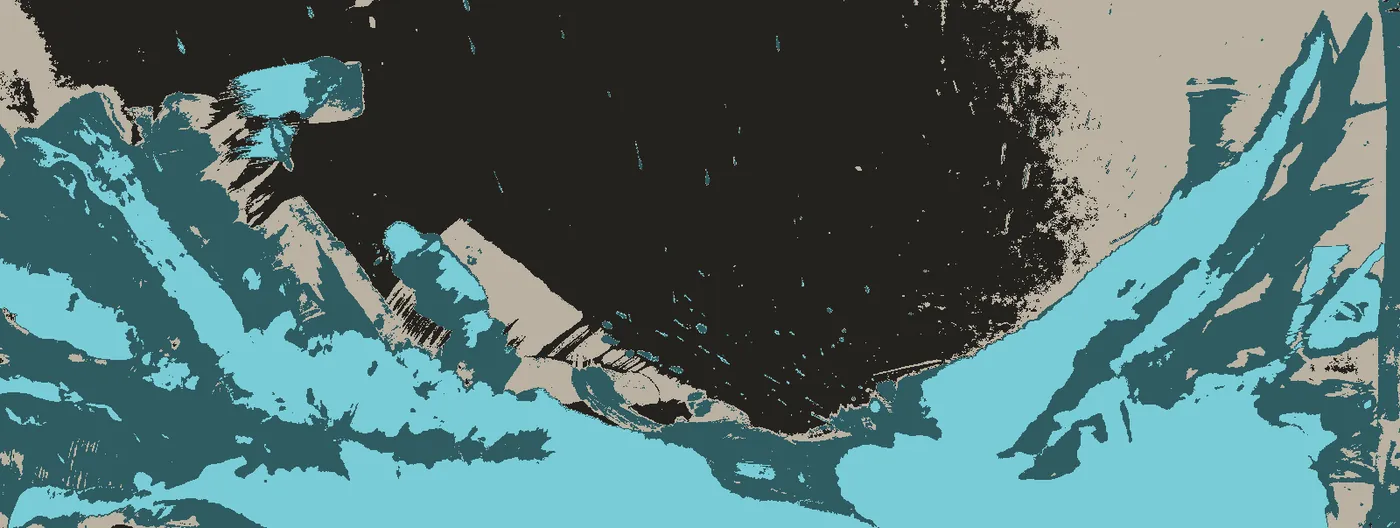
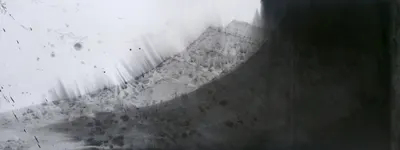
Left, the photograph. Centre, the tone stretch the model is shown beside it: the darkest 45% of tones spread over the whole range, so flat black, banding and stains show. Right, every pixel as the measuring code classes it: cyan black ink, deep teal translucent grey, stone the palest ink, near black bare paper.
3 families of tone.
Every inked pixel's brightness in 64 bins, smoothed; each circled peak holds at least 4% of the ink. Life inside the black: 0.052 (under 0.045 reads as flat).
Five reads, agreeing on 4 of 5 qualities.
Each quality placed on its ladder by each read, and the mean the engine keeps. Where reads differ, they differ by one rung; close calls resolve down.
READ 1, IN ITS OWN WORDS
“Valley composition with masses rising from both corners around an open, spattered centre. Right arc strokes are fluent, but the bottom blacks are heavy and flat, and mottled tide blotches mark the left grey strokes.”
Right arc strokes follow brush travel; left diagonal grey strokes hold; bottom dark masses are heavy, lumpy slabs with blobby dabbed edges at left-centre.
WEAKEST Bulky dark slab along bottom centre-right
STRONGEST Sweeping curved strokes rising at right
Grey strokes show streaks and graded density; bottom dark masses mostly uniform black; modulation 0.052 only just above flat; three tonal steps.
WEAKEST Bottom right dark mass nearly flat inside
STRONGEST Left diagonal grey strokes with streaked grain
Pale grey washes, mid-grey strokes and black passes read separately at left and right; at the bottom the black largely buries what lies beneath.
WEAKEST Bottom blacks cover earlier greys
STRONGEST Pale grey washes under dark strokes left
Two masses rise from the corners into a U-shaped arc around shaped empty paper, with spatter leading inward; the bottom edge is congested and heavy.
WEAKEST Heavy, crowded bottom band
STRONGEST Valley arc framing open central sky
Top-left grey stroke and left dark dabs show blotchy rings and tide edges visible in colour view; there is also a gold object at the bottom-right edge.
WEAKEST Mottled tide-ringed grey stroke top-left
STRONGEST Dry-brush streaks in right arc strokes
4 distinct places, 0 major.
Each read must name every flaw and where it is, in a ninth of the sheet. Here the reads named flaws in 4 distinct places, 13 mentions in all across 5 reads; the number in each ninth is how many times a flaw was named there. Reads agreeing on a place strengthen the evidence for one flaw; they do not multiply it.
Measured from the 16-bit master.
The previous engine (V22) measured this sheet's master file: 2 principal ink masses traced (cyan), 7 enclosed voids at true size in their grid cells (amber), the main gesture from start to end (red). Of 15 edge segments, 53% crisp, 33% soft or bloomed, 13% broken.
The rating these readings produce, the rules applied and the arithmetic, with Peter's own rating where he gave one, are in the Archive record.
Date
2026.03.27, day 89 of the Crucible Year, one of 10 paintings from that date (6 shown). 70 works were registered in the fourteen days before. Paintings are dated by the day their batch was registered and photographed; each was finished that day or within the few days before. Phase: P1 Warm-up (working title).
T_154 among all 402
Every painting of the year by date; this one is outlined.
Materials
- Paper
- Tanxi Thickened Grade A Special Jing Pi Small 6-Foot (raw), Anhui Jingxian Tanxi Xuan Paper Art Products Co., Ltd., made 2015.11.19
- Ink MB1
- Kuretake Shogei Kiwami, Kuretake
- Ink MB2
- Yi De Ge Zhonghua, Yi De Ge (Beijing)
- Ink MB3
- Boku-Undo Bokkou, Boku-Undo
Related