T_148
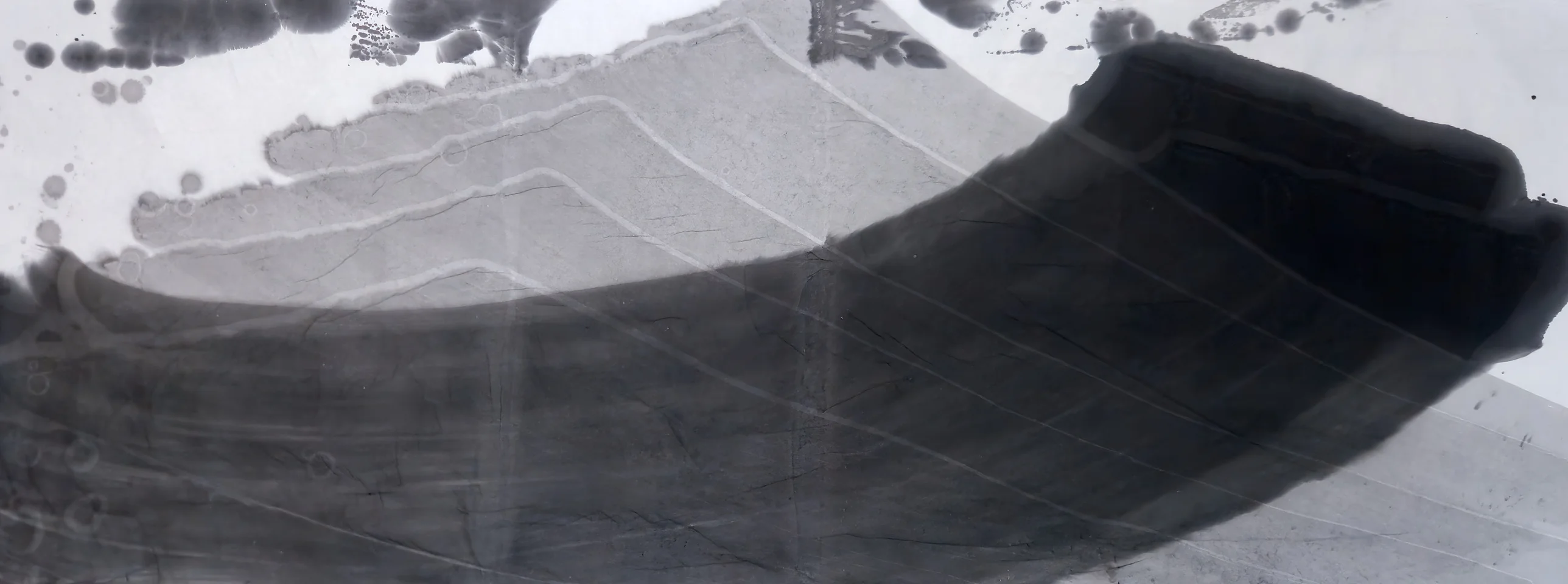
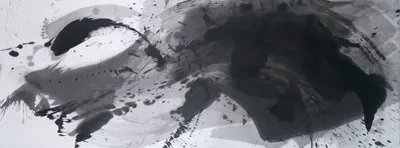
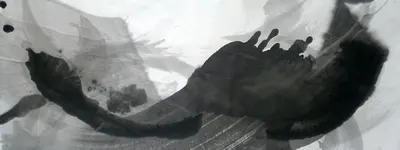
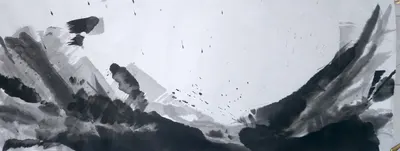
The engine's readingA broad ink band climbs from the lower left into a squared black end, beneath a fan of pale grey steps and a scatter of drops.
Record- Date
- 2026.03.27
- Dimensions
- 70 × 180 cm
- Paper
- Tanxi Thickened Grade A Special Jing Pi Small 6-Foot (raw)
- Ink
- Kuretake Shogei Kiwami, Yi De Ge Zhonghua, Boku-Undo Bokkou
The pale steps at the upper left are tide lines. I have walked that beach in March, when the sea signs its name in foam a little lower each time and the gulls stand about like auditors. Then the big water comes in all at once, dark and heavy, and runs out of room on the right, squared off against a breakwater I cannot see. Waves are not supposed to end in corners. This one does, and I like it for that, the way you like a dog that has misjudged the width of a door. Above it the spray went up and stayed up, small black drops that never came down. The tide turns at dusk. The foam line will be a little lower.
The reading
Written by the engine after the painting was rated, from the settled findings, and checked by hand before approval. It explains the numbers; it may not change them.
- Structure
- one broad curved band, pale stepped fan tucked above its upper left
- Movement
- rising sweep from lower left to upper right, nothing running against it
- Coverage
- ink on about nine tenths of the paper
- Tone
- three tonal steps, weighted dark
- Layering
- pale grey passes under the dark band, readable along its upper edge
- Edges
- band walls soft but held; lobed scallops on grey fan; squared right end
- Feibai
- none
- Open paper
- white crescent above the arc, widest at upper right
- Chance marks
- rings inside band lower left; drip blots along top; vertical pale streak
- Frame
- ink runs off left, bottom and lower right; upper right corner stays open
One broad sweep of ink takes nearly the whole paper. It enters low at the left, climbs to the right, and thickens there into a near-black block. Above it a crescent of white keeps the sheet from closing over. That curve is the whole case, and the case is sound.
The middle of the band is where the sheet lives. Long pale striations run with the brush's travel, and the raw paper, quick to drink and spread, has kept each bristle path as its own line inside the grey. Behind it, stepped grey passes fan out at the upper left and stay legible where the dark wash crosses their edges.
The trouble gathers at both ends. At the left the band turns milky and cloudy, and circular rings sit inside it where standing water dried on the surface. At the right the curve stops in a squared slab whose black is dense and flat. Drip blots along the top edge scatter across the white the arc had shaped.
What stands is a competent sheet: one clear movement, a good middle, and two ends that do not keep up with it.
How it was read
Read by the Visual Analysis Engine, version 23.8, on 2026.10.06: measured by code, then read 5 times by Claude Opus 5.5 against three reference paintings (R1 to R3), each read independent of the others. How the engine works.
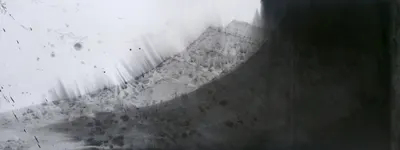
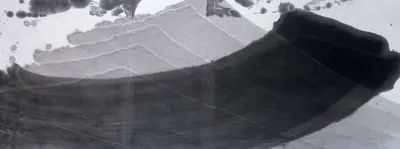
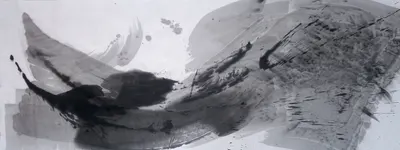
Three views of one sheet.
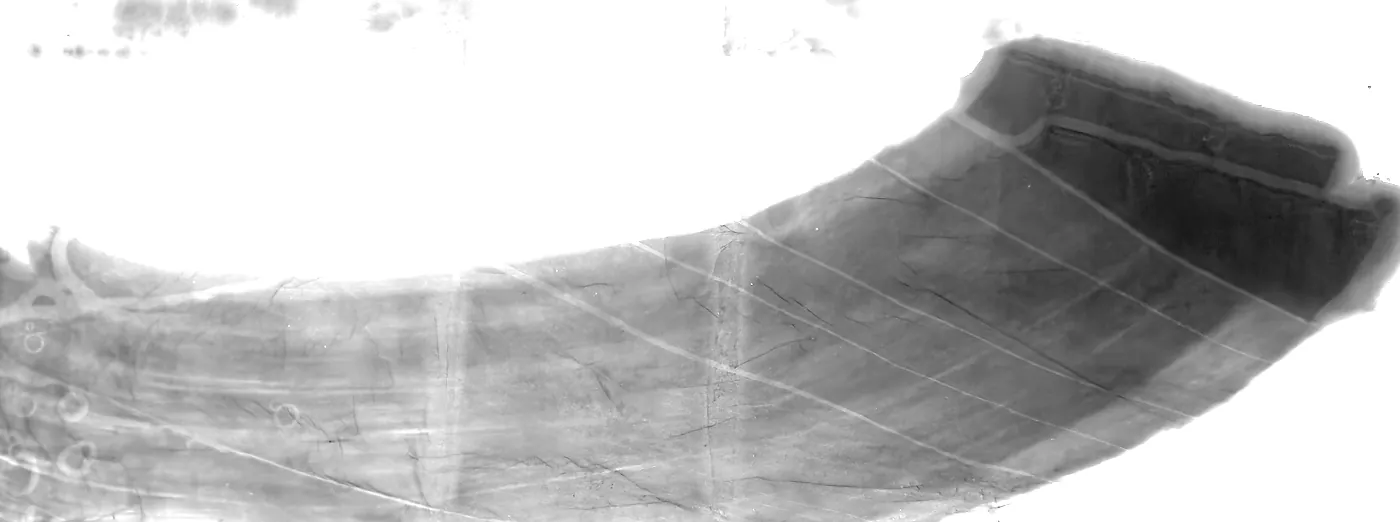
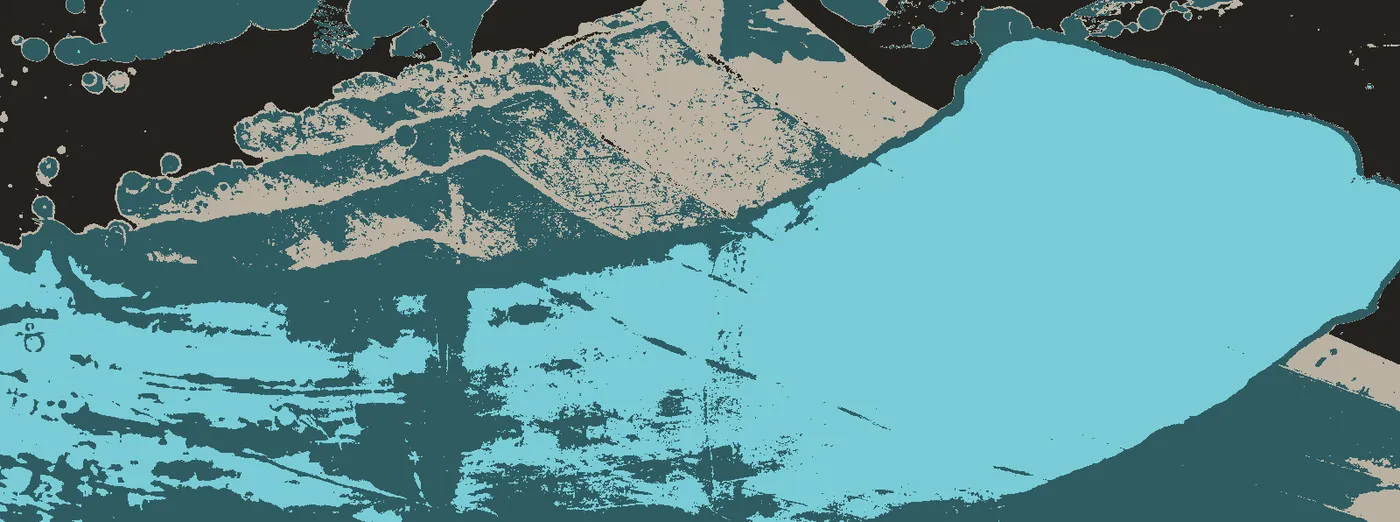
Left, the photograph. Centre, the tone stretch the model is shown beside it: the darkest 45% of tones spread over the whole range, so flat black, banding and stains show. Right, every pixel as the measuring code classes it: cyan black ink, deep teal translucent grey, stone the palest ink, near black bare paper.
3 families of tone.
Every inked pixel's brightness in 64 bins, smoothed; each circled peak holds at least 4% of the ink. Life inside the black: 0.072 (under 0.045 reads as flat).
Five reads, agreeing on 4 of 5 qualities.
Each quality placed on its ladder by each read, and the mean the engine keeps. Where reads differ, they differ by one rung; close calls resolve down.
READ 1, IN ITS OWN WORDS
“One bold sweeping arc over a grey fan gives the sheet direction, with some banding inside the dark. It is bulky and crowded, and visible rings at bottom left and blots along the top weaken the surface.”
The main dark arc follows the brush's travel and its walls hold, but it is a bulky slab. Its squared right end is stiff, and the top blots are formless.
WEAKEST Scattered blots and drips along the top edge
STRONGEST Main curved sweep from left to the right end
Pale striations and grain run inside the band (modulation 0.072). Three tonal steps. The densest black at the right end reads mostly as flat surface.
WEAKEST Darkest right end of the band is nearly flat
STRONGEST Banded mid-section of the arc with striations
The translucent grey fan steps sit under the dark arc and stay readable at its upper edge. In effect there are two passes, with no deeper sequence.
WEAKEST Dark pass mostly covers the grey fan beneath
STRONGEST Grey fan layers behind the dark arc, upper left
One strong curve gives the sheet direction. The white lens of paper at upper left is shaped, but 87% ink coverage crowds the frame, and the blots along the top edge distract.
WEAKEST Top-edge blots clutter the empty paper
STRONGEST Sweeping arc carrying the eye left to right
Clear circular rings sit inside the grey-dark band at bottom left and in the pale fan, all visible in the colour view. Scattered drip blots line the top edge.
WEAKEST Ring marks inside the band at bottom left
STRONGEST Grainy striated interior of the dark arc
6 distinct places, 2 major.
Each read must name every flaw and where it is, in a ninth of the sheet. Here the reads named flaws in 6 distinct places, 20 mentions in all across 5 reads; the number in each ninth is how many times a flaw was named there. Reads agreeing on a place strengthen the evidence for one flaw; they do not multiply it. A major flaw holds Material and surface at rung 1.
Measured from the 16-bit master.
The previous engine (V22) measured this sheet's master file: 4 principal ink masses traced (cyan), 3 enclosed voids at true size in their grid cells (amber), the main gesture from start to end (red). Of 19 edge segments, 16% crisp, 84% soft or bloomed, 0% broken.
The rating these readings produce, the rules applied and the arithmetic, with Peter's own rating where he gave one, are in the Archive record.
Date
2026.03.27, day 89 of the Crucible Year, one of 10 paintings from that date (6 shown). 70 works were registered in the fourteen days before. Paintings are dated by the day their batch was registered and photographed; each was finished that day or within the few days before. Phase: P1 Warm-up (working title).
T_148 among all 402
Every painting of the year by date; this one is outlined.
Materials
- Paper
- Tanxi Thickened Grade A Special Jing Pi Small 6-Foot (raw), Anhui Jingxian Tanxi Xuan Paper Art Products Co., Ltd., made 2015.11.19
- Ink MB1
- Kuretake Shogei Kiwami, Kuretake
- Ink MB2
- Yi De Ge Zhonghua, Yi De Ge (Beijing)
- Ink MB3
- Boku-Undo Bokkou, Boku-Undo
Related