T_159
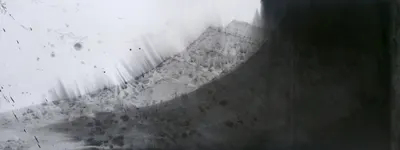
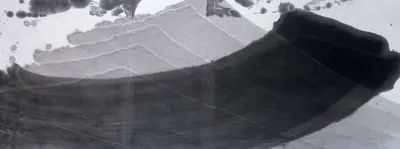
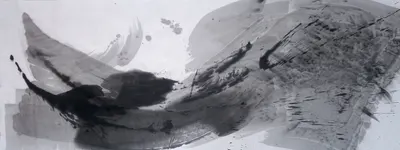
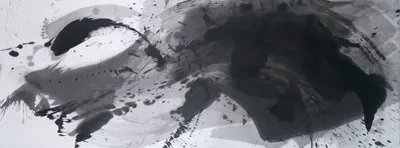
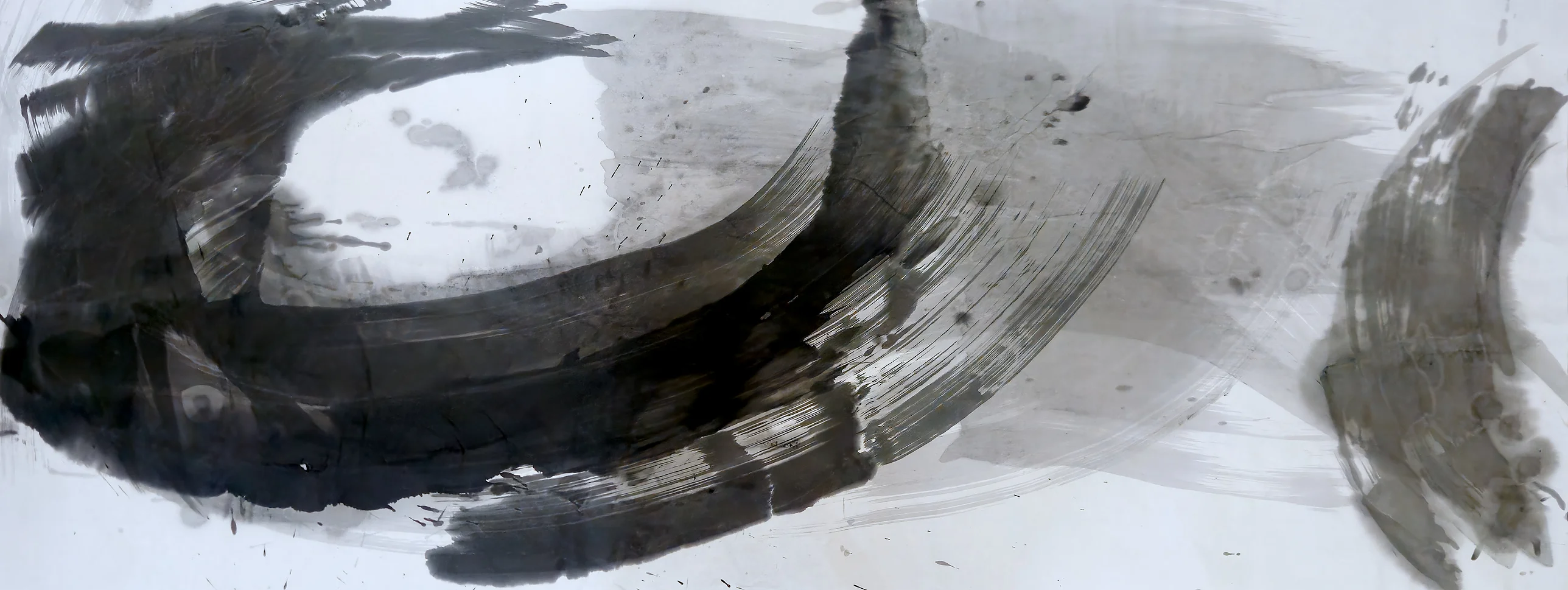
The engine's readingA black ink arc sweeps from the left edge up to the top of a long sheet, breaking into dry streaks, with a grey crescent standing apart at right.
Record- Date
- 2026.03.28
- Dimensions
- 70 × 180 cm
- Paper
- Tanxi Thickened Grade A Special Jing Pi Small 6-Foot (raw)
- Ink
- Kuretake Shogei Kiwami, Yi De Ge Zhonghua, Boku-Undo Bokkou
The crescent on the right is the one who left the party early and is now standing under an awning across the street, getting rained on in rings. I know that figure from the roof. Every block has one: the late bus shelter, the shuttered kiosk with its light still humming, a moon that came up wrong and decided to stay. The big black stroke is still inside, loud, swinging its arm across the whole room. The light changes twice and the road stays empty. The gap fills with the grey that streetlights make of fog. I would go down with an umbrella. By the time I got there it would be smudged at the edges, watching a cab turn the other way.
The reading
Written by the engine after the painting was rated, from the settled findings, and checked by hand before approval. It explains the numbers; it may not change them.
- Structure
- dark left block, long arc rising to a top stroke, separate right crescent
- Movement
- left to right along the arc; the right crescent curves back against it
- Coverage
- ink on about three quarters of the paper
- Tone
- seven tonal steps, spread across the range
- Layering
- grey wash, black arc, dry-brush overstrokes; readable where they cross at centre
- Edges
- crisp at the arc's dry tail; soft and lobed around the right crescent
- Feibai
- present at the arc's tail, where it fans upward at centre
- Open paper
- white oval enclosed by the arc, upper left; pale band along the bottom
- Chance marks
- tide rings in central wash, pale stains in the oval, blooms in the crescent
- Frame
- ink runs off the left and top edges; the right edge stays mostly open
A single black arc rises from the left edge, swings low along the sheet and climbs to the top, closing an oval of bare paper as it goes. The eye travels with it, left to right, and then runs out of road somewhere past the centre.
The arc carries the sheet. Where it turns upward it opens into flying white: the hairs part, bare paper streaks through in parallel, and the stroke still holds its curve. Inside the body the black steps down to grey, with grain and fine cracks showing. Raw paper grips the dry hairs, so those streaks stay sharp while the wetter wash beneath them softens and still reads through. Pale water stains sit in the oval, and the space absorbs them.
The right crescent is where it costs. Raw paper drinks fast and spreads far, and here the water wandered: blooms and tide rings eat the walls until the shape goes cloudy. The grey field between it and the arc is slack, so the crescent stands alone. At the far left, the dark block is heavy and flat inside.
That leaves one sure stroke and a right half that does not keep up. Fair work, worth a look for the arc.
How it was read
Read by the Visual Analysis Engine, version 23.8, on 2026.10.06: measured by code, then read 5 times by Claude Opus 5.5 against three reference paintings (R1 to R3), each read independent of the others. How the engine works.
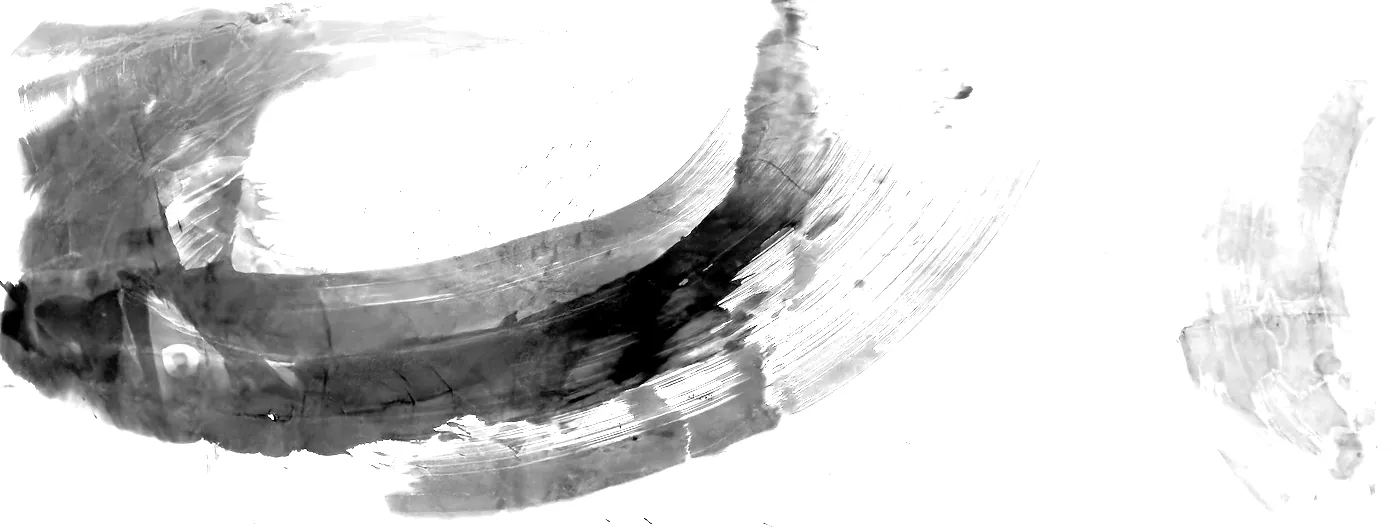
Three views of one sheet.
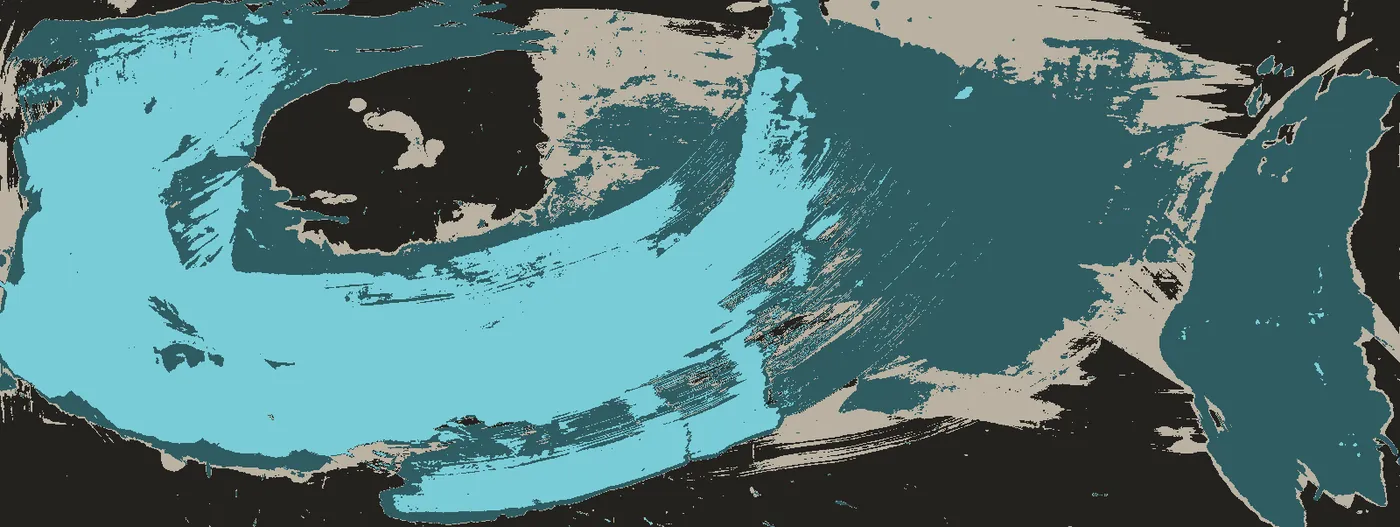
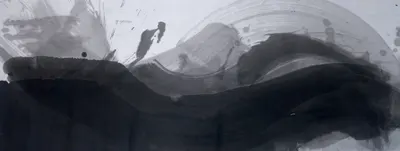
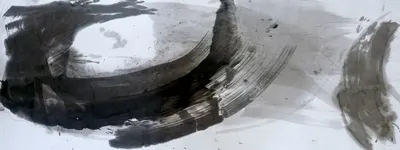
Left, the photograph. Centre, the tone stretch the model is shown beside it: the darkest 45% of tones spread over the whole range, so flat black, banding and stains show. Right, every pixel as the measuring code classes it: cyan black ink, deep teal translucent grey, stone the palest ink, near black bare paper.
7 families of tone.
Every inked pixel's brightness in 64 bins, smoothed; each circled peak holds at least 4% of the ink. Life inside the black: 0.063 (under 0.045 reads as flat).
Five reads, one answer.
Each quality placed on its ladder by each read, and the mean the engine keeps.
READ 1, IN ITS OWN WORDS
“An ordinary sheet. A strong sweeping arc with good dry-brush and grained tone is let down by a weak, bloomed right crescent and by water rings in the grey wash.”
The left arc follows the brush's travel, ending in fluent dry-brush streaks. The left end is bulky and slab-like. The right crescent's edges are blotchy, not fully made.
WEAKEST Right crescent: blotchy, its walls dissolve into mottling
STRONGEST Main sweeping arc with dry-brush tail
Seven tonal steps and dark modulation of 0.063. The arc shows grain, cracks and graded density. The far-left dark mass is fairly flat. The right crescent is mottled rather than modelled.
WEAKEST Lower-left black end of arc is fairly uniform
STRONGEST Arc body grading from black to grain-streaked grey
There is a grey ground wash, a dark arc pass, dry-brush overstrokes and the right crescent. These overlaps can be read at centre, but the sequence doesn't build much depth.
WEAKEST The black arc mostly covers the grey wash beneath
STRONGEST Dry-brush streaks crossing the pale grey wash at centre
The big arc gives strong left-to-right movement and shapes the white oval. The right-hand crescent echoes the curve, but the gap of grey wash at centre-right feels slack.
WEAKEST The right crescent sits isolated and is weakly tied in
STRONGEST Large arc enclosing the shaped white oval upper-left
The right crescent's interior is full of bloom rings and blotches. There are tide rings in the grey wash at centre-right and pale stain splotches in the white oval, all visible in the colour view.
WEAKEST Bloomed, ringed interior of right crescent
STRONGEST Dry-brush streak edges of the arc's tail
6 distinct places, 2 major.
Each read must name every flaw and where it is, in a ninth of the sheet. Here the reads named flaws in 6 distinct places, 20 mentions in all across 5 reads; the number in each ninth is how many times a flaw was named there. Reads agreeing on a place strengthen the evidence for one flaw; they do not multiply it. A major flaw holds Material and surface at rung 1.
Measured from the 16-bit master.
The previous engine (V22) measured this sheet's master file: 2 principal ink masses traced (cyan), 7 enclosed voids at true size in their grid cells (amber), the main gesture from start to end (red). Of 17 edge segments, 29% crisp, 59% soft or bloomed, 12% broken.
The rating these readings produce, the rules applied and the arithmetic, with Peter's own rating where he gave one, are in the Archive record.
Date
2026.03.28, day 90 of the Crucible Year, one of 4 paintings from that date (2 shown). 80 works were registered in the fourteen days before. Paintings are dated by the day their batch was registered and photographed; each was finished that day or within the few days before. Phase: P1 Warm-up (working title).
T_159 among all 402
Every painting of the year by date; this one is outlined.
Materials
- Paper
- Tanxi Thickened Grade A Special Jing Pi Small 6-Foot (raw), Anhui Jingxian Tanxi Xuan Paper Art Products Co., Ltd., made 2015.11.19
- Ink MB1
- Kuretake Shogei Kiwami, Kuretake
- Ink MB2
- Yi De Ge Zhonghua, Yi De Ge (Beijing)
- Ink MB3
- Boku-Undo Bokkou, Boku-Undo
Related