T_391
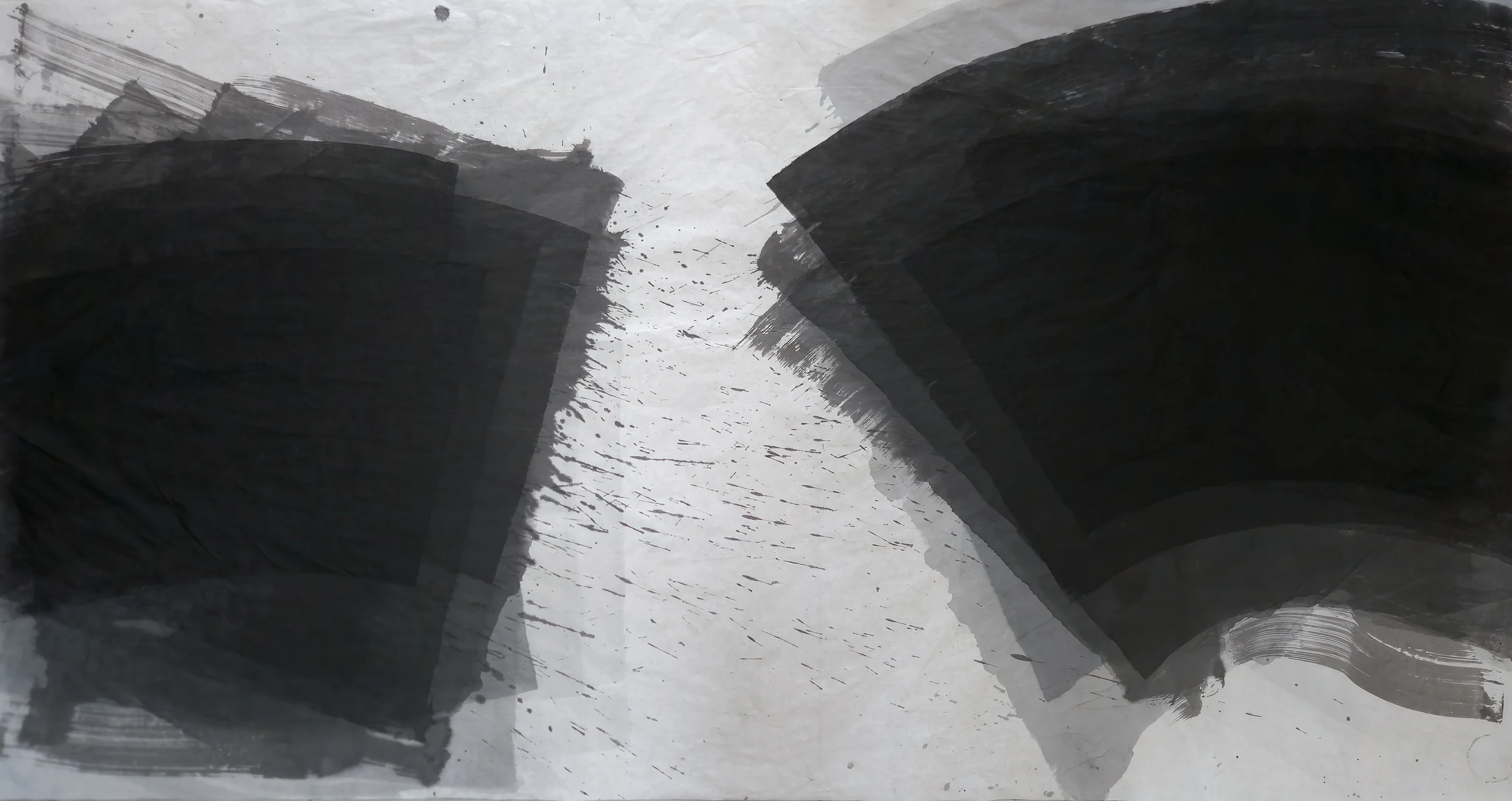
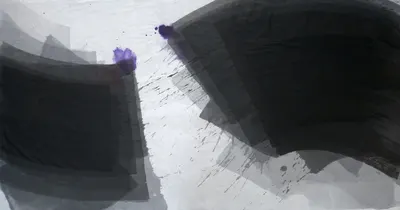
The engine's readingA square black slab and a swung black fan lean toward each other across a channel of bare paper, with spatter streaking down through the gap.
Record- Date
- 2026.10.16
- Dimensions
- 97 × 180 cm
- Paper
- Half-Cooked Red Star Mo She 6-Foot Bark Xuan Paper, self-sized from October 2026
- Ink
- Yi De Ge Yun Tou Yan, Boku-Undo Gentoku Super Concentrated, Yi De Ge Pine Soot Ink, Shisan Yue Calligraphy and Painting Ink
Two towers lean together at the end of my street, and at two in the morning the rain between them comes in sideways, lit, every drop a short bright scratch. One tower is all balconies, floor stepped out past floor, each lit ledge a little further into the weather than the one above it. The other is a car park. Dark, square, unbothered. I stand in the alley between them anyway, because the alley is where the night gets fast. High on the roofline one black drop has already landed and decided to stay. The car park hums to itself like a fridge. The balconies keep stepping out into the wet.
The reading
Written by the engine after the painting was rated, from the settled findings, and checked by hand before approval. It explains the numbers; it may not change them.
- Structure
- blocky slab at left, curved fan at right, pale channel between
- Movement
- both masses lean inward; spatter streaks diagonally down through the gap
- Coverage
- ink on about four fifths of the paper
- Tone
- five tonal steps, weighted dark
- Layering
- several offset translucent passes, readable at mass edges, buried under black cores
- Edges
- soft wash edges on stepped grey bands; broken dry-brush fringes at both bases
- Feibai
- none
- Open paper
- central channel, pinched near the top, opening toward the foot
- Chance marks
- spatter through central gap; small blot near top, left of centre; faint ring bottom right
- Frame
- slab runs off left edge; fan runs off top and right; top centre and foot open
Two black masses lean in from the sides and leave a channel of pale paper between them, pinched near the top and opening toward the foot. Spatter flies through that channel on a slant, the quickest thing on the sheet.
The fan on the right is where the painting lives. It swings down from the upper corner, and its lower edge steps outward in translucent grey bands, each pass offset from the one before and each still legible. The half-sized paper lets the ink spread without drowning what lies under it, so the passes sit in order. At the base the brush drags dry and leaves a frayed grey hem.
The slab on the left never finds that swing. Its shape owes nothing to the travel of the brush, and its black is sealed: the last pass buried the greys beneath, and inside the core only the crinkle of the paper moves. Its dry skirts are stiff. A small blot near the top edge and a faint ring at bottom right sit far from the action and cost nothing.
So the sheet stands on one fully made mass and a well-shaped gap. It is solid and worth a second look, held back from more by a partner that has nothing to say back.
How it was read
Read by the Visual Analysis Engine, version 23.11, on 2026.10.26: measured by code, then read 5 times by Claude Opus 5.5 against three reference paintings (R1 to R3), each read independent of the others. How the engine works.
Three views of one sheet.
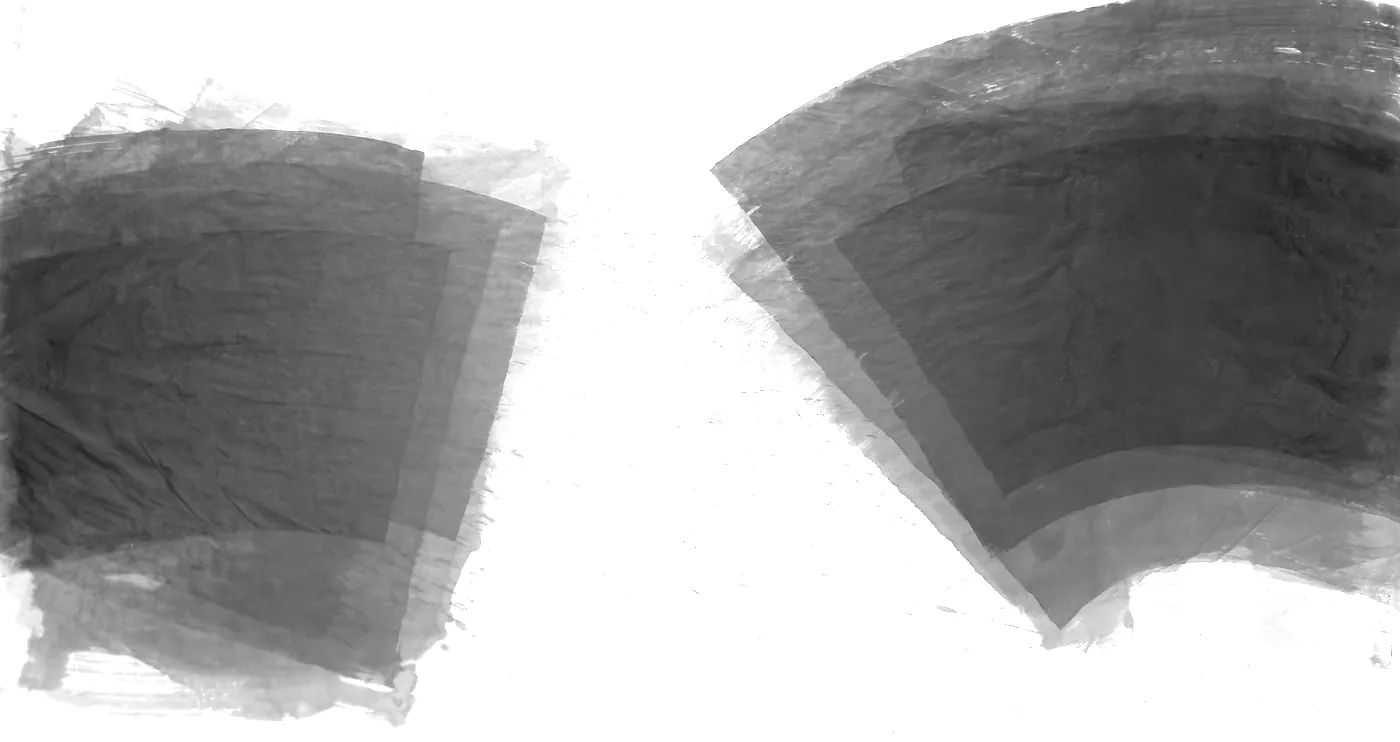
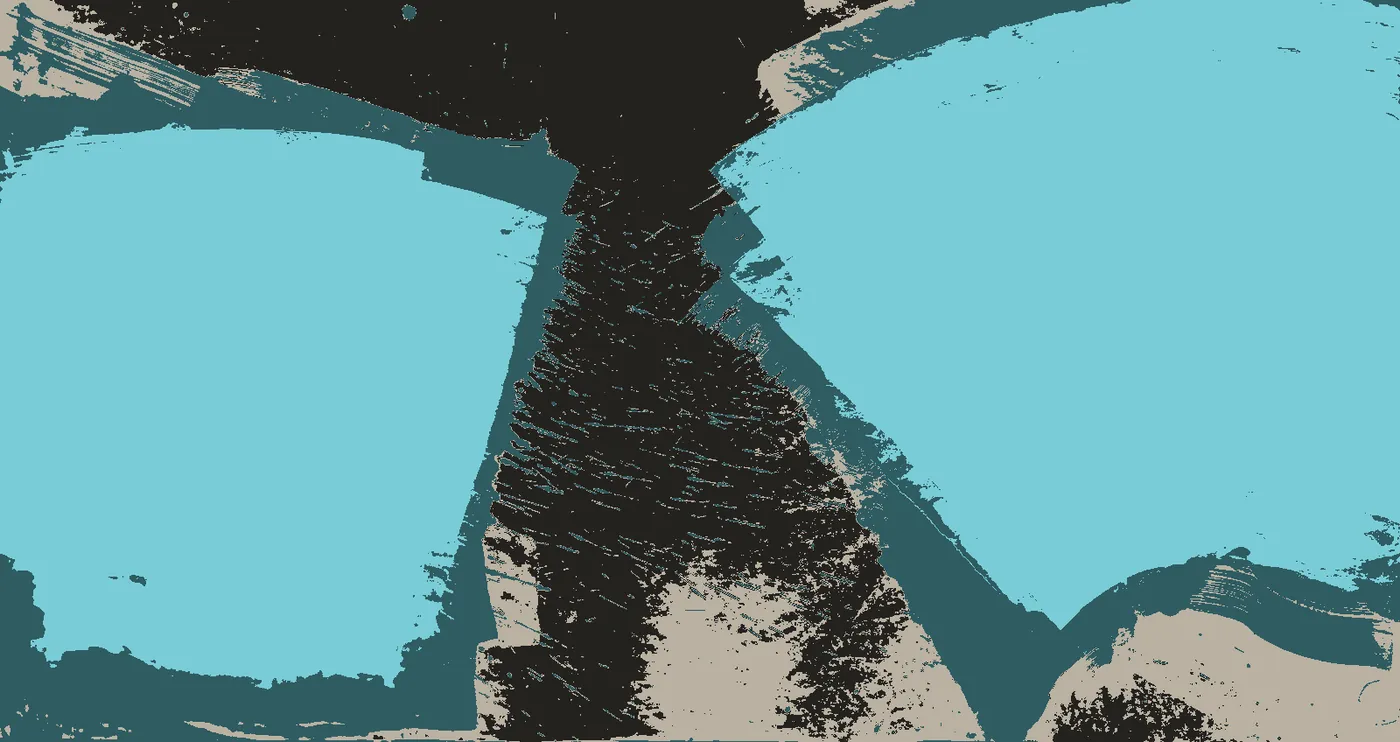
Left, the photograph. Centre, the tone stretch the model is shown beside it: the darkest 45% of tones spread over the whole range, so flat black, banding and stains show. Right, every pixel as the measuring code classes it: cyan black ink, deep teal translucent grey, stone the palest ink, near black bare paper.
5 families of tone.
Every inked pixel's brightness in 64 bins, smoothed; each circled peak holds at least 4% of the ink. Life inside the black: 0.051 (under 0.045 reads as flat).
Five reads, one answer.
Each quality placed on its ladder by each read, and the mean the engine keeps.
READ 1, IN ITS OWN WORDS
“Two layered black masses converge across a spattered gap, recalling R3's fans but heavier. The black cores are largely flat, and the left block is slab-like. The sheet is ordinary throughout and closest to R2.”
Right mass is a coherent arc following brush travel. The left mass is a heavy near-rectangle, stiff and slab-like, with a ragged lower edge.
WEAKEST Left block: bulky slab with blunt rectangular outline
STRONGEST Right arc fan whose curved outline follows the sweep
Stepped grey bands frame both cores. The tone-stretched view shows grain, and modulation of 0.051 is only just above flat. The black cores read largely uniform in colour.
WEAKEST Left black core reads nearly flat in colour view
STRONGEST Right fan's stepped grey bands around black core
Two or three translucent passes stack legibly at the edges of both masses. The black top pass hides most of what lies beneath.
WEAKEST Black cores cover earlier passes rather than revealing them
STRONGEST Right fan's translucent stacked arcs at the outer edge
Two masses face each other across a spattered central channel, which gives tension and a direction. With about 80% coverage the sheet is heavy, and the left block sits static.
WEAKEST Two heavy blocks crowd the frame with little breathing room
STRONGEST Spatter-filled central gap between the two converging masses
Ink is controlled, with dry-brush edges and spatter. A small stray blot sits at top centre. There is no tide line or stain inside the dark masses. Paper cockling is ignored.
WEAKEST Small blot near top centre
STRONGEST Dry-brush feathered edges on the right fan's lower arc
2 distinct places, 0 major.
Each read must name every flaw and where it is, in a ninth of the sheet. Here the reads named flaws in 2 distinct places, 7 mentions in all across 5 reads; the number in each ninth is how many times a flaw was named there. Reads agreeing on a place strengthen the evidence for one flaw; they do not multiply it.
The rating these readings produce, the rules applied and the arithmetic, with Peter's own rating where he gave one, are in the Archive record.
Date
2026.10.16, day 292 of the Crucible Year, one of 12 paintings from that date (9 shown). 0 works were registered in the fourteen days before. Paintings are dated by the day their batch was registered and photographed; each was finished that day or within the few days before. Phase: P4 S14 (working title).
T_391 among all 402
Every painting of the year by date; this one is outlined.
Materials
- Paper
- Half-Cooked Red Star Mo She 6-Foot Bark Xuan Paper, self-sized from October 2026, China Xuan Paper Co., Ltd., made 2026.04.08
- Ink MB6
- Yi De Ge Yun Tou Yan, Yi De Ge (Beijing)
- Ink MB8
- Boku-Undo Gentoku Super Concentrated, Boku-Undo
- Ink MB9
- Yi De Ge Pine Soot Ink, Yi De Ge (Beijing)
- Ink MB10
- Shisan Yue Calligraphy and Painting Ink, Shisan Yue (Thirteenth Month)
Related