T_395
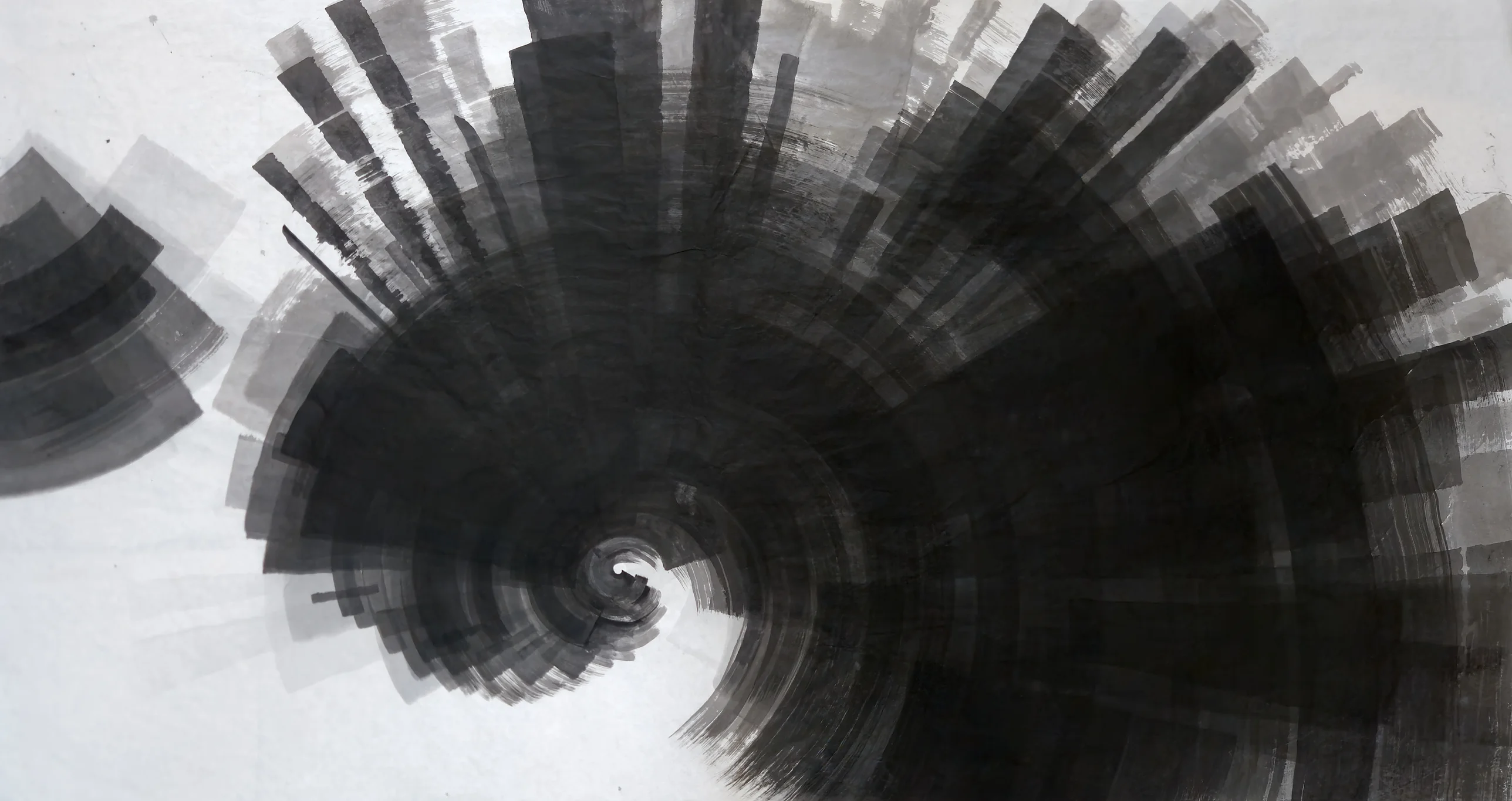
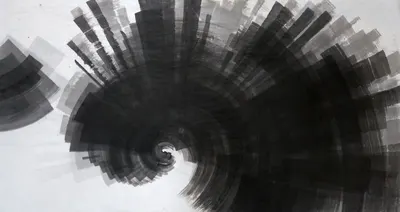
The engine's readingA wheel of overlapping ink bands coils around a small pale eye, throwing square-ended rays to the top edge while a grey fan turns alone at the left.
Record- Date
- 2026.10.16
- Dimensions
- 97 × 180 cm
- Paper
- Half-Cooked Red Star Mo She 6-Foot Bark Xuan Paper, self-sized from October 2026
- Ink
- Yi De Ge Yun Tou Yan, Boku-Undo Gentoku Super Concentrated, Yi De Ge Pine Soot Ink, Shisan Yue Calligraphy and Painting Ink
I read the pale eye as the place where light went in and did not come back. Galaxies keep a heavy secret at the middle like that, too dense to say anything, and they wear their arms thin and bright at the edges where the stars are young. The fan off to the left is a dwarf companion, a few billion years from being swallowed, still turning in step out of courtesy. I like the black core the way I like old rock: it has stopped telling stories. Long after the arms have gone to dust, the middle will still be there, folded and cracked, holding its own weight in the dark.
The reading
Written by the engine after the painting was rated, from the settled findings, and checked by hand before approval. It explains the numbers; it may not change them.
- Structure
- large spiral of radiating arc bands left of centre; separate fan fragment at left edge
- Movement
- rotation around a pale eye, rays thrown outward; left fan turns with it
- Coverage
- ink on about four fifths of the paper
- Tone
- three tonal steps, weighted dark
- Layering
- many translucent passes; readable at rim, top rays and left fan; buried centre right
- Edges
- crisp squared ends on top rays; dry ragged ends upper right; soft frayed tail below eye
- Feibai
- none
- Open paper
- pale wedge from lower left reaching into the spiral's eye; open corners top left
- Chance marks
- crease and crinkle lines through the dark core; small specks top left
- Frame
- ink runs off top, right, bottom and left edges; lower left and top left open
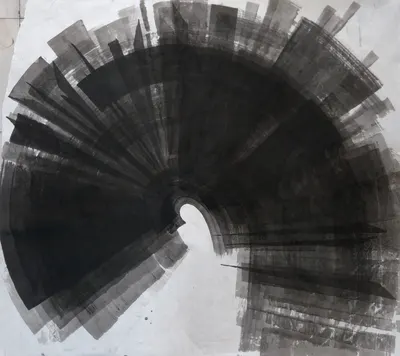
A wheel of black coils around a small pale eye, left of centre, and throws its rays up and out until they leave the top and right edges. At the left, a loose fan of greys turns the same way, like a moon kept at arm's length.
The rim is where the painting lives. Along the top, square-ended bands stand in grey after grey, each translucent pass laid over the last and still legible through it. The paper was sized before work began, which slows the sink and keeps the order of making on the surface. Where the brush runs dry at the upper right, the bands fray into streaks and the turn gets air. A pale wedge of open paper runs from the lower left into the eye and stops the coil from closing.
The cost sits at centre right. Dark pass on dark pass has stacked there until the strokes fuse into one slab, a near-flat black jammed against the lower and right edges. Fine crease lines in the paper are the only event inside it.
The turn convinces, and the outer passes show real control. The core holds the sheet down: a good painting, solidly made, whose loudest passage is its least eventful.
How it was read
Read by the Visual Analysis Engine, version 23.8, on 2026.10.16: measured by code, then read 5 times by Claude Opus 5.5 against three reference paintings (R1 to R3), each read independent of the others. How the engine works.
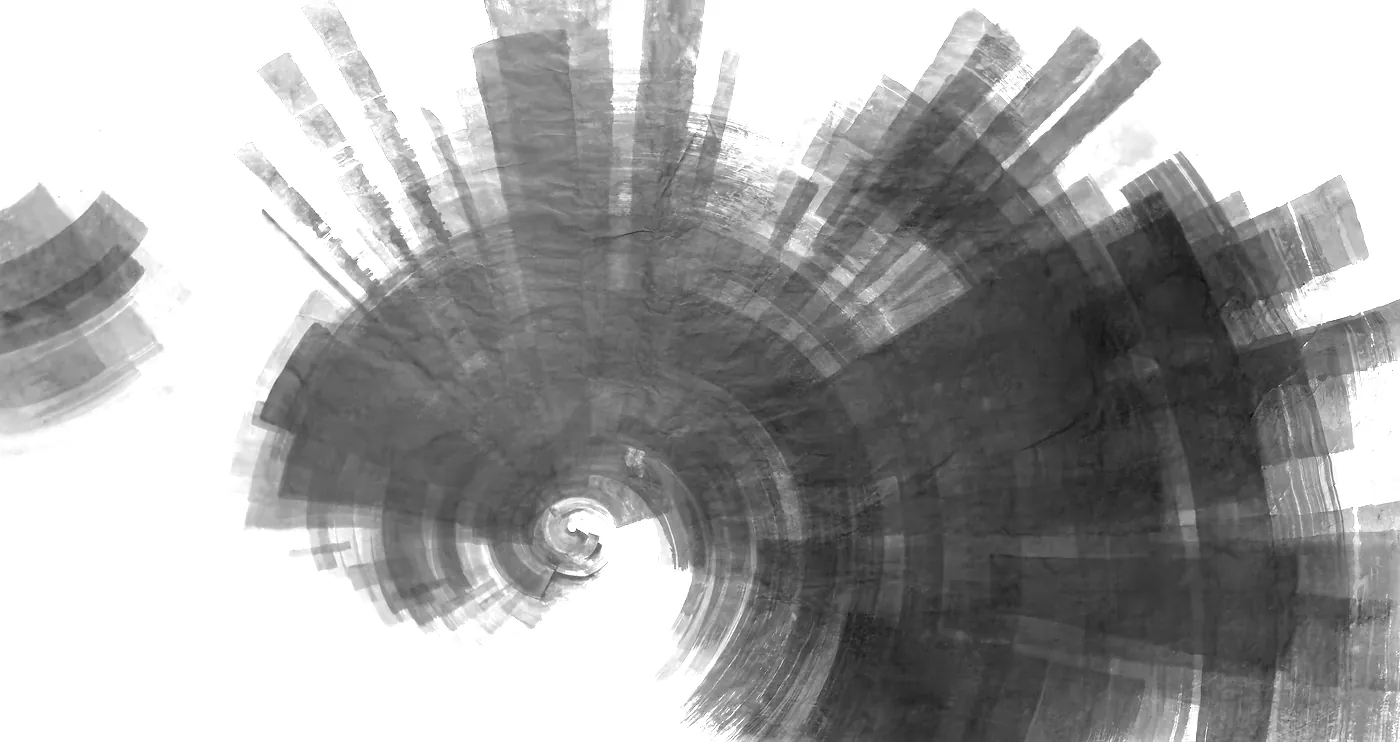
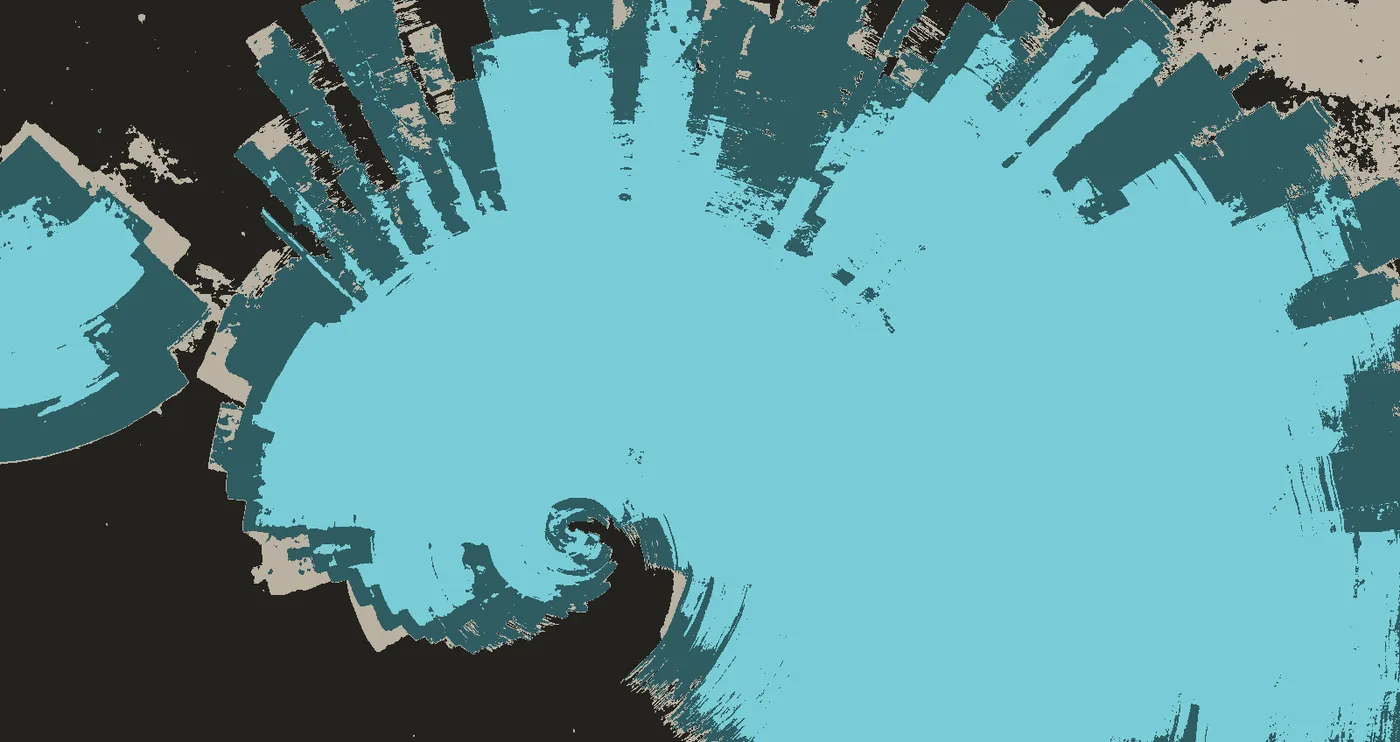
Three views of one sheet.
Left, the photograph. Centre, the tone stretch the model is shown beside it: the darkest 45% of tones spread over the whole range, so flat black, banding and stains show. Right, every pixel as the measuring code classes it: cyan black ink, deep teal translucent grey, stone the palest ink, near black bare paper.
3 families of tone.
Every inked pixel's brightness in 64 bins, smoothed; each circled peak holds at least 4% of the ink. Life inside the black: 0.051 (under 0.045 reads as flat).
Five reads, agreeing on 4 of 5 qualities.
Each quality placed on its ladder by each read, and the mean the engine keeps. Where reads differ, they differ by one rung; close calls resolve down.
READ 1, IN ITS OWN WORDS
“A spiral of layered radial strokes, close to R3 in idea, with strong ordered translucent passes. The over-dense, near-flat black mass at the lower right crowds the sheet and weighs down its form, tone and composition.”
Radial strokes follow the brush's travel around the spiral; the top rays end in stiff rectangular blocks, and the lower-right mass reads as filled bulk rather than strokes.
WEAKEST Lower-right dark mass merges into bulky undifferentiated slab
STRONGEST Arcing strokes winding tightly into the spiral eye
Modulation 0.051 is only just above flat. Greys step through the rays and the left fan, but the large central-right black barely varies in the colour view.
WEAKEST Dense black lower-right quadrant, near-flat inside
STRONGEST Graded translucent rays at upper right and left fan
Many translucent arc passes overlap in clear order at the rim and in the left fan, building depth; the order is lost only in the blackest centre-right area.
WEAKEST Overlaps inside the darkest mass become hard to read
STRONGEST Stacked translucent rays around the outer rim
The spiral gives a strong rotating direction, and the left fan answers it. With 80% ink coverage the lower right is jammed and the empty paper is reduced to the left margin.
WEAKEST Crowded heavy mass filling the lower right
STRONGEST Spiral eye drawing movement around the sheet
Ink handling is controlled and the dry-brush edges are used well. The stretched view shows paper creases and a small pale cloudy patch at the upper right; neither shows at viewing distance in the colour view.
WEAKEST Crinkled, cloudy texture in the central black
STRONGEST Dry-brush ragged ends on the upper rays
4 distinct places, 0 major.
Each read must name every flaw and where it is, in a ninth of the sheet. Here the reads named flaws in 4 distinct places, 13 mentions in all across 5 reads; the number in each ninth is how many times a flaw was named there. Reads agreeing on a place strengthen the evidence for one flaw; they do not multiply it.
The rating these readings produce, the rules applied and the arithmetic, with Peter's own rating where he gave one, are in the Archive record.
Date
2026.10.16, day 292 of the Crucible Year, one of 12 paintings from that date (9 shown). 0 works were registered in the fourteen days before. Paintings are dated by the day their batch was registered and photographed; each was finished that day or within the few days before. Phase: P4 S14 (working title).
T_395 among all 402
Every painting of the year by date; this one is outlined.
Materials
- Paper
- Half-Cooked Red Star Mo She 6-Foot Bark Xuan Paper, self-sized from October 2026, China Xuan Paper Co., Ltd., made 2026.04.08
- Ink MB6
- Yi De Ge Yun Tou Yan, Yi De Ge (Beijing)
- Ink MB8
- Boku-Undo Gentoku Super Concentrated, Boku-Undo
- Ink MB9
- Yi De Ge Pine Soot Ink, Yi De Ge (Beijing)
- Ink MB10
- Shisan Yue Calligraphy and Painting Ink, Shisan Yue (Thirteenth Month)
Related