T_392
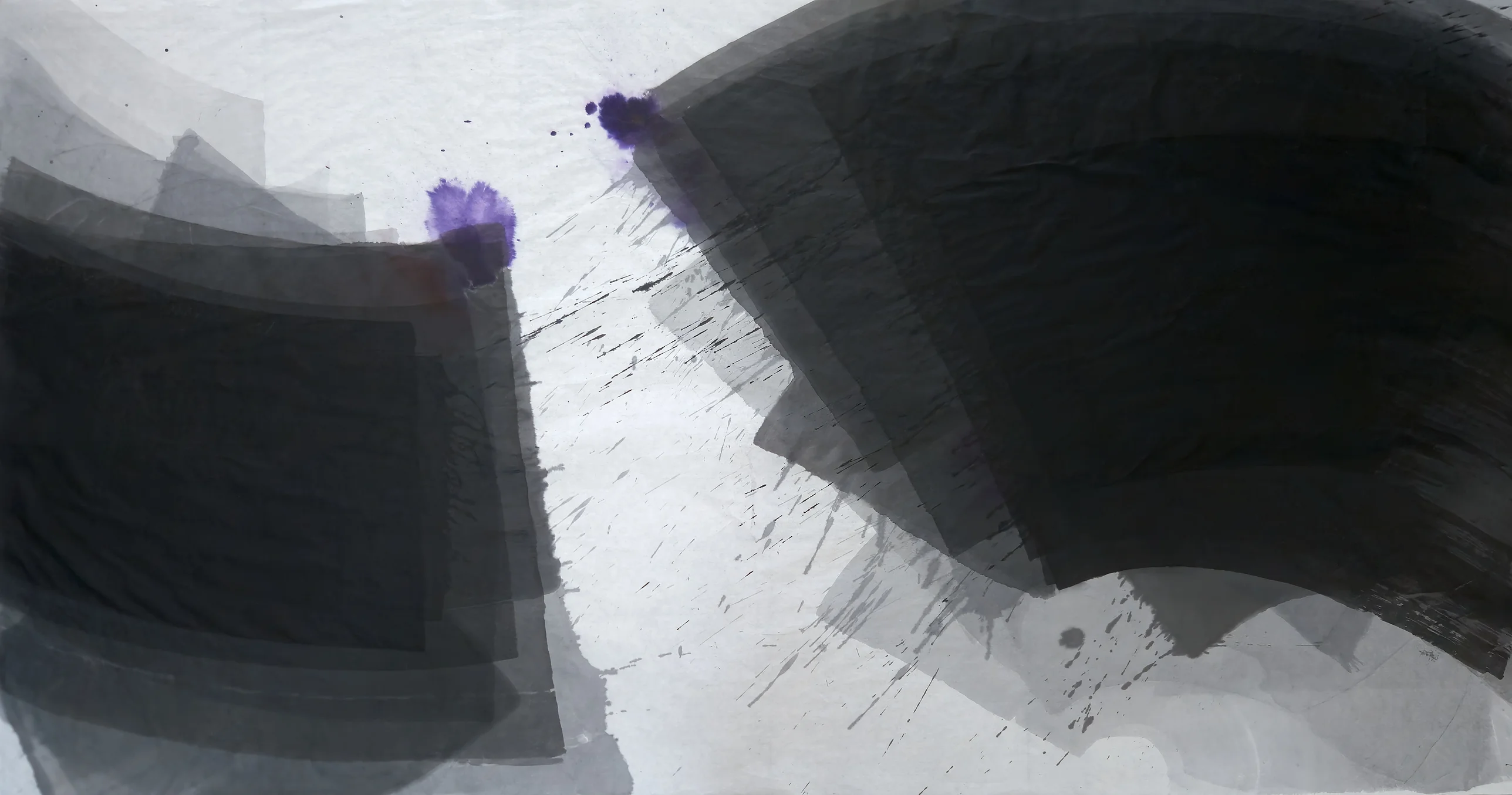
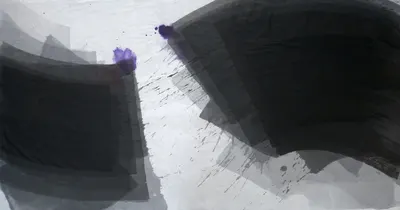
The engine's readingA squared black stack and a rising banded fan face each other across a white channel, joined by flung spatter and two violet drops.
Record- Date
- 2026.10.16
- Dimensions
- 97 × 180 cm
- Paper
- Half-Cooked Red Star Mo She 6-Foot Bark Xuan Paper, self-sized from October 2026
- Ink
- Yi De Ge Yun Tou Yan, Boku-Undo Gentoku Super Concentrated, Yi De Ge Pine Soot Ink, Shisan Yue Calligraphy and Painting Ink, colour inks
Two hulls, one fast, one parked, and a violet light burning on each nose so they can find each other across the dark between. I was the relay. My job was the static: the long diagonal streaks you get when a signal is pushed across a gap too wide for it, half arriving, half scattering into small black debris on the way. The fast hull was singing, all banked wings and exhaust. The parked one was a cargo block, stubborn, pure mass, running its engines on the memory of a launch. I liked it anyway. You need something that heavy to aim at. Last log entry: two lamps the colour of bruised plums, blinking at each other, close enough now to touch.
The reading
Written by the engine after the painting was rated, from the settled findings, and checked by hand before approval. It explains the numbers; it may not change them.
- Structure
- squared stack at left, broad banded fan at right, open channel between
- Movement
- right fan sweeps up and out to the right; left stack stands still
- Coverage
- ink on about four fifths of the paper
- Tone
- five tonal steps, weighted dark
- Layering
- many translucent passes; readable at stepped edges, sealed in both dark cores
- Edges
- crisp stepped edges on both masses; soft wash edges along the bottom
- Feibai
- present, along the lower trailing edge of the right fan
- Open paper
- diagonal white channel through the centre, widening at top and bottom
- Colour
- violet drops at the facing upper corners of both masses
- Chance marks
- diagonal spatter across the channel; cloudy pale wash with tide edges below right fan; brownish spot at left stack's corner
- Frame
- ink runs off left, top and right edges; centre top and centre bottom stay open
Two dark masses lean toward each other across a white channel, and only one of them is moving. The right mass rises from the centre as a broad fan, banded from pale grey to near black, and sweeps up and out past the top and right edges. The left mass stays where it was put.
The right fan is where the painting lives. Its edges step down in translucent bands, each pass laid over the last and still legible, because the alum-sized paper holds a wet edge where it lands. At the lower right the stroke thins into dry streaks that still carry the direction of the brush. Across the gap, spatter flies on the same diagonal, and two violet drops sit at the facing corners like signal lamps, tying the halves together.
The left block pays for all that motion. It is a squared stack pressed against the edge, and its core has sealed into one even black; the only life inside is the crinkle of the paper. A cloudy pale wash with soft tide edges sits under the right arc.
Those costs are real and they stay at the margins. The fan, the charged gap and the flung ink make a painting that is resolved and alive, and the heavy block reads as weight it can afford.
How it was read
Read by the Visual Analysis Engine, version 23.8, on 2026.10.17: measured by code, then read 5 times by Claude Opus 5.5 against three reference paintings (R1 to R3), each read independent of the others. How the engine works.
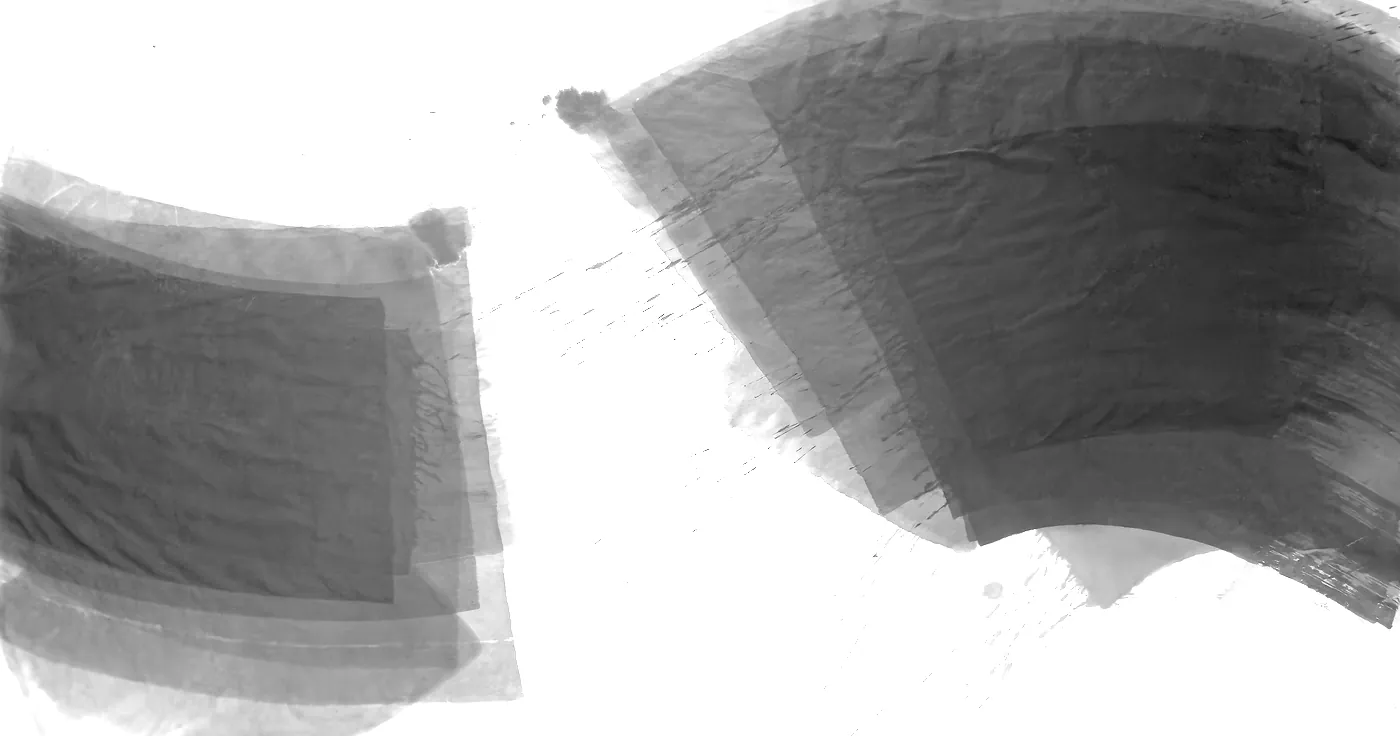
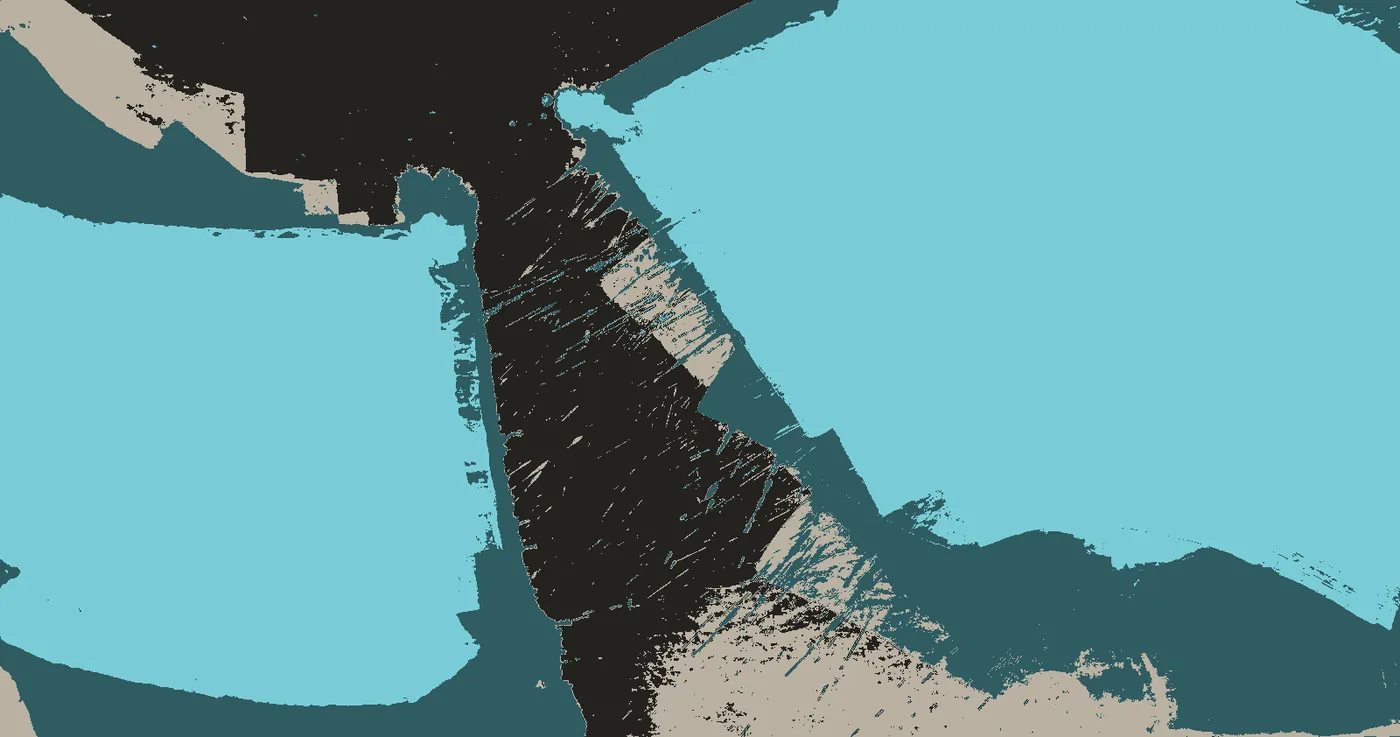
Three views of one sheet.
Left, the photograph. Centre, the tone stretch the model is shown beside it: the darkest 45% of tones spread over the whole range, so flat black, banding and stains show. Right, every pixel as the measuring code classes it: cyan black ink, deep teal translucent grey, stone the palest ink, near black bare paper.
5 families of tone.
Every inked pixel's brightness in 64 bins, smoothed; each circled peak holds at least 4% of the ink. Life inside the black: 0.058 (under 0.045 reads as flat).
Five reads, agreeing on 4 of 5 qualities.
Each quality placed on its ladder by each read, and the mean the engine keeps. Where reads differ, they differ by one rung; close calls resolve down.
READ 1, IN ITS OWN WORDS
“Layered translucent passes build two facing masses with legible order, nearer R3's method but blockier. Left slab is stiff, dark cores fairly flat, composition working but heavy. Violet drops are deliberate colour.”
Right mass follows a curved brush travel with dry-brush ending; left mass is a stiff squared slab stack. Walls hold throughout.
WEAKEST Left block: bulky stacked rectangle, slab-like
STRONGEST Right arcing fan sweeping to dry-brush tail
Stepped greys at both masses' edges, five tonal plateaus; dark cores carry only paper-crinkle texture, modulation 0.058 modest, left core fairly flat.
WEAKEST Left block's dark core, near-uniform inside
STRONGEST Right fan's stepped grey bands toward black
Several translucent passes stack in clear order on both masses; overlapping edges stay legible and build depth, as in R3, though cores close up.
WEAKEST Dark cores where passes merge into one black
STRONGEST Translucent stacked edges of the right fan
Two masses face across a shaped white channel, spatter and violet drops carrying the eye; heavy coverage, left block inert and crowded to the edge.
WEAKEST Left block sits static, heavy against left edge
STRONGEST Gap with spatter linking the two masses
Ink controlled; violet drops are deliberate colour. Paper wrinkle texture in dark interiors and a small brownish mark near the left block corner are minor.
WEAKEST Small brownish spot at left block's top-right corner
STRONGEST Dry-brush tail of right fan, lower right
5 distinct places, 0 major.
Each read must name every flaw and where it is, in a ninth of the sheet. Here the reads named flaws in 5 distinct places, 11 mentions in all across 5 reads; the number in each ninth is how many times a flaw was named there. Reads agreeing on a place strengthen the evidence for one flaw; they do not multiply it.
The rating these readings produce, the rules applied and the arithmetic, with Peter's own rating where he gave one, are in the Archive record.
Date
2026.10.16, day 292 of the Crucible Year, one of 12 paintings from that date (9 shown). 0 works were registered in the fourteen days before. Paintings are dated by the day their batch was registered and photographed; each was finished that day or within the few days before. Phase: P4 S14 (working title).
T_392 among all 402
Every painting of the year by date; this one is outlined.
Materials
- Paper
- Half-Cooked Red Star Mo She 6-Foot Bark Xuan Paper, self-sized from October 2026, China Xuan Paper Co., Ltd., made 2026.04.08
- Ink MB6
- Yi De Ge Yun Tou Yan, Yi De Ge (Beijing)
- Ink MB8
- Boku-Undo Gentoku Super Concentrated, Boku-Undo
- Ink MB9
- Yi De Ge Pine Soot Ink, Yi De Ge (Beijing)
- Ink MB10
- Shisan Yue Calligraphy and Painting Ink, Shisan Yue (Thirteenth Month)
- Colour
- colour inks, recorded together
Related