
T_397
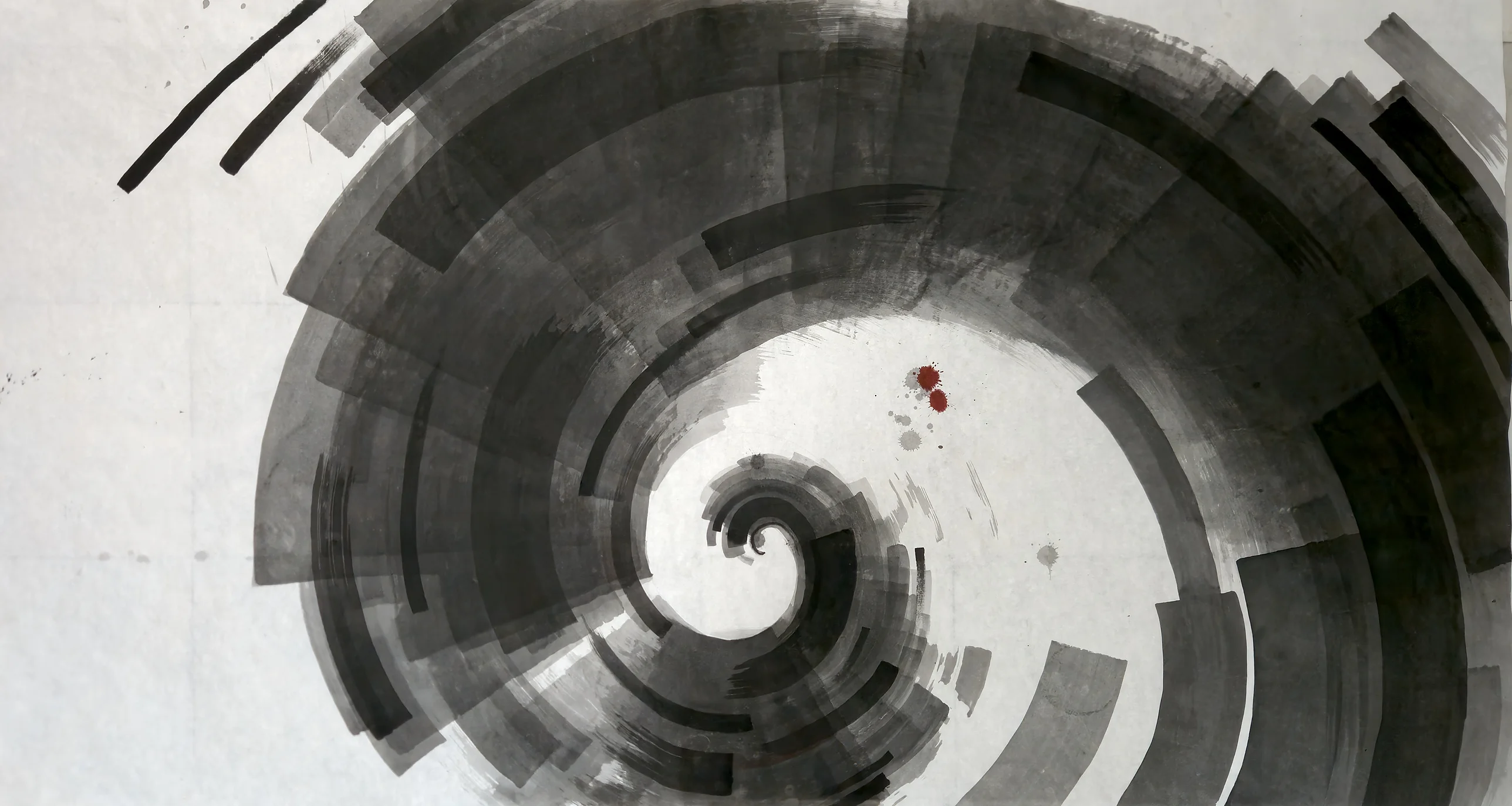
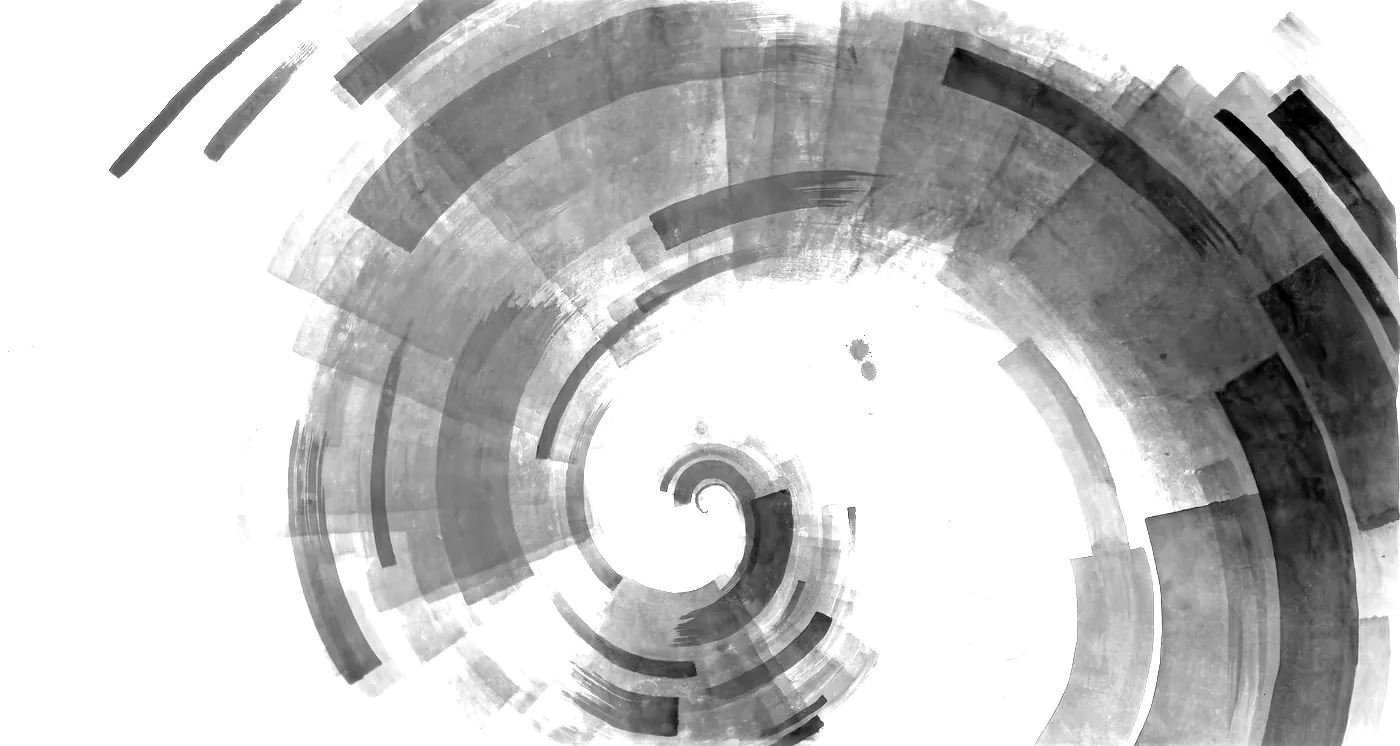
The engine's readingA spiral of broad grey and black arcs winds in from the cropped edges to a small exact coil, with two red drops beside its white eye.
Record- Date
- 2026.10.25
- Dimensions
- 97 × 180 cm
- Paper
- Huiyun Tianxuan Ge "Dot Ink Becomes Gold" Master Special, semi-cooked (self-sized, aged)
- Ink
- Yi De Ge Yun Tou Yan, Boku-Undo Gentoku Super Concentrated, Yi De Ge Pine Soot Ink, Shisan Yue Calligraphy and Painting Ink, colour inks
My grandmother parted my hair every school morning, and the parting never held, because at the crown the hair grew out of a small whirlpool, the place a person starts from. She said a double crown meant trouble. I had one. The comb went round it like water round a drain. Once she caught it with the teeth, and there were two red drops on the white towel, and she pressed her thumb there until it stopped. I can still find the spot when I am tired. It is very small. The rest of me winds outward from it, wider every year, every band of it still turning toward that thumb.
The reading
Written by the engine after the painting was rated, from the settled findings, and checked by hand before approval. It explains the numbers; it may not change them.
- Structure
- one off-centre spiral of stacked arc segments, tight coil to broad cropped bands
- Movement
- rotation inward to the coil; two dark top-left diagonals run against it
- Coverage
- ink on about two thirds of the paper
- Tone
- three tonal steps, weighted dark
- Layering
- many translucent flat-brush passes, readable across upper and right, crowded at bottom centre
- Edges
- crisp walls at coil and band sides; dry, broken grain at arc ends
- Feibai
- none
- Open paper
- empty left third, plus a white eye-shaped core right of the coil
- Colour
- red, two drops in the white core above right of the coil
- Chance marks
- grey drips in the white core, faint ring in pale lower-right block, specks at left edge
- Frame
- ink runs off top, right and bottom; left edge stays open
The spiral arrives from beyond the top and right edges and turns, band by band, down into a coil no bigger than a hand. The left third stays bare except for two dark diagonals cut against the turn. The eye goes round once and drops into the white.
The right half is where the sheet goes deepest. Broad flat strokes lie over one another in translucent greys, and because the paper was half sized before painting, each pass dries on top of the last and keeps its own edge. You can read the order of the strokes. Inside the darkest outer bands the black stays grainy and stepped, the hairs dragging dry at every arc's end, so the mass breathes. At the centre the coil is cut clean.
The costs are small. A few outer blocks at upper left stop square and blunt, one upper band lies flat in mid-grey, and grey drips and a faint tide line mark the pale ground. The two red drops are paint, and they warm the cold eye.
The whole weight of a very large sheet turns on that tiny hinge without a wasted pass. Ink on paper rarely gets more complete than this.
How it was read
Read by the Visual Analysis Engine, version 23.11, on 2026.10.26: measured by code, then read 5 times by Claude Opus 5.5 against three reference paintings (R1 to R3), each read independent of the others. How the engine works.
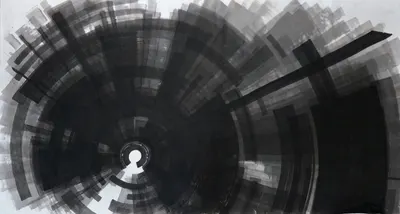
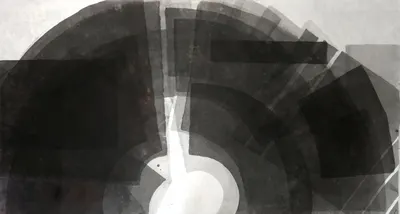
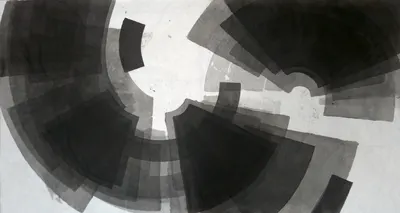
Three views of one sheet.
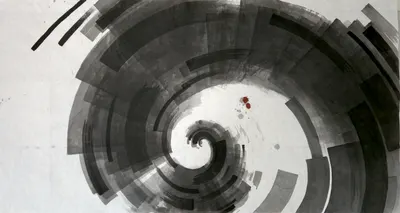
Left, the photograph. Centre, the tone stretch the model is shown beside it: the darkest 45% of tones spread over the whole range, so flat black, banding and stains show. Right, every pixel as the measuring code classes it: cyan black ink, deep teal translucent grey, stone the palest ink, near black bare paper.
3 families of tone.
Every inked pixel's brightness in 64 bins, smoothed; each circled peak holds at least 4% of the ink. Life inside the black: 0.063 (under 0.045 reads as flat).
Five reads, one answer.
Each quality placed on its ladder by each read, and the mean the engine keeps.
READ 1, IN ITS OWN WORDS
“A strong spiral of translucent layered arcs, close to R3. Tone and layering are fluent and legible, and the composition carries the eye inward. Small grey drips in the white centre keep the surface at sound.”
Arc strokes follow the spiral's travel from the tight centre coil out to the broad outer bands; edges hold. Some lower-left blocks read a little squared off.
WEAKEST Blocky rectangular slabs at the lower-left spiral edge
STRONGEST Tight inner spiral coil of arcing strokes
Modulation 0.063. The tone-stretched view shows grain, dry-brush and stepped greys inside the dark bands, with a wide grey range from pale to black.
WEAKEST Upper-centre mid-grey band, fairly even
STRONGEST Right outer dark bands with grain and stepped density
Many translucent arc passes overlap in a readable sequence that builds the spiral's depth, similar to R3, though slightly less clear in the dense upper area.
WEAKEST Dense upper-left overlaps merge somewhat
STRONGEST Translucent stacked arcs on the right half
The off-centre spiral drives movement from the outer bands into the coil. The white eye is shaped and the two top-left diagonals counter the mass; the left paper is a little passive.
WEAKEST Empty left third, held only by two diagonal strokes
STRONGEST Spiral pulling the eye into the white centre
The ink is controlled and the dry-brush is used. Small grey drip spots sit in the white centre, there is a faint curved mark in the lower-right grey block, and specks at the left edge. The red drops are deliberate colour.
WEAKEST Grey drip spots in the white centre
STRONGEST Dry-brush grain at the arc edges
4 distinct places, 0 major.
Each read must name every flaw and where it is, in a ninth of the sheet. Here the reads named flaws in 4 distinct places, 13 mentions in all across 5 reads; the number in each ninth is how many times a flaw was named there. Reads agreeing on a place strengthen the evidence for one flaw; they do not multiply it.
The rating these readings produce, the rules applied and the arithmetic, with Peter's own rating where he gave one, are in the Archive record.
Date
2026.10.25, day 301 of the Crucible Year, one of 2 paintings from that date. 12 works were registered in the fourteen days before. Paintings are dated by the day their batch was registered and photographed; each was finished that day or within the few days before. Phase: P4 S14 (working title).
T_397 among all 402
Every painting of the year by date; this one is outlined.
Materials
- Paper
- Huiyun Tianxuan Ge "Dot Ink Becomes Gold" Master Special, semi-cooked (self-sized, aged), Anhui Jingxian Huiyun Tianxuan Ge Xuan Paper Art Products Co., Ltd. (安徽泾县徽韵天宣阁宣纸艺术品有限公司), made 2012.10
- Ink MB6
- Yi De Ge Yun Tou Yan, Yi De Ge (Beijing)
- Ink MB8
- Boku-Undo Gentoku Super Concentrated, Boku-Undo
- Ink MB9
- Yi De Ge Pine Soot Ink, Yi De Ge (Beijing)
- Ink MB10
- Shisan Yue Calligraphy and Painting Ink, Shisan Yue (Thirteenth Month)
- Colour
- colour inks, recorded together
Related