T_399
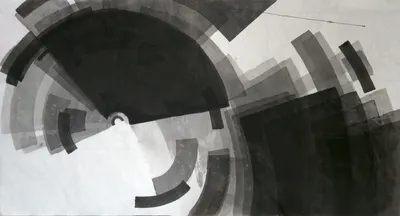
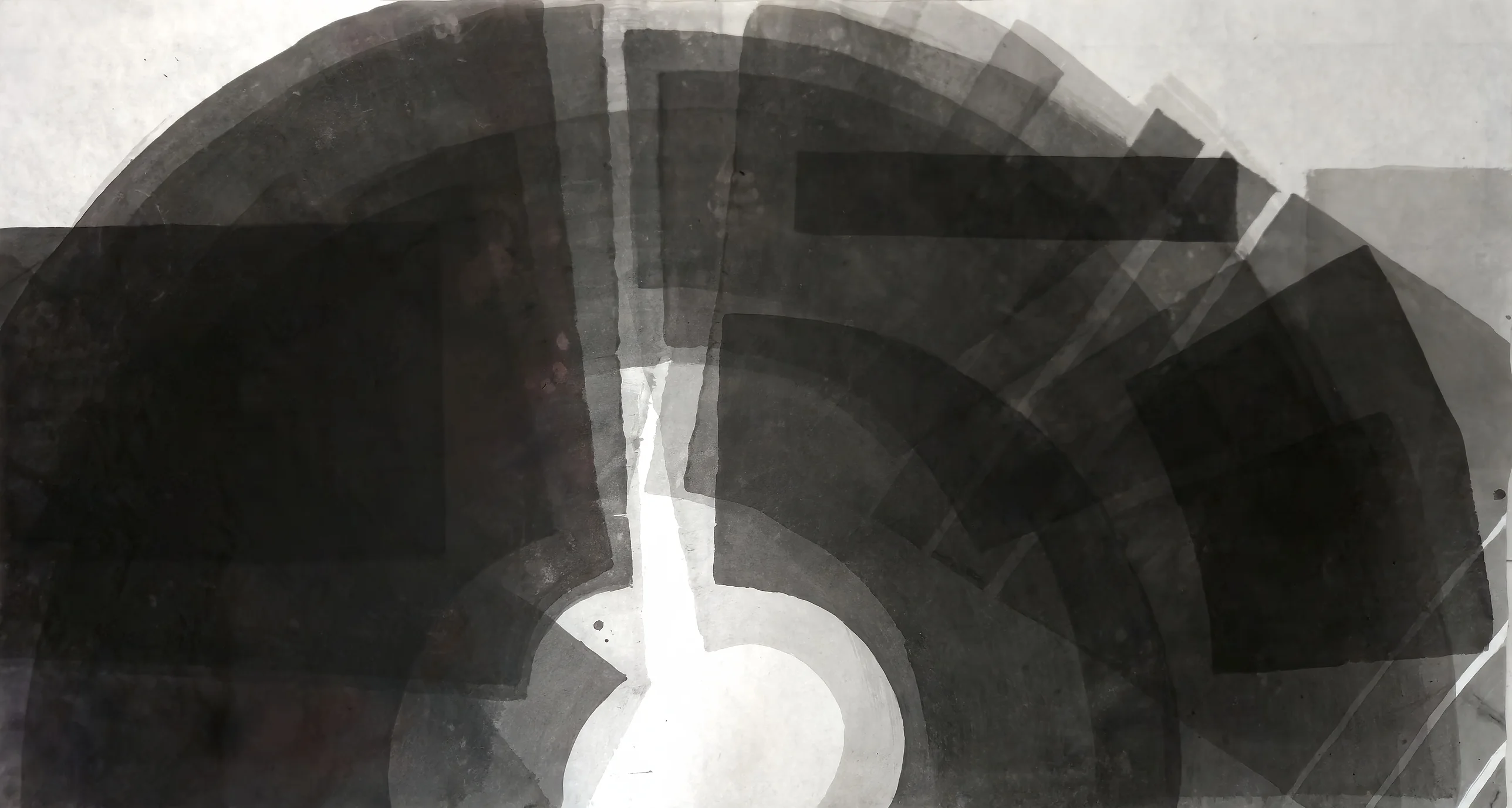
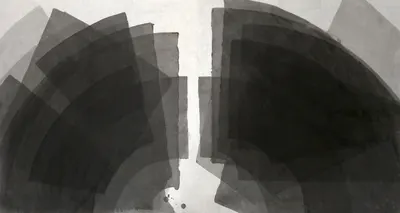
The engine's readingA dome of black and grey ink across a long sheet, fanned arcs at right and a black slab at left, split down to a white circle.
Record- Date
- 2026.10.26
- Dimensions
- 97 × 180 cm
- Paper
- Huiyun Tianxuan Ge "Dot Ink Becomes Gold" Master Special, semi-cooked (self-sized, aged)
- Ink
- Yi De Ge Yun Tou Yan, Boku-Undo Gentoku Super Concentrated, Yi De Ge Pine Soot Ink, Shisan Yue Calligraphy and Painting Ink, colour inks
From the roof the alley looks like this: two black blocks leaning in, a crack of sky running down between them to a pool of light where the street lamp lands. I lived over one once. The left block was the office tower that never turned a light on, a dark so solid you could set a drink on it. The right side was the parking garage, ramp over ramp, each level a shade paler than the one beneath, headlights climbing the spiral at the dead hour, slowly, with nowhere to be. I leaned on the rail and watched the bottom of the crack. Moths. A cat. A bicycle wheel, lit, ticking.
The reading
Written by the engine after the painting was rated, from the settled findings, and checked by hand before approval. It explains the numbers; it may not change them.
- Structure
- dark half-dome; left rectangular slab, right fan of arcs, split by a white cut
- Movement
- radial sweep around the bottom-centre circle; left slab and top-right bar sit square against it
- Coverage
- ink on about nine tenths of the paper
- Tone
- three tonal steps, weighted dark
- Layering
- many translucent passes; legible in the right fan, buried under the left slab
- Edges
- crisp on right wedges and around the circle; ragged along the vertical cut
- Feibai
- none
- Open paper
- keyhole of white circle at bottom centre and vertical cut; top corners
- Colour
- faint maroon warmth inside the left dark mass
- Chance marks
- pale specks beside the cut; dark blot lower left; small dark spatter near the circle
- Frame
- ink runs off left, bottom and lower right; top corners stay open
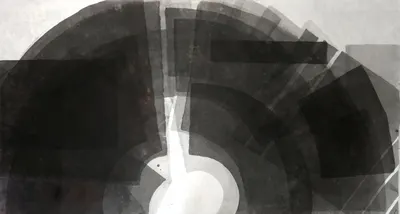
A dark dome fills the sheet, and a white keyhole opens at its foot: a circle of bare paper at bottom centre, reached by a ragged cut from the top. Everything turns on that opening. To the right, arcs and wedges fan out from it like the vanes of a shutter easing open.
The fan is where the sheet lives. Translucent passes lie one over another, each wall still clean, so the greys climb from smoke to near black and the order of laying reads band by band. The sized paper stops each wash at its edge and lets the next sit on top.
The left half pays for it. A broad rectangle of near black sits square across the earlier arcs and buries them, and inside it the dark barely moves; its faint maroon is too quiet to lift it. Its blunt corners refuse the turn the rest of the sheet makes. Pale specks beside the cut and a blot low at left are small, and absorbed.
Even so, the keyhole and its fan give the sheet a centre, a direction and real depth. The slab is dead weight, not ruin. A serious, fine sheet, held a step short by one stubborn block.
How it was read
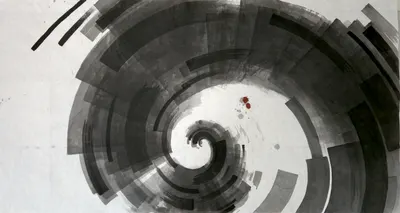
Read by the Visual Analysis Engine, version 23.11, on 2026.10.26: measured by code, then read 5 times by Claude Opus 5.5 against three reference paintings (R1 to R3), each read independent of the others. How the engine works.
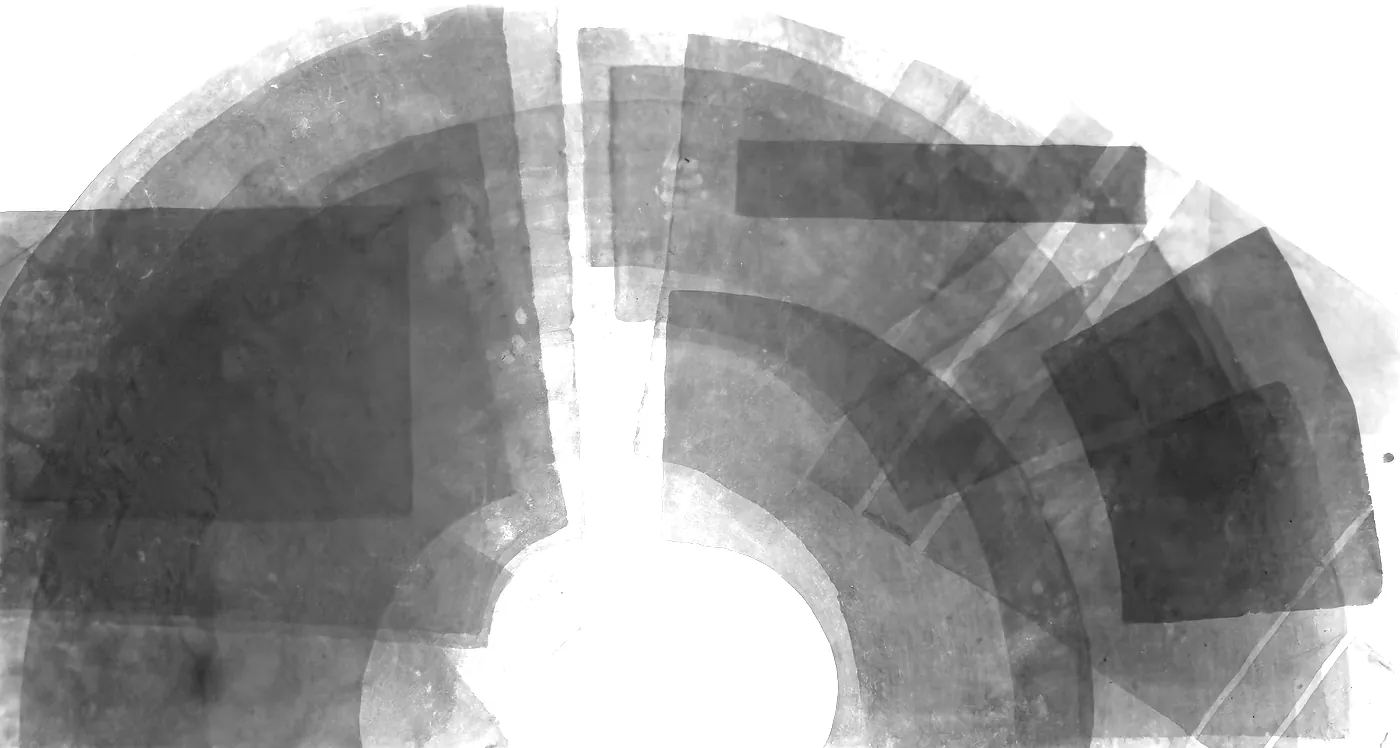
Three views of one sheet.
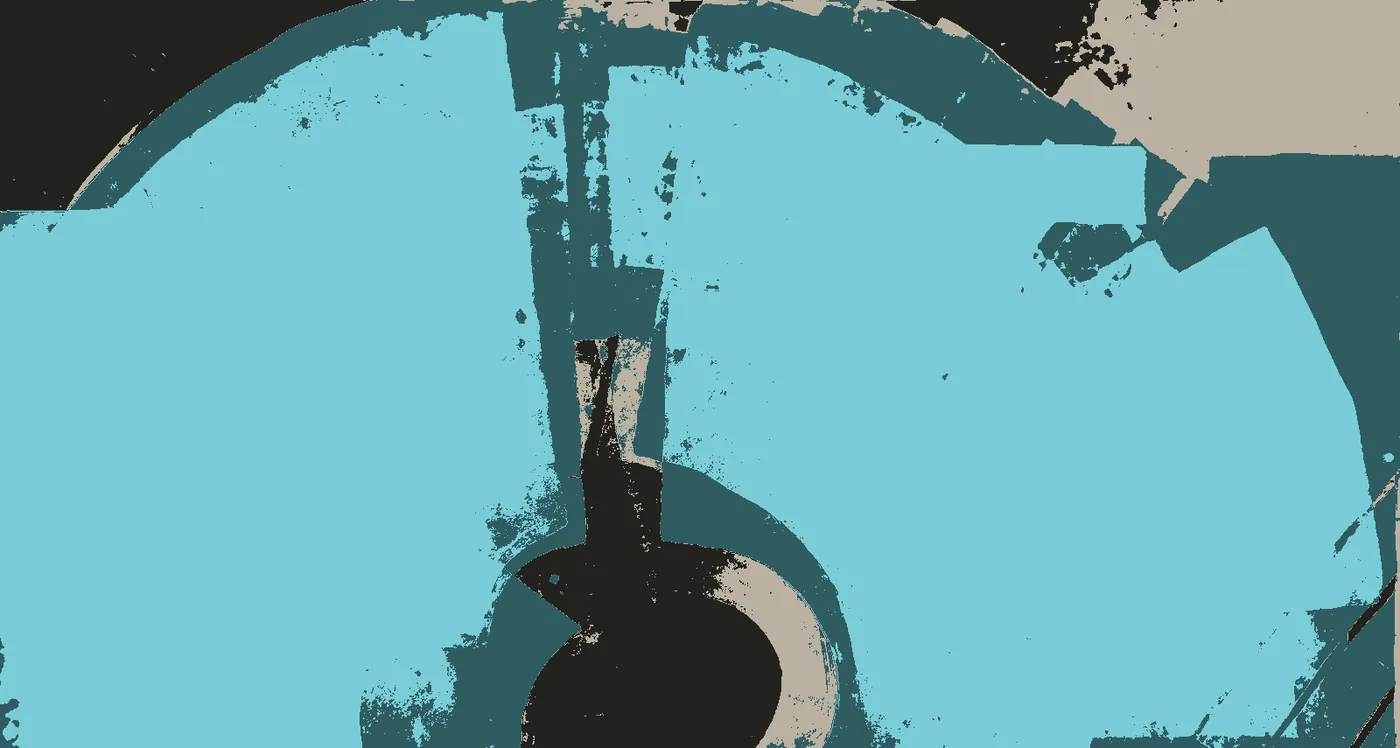
Left, the photograph. Centre, the tone stretch the model is shown beside it: the darkest 45% of tones spread over the whole range, so flat black, banding and stains show. Right, every pixel as the measuring code classes it: cyan black ink, deep teal translucent grey, stone the palest ink, near black bare paper.
3 families of tone.
Every inked pixel's brightness in 64 bins, smoothed; each circled peak holds at least 4% of the ink. Life inside the black: 0.053 (under 0.045 reads as flat).
Five reads, one answer.
Each quality placed on its ladder by each read, and the mean the engine keeps.
READ 1, IN ITS OWN WORDS
“This is a radial, layered sheet in R3's mode, with legible translucent passes on the right. It is heavier and more crowded, with a blunt, flat-ish left slab and minor specks near the central gap.”
Arc bands around the central white hole hold their walls and follow the brush's travel. The big left rectangle and the top-right bar are stiff, blunt slabs.
WEAKEST Bulky rectangular slab dominating the left half
STRONGEST Curved arc bands circling the white core
The right arcs step through several translucent greys. The left black mass is only mottled (modulation 0.053), and its darks read as surface, not depth.
WEAKEST Left dark block is nearly uniform inside
STRONGEST Stepped translucent greys in the right-side arcs
Many translucent wedge and arc passes overlap on the right and can be read in order. The overlaps build radial depth, much like R3.
WEAKEST Left block covers the earlier arcs beneath it
STRONGEST Overlapping fan of wedges on the right
The radial movement and the white core with its vertical cut give the sheet direction. With 90% coverage it is crowded, and the left block sits dead and heavy.
WEAKEST Heavy left block crowds the left half
STRONGEST Radial sweep around the white core and vertical split
The ink is controlled overall. There are small pale specks and blotches in the left-centre dark beside the vertical gap, and a minor dark spot at the lower left.
WEAKEST Pale specks inside the dark mass near the gap
STRONGEST Clean edges on the translucent wedges at right
5 distinct places, 0 major.
Each read must name every flaw and where it is, in a ninth of the sheet. Here the reads named flaws in 5 distinct places, 11 mentions in all across 5 reads; the number in each ninth is how many times a flaw was named there. Reads agreeing on a place strengthen the evidence for one flaw; they do not multiply it.
The rating these readings produce, the rules applied and the arithmetic, with Peter's own rating where he gave one, are in the Archive record.
Date
2026.10.26, day 302 of the Crucible Year, one of 5 paintings from that date. 14 works were registered in the fourteen days before. Paintings are dated by the day their batch was registered and photographed; each was finished that day or within the few days before. Phase: P4 S14 (working title).
T_399 among all 402
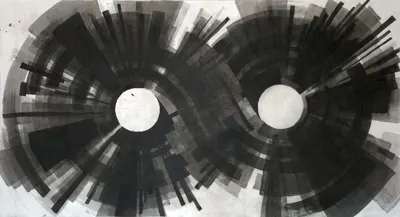
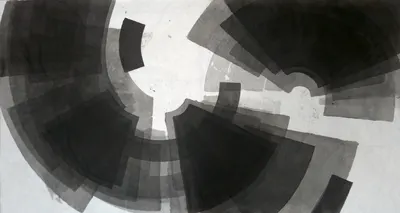
Every painting of the year by date; this one is outlined.
Materials
- Paper
- Huiyun Tianxuan Ge "Dot Ink Becomes Gold" Master Special, semi-cooked (self-sized, aged), Anhui Jingxian Huiyun Tianxuan Ge Xuan Paper Art Products Co., Ltd. (安徽泾县徽韵天宣阁宣纸艺术品有限公司), made 2012.10
- Ink MB6
- Yi De Ge Yun Tou Yan, Yi De Ge (Beijing)
- Ink MB8
- Boku-Undo Gentoku Super Concentrated, Boku-Undo
- Ink MB9
- Yi De Ge Pine Soot Ink, Yi De Ge (Beijing)
- Ink MB10
- Shisan Yue Calligraphy and Painting Ink, Shisan Yue (Thirteenth Month)
- Colour
- colour inks, recorded together
Related