T_402
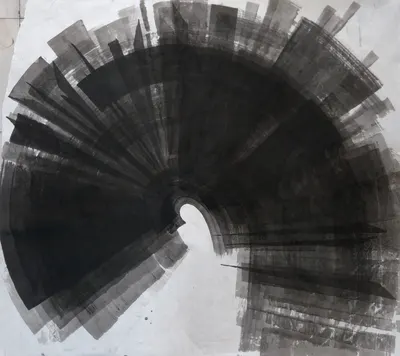
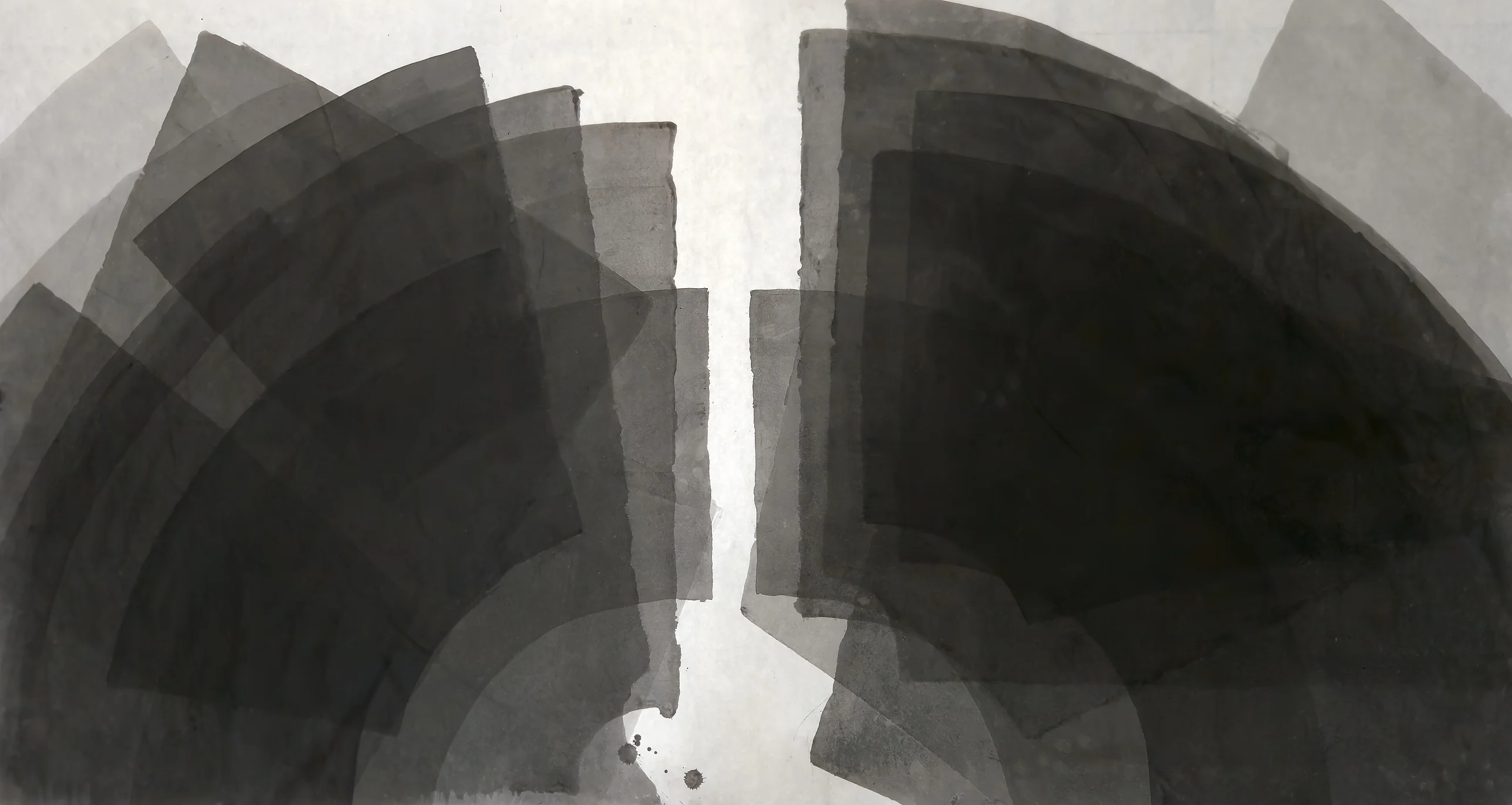
The engine's readingTwo fans of stacked grey ink bands swing open from the foot of a wide sheet, parted by a thin white seam of bare paper.
Record- Date
- 2026.10.26
- Dimensions
- 97 × 180 cm
- Paper
- Huiyun Tianxuan Ge "Dot Ink Becomes Gold" Master Special, semi-cooked (self-sized, aged)
- Ink
- Yi De Ge Yun Tou Yan, Boku-Undo Gentoku Super Concentrated, Yi De Ge Pine Soot Ink, Shisan Yue Calligraphy and Painting Ink
I know this pass. It runs between two kingdoms that raised their walls one shutter at a time, each shutter a little darker than the last, until the eastern one forgot how to open. The road through is one cart wide, and the carts stopped coming. At the bottom, where the road meets the old ring of standing stones, something small and wet came down the mountain and shook itself off. I have the drops to prove it. In the east the king keeps his night sealed, but the seal leaks. A few stars tunnelled out and live rough now in the dark stone, pale and pin-sized. I leave them bread at the gate, under a sky the colour of a closed door.
The reading
Written by the engine after the painting was rated, from the settled findings, and checked by hand before approval. It explains the numbers; it may not change them.
- Structure
- two radial fans of overlapping square-ended bands, meeting at a central seam
- Movement
- bands swing outward and upward from a centre below the bottom edge
- Coverage
- ink on about nine tenths of the paper
- Tone
- three tonal steps, weighted dark
- Layering
- many translucent passes of one kind, readable on the left, merging in right core
- Edges
- crisp straight band ends throughout; dry broken edges along the central seam
- Feibai
- none
- Open paper
- narrow vertical seam at centre, plus a pale band along the top
- Chance marks
- dark ink spatter at the seam's foot; pale water spots in right dark core
- Frame
- ink runs off left, right and bottom; top stays mostly open
Two fans of grey open from the foot of the paper and lean apart, split by a narrow white seam that runs from the top edge nearly to the bottom. Each fan is built from broad, square-ended bands swung round a centre below the sheet, so the image spreads outward like a ribcage.
The left fan is the finer instrument. Its bands step from a pale rim at the upper left into a deep core, and each pass stays legible through the next, because the self-sized paper keeps every layer at the surface. Where the band ends meet the seam they break into dry grain, and that rough edge keeps the gap alive.
The right fan pays for its weight. Its passes pile up until the core goes almost flat black, and the edges of the later bands are swallowed. A scatter of pale water spots shows through that dark. The spatter at the foot of the seam sits quietly and does no harm.
The result is a clear, well-built image with real depth on one side. It is held back by a dark that stopped being layers.
How it was read
Read by the Visual Analysis Engine, version 23.11, on 2026.10.26: measured by code, then read 5 times by Claude Opus 5.5 against three reference paintings (R1 to R3), each read independent of the others. How the engine works.
Three views of one sheet.
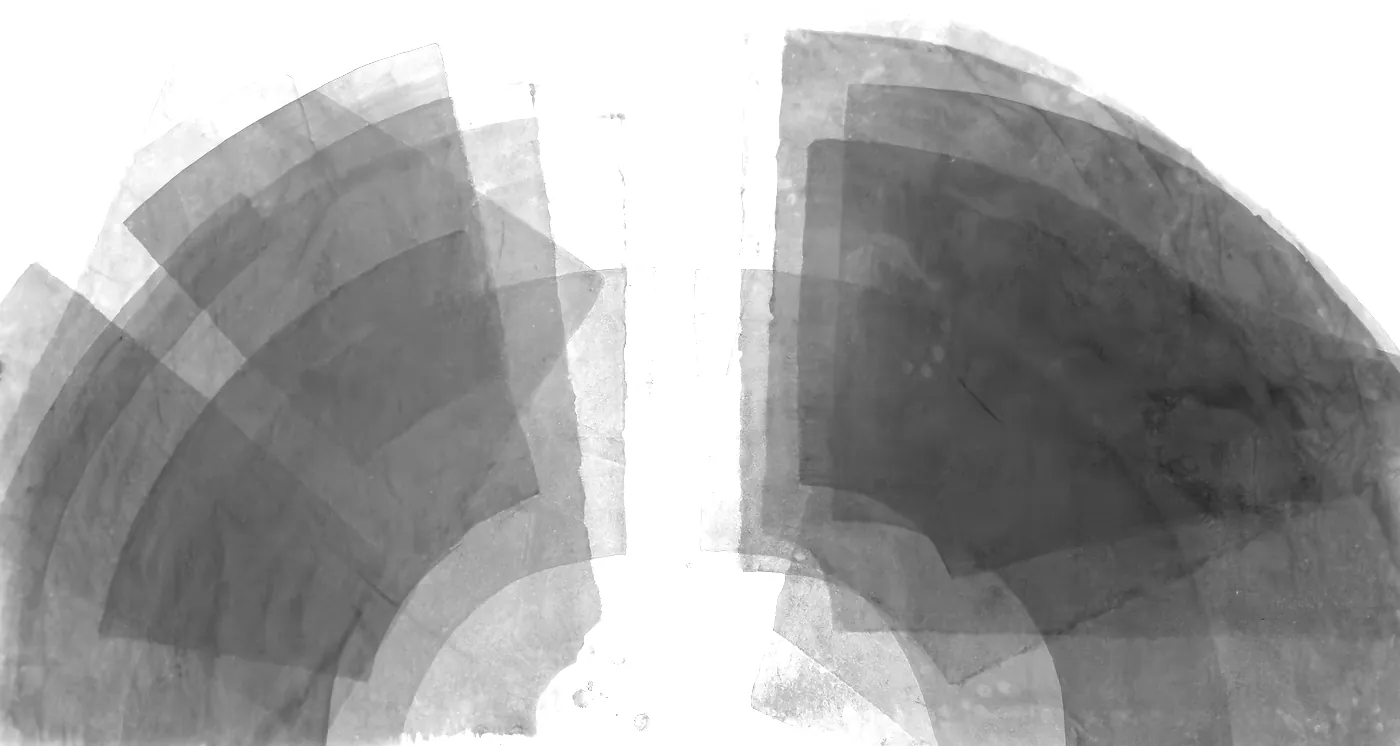
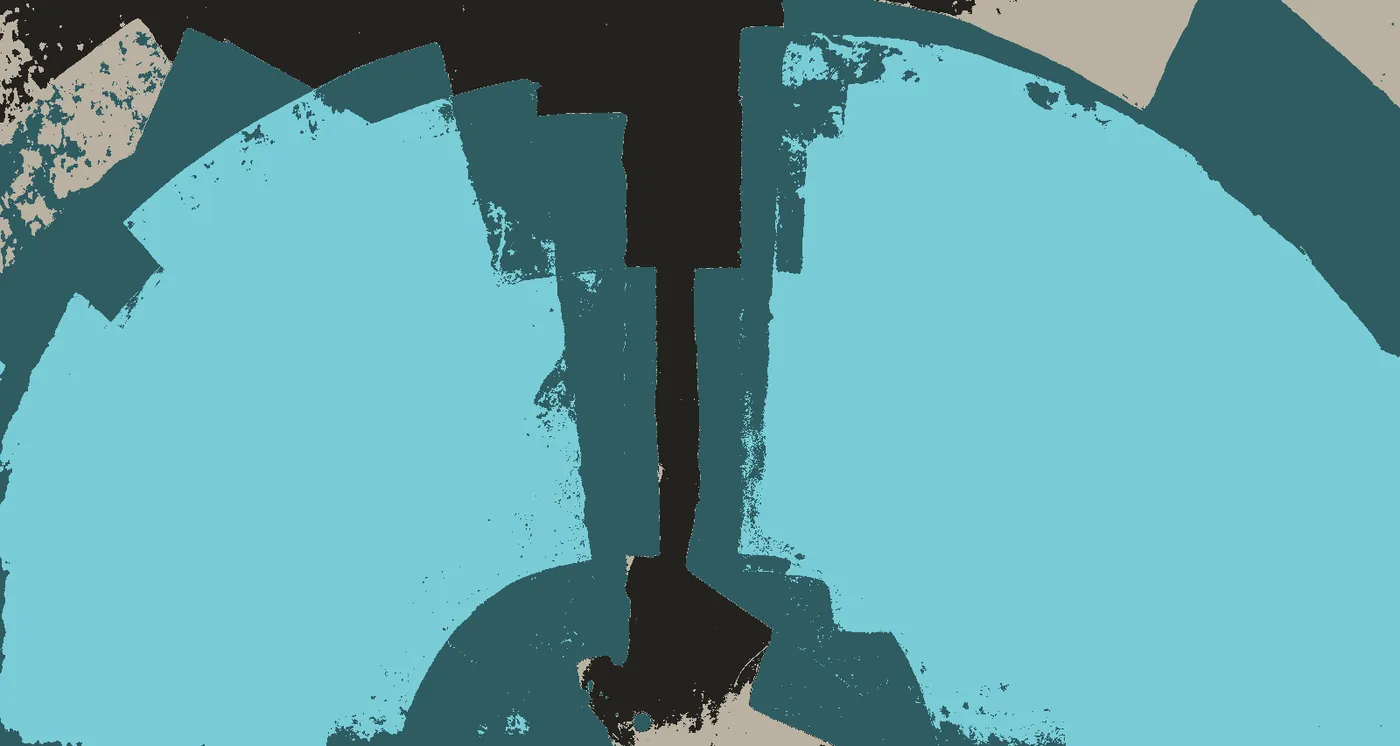
Left, the photograph. Centre, the tone stretch the model is shown beside it: the darkest 45% of tones spread over the whole range, so flat black, banding and stains show. Right, every pixel as the measuring code classes it: cyan black ink, deep teal translucent grey, stone the palest ink, near black bare paper.
3 families of tone.
Every inked pixel's brightness in 64 bins, smoothed; each circled peak holds at least 4% of the ink. Life inside the black: 0.049 (under 0.045 reads as flat).
Five reads, agreeing on 3 of 5 qualities.
Each quality placed on its ladder by each read, and the mean the engine keeps. Where reads differ, they differ by one rung; close calls resolve down.
READ 1, IN ITS OWN WORDS
“This is a close relative of R3, with layered radial fans either side of a central gap. It is heavier and more crowded, its right dark mass is less modelled inside, and small drips sit at the bottom centre.”
Fan-shaped passes follow the brush's curved travel with clean, dry-edged ends at the central gap; the right dark block is bulky but still holds its arc.
WEAKEST Heavy dark fan block in right mass, slightly slab-like
STRONGEST Stepped arc bands of the left fan
The left fan steps its density across overlapping bands. The right dark mass shows only faint grain and has modulation of 0.049, barely above flat.
WEAKEST Right dark mass interior, close to one dense tone
STRONGEST Left fan's stepped greys from pale rim to dark
Many translucent arc passes overlap in a readable order on both sides. The overlaps build depth, though the right side's darkest layers are hard to tell apart.
WEAKEST Deep right overlaps where passes merge toward black
STRONGEST Translucent overlapping fan passes on the left
Two radiating fans on either side of a vertical gap create a strong focus, but 90% ink coverage leaves the edges crowded. The right mass is heavy and sits weightily.
WEAKEST Crowded heavy right mass with little breathing paper
STRONGEST Narrow central gap splitting the two fans
The ink is controlled and the edge grain is well used. Small drips sit in the paper at the bottom centre, and faint droplet spots appear in the right dark mass, mostly in the stretched view.
WEAKEST Drip spatters at the bottom of the central gap
STRONGEST Dry-brush grain at the fan edges near the gap
3 distinct places, 1 major.
Each read must name every flaw and where it is, in a ninth of the sheet. Here the reads named flaws in 3 distinct places, 14 mentions in all across 5 reads; the number in each ninth is how many times a flaw was named there. Reads agreeing on a place strengthen the evidence for one flaw; they do not multiply it. A major flaw holds Material and surface at rung 1.
The rating these readings produce, the rules applied and the arithmetic, with Peter's own rating where he gave one, are in the Archive record.
Date
2026.10.26, day 302 of the Crucible Year, one of 5 paintings from that date. 14 works were registered in the fourteen days before. Paintings are dated by the day their batch was registered and photographed; each was finished that day or within the few days before. Phase: P4 S14 (working title).
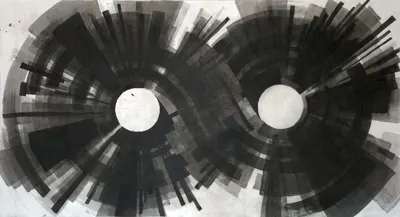
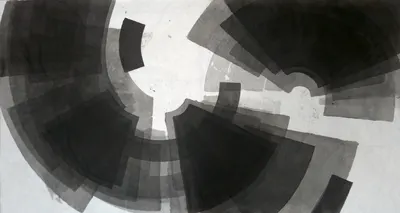
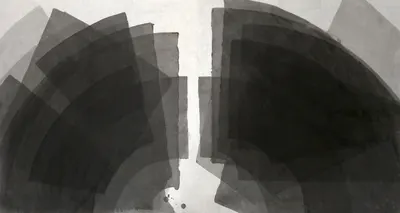
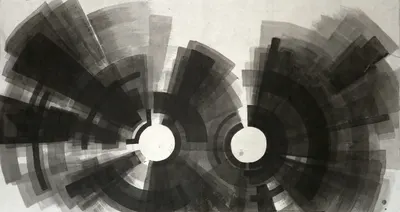
T_402 among all 402
Every painting of the year by date; this one is outlined.
Materials
- Paper
- Huiyun Tianxuan Ge "Dot Ink Becomes Gold" Master Special, semi-cooked (self-sized, aged), Anhui Jingxian Huiyun Tianxuan Ge Xuan Paper Art Products Co., Ltd. (安徽泾县徽韵天宣阁宣纸艺术品有限公司), made 2012.10
- Ink MB6
- Yi De Ge Yun Tou Yan, Yi De Ge (Beijing)
- Ink MB8
- Boku-Undo Gentoku Super Concentrated, Boku-Undo
- Ink MB9
- Yi De Ge Pine Soot Ink, Yi De Ge (Beijing)
- Ink MB10
- Shisan Yue Calligraphy and Painting Ink, Shisan Yue (Thirteenth Month)
Related