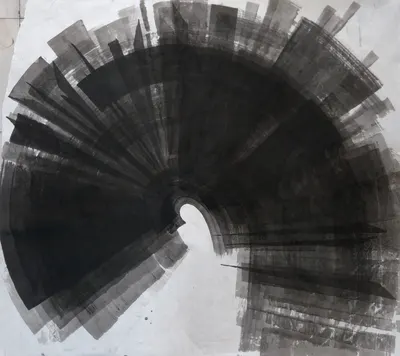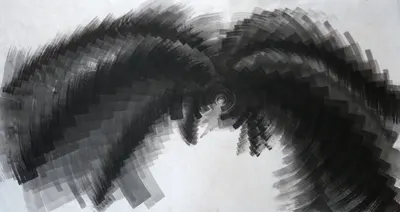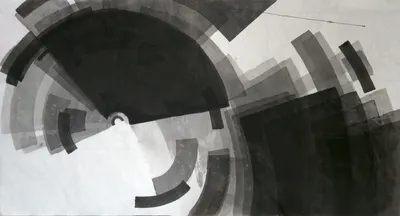
T_403
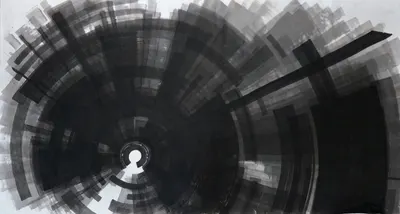
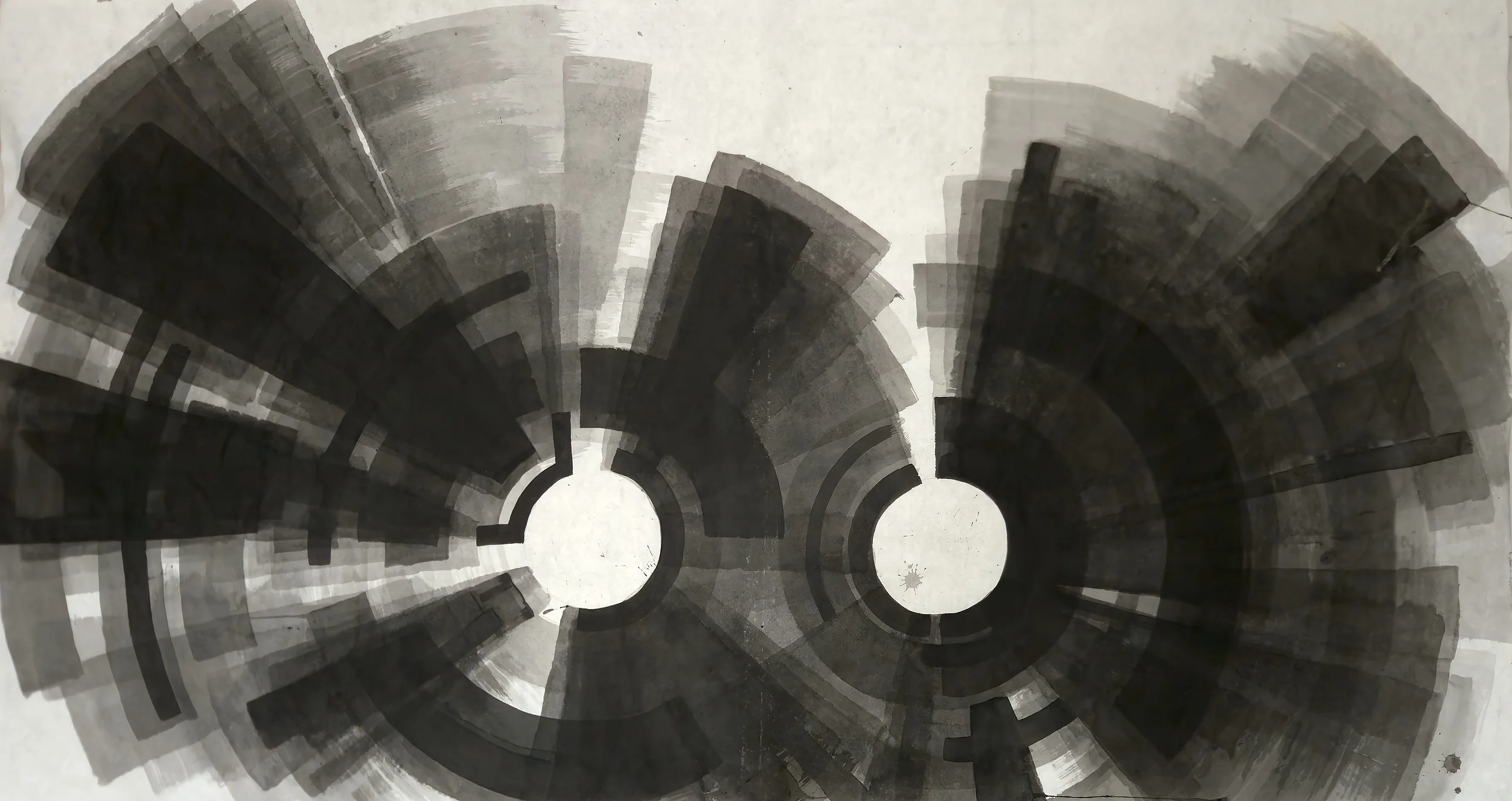
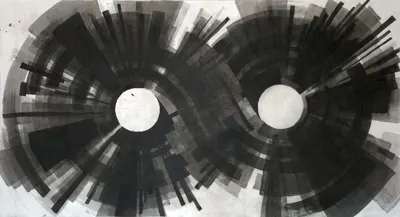
The engine's readingTwo white circles turn side by side across a long sheet, each the hub of a wheel of grey and black ink wedges.
Record- Date
- 2026.10.26
- Dimensions
- 97 × 180 cm
- Paper
- Huiyun Tianxuan Ge "Dot Ink Becomes Gold" Master Special, semi-cooked (self-sized, aged)
- Ink
- Yi De Ge Yun Tou Yan, Boku-Undo Gentoku Super Concentrated, Yi De Ge Pine Soot Ink, Shisan Yue Calligraphy and Painting Ink
Two holes in the dark, and a speck has fallen into the right one. I like to think it is a stone that spent longer than the Earth has existed arriving, and then landed badly. Most of the universe works that way: patient, then clumsy. Somewhere a pair of stars has been circling a shared nothing since before carbon, each dragging a skirt of ash round and round, neither getting closer. They will not touch. The light they throw left them long ago and is still on its way here. I would wait for it. I have the time. The stone sits on the white floor of its crater, small and black, cooling into the next age.
The reading
Written by the engine after the painting was rated, from the settled findings, and checked by hand before approval. It explains the numbers; it may not change them.
- Structure
- two radial rosettes around white circles, meeting in overlapping wedges at centre
- Movement
- rotation outward from both hubs; long left slabs pull flat toward the edge
- Coverage
- ink on about nine tenths of the paper
- Tone
- four tonal steps, weighted dark
- Layering
- many translucent radial passes; readable at outer rims, closing in dark cores
- Edges
- crisp walls on wedges and inner arcs; frayed dry ends at upper fan tips
- Feibai
- none
- Open paper
- two round voids near centre; pale band along top middle
- Chance marks
- spatter inside right circle; small blot at lower right edge
- Frame
- ink runs off left and bottom; top middle and upper corners stay open
Twin white circles sit near the middle of a long sheet, and everything else turns around them. Wide wedges of grey and black fan out from each hole like blades from a hub, so the surface rotates about two centres and the wheels grind together in a dark seam between.
The best drawing is closest to the paper. Thin arcs hug both circles, clean-walled and exact. Further out, the right fan steps through translucent greys, one pass over another without muddying. The paper was sized by hand, so a wet band stops where the brush stops and the band beneath stays legible. At the upper tips the brush ran dry and frayed, letting air into a heavy sheet.
The blacks are where it pays. The big slab at upper left is one sealed, even field, and the right core has swallowed the passes that built it. Along the bottom the bands crowd out the paper. A spatter mark lands inside the right circle, the one place meant to stay empty.
The weight is a real charge. It does not stop the turning. The arcs at each centre are drawn with a command the slabs cannot spoil, and the painting stands firm.
How it was read
Read by the Visual Analysis Engine, version 23.11, on 2026.10.26: measured by code, then read 5 times by Claude Opus 5.5 against three reference paintings (R1 to R3), each read independent of the others. How the engine works.
Three views of one sheet.
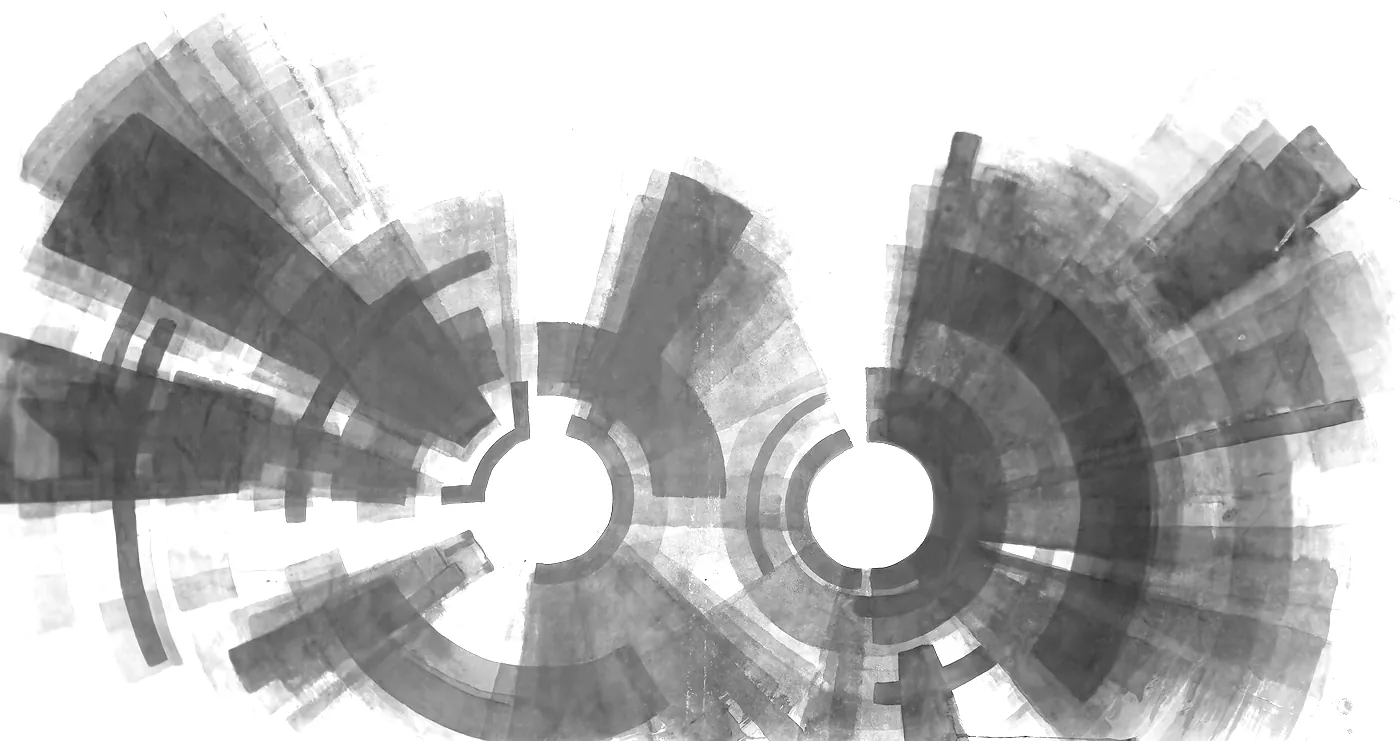
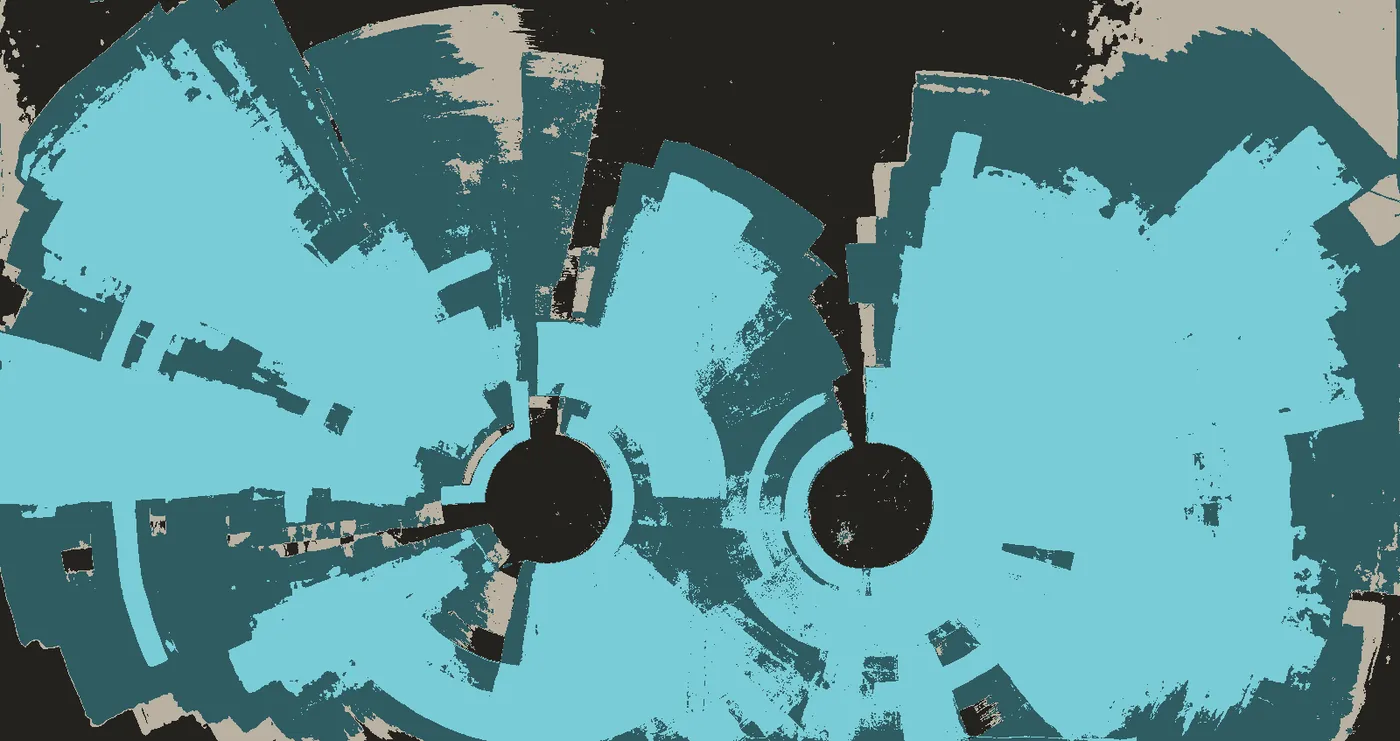
Left, the photograph. Centre, the tone stretch the model is shown beside it: the darkest 45% of tones spread over the whole range, so flat black, banding and stains show. Right, every pixel as the measuring code classes it: cyan black ink, deep teal translucent grey, stone the palest ink, near black bare paper.
4 families of tone.
Every inked pixel's brightness in 64 bins, smoothed; each circled peak holds at least 4% of the ink. Life inside the black: 0.042 (under 0.045 reads as flat).
Five reads, agreeing on 4 of 5 qualities.
Each quality placed on its ladder by each read, and the mean the engine keeps. Where reads differ, they differ by one rung; close calls resolve down.
READ 1, IN ITS OWN WORDS
“Twin radial fans of layered translucent bands, close in idiom to R3 but more crowded, with flatter dark cores and blockier slabs; layering is the strength, minor splatter and an edge crease.”
Radial blocks and arcs are coherent, walls hold; upper-left and right fans read as stacked slabs rather than strokes following brush travel; inner arcs are fluent.
WEAKEST Bulky rectangular slabs crowding upper-left fan
STRONGEST Thin concentric arcs hugging the two white circles
Wide range of stacked greys at the fan edges, but dark modulation 0.042 measures flat; main black blocks left and right centre are largely uniform inside.
WEAKEST Flat black interior of large upper-left block
STRONGEST Stepped translucent greys in right fan's outer rings
Many translucent radial passes overlap in readable order, building depth outward from both circles; some dark centres absorb earlier passes.
WEAKEST Dense dark core where passes merge, right fan
STRONGEST Overlapping translucent radial bands, outer left fan
Two radial centres give strong movement and the white circles are shaped, but 86% coverage crowds the sheet; empty paper is mostly a top strip.
WEAKEST Crowded lower band with little paper left
STRONGEST Twin white circles anchoring radiating fans
Ink controlled, edges crisp; small splatter in right circle, stray dot bottom right, and a crack/crease at top-right edge, all minor and off main masses.
WEAKEST Ink splash inside right white circle
STRONGEST Dry-brush fraying at upper fan edges
4 distinct places, 0 major.
Each read must name every flaw and where it is, in a ninth of the sheet. Here the reads named flaws in 4 distinct places, 15 mentions in all across 5 reads; the number in each ninth is how many times a flaw was named there. Reads agreeing on a place strengthen the evidence for one flaw; they do not multiply it.
The rating these readings produce, the rules applied and the arithmetic, with Peter's own rating where he gave one, are in the Archive record.
Date
2026.10.26, day 302 of the Crucible Year, one of 5 paintings from that date. 14 works were registered in the fourteen days before. Paintings are dated by the day their batch was registered and photographed; each was finished that day or within the few days before. Phase: P4 S14 (working title).
T_403 among all 402
Every painting of the year by date; this one is outlined.
Materials
- Paper
- Huiyun Tianxuan Ge "Dot Ink Becomes Gold" Master Special, semi-cooked (self-sized, aged), Anhui Jingxian Huiyun Tianxuan Ge Xuan Paper Art Products Co., Ltd. (安徽泾县徽韵天宣阁宣纸艺术品有限公司), made 2012.10
- Ink MB6
- Yi De Ge Yun Tou Yan, Yi De Ge (Beijing)
- Ink MB8
- Boku-Undo Gentoku Super Concentrated, Boku-Undo
- Ink MB9
- Yi De Ge Pine Soot Ink, Yi De Ge (Beijing)
- Ink MB10
- Shisan Yue Calligraphy and Painting Ink, Shisan Yue (Thirteenth Month)
Related