
T_401
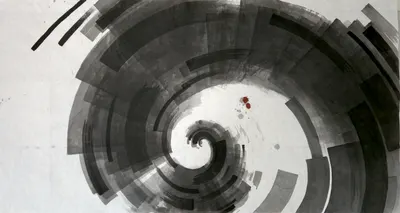
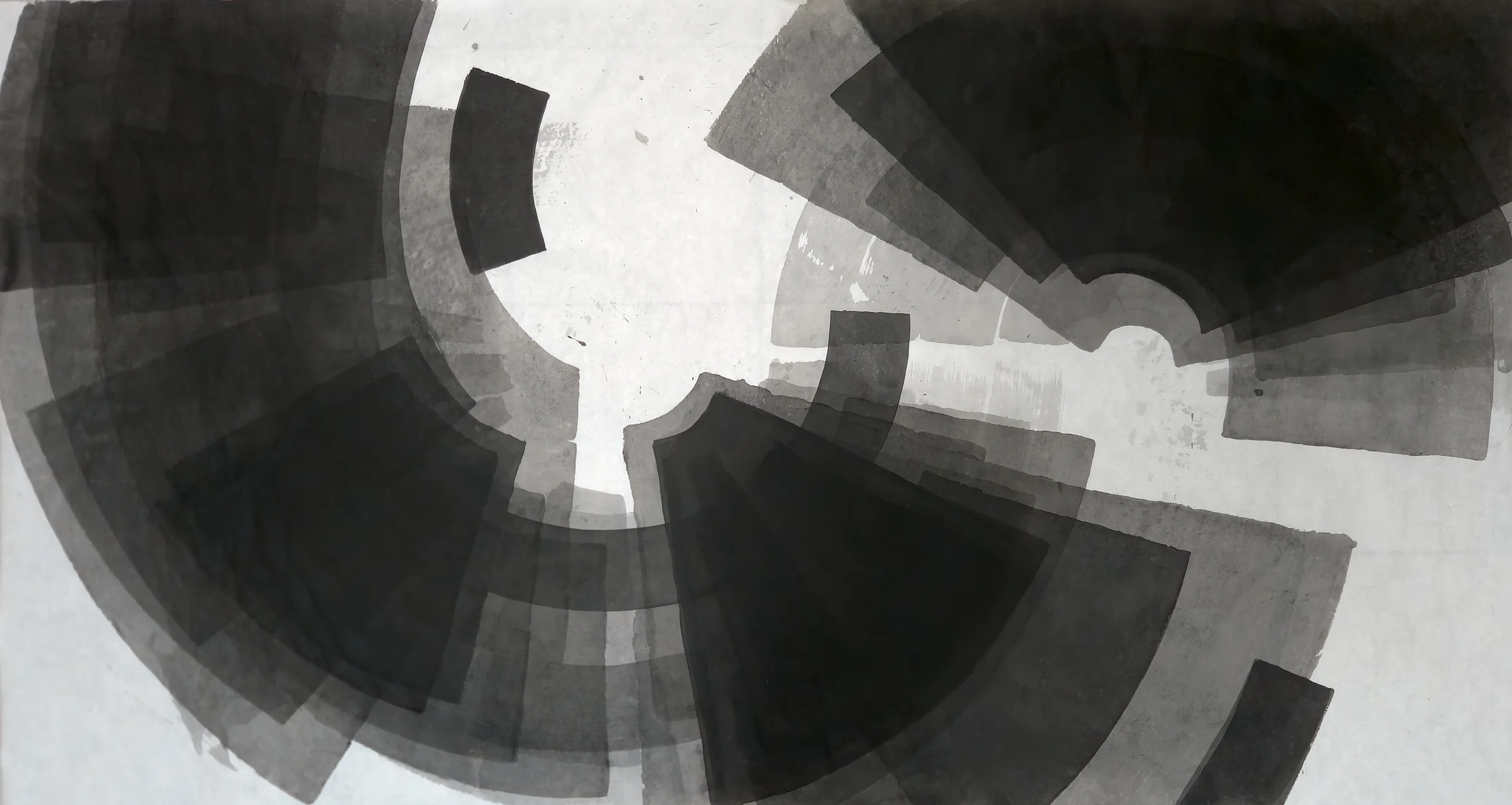
The engine's readingTranslucent grey and black arcs and fan wedges wheel round a notched white centre, pass laid over pass across a long horizontal sheet.
Record- Date
- 2026.10.26
- Dimensions
- 97 × 180 cm
- Paper
- Huiyun Tianxuan Ge "Dot Ink Becomes Gold" Master Special, semi-cooked (self-sized, aged)
- Ink
- Yi De Ge Yun Tou Yan, Boku-Undo Gentoku Super Concentrated, Yi De Ge Pine Soot Ink, Shisan Yue Calligraphy and Painting Ink, colour inks
The grey arcs go round and round, each still showing through the next, like faces in a crowd that keeps re-forming. In the Welsh story, Rhys hears music in a field, steps into a fairy ring and reels for what he swears is a moment. It is a year. His friend has to keep one foot outside the ring and reach in for his sleeve. Here only the stiff block at bottom right has been pulled clear, square-shouldered in the wet grass, hat in hand, wondering why the village has gone so quiet. I would have stayed. The ring is tight, and the white hole at its middle shines like a moon that fell into the field and liked it there.
The reading
Written by the engine after the painting was rated, from the settled findings, and checked by hand before approval. It explains the numbers; it may not change them.
- Structure
- arc bands and fan wedges ringing a shaped white centre, overlapping at their ends
- Movement
- circular sweep round the centre; square top-left blocks and bottom-right block sit against it
- Coverage
- ink on about nine tenths of the paper
- Tone
- four tonal steps, weighted dark
- Layering
- many translucent grey passes, readable round the whole ring, clearest lower left and bottom centre
- Edges
- crisp wet walls on arcs and wedges; grainy dry edges on the top-right fan
- Feibai
- none
- Open paper
- notched white void at centre, opening rightward toward the right edge
- Chance marks
- small ink dots and specks right of centre and in the void; faint grey drips top centre
- Frame
- ink runs off top, left, bottom and upper right; bottom-left corner and lower right edge open
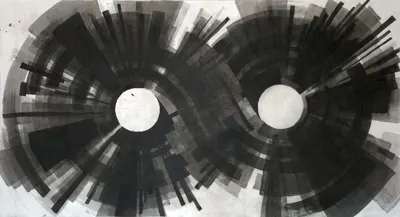
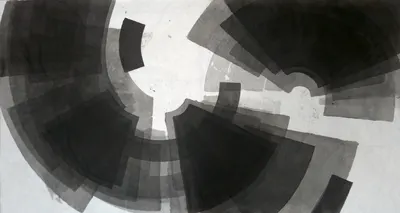
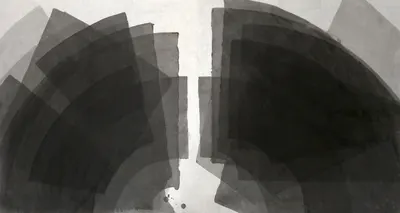
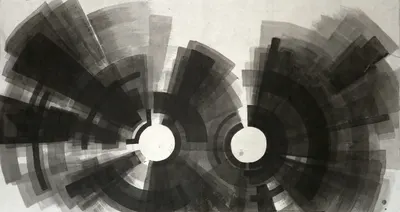
A wheel of ink turns across the paper. Arcs and fan-shaped wedges, some near black, some a pale wash, ring a white centre that is not a circle but a cut shape, notched and pushed open to the right. The eye goes round and finds no place to stop.
The turning lives in the overlaps. Pass after pass of translucent grey lies over the last, and every earlier edge still shows through, so the lower left and bottom centre read as a stair of greys you can count down. The paper, half sized by hand with alum, holds each wash at its own wall, and nothing bleeds into the next. At top right the dark fan goes further: its black is grained and banded, open where the brush thinned.
The costs are real and small. The top-left blocks sit square and bulky in a sheet that otherwise curves. The black wedge at bottom centre is nearly flat inside, a sealed weight beside that breathing fan. The stiff block at bottom right floats loose, and specks dot the white.
The wheel turns through all of it. Sheets this full of ink that keep every pass this clear almost never arrive, and the white at their centre seldom spins like a held breath.
How it was read
Read by the Visual Analysis Engine, version 23.11, on 2026.10.26: measured by code, then read 5 times by Claude Opus 5.5 against three reference paintings (R1 to R3), each read independent of the others. How the engine works.
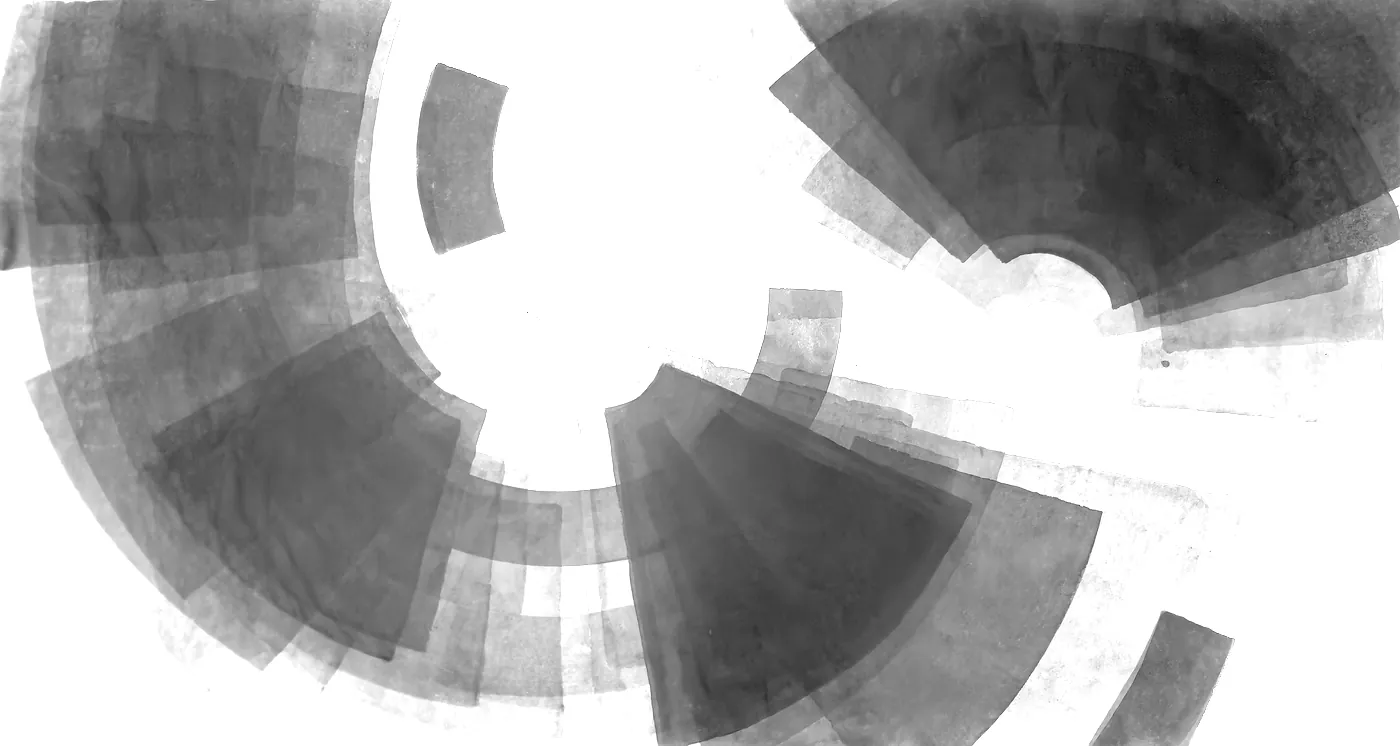
Three views of one sheet.
Left, the photograph. Centre, the tone stretch the model is shown beside it: the darkest 45% of tones spread over the whole range, so flat black, banding and stains show. Right, every pixel as the measuring code classes it: cyan black ink, deep teal translucent grey, stone the palest ink, near black bare paper.
4 families of tone.
Every inked pixel's brightness in 64 bins, smoothed; each circled peak holds at least 4% of the ink. Life inside the black: 0.054 (under 0.045 reads as flat).
Five reads, agreeing on 4 of 5 qualities.
Each quality placed on its ladder by each read, and the mean the engine keeps. Where reads differ, they differ by one rung; close calls resolve down.
READ 1, IN ITS OWN WORDS
“A radial composition of translucent arc segments, close to R3 in idiom. The layering is legible and the arcs are fluent, but some dark interiors are flatter and there are minor specks on the paper. Slightly below R3.”
Fan and arc segments follow the brush's radial travel with clean, holding walls; top-left blocks are squarer and bulkier, but the principal arcs are fluent.
WEAKEST Blunt rectangular blocks stacked in top-left quarter
STRONGEST Curved arc-band segments sweeping round the central void
Stepped greys from the overlaps throughout; top-right mass is textured inside; the bottom-centre black fan is smoother and close to flat; modulation 0.054 is moderate.
WEAKEST Central lower dark fan fairly even inside
STRONGEST Top-right dark fan with grain and banded density
Many translucent passes overlap in a readable order around the circle; each band edge is still visible through later ones, which builds depth across the sheet.
WEAKEST Dense top-left stacking where passes blur together
STRONGEST Translucent overlapping arcs in lower-left and bottom centre
Arcs rotate around a shaped white void that works as hard as the ink, carrying the eye round the sheet; the bottom-right fragment is a bit detached.
WEAKEST Isolated small block at bottom right
STRONGEST Radial swirl around off-centre white void
Ink is controlled with crisp edges; small spots and specks sit in the paper right of centre and in the central void, away from the principal masses.
WEAKEST Small speckles and blots in right-side paper
STRONGEST Grainy dry edges on top-right fan
3 distinct places, 0 major.
Each read must name every flaw and where it is, in a ninth of the sheet. Here the reads named flaws in 3 distinct places, 10 mentions in all across 5 reads; the number in each ninth is how many times a flaw was named there. Reads agreeing on a place strengthen the evidence for one flaw; they do not multiply it.
The rating these readings produce, the rules applied and the arithmetic, with Peter's own rating where he gave one, are in the Archive record.
Date
2026.10.26, day 302 of the Crucible Year, one of 5 paintings from that date. 14 works were registered in the fourteen days before. Paintings are dated by the day their batch was registered and photographed; each was finished that day or within the few days before. Phase: P4 S14 (working title).
T_401 among all 402
Every painting of the year by date; this one is outlined.
Materials
- Paper
- Huiyun Tianxuan Ge "Dot Ink Becomes Gold" Master Special, semi-cooked (self-sized, aged), Anhui Jingxian Huiyun Tianxuan Ge Xuan Paper Art Products Co., Ltd. (安徽泾县徽韵天宣阁宣纸艺术品有限公司), made 2012.10
- Ink MB6
- Yi De Ge Yun Tou Yan, Yi De Ge (Beijing)
- Ink MB8
- Boku-Undo Gentoku Super Concentrated, Boku-Undo
- Ink MB9
- Yi De Ge Pine Soot Ink, Yi De Ge (Beijing)
- Ink MB10
- Shisan Yue Calligraphy and Painting Ink, Shisan Yue (Thirteenth Month)
- Colour
- colour inks, recorded together
Related