T_235
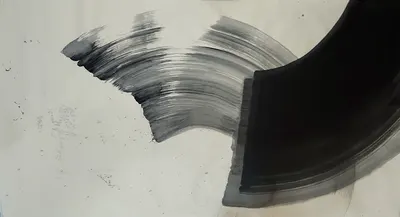
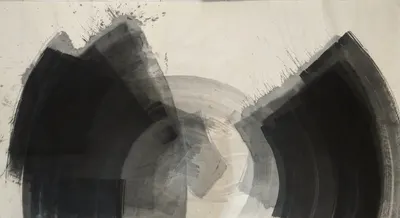
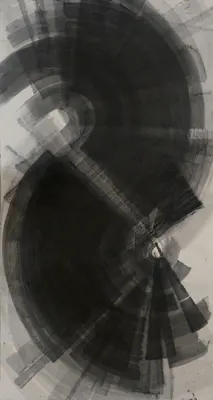
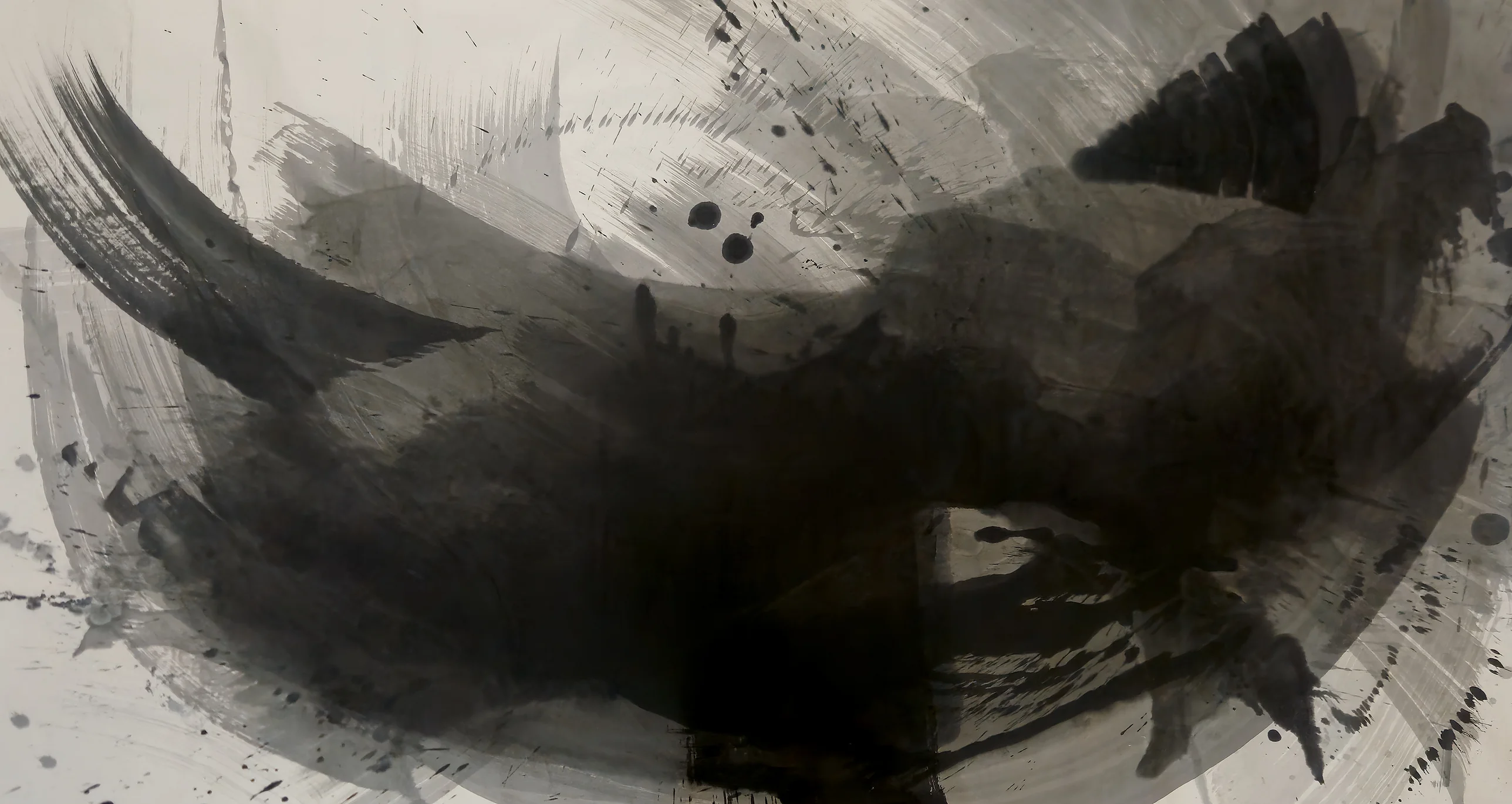
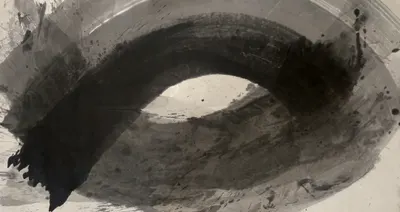
The engine's readingA bowl of grey and black ink swung across a long sheet of bark paper: a dry arc at upper left, a black fan at upper right, a heavy floor between.
Record- Date
- 2026.04.18
- Dimensions
- 97 × 180 cm
- Paper
- Red Star Mo She Imitation Antique Chu Bark, Exhibition Edition, half-raw
- Ink
- Yi De Ge Refined Ink Juice, Boku-Undo Genso, Yi De Ge Yun Tou Yan
Three round drops hang above the pale crescent, and I take them for moons. Small, dark, unbothered. Under them the black has done what heavy things do when given long enough: pulled everything inward until nothing in the middle can be told from anything else. That is how a core gets made. Iron sinks, rock presses, ages pass, and the centre of the world becomes one dense fact no foot will ever stand on. The moons don't mind. They keep their places and stay round. Out at the rim one dry stroke is still leaving, streaming white behind it, the way a comet leaves a system without looking back. The core stays where it is, brown at the edges, holding its weight in the dark.
The reading
Written by the engine after the painting was rated, from the settled findings, and checked by hand before approval. It explains the numbers; it may not change them.
- Structure
- bowl-shaped sweep; dry arc upper left, black fan upper right, dense mass below
- Movement
- bowl sweep from left to right; the top-right fan points back against it
- Coverage
- ink on about nine tenths of the paper
- Tone
- seven tonal steps, weighted dark
- Layering
- pale washes, mid-grey passes, black overlays; readable at right and left edges
- Edges
- crisp at arc tip and fan; soft in grey washes; broken in dry brush
- Feibai
- present, along the top-left arc as it sweeps toward its point
- Open paper
- pale crescent at top centre, cupped between arc and fan
- Chance marks
- round drops and fine spatter at top; drips from black; tide lines at right
- Frame
- ink runs off top, left and bottom; right edge and lower corners stay open
A bowl of ink swings in from the upper left, sinks through a heavy black floor, and rises to a fan of strokes at the top right. Above it a pale crescent of bare paper keeps the curve open. The whole shape reads from across the room.
The upper-left arc is the best thing on the sheet. One dry stroke sweeps down and tapers to a point, the hairs parting into long white streaks that hold their direction to the tip. The half-sized paper grips the dry brush without letting it bleed, so every streak stays sharp. The fan answers it well. On the right, translucent greys sit under the black in bands you can still count.
The centre is where it gives way. Pass after pass has gathered in the bottom middle until the black is flat, cloudy and faintly brown, cut by a hard vertical edge near the bottom. Nothing inside it reads as a stroke. It is only weight.
So the sheet is alive at its rim and heavy at its core, and the core is where the eye lands. It is a fair sheet of the common run, with one fine stroke in its upper corner.
How it was read
Read by the Visual Analysis Engine, version 23.8, on 2026.10.06: measured by code, then read 5 times by Claude Opus 5.5 against three reference paintings (R1 to R3), each read independent of the others. How the engine works.
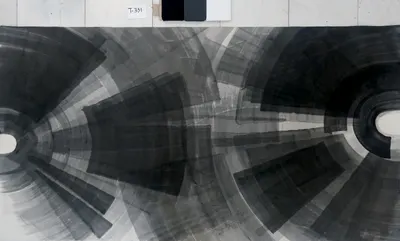
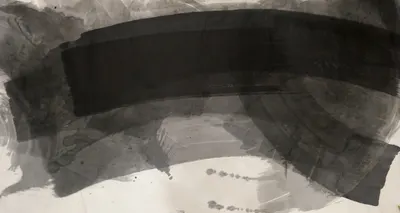
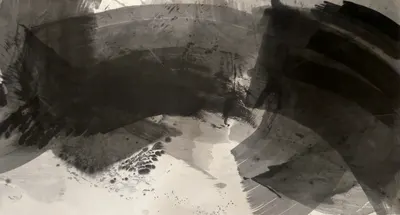
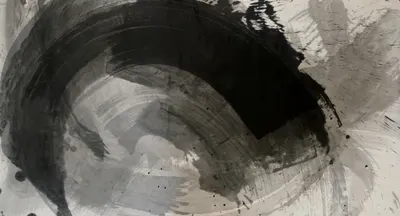
Three views of one sheet.
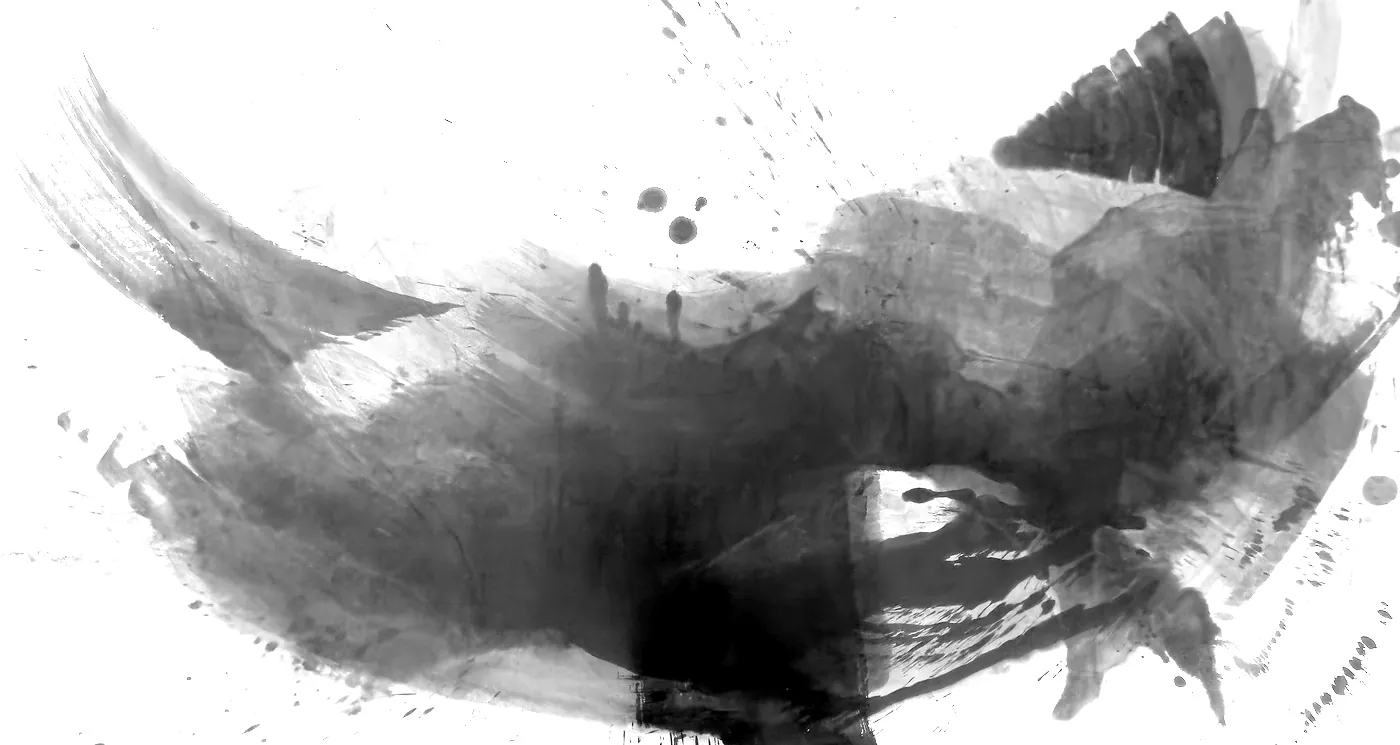
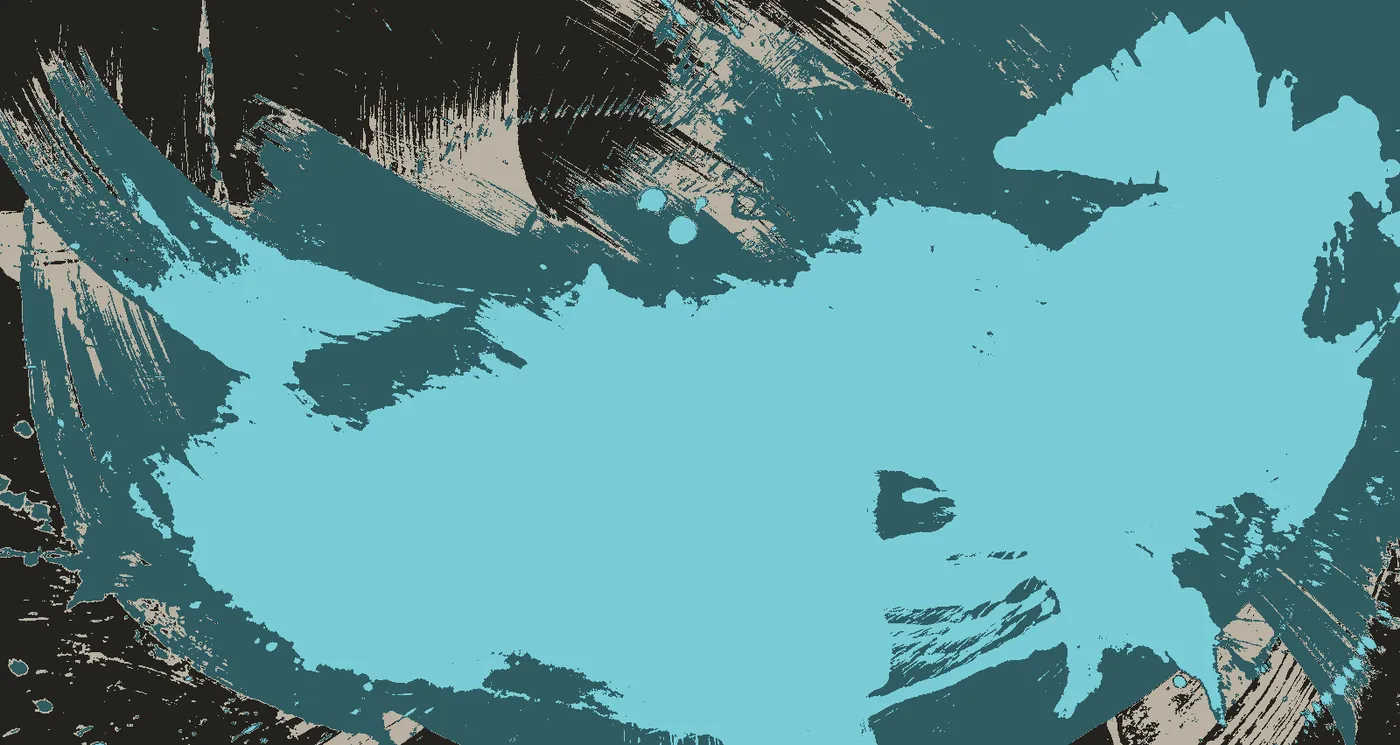
Left, the photograph. Centre, the tone stretch the model is shown beside it: the darkest 45% of tones spread over the whole range, so flat black, banding and stains show. Right, every pixel as the measuring code classes it: cyan black ink, deep teal translucent grey, stone the palest ink, near black bare paper.
7 families of tone.
Every inked pixel's brightness in 64 bins, smoothed; each circled peak holds at least 4% of the ink. Life inside the black: 0.070 (under 0.045 reads as flat).
Five reads, one answer.
Each quality placed on its ladder by each read, and the mean the engine keeps.
READ 1, IN ITS OWN WORDS
“A sweeping arc composition close to R2. The fluent top-left arc and top-right fan stroke are offset by a bulky, flat, discoloured central black mass. Passes are legible at the edges and fused in the centre, and the sheet is crowded.”
Top-left arc and top-right fan stroke have travel and taper; the central-bottom black mass is a bulky fill with no stroke shape, and it has a hard vertical edge.
WEAKEST Central black mass, a bulky undefined blob
STRONGEST Top-left dry-brush arc sweeping into a tapered point
Seven tonal steps; the right-side greys and the top-right fan show banding and grain. The bottom-centre black is uniform and cloudy inside. Modulation 0.07 is moderate.
WEAKEST Bottom-centre black core, flat and dead
STRONGEST Right grey masses with stepped, grained density
Grey arcs and washes are legible under the black strokes at the right and top-left, but the central overlaps merge into dense black, so the order can't be read there.
WEAKEST Centre, where passes fuse into one dark
STRONGEST Translucent grey sweeps under black on the right
A bowl-shaped arc gives a clear direction and the top paper is shaped, but 86% coverage and a heavy bottom-centre mass crowd the lower half.
WEAKEST Crowded heavy centre and lower band
STRONGEST Large circular sweep carrying the eye left to right
In the colour view, a brownish, cloudy tint and a hard vertical seam edge sit inside the principal central dark mass, visible at viewing distance. The splatter and drips elsewhere are controlled.
WEAKEST Brownish cloudy discolouration inside the central black
STRONGEST Dry-brush grain in the top-left arc
8 distinct places, 3 major.
Each read must name every flaw and where it is, in a ninth of the sheet. Here the reads named flaws in 8 distinct places, 16 mentions in all across 5 reads; the number in each ninth is how many times a flaw was named there. Reads agreeing on a place strengthen the evidence for one flaw; they do not multiply it. A major flaw holds Material and surface at rung 1.
Measured from the 16-bit master.
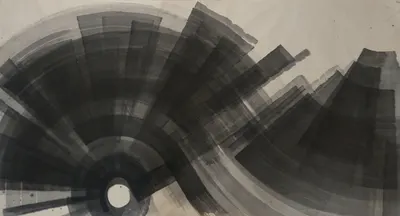
The previous engine (V22) measured this sheet's master file: 1 principal ink mass traced (cyan), 8 enclosed voids at true size in their grid cells (amber), the main gesture from start to end (red). Of 16 edge segments, 31% crisp, 44% soft or bloomed, 25% broken.
The rating these readings produce, the rules applied and the arithmetic, with Peter's own rating where he gave one, are in the Archive record.
Date
2026.04.18, day 111 of the Crucible Year, one of 12 paintings from that date (8 shown). 56 works were registered in the fourteen days before. Paintings are dated by the day their batch was registered and photographed; each was finished that day or within the few days before. Phase: P2 The Switch (working title).
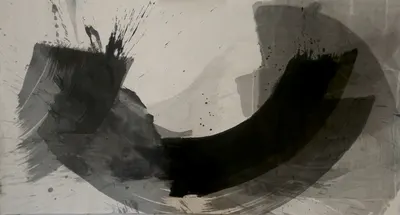
T_235 among all 402
Every painting of the year by date; this one is outlined.
Materials
- Paper
- Red Star Mo She Imitation Antique Chu Bark, Exhibition Edition, half-raw, China Xuan Paper Co., Ltd. (中国宣纸股份有限公司), made 2026.01.14
- Ink MB4
- Yi De Ge Refined Ink Juice, Yi De Ge (Beijing)
- Ink MB5
- Boku-Undo Genso, Boku-Undo
- Ink MB6
- Yi De Ge Yun Tou Yan, Yi De Ge (Beijing)
Related