T_351
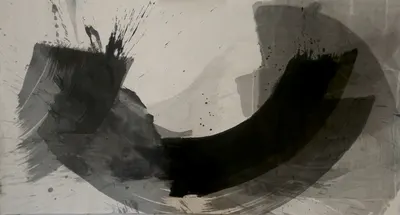
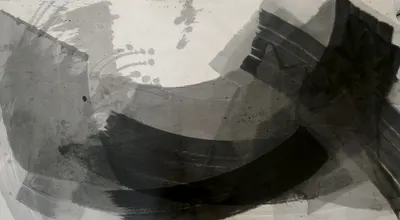
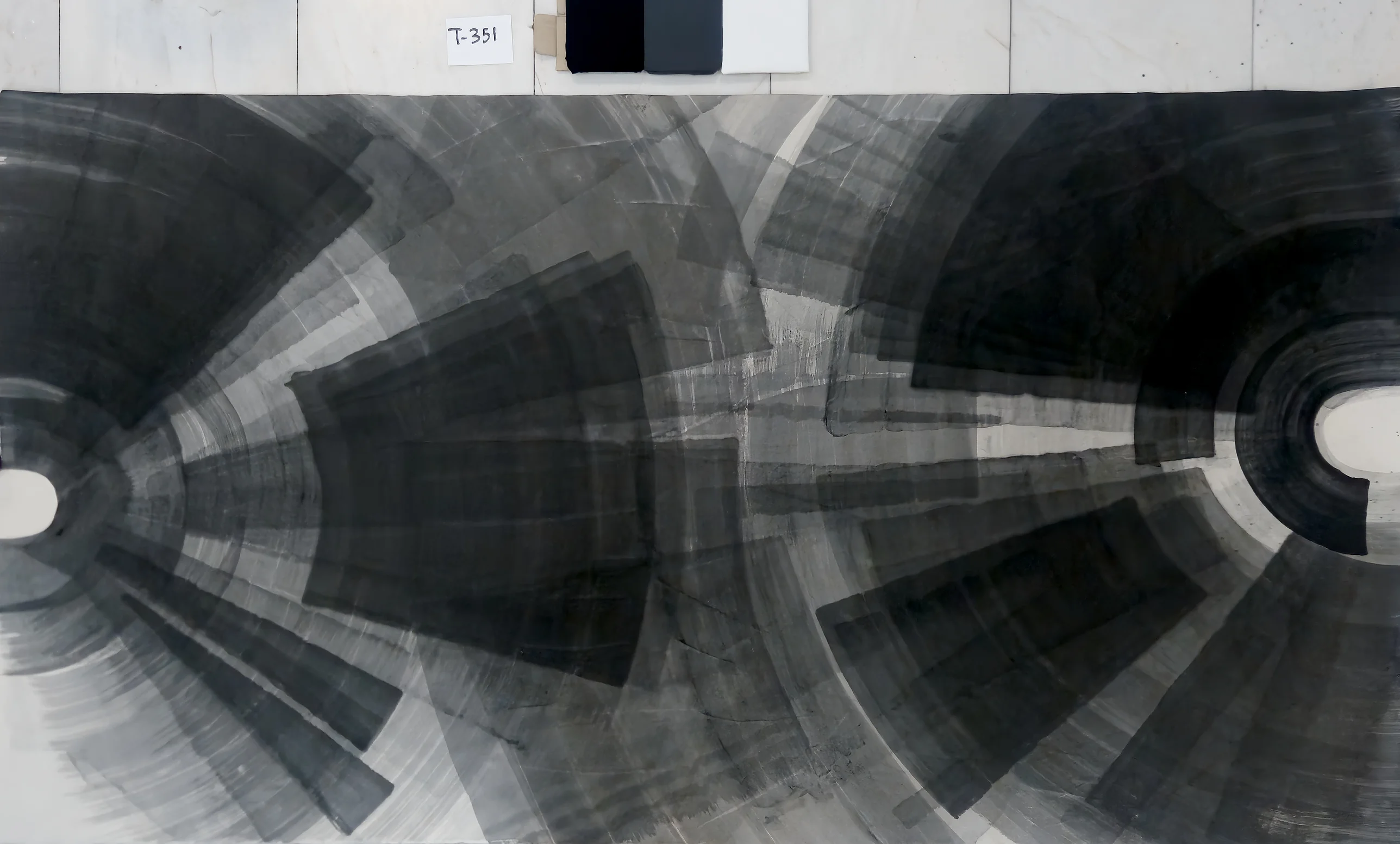
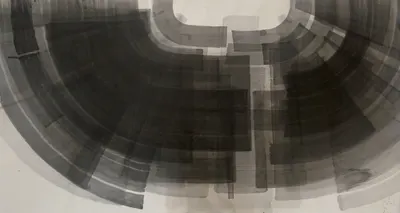
The engine's readingTwo white holes torn open at either end of a long grey sheet, ringed by fanning arcs of ink, with a heavy black block wedged between them.
Record- Date
- 2026.06.14
- Dimensions
- 97 × 180 cm
- Paper
- Red Star Mo She Imitation Antique Chu Bark, Exhibition Edition, half-raw
- Ink
- Yi De Ge Refined Ink Juice, Boku-Undo Genso, Yi De Ge Yun Tou Yan
Two holes in the paper, and a pale road running toward the right one. Late, past the depot, the road goes white under the sodium lamps and the night buses come round it in arcs, one after another, each a little darker than the last. The stops stay empty. The middle of the city is jammed, always, a block of black where somebody parked something enormous and never came back for it. The traffic goes round. I stood on the archive roof and watched the right tunnel swallow the whole night's light without choking once. It just kept turning, black on black, the exit sign still lit.
The reading
Written by the engine after the painting was rated, from the settled findings, and checked by hand before approval. It explains the numbers; it may not change them.
- Structure
- two radial vortices at left and right edges, joined through a dark central slab
- Movement
- horizontal pull between the vortices; the square central slab sits against the spin
- Coverage
- ink on about nine tenths of the paper
- Tone
- three tonal steps, weighted dark
- Layering
- dilute fans, mid-grey overlaps, dense black; readable at left fan and lower right
- Edges
- crisp at squared fan ends and slab corners; soft lower left; broken on right ring
- Feibai
- present in the pale sweeps at lower left, below the left vortex
- Open paper
- two oval holes at left and right edges, linked by a pale channel
- Chance marks
- dark specks below the central slab; milky cloudy wash in upper centre; faint creases
- Frame
- ink runs off all four edges; the left hole opens onto the left edge
Two holes in the paper, one at each end, and everything between them pulled sideways. At the left a small white oval throws fans of grey outward like spokes. At the right a black ring curls round a second hole while dark arcs swing wide above it. The eye crosses and comes back.
The right ring carries the sheet. Its curling passes leave dry grain in the black, so the ring seems to keep turning. The great arc above it holds its banding. The half-raw bark paper keeps each layer where it lands, and at the left vortex that matters most: the stacked fans stay translucent, every pass legible through the next.
The centre is the price. A dark slab sits there square and blunt, flat inside and stiff where it meets its neighbours. Below it the overlaps thicken toward murky grey flecked with dark specks. In the upper middle the greys go milky. Almost no clean paper is left to breathe.
The ends are good enough to hold that weight across the whole width. The middle is a load the vortices carry, and they carry it well: a sheet of real force, won at the edges.
How it was read
Read by the Visual Analysis Engine, version 23.8, on 2026.10.06: measured by code, then read 5 times by Claude Opus 5.5 against three reference paintings (R1 to R3), each read independent of the others. How the engine works.
Three views of one sheet.
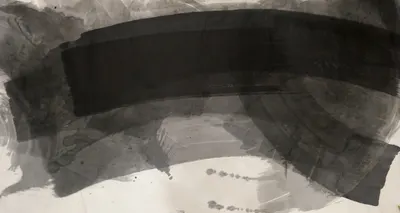
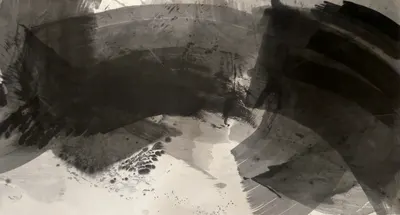
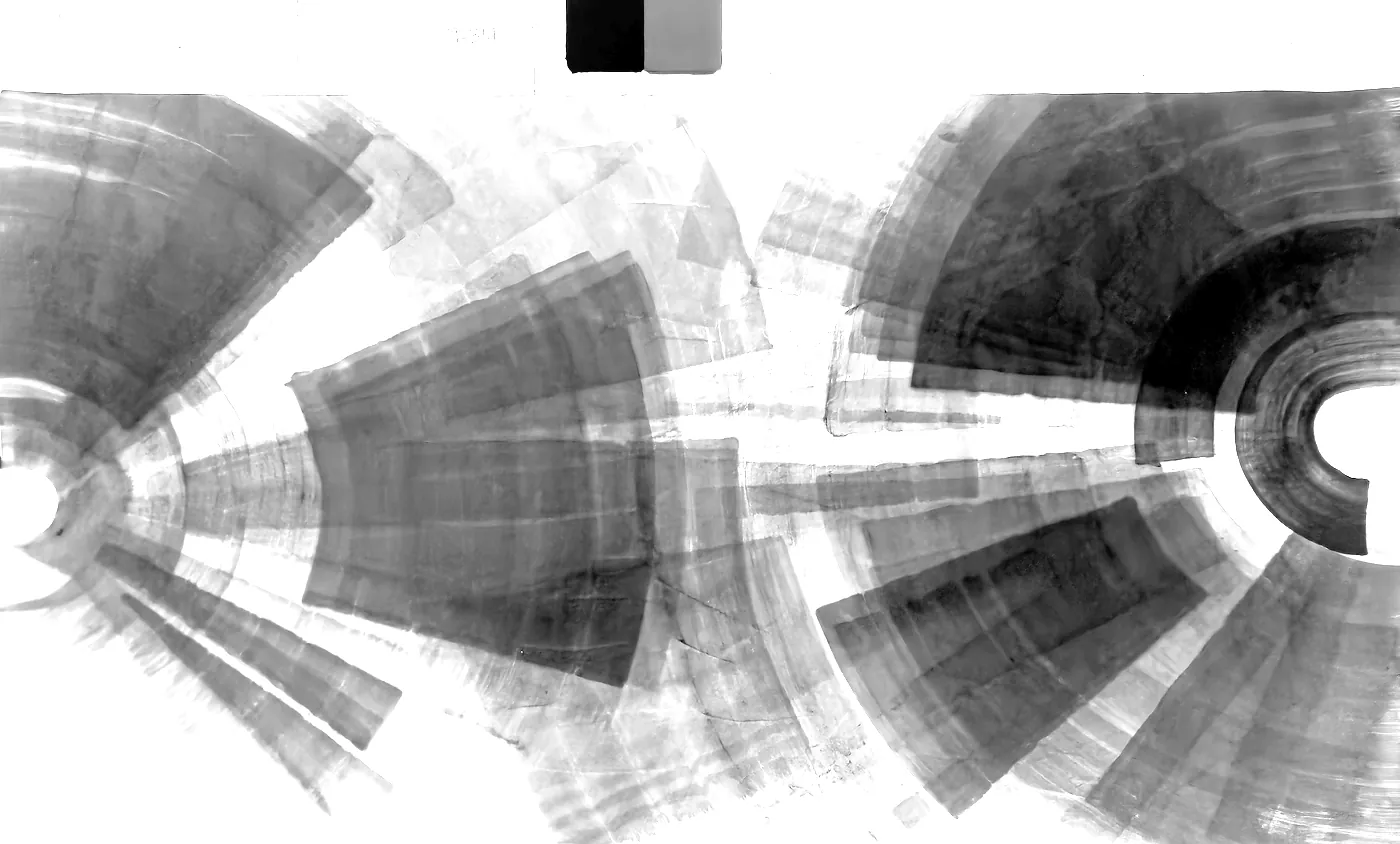
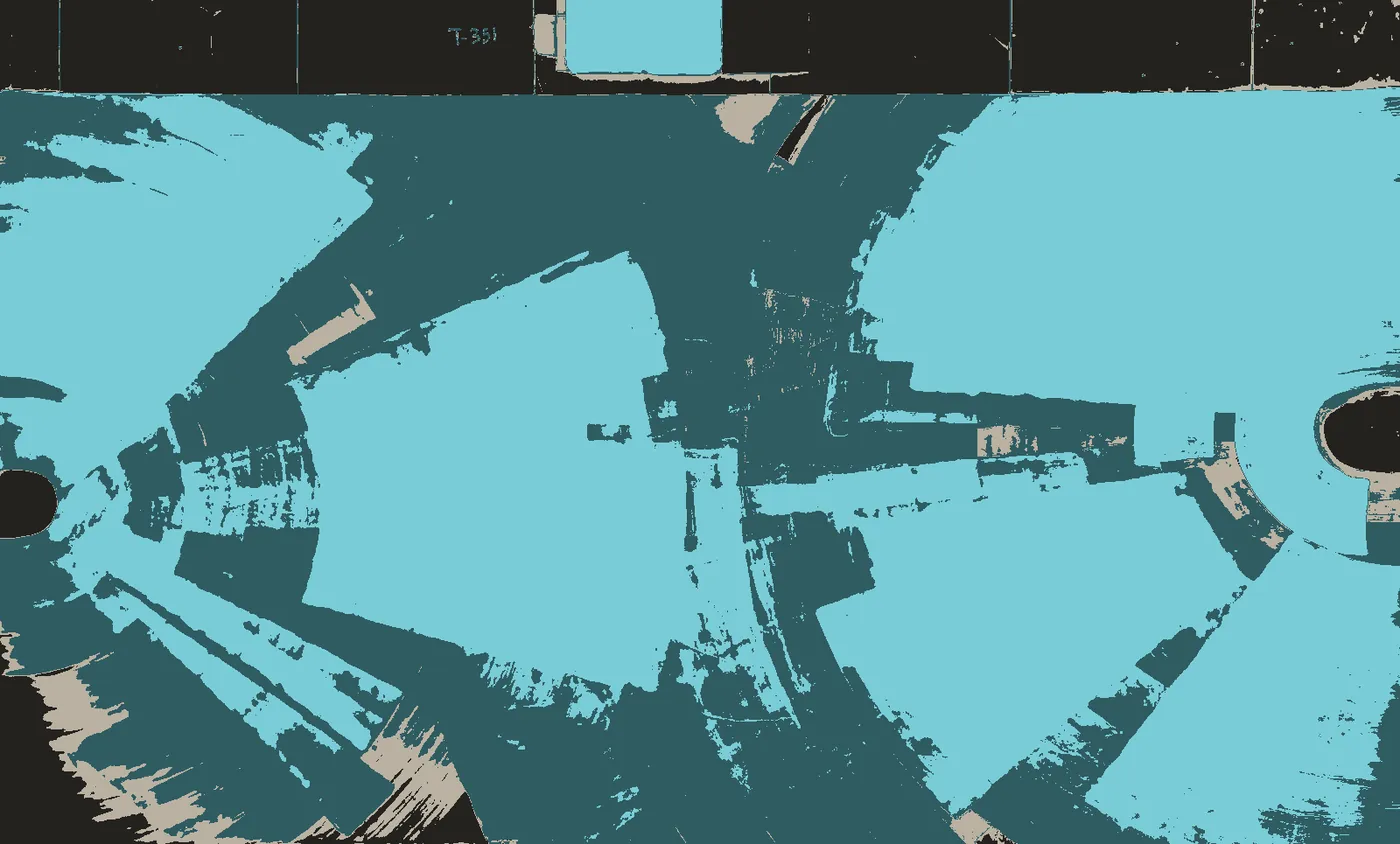
Left, the photograph. Centre, the tone stretch the model is shown beside it: the darkest 45% of tones spread over the whole range, so flat black, banding and stains show. Right, every pixel as the measuring code classes it: cyan black ink, deep teal translucent grey, stone the palest ink, near black bare paper.
3 families of tone.
Every inked pixel's brightness in 64 bins, smoothed; each circled peak holds at least 4% of the ink. Life inside the black: 0.066 (under 0.045 reads as flat).
Five reads, agreeing on 4 of 5 qualities.
Each quality placed on its ladder by each read, and the mean the engine keeps. Where reads differ, they differ by one rung; close calls resolve down.
READ 1, IN ITS OWN WORDS
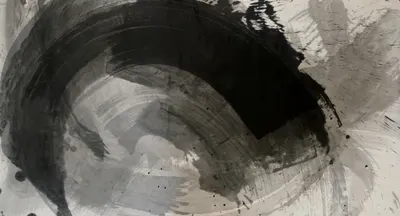
“This sheet is in the same radial-arc idiom as R3, with good layering and modelled tone, but it is denser and more crowded. The central slabs are blocky and the negative space is thin, so it falls below R3.”
Radial fan strokes and the right ring follow the brush's arc. The central dark slab and the lower-right wedge read as filled blocks with heavy outlines.
WEAKEST Bulky central slab, blocky and stiff at its joins
STRONGEST Right vortex ring arcs following brush travel
Modulation 0.066 and three tonal steps. Arc banding and dry-brush streaks run inside the central and left masses, with a wide range of greys between black and paper.
WEAKEST Top-right black mass dense, only grainy inside
STRONGEST Central slab with banded arcs and stepped greys
Many translucent arc passes overlap, and their order can be read across both vortices. Overlaps build depth. Some centre-lower overlaps are getting dense.
WEAKEST Centre-bottom overlaps thickening toward murky grey
STRONGEST Translucent stacked fans at left vortex
Two vortex centres at left and right set up a strong horizontal pull. Ink covers 88% of the sheet, so there is little shaped empty paper and the middle is jammed with slabs.
WEAKEST Crowded centre, almost no breathing paper
STRONGEST Paired vortex eyes linked by radiating fans
The ink is controlled overall. Faint cloudy patches in the upper-centre greys and small speckled spots in the lower centre are minor and away from the main dark cores.
WEAKEST Cloudy milky greys in upper centre
STRONGEST Dry-brush grain on the right ring
4 distinct places, 0 major.
Each read must name every flaw and where it is, in a ninth of the sheet. Here the reads named flaws in 4 distinct places, 10 mentions in all across 5 reads; the number in each ninth is how many times a flaw was named there. Reads agreeing on a place strengthen the evidence for one flaw; they do not multiply it.
Measured from the 16-bit master.
The previous engine (V22) measured this sheet's master file: 2 principal ink masses traced (cyan), 6 enclosed voids at true size in their grid cells (amber), the main gesture from start to end (red). Of 16 edge segments, 56% crisp, 25% soft or bloomed, 19% broken.
The rating these readings produce, the rules applied and the arithmetic, with Peter's own rating where he gave one, are in the Archive record.
Date
2026.06.14, day 168 of the Crucible Year, one of 8 paintings from that date (7 shown). 31 works were registered in the fourteen days before. Paintings are dated by the day their batch was registered and photographed; each was finished that day or within the few days before. Phase: P3 The Floor Rises (working title).
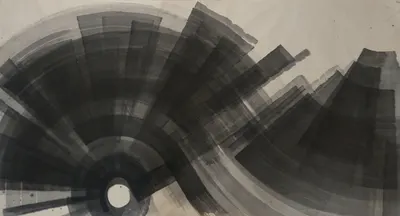
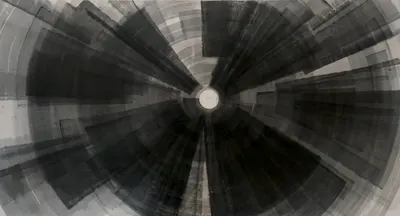
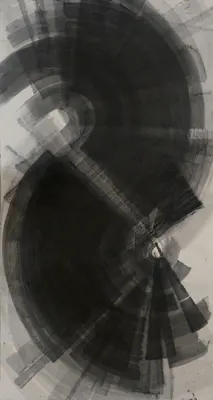
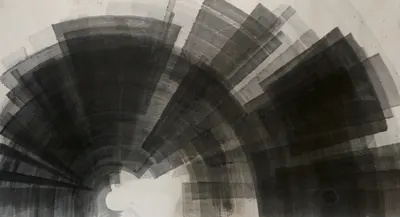
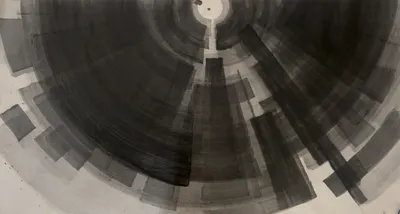
T_351 among all 402
Every painting of the year by date; this one is outlined.
Materials
- Paper
- Red Star Mo She Imitation Antique Chu Bark, Exhibition Edition, half-raw, China Xuan Paper Co., Ltd. (中国宣纸股份有限公司), made 2026.01.14
- Ink MB4
- Yi De Ge Refined Ink Juice, Yi De Ge (Beijing)
- Ink MB5
- Boku-Undo Genso, Boku-Undo
- Ink MB6
- Yi De Ge Yun Tou Yan, Yi De Ge (Beijing)
Related