T_356
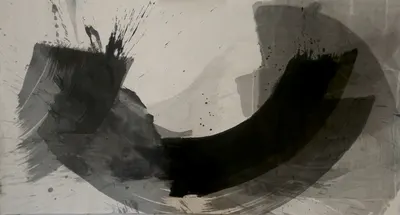
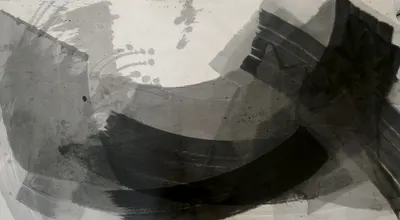
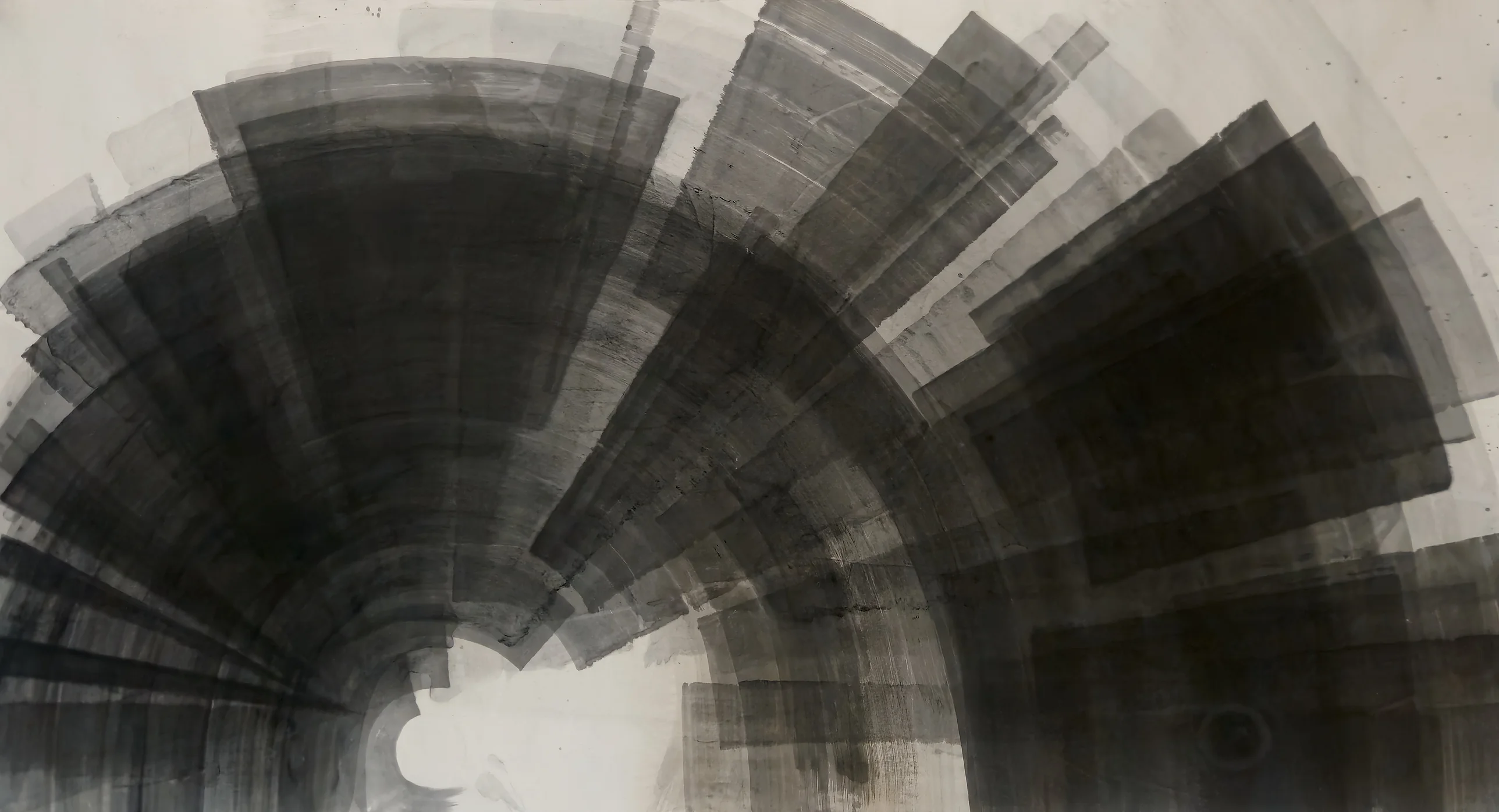
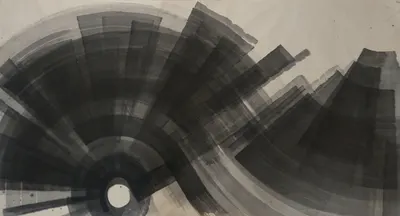
The engine's readingTranslucent grey bands wheel from the left edge, over the top and down into heavy black slabs, all hinged on a small white opening low in the middle.
Record- Date
- 2026.06.14
- Dimensions
- 97 × 180 cm
- Paper
- Red Star Mo She Imitation Antique Chu Bark, Exhibition Edition, half-raw
- Ink
- Yi De Ge Refined Ink Juice, Boku-Undo Genso, Yi De Ge Yun Tou Yan
The white hole low in the middle is the sun just under a bank of cloud, and the dark bands fanning out from it are the shadows the cloud throws up across the sky. Some call the bright ones Jacob's ladder. They look as if they spread from a single point, like the ribs of a fan, but they run side by side; only distance bends them together, the way railway lines meet at the horizon. I watched this from a harbour wall at the end of a wet day, the whole sky striped like a held breath. The ring at the right is a gull, turning. Then the sun dropped a little further, and the ladder came down.
The reading
Written by the engine after the painting was rated, from the settled findings, and checked by hand before approval. It explains the numbers; it may not change them.
- Structure
- one broad fan of arc bands around a low opening; squared slabs stacked at right
- Movement
- a clockwise sweep from left edge over the top; right-hand slabs sit square against it
- Coverage
- ink on about four fifths of the paper
- Tone
- two tonal steps, weighted dark
- Layering
- many translucent passes; readable across the left fan, merged in the right darks
- Edges
- crisp squared band ends at the rim; soft grey fringes beyond; broken dry ends here and there
- Feibai
- along the upper-centre bands and through the left fan's arcs
- Open paper
- a pale strip along the top, a small white hole at bottom centre
- Chance marks
- circular ring inside the lower-right dark block; small dark specks at top right
- Frame
- runs off left and bottom edges, touches top centre; top corners stay open
A wheel of grey bands turns across the paper, rising from the left edge, cresting at the top and coming down hard on the right, all of it hinged on a small white opening low in the middle. The sweep reads at once, and it is the sheet's real idea.
The left fan is the reason to stay. Each band there follows the brush round the curve with firm walls, and the translucent passes stack without drowning. The half-sized paper holds a wet edge, so an earlier band still shows through a later one, and parted hairs leave fine grain running the length of each arc.
The right half pays for it. The arcs harden into square slabs, stroke turning into fill, and the passes pile up until they close into one dense black. The big block at lower right is nearly flat inside, and a circular ring sits in it like a stain on a tabletop. Little paper survives on that side to breathe.
So the sheet is half of a good painting. The left fan holds its place; the right sits on it, and the whole lands as sound, ordinary work.
How it was read
Read by the Visual Analysis Engine, version 23.8, on 2026.10.06: measured by code, then read 5 times by Claude Opus 5.5 against three reference paintings (R1 to R3), each read independent of the others. How the engine works.
Three views of one sheet.
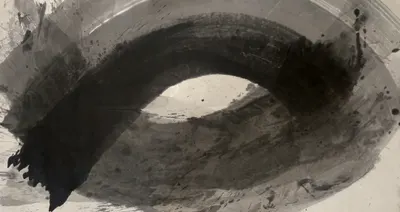
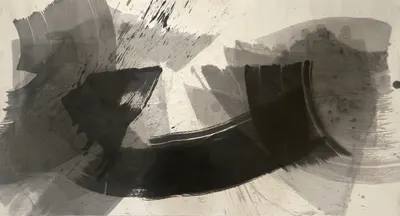
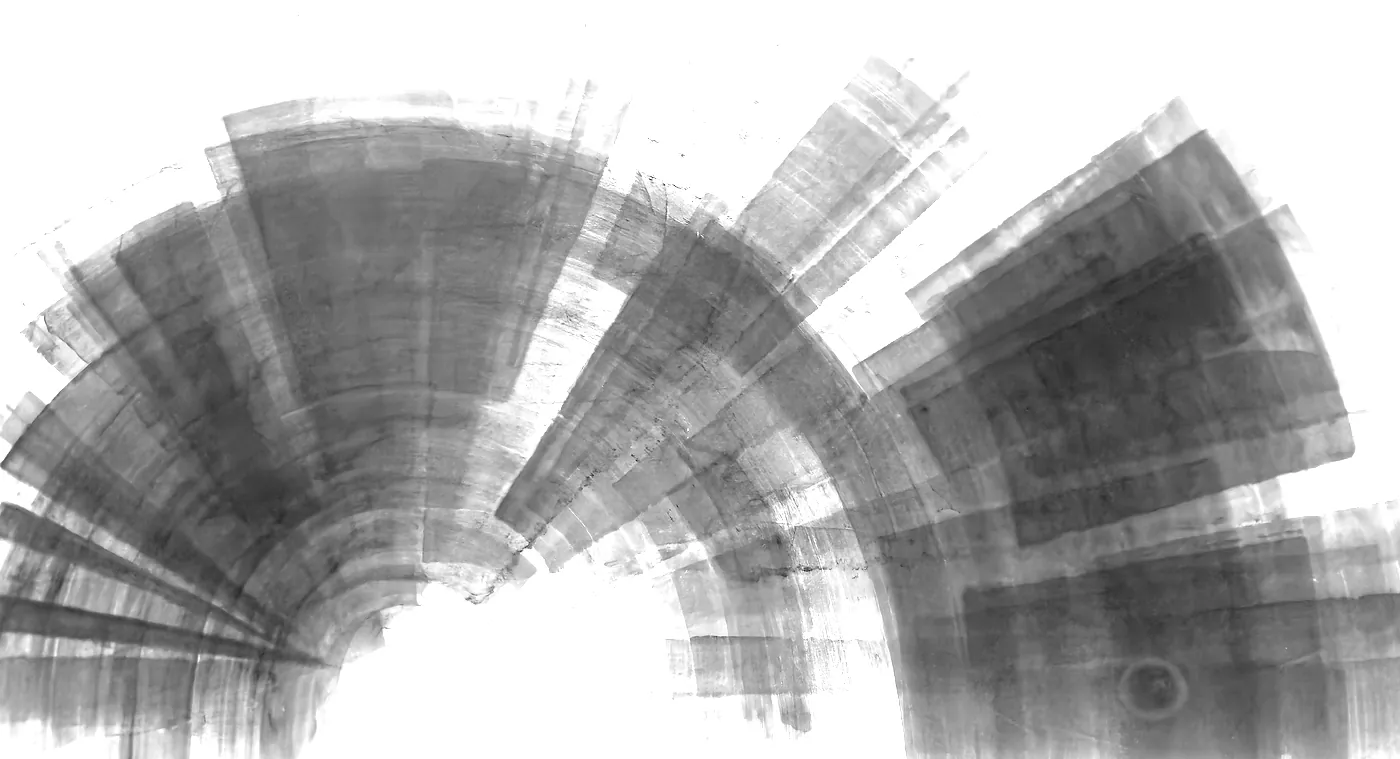
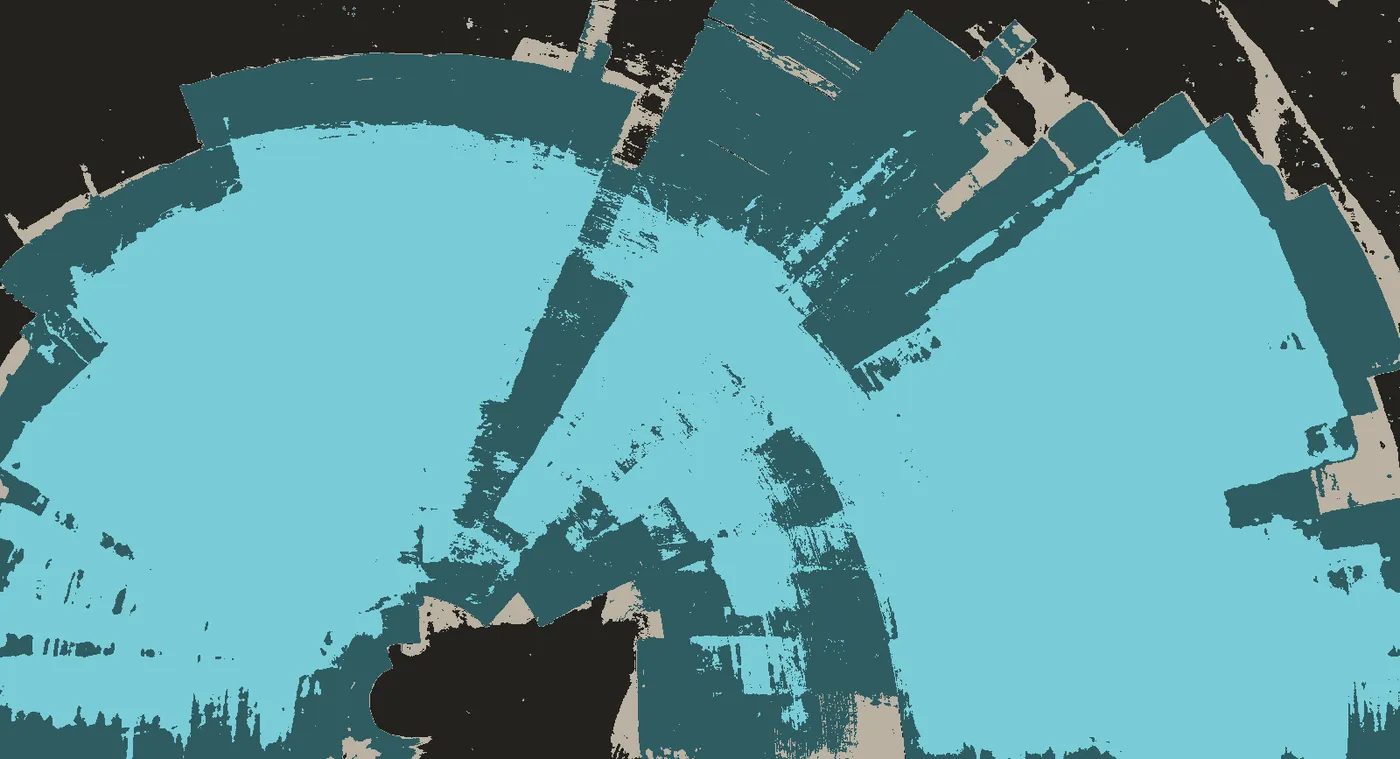
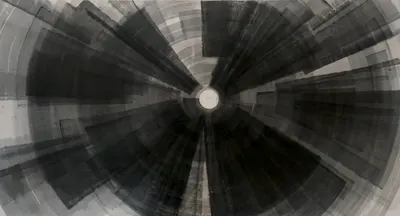
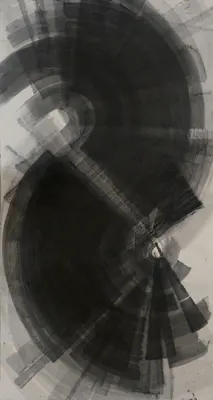
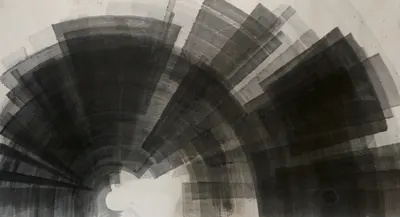
Left, the photograph. Centre, the tone stretch the model is shown beside it: the darkest 45% of tones spread over the whole range, so flat black, banding and stains show. Right, every pixel as the measuring code classes it: cyan black ink, deep teal translucent grey, stone the palest ink, near black bare paper.
2 families of tone.
Every inked pixel's brightness in 64 bins, smoothed; each circled peak holds at least 4% of the ink. Two or fewer: Tonal depth is held at the bottom rung whatever the model reads. A dense sheet of many translucent passes can count low here, so Layering is left to the reads. Life inside the black: 0.046 (under 0.045 reads as flat).
Five reads, agreeing on 3 of 5 qualities.
Each quality placed on its ladder by each read, and the mean the engine keeps. Where reads differ, they differ by one rung; close calls resolve down.
READ 1, IN ITS OWN WORDS
“This sheet uses the same radial-arc language as R3, with legible translucent layering, but it is more crowded and its darks are flatter. A visible ring inside the lower-right dark mass lowers the material score.”
The radial bands keep firm walls and curve with the stroke on the left and through the centre. The right-side slabs are squarer but still read as made marks.
WEAKEST Blocky rectangular slabs in the right-hand mass
STRONGEST Radiating arc bands at left that follow the brush's travel
Only two tonal steps were measured, and interior modulation (0.046) is barely above the flat line. Streaks and banding show in the arcs, but the dense lower-right mass reads flat.
WEAKEST Lower-right dark block is nearly flat inside
STRONGEST Banded grain inside the upper-left fan of arcs
Many translucent passes overlap in sequence across both fans, and their edges stay readable. In the darkest right areas the overlaps thicken and are harder to tell apart.
WEAKEST Dense right overlaps where passes merge into dark
STRONGEST Stacked translucent arc bands on the left fan
A clear sweep of arcs turns around the pale opening at the bottom centre. With 85% of the sheet inked, the right side is jammed and the empty paper has little shape.
WEAKEST Crowded, heavy right half with little paper left
STRONGEST Sweeping radial arc around the pale central opening
A circular ring/tide mark sits inside the dark block at the lower right and shows in both the colour and stretched views. Small spots appear at the top right.
WEAKEST Ring mark inside lower-right dark mass
STRONGEST Dry-brush streaking along the arc bands
2 distinct places, 1 major.
Each read must name every flaw and where it is, in a ninth of the sheet. Here the reads named flaws in 2 distinct places, 10 mentions in all across 5 reads; the number in each ninth is how many times a flaw was named there. Reads agreeing on a place strengthen the evidence for one flaw; they do not multiply it. A major flaw holds Material and surface at rung 1.
Measured from the 16-bit master.
The previous engine (V22) measured this sheet's master file: 1 principal ink mass traced (cyan), 5 enclosed voids at true size in their grid cells (amber), the main gesture from start to end (red). Of 14 edge segments, 71% crisp, 21% soft or bloomed, 7% broken.
The rating these readings produce, the rules applied and the arithmetic, with Peter's own rating where he gave one, are in the Archive record.
Date
2026.06.14, day 168 of the Crucible Year, one of 8 paintings from that date (7 shown). 31 works were registered in the fourteen days before. Paintings are dated by the day their batch was registered and photographed; each was finished that day or within the few days before. Phase: P3 The Floor Rises (working title).
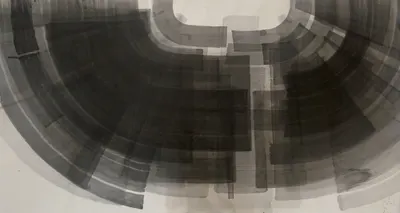
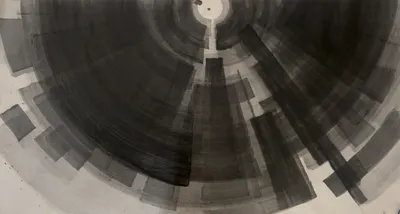
T_356 among all 402
Every painting of the year by date; this one is outlined.
Materials
- Paper
- Red Star Mo She Imitation Antique Chu Bark, Exhibition Edition, half-raw, China Xuan Paper Co., Ltd. (中国宣纸股份有限公司), made 2026.01.14
- Ink MB4
- Yi De Ge Refined Ink Juice, Yi De Ge (Beijing)
- Ink MB5
- Boku-Undo Genso, Boku-Undo
- Ink MB6
- Yi De Ge Yun Tou Yan, Yi De Ge (Beijing)
Related