T_239
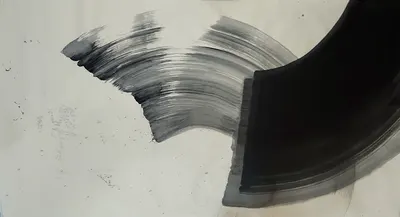
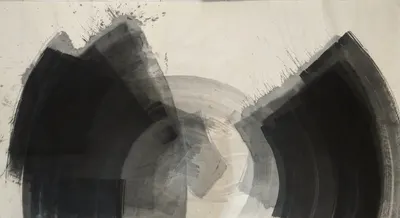
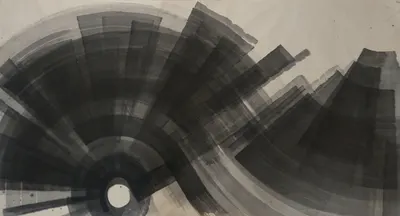
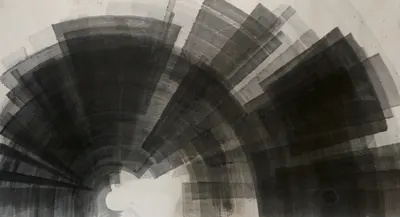
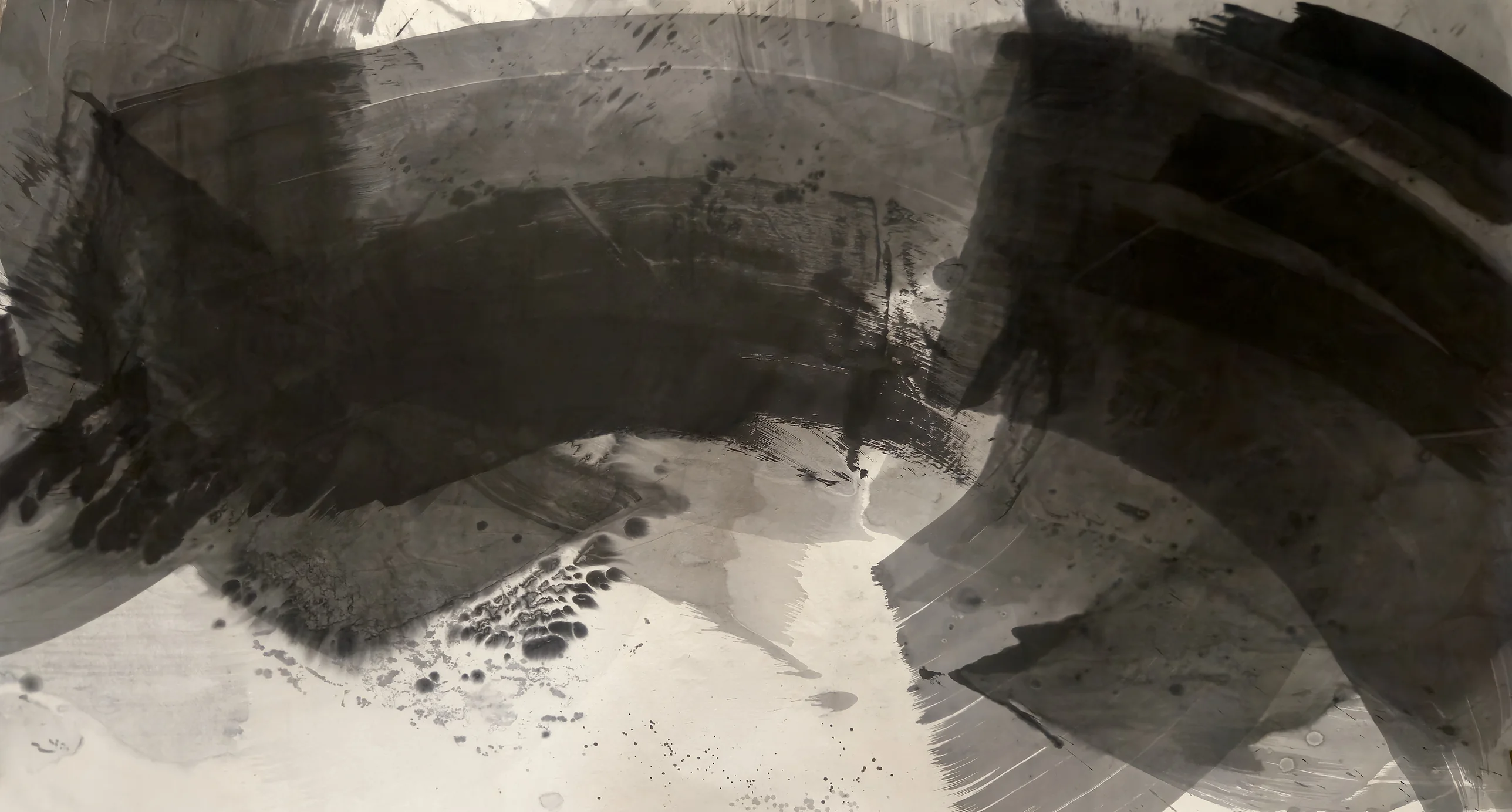
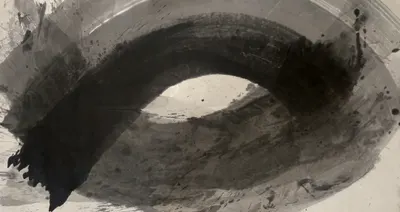
The engine's readingA great ink arch on bark paper: a black slab across the top, grey and black bands sweeping down the right around a pale bay.
Record- Date
- 2026.04.18
- Dimensions
- 97 × 180 cm
- Paper
- Red Star Mo She Imitation Antique Chu Bark, Exhibition Edition, half-raw
- Ink
- Yi De Ge Refined Ink Juice, Boku-Undo Genso, Yi De Ge Yun Tou Yan
The beaded black under the big band looks like a flat roof after rain, when the tar has blistered and the water stands in little rows. I stood on one like that, late, the hour when the district hums under a lid of cloud. Across the street a heavy lit sign was trying to bend around a corner and only managed to lean. The puddles held it, in small round pieces, each bead keeping its own scrap of the light. Up there the weight of a block is somebody else's problem. You watch the drains. When the sign switches off, the beads go dark one at a time, and the last one shines for a long while on its own.
The reading
Written by the engine after the painting was rated, from the settled findings, and checked by hand before approval. It explains the numbers; it may not change them.
- Structure
- left wedge, heavy top band, right arcing mass, joined into one arch
- Movement
- one arc from left across and down to lower right, nothing firmly against it
- Coverage
- ink on about nine tenths of the paper
- Tone
- five tonal steps, weighted dark
- Layering
- grey sweeps under black bands, readable at right, merged on left
- Edges
- crisp at right stroke ends, blurred at left joins, broken along dry tails
- Feibai
- present, at the right arc stroke ends and lower-right grey sweep
- Open paper
- rounded pale bay at bottom centre, beneath the arch
- Chance marks
- beaded crackled bloom below top band; small rings lower right; tide edges in bay
- Frame
- ink runs off left, top and right; bottom left and centre stay open
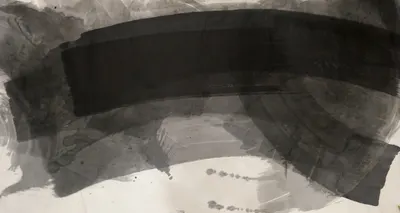
An arch fills the paper. It rises at the left, runs heavy and black across the top, and comes down the right in long curved bands, closing round a pale bay at the bottom centre. Ink crowds almost every edge, so the eye takes the sheet as one large turning shape before it finds a single stroke.
The right side is where the brush is alive. Grey sweeps lie under black bands and stay legible through them, because the half-raw bark paper holds each pass at its edge. The black steps down to grey in clean bands, and the stroke ends break into flying white, the hairs parting into streaks that keep the curve.
The left and centre are where it pays. The top band is a broad slab, nearly uniform inside, and where it meets the left wedge several passes have sunk into one murky body with a blurred join. Beneath it a beaded, crackled bloom of pooled ink sits against the mass, and the sheet absorbs that as weather.
So the arc works and the mass does not. A sure hand shows on the right; the left buries it under weight it never organises, and the sheet settles among the many like it.
How it was read
Read by the Visual Analysis Engine, version 23.8, on 2026.10.06: measured by code, then read 5 times by Claude Opus 5.5 against three reference paintings (R1 to R3), each read independent of the others. How the engine works.
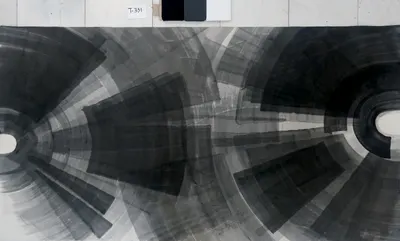
Three views of one sheet.
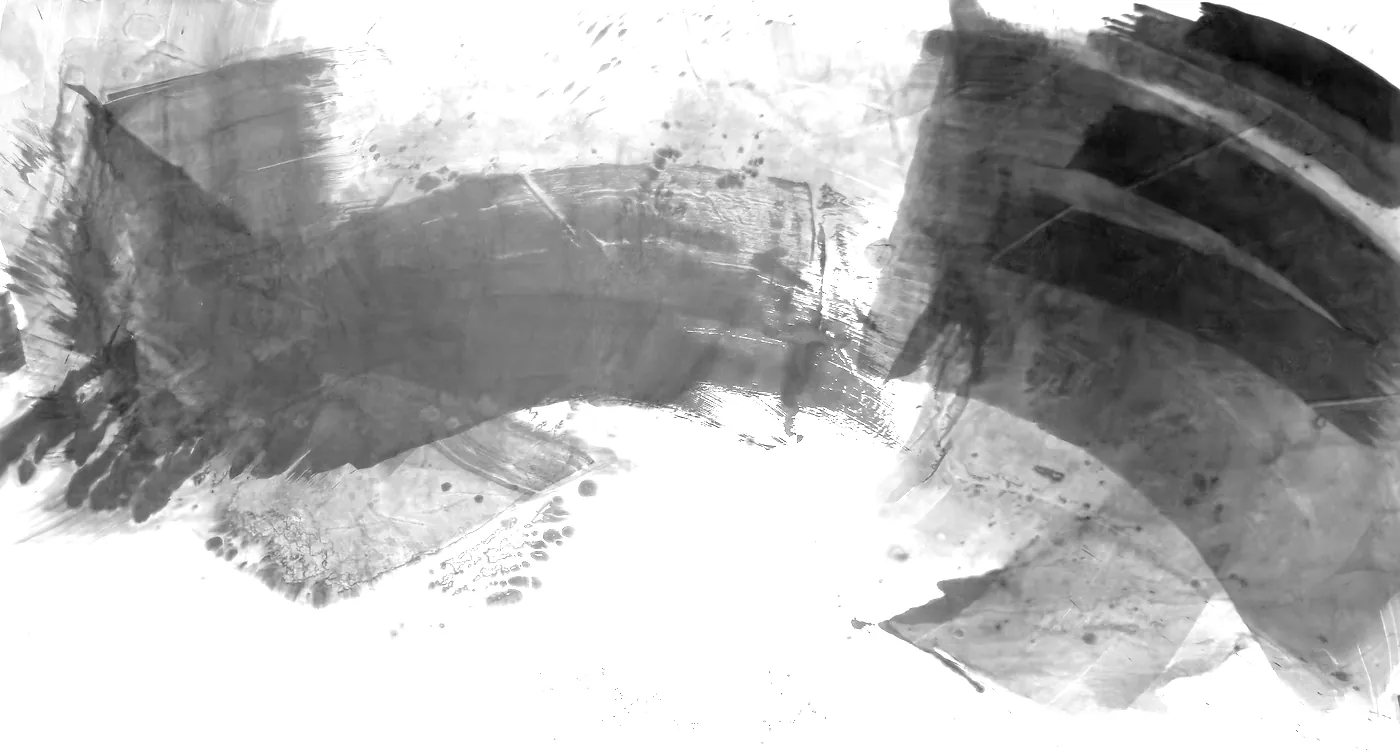
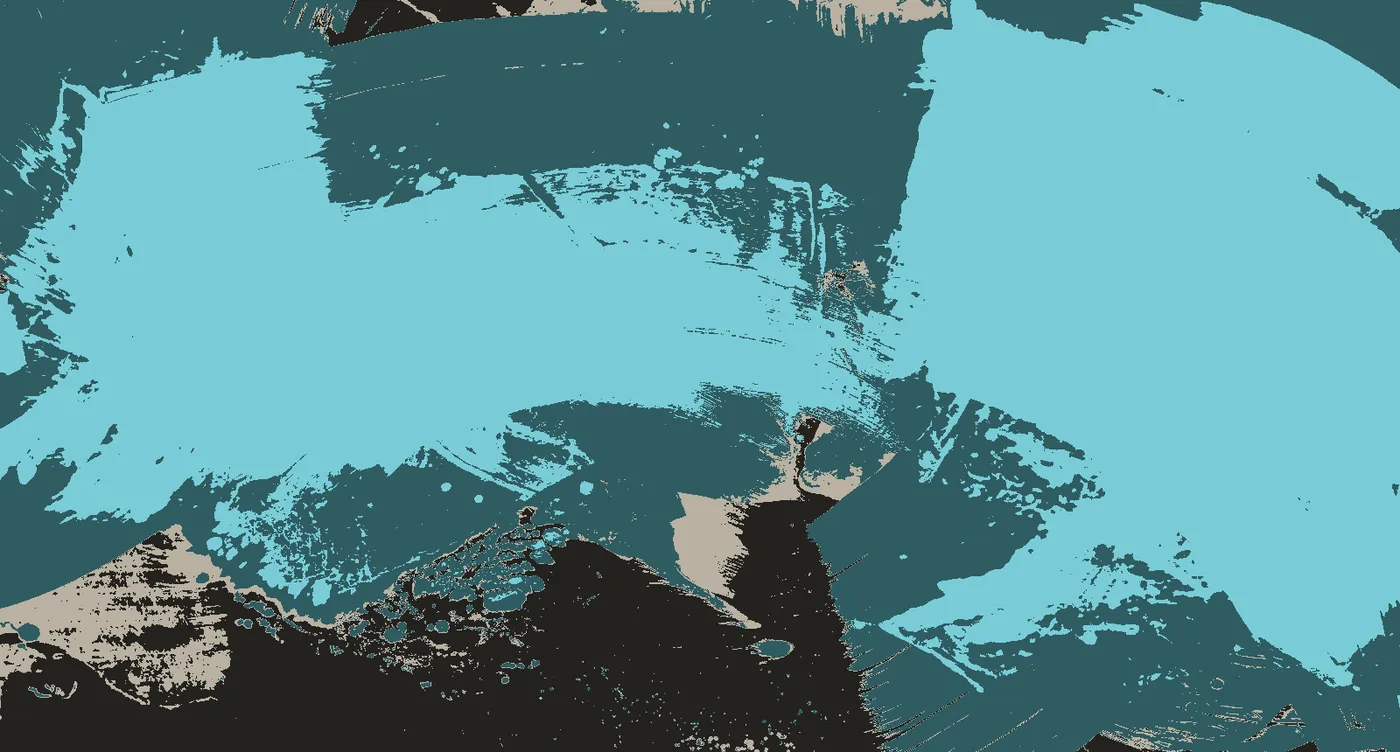
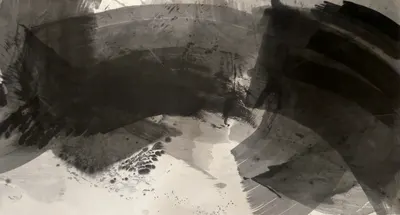
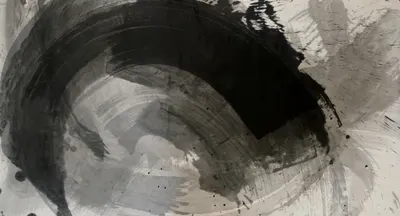
Left, the photograph. Centre, the tone stretch the model is shown beside it: the darkest 45% of tones spread over the whole range, so flat black, banding and stains show. Right, every pixel as the measuring code classes it: cyan black ink, deep teal translucent grey, stone the palest ink, near black bare paper.
5 families of tone.
Every inked pixel's brightness in 64 bins, smoothed; each circled peak holds at least 4% of the ink. Life inside the black: 0.059 (under 0.045 reads as flat).
Five reads, one answer.
Each quality placed on its ladder by each read, and the mean the engine keeps.
READ 1, IN ITS OWN WORDS
“A sweeping arc composition with good layered arcs on the right. It is let down by a heavy, flat left mass and a beaded, crackled bloom accident against the lower edge of the central dark mass.”
Right arcs follow the brush's sweep with dry-brush tails. The left-centre dark band is a heavy slab whose left end blurs into a clumsy join.
WEAKEST Bulky left dark mass with blurred, clumsy join
STRONGEST Right arcing bands with dry-brush tails
Right arcs step from black to grey with streaks. The central dark band is mostly uniform inside. Modulation is 0.059 across five tonal steps.
WEAKEST Centre-left dark band nearly flat inside
STRONGEST Right arcs stepped from black to grey
Grey passes sit under the black arcs on the right and can still be read. On the left the passes are cloudy and their order is unclear.
WEAKEST Left overlaps murky and hard to read
STRONGEST Translucent grey arc under black bands, right
A large arc carries the eye from left to lower right around a shaped pale opening at bottom centre. Ink covers 87%, so the upper left feels crowded.
WEAKEST Crowded, heavy upper-left quarter
STRONGEST Sweeping arc from left across to lower right
Bubbly reticulated beads and crackle stains sit lower-centre-left against the dark mass. Cloudy wash and small rings appear on the right. Visible in the colour view.
WEAKEST Bloom and crackle patch at lower-left edge
STRONGEST Dry-brush streaks at right arc ends
5 distinct places, 2 major.
Each read must name every flaw and where it is, in a ninth of the sheet. Here the reads named flaws in 5 distinct places, 19 mentions in all across 5 reads; the number in each ninth is how many times a flaw was named there. Reads agreeing on a place strengthen the evidence for one flaw; they do not multiply it. A major flaw holds Material and surface at rung 1.
Measured from the 16-bit master.
The previous engine (V22) measured this sheet's master file: 1 principal ink mass traced (cyan), 5 enclosed voids at true size in their grid cells (amber), the main gesture from start to end (red). Of 16 edge segments, 50% crisp, 38% soft or bloomed, 13% broken.
The rating these readings produce, the rules applied and the arithmetic, with Peter's own rating where he gave one, are in the Archive record.
Date
2026.04.18, day 111 of the Crucible Year, one of 12 paintings from that date (8 shown). 56 works were registered in the fourteen days before. Paintings are dated by the day their batch was registered and photographed; each was finished that day or within the few days before. Phase: P2 The Switch (working title).
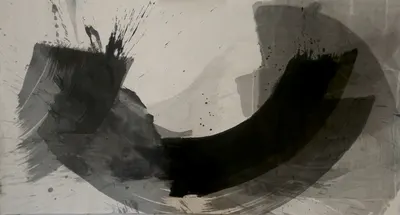
T_239 among all 402
Every painting of the year by date; this one is outlined.
Materials
- Paper
- Red Star Mo She Imitation Antique Chu Bark, Exhibition Edition, half-raw, China Xuan Paper Co., Ltd. (中国宣纸股份有限公司), made 2026.01.14
- Ink MB4
- Yi De Ge Refined Ink Juice, Yi De Ge (Beijing)
- Ink MB5
- Boku-Undo Genso, Boku-Undo
- Ink MB6
- Yi De Ge Yun Tou Yan, Yi De Ge (Beijing)
Related