
T_335
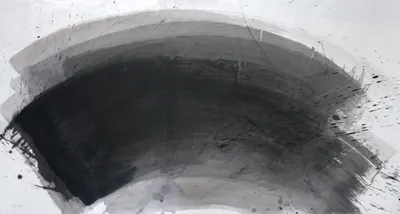
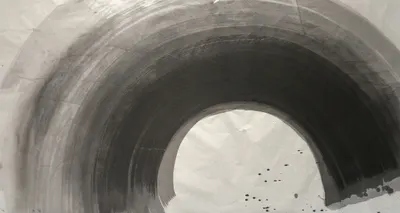
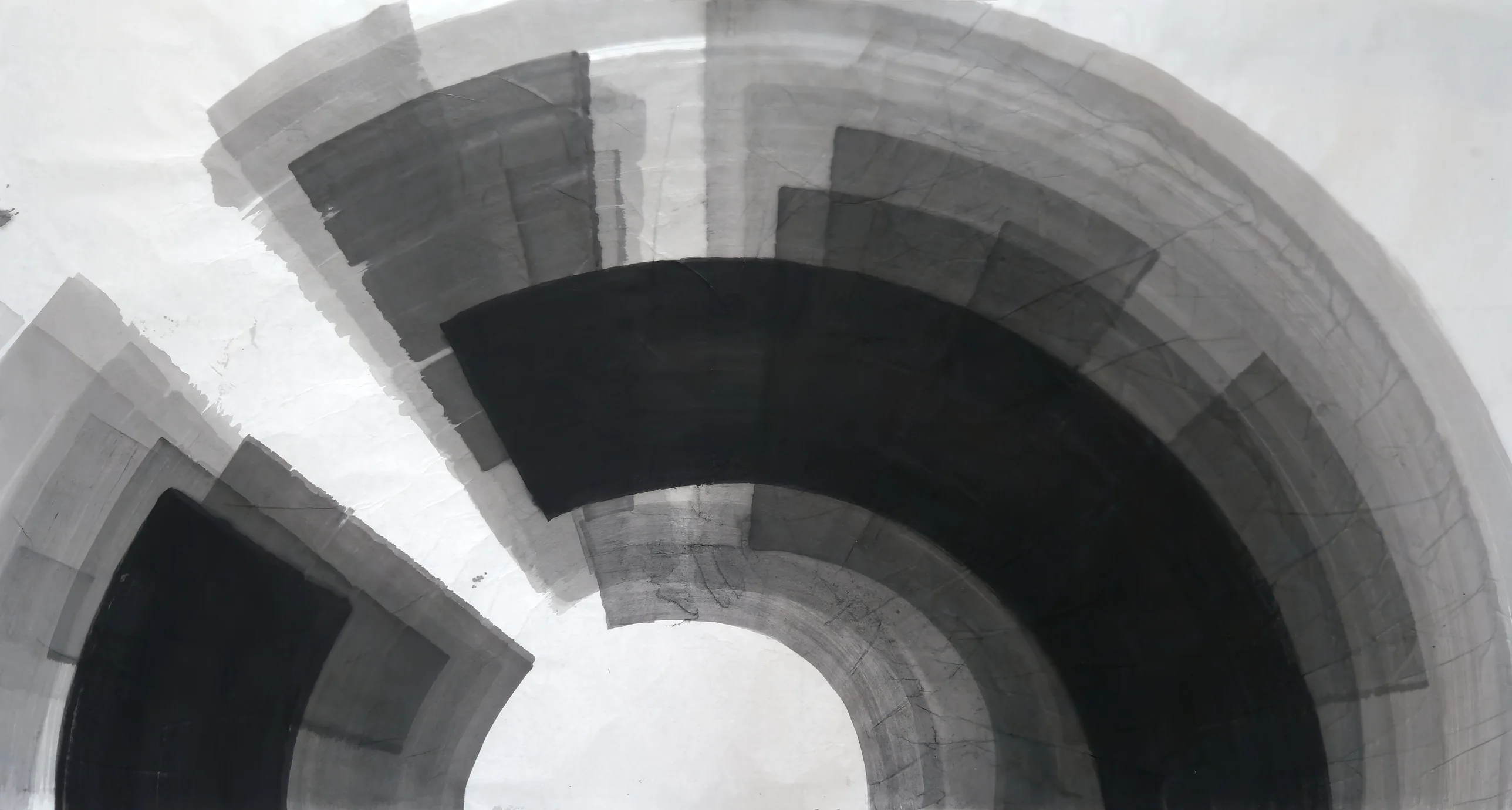
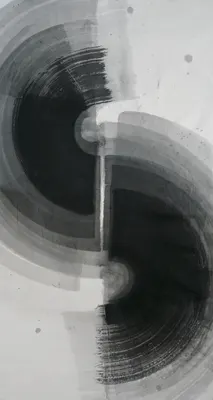
The engine's readingA great wheel of ink bands turning around a white opening at the bottom edge, its black arc sweeping right and a broken sector holding the left.
Record- Date
- 2026.06.03
- Dimensions
- 97 × 180 cm
- Paper
- Red Star Mo She Special Effect Xieyi Edition, half-raw (June 2025 batch)
- Ink
- Yi De Ge Refined Ink Juice, Boku-Undo Genso, Yi De Ge Yun Tou Yan
The white at the bottom is the way out, and I know that stairwell. Spiral, concrete, the kind they poured into car parks when the city still believed in cars. Stand on the lowest landing and look up and every floor is a ring: grey, greyer, then the black one where the bulbs died and stayed dead. The creases are the cracks in the render. I climbed it before dawn to reach the roof, counting landings by smell: rain, diesel, a cigarette, rain again. The door at the top was always chained, and the chain was always long enough. Up there the whole city turned slowly around the hole I had climbed out of, lit and enormous, holding still for once.
The reading
Written by the engine after the painting was rated, from the settled findings, and checked by hand before approval. It explains the numbers; it may not change them.
- Structure
- concentric arc bands around a white core; a separate sector at lower left
- Movement
- rotation from lower left, over the top, down to lower right; nothing opposes
- Coverage
- ink on about four fifths of the paper
- Tone
- seven tonal steps, weighted to the middle greys
- Layering
- pale, mid grey and black passes; readable across upper right and left sector
- Edges
- crisp band walls throughout; squared, slightly feathered ends upper left; grainy inner ring edge
- Feibai
- none
- Open paper
- white void bottom centre; diagonal wedge between sectors; both upper corners
- Chance marks
- dark speck at upper left edge; faint specks above left sector; crease lines through greys
- Frame
- ink runs off bottom, left and top edges; upper corners stay open
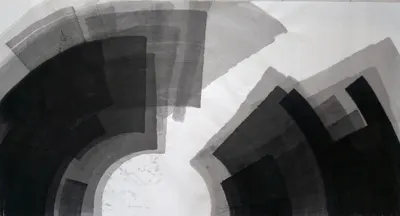
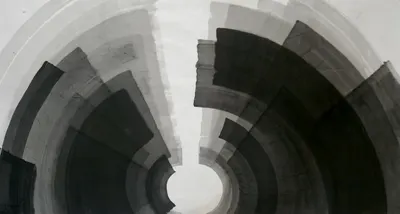
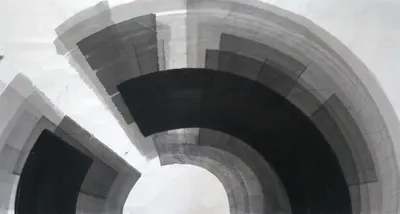
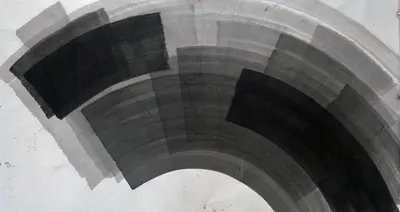
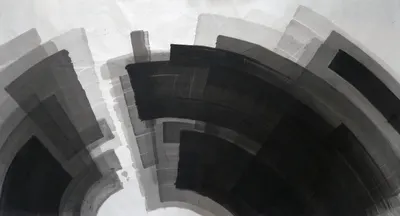
A great wheel turns across the paper. Its hub sits at the bottom edge, a white opening the rings bend around, and the bands rise from the lower left, cross the top and come down hard at the right. A second sector at the left, cut off by a wedge of bare paper, keeps the turn going past the frame.
The black arc is the engine. It sweeps from the centre to the lower right in one broad band, and its walls hold true the whole way. Behind it the greys step outward in translucent courses, palest at the rim. On this half-sized bark paper each pass stays where it fell, so the order of laying reads ring by ring across the upper right. Beneath the black, the inner ring runs dry and grainy, the paper's tooth showing through like weathered stone.
The costs are real and small. The black barely moves inside. It is dense enough to seal the fibre, so it sits on the passes beneath rather than showing them. Fine crease lines cross the greys at right and centre where wash settled into folds, and the square ends of the upper-left greys stop bluntly.
The wheel turns with such weight and such clear order that it reads as a built thing, larger than its edges, every grey in its place. Sheets like this are why the others get made.
How it was read
Read by the Visual Analysis Engine, version 23.8, on 2026.10.06: measured by code, then read 5 times by Claude Opus 5.5 against three reference paintings (R1 to R3), each read independent of the others. How the engine works.
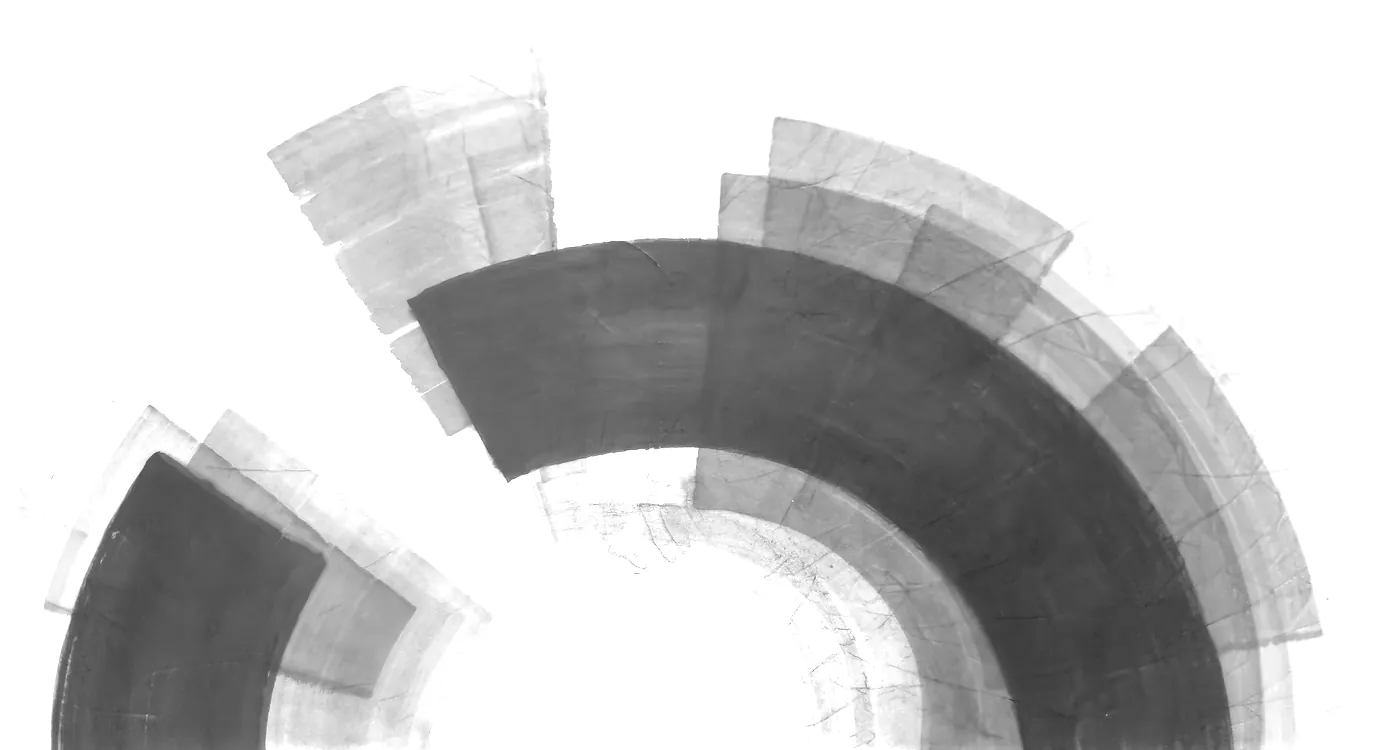
Three views of one sheet.
Left, the photograph. Centre, the tone stretch the model is shown beside it: the darkest 45% of tones spread over the whole range, so flat black, banding and stains show. Right, every pixel as the measuring code classes it: cyan black ink, deep teal translucent grey, stone the palest ink, near black bare paper.
7 families of tone.
Every inked pixel's brightness in 64 bins, smoothed; each circled peak holds at least 4% of the ink. Life inside the black: 0.054 (under 0.045 reads as flat).
Five reads, agreeing on 4 of 5 qualities.
Each quality placed on its ladder by each read, and the mean the engine keeps. Where reads differ, they differ by one rung; close calls resolve down.
READ 1, IN ITS OWN WORDS
“A concentric arc sheet in R3's family, with fluent arcs and ordered translucent layering. The black arc is fairly flat inside and the composition is less resolved than R3's. The surface is sound, with only minor crease marks.”
Concentric arc bands follow the brush's curved travel; walls hold cleanly. Squared stepped terminations at the upper-left greys are slightly blunt, but not clumsy.
WEAKEST Stepped blocky ends of upper-left grey bands
STRONGEST Broad black arc sweeping centre to bottom right
Seven tonal steps across many grey bands. Interior modulation of 0.054 is only modest, and the large black arc and the black block at left read mostly flat inside.
WEAKEST Main black arc interior nearly uniform
STRONGEST Dry-brush inner grey arc, bottom centre
Several translucent grey passes overlap in a readable order, building out from black to pale outer arcs at right and left. The overlaps stay legible.
WEAKEST Black arc covers rather than shows underlying passes
STRONGEST Stacked translucent grey arcs, upper right
The concentric sweep gives clear direction and the white core is shaped. The left fragment and the top-left paper wedge feel less resolved than R3's balanced opening.
WEAKEST Left arc fragment feels cut off and wedged
STRONGEST Large arc sweep around the white centre
Ink is controlled with no tide lines or rings. Crease networks show in the greys at right and centre, and there is a small speck at the left edge.
WEAKEST Paper crease lines visible through grey bands
STRONGEST Grainy dry-brush texture in inner arc
5 distinct places, 0 major.
Each read must name every flaw and where it is, in a ninth of the sheet. Here the reads named flaws in 5 distinct places, 12 mentions in all across 5 reads; the number in each ninth is how many times a flaw was named there. Reads agreeing on a place strengthen the evidence for one flaw; they do not multiply it.
Measured from the 16-bit master.
The previous engine (V22) measured this sheet's master file: 5 principal ink masses traced (cyan), 3 enclosed voids at true size in their grid cells (amber), the main gesture from start to end (red). Of 23 edge segments, 39% crisp, 52% soft or bloomed, 9% broken.
The rating these readings produce, the rules applied and the arithmetic, with Peter's own rating where he gave one, are in the Archive record.
Date
2026.06.03, day 157 of the Crucible Year, one of 12 paintings from that date. 18 works were registered in the fourteen days before. Paintings are dated by the day their batch was registered and photographed; each was finished that day or within the few days before. Phase: P3 The Floor Rises (working title).
T_335 among all 402
Every painting of the year by date; this one is outlined.
Materials
- Paper
- Red Star Mo She Special Effect Xieyi Edition, half-raw (June 2025 batch), China Xuan Paper Co., Ltd., made 2025.06.07
- Ink MB4
- Yi De Ge Refined Ink Juice, Yi De Ge (Beijing)
- Ink MB5
- Boku-Undo Genso, Boku-Undo
- Ink MB6
- Yi De Ge Yun Tou Yan, Yi De Ge (Beijing)
Related