T_280
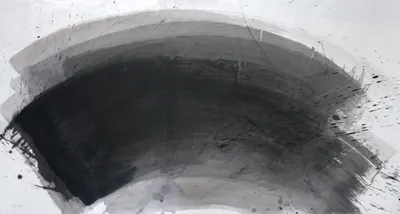
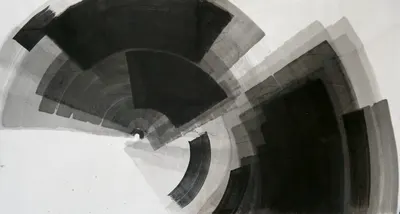
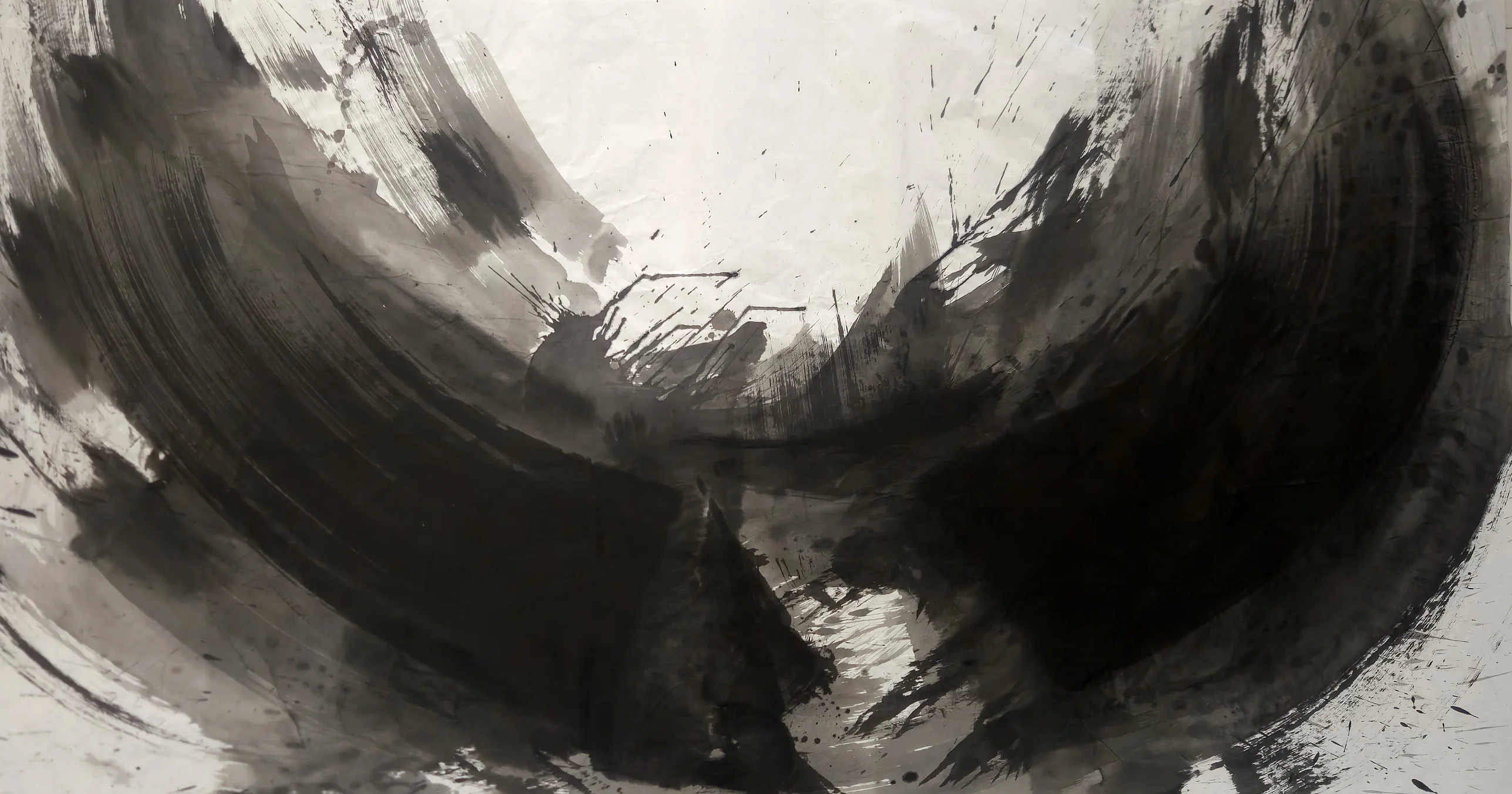
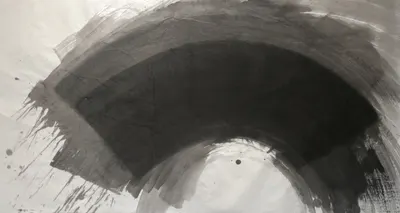
The engine's readingTwo black arcs swing down from the top corners of a long sheet and meet in a burst of spatter, cupping a pale dome of bare paper.
Record- Date
- 2026.05.07
- Dimensions
- 97 × 180 cm
- Paper
- Red Star Mo She Special Effect Xieyi Edition, half-raw (June 2025 batch)
- Ink
- Yi De Ge Refined Ink Juice, Boku-Undo Genso, Yi De Ge Yun Tou Yan
It is a dish, and it is pointed up. Two black arms curve to catch whatever falls out of that pale sky, and at the focus, low in the middle, the receiver has gone to spray, which is what a signal looks like when it has travelled a long time and arrives too loud. Up in the right arm, small pale rings: condensation on the housing. I sat the night shift with this antenna. Mostly it heard its own weight humming. Once, near dawn, the left arm caught something clean and ran it down the whole curve in long fine lines, like a transcript. Then the static came back, thick and black, the colony slept on, and the dish kept its mouth open at the white.
The reading
Written by the engine after the painting was rated, from the settled findings, and checked by hand before approval. It explains the numbers; it may not change them.
- Structure
- two great arcs meeting low in a bowl, dark wedge at their join
- Movement
- both arcs sweep down and inward; centre spatter bursts upward against them
- Coverage
- ink on about nine tenths of the paper
- Tone
- five tonal steps, weighted dark
- Layering
- grey washes under black, readable at the arcs' upper outer edges
- Edges
- crisp on the central wedge; broken along the arcs; soft in grey washes
- Feibai
- present along the left arc's sweep and the right arc's outer rim
- Open paper
- pale dome at top centre, held between the arcs
- Chance marks
- centre spatter; pale droplet spots in the upper right grey and lower left
- Frame
- ink runs off left, bottom and upper right; top centre and lower right corner stay open
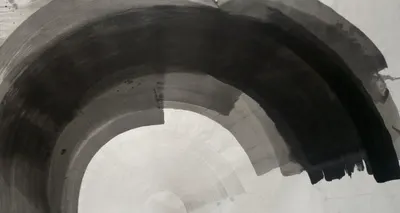
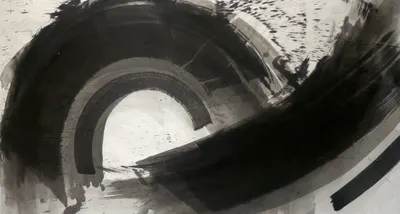
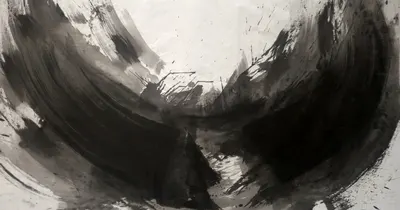
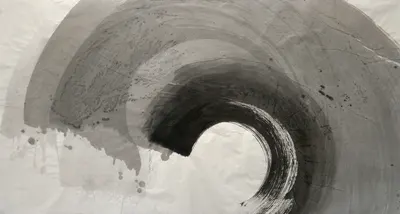
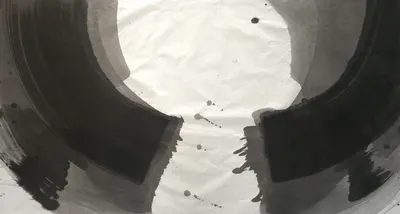
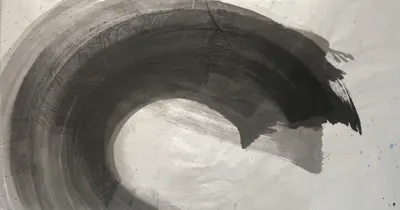
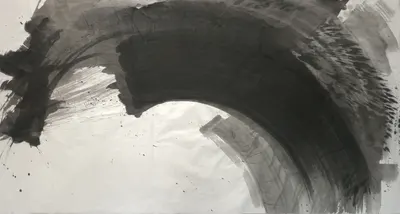
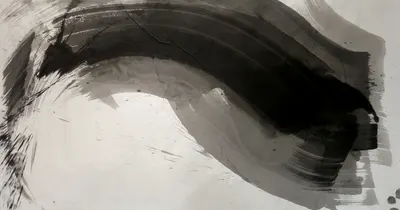
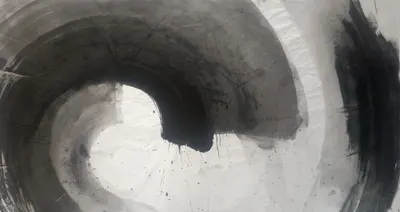
Two great arcs swing down from the top corners and meet low in the middle, a bowl the width of the sheet. They press the bare paper above into a pale dome, and a burst of spatter at their meeting throws ink up into it.
The left arc is the reason to stand here. Long striations run the whole curve, the hairs parting into streaks of bare paper while the stroke holds its line. Grey washes went down first, and the half-sized paper kept them apart from the black laid over them, so the band reads in several greys, grained like weathered wood.
A dark wedge drives into the bowl's floor at bottom centre, blunt where it joins the arcs. Splatter and stacked black crowd that junction until the order of passes is lost. Inside the right arc the black lies on itself and seals flat. Pale water spots freckle the grey of its upper sweep, small and clear of the main darks.
So the bowl holds, and its left side is very good. The rest is sound and heavy-footed: a well-built sheet above the archive's usual run, short of its strongest.
How it was read
Read by the Visual Analysis Engine, version 23.8, on 2026.10.06: measured by code, then read 5 times by Claude Opus 5.5 against three reference paintings (R1 to R3), each read independent of the others. How the engine works.
Three views of one sheet.
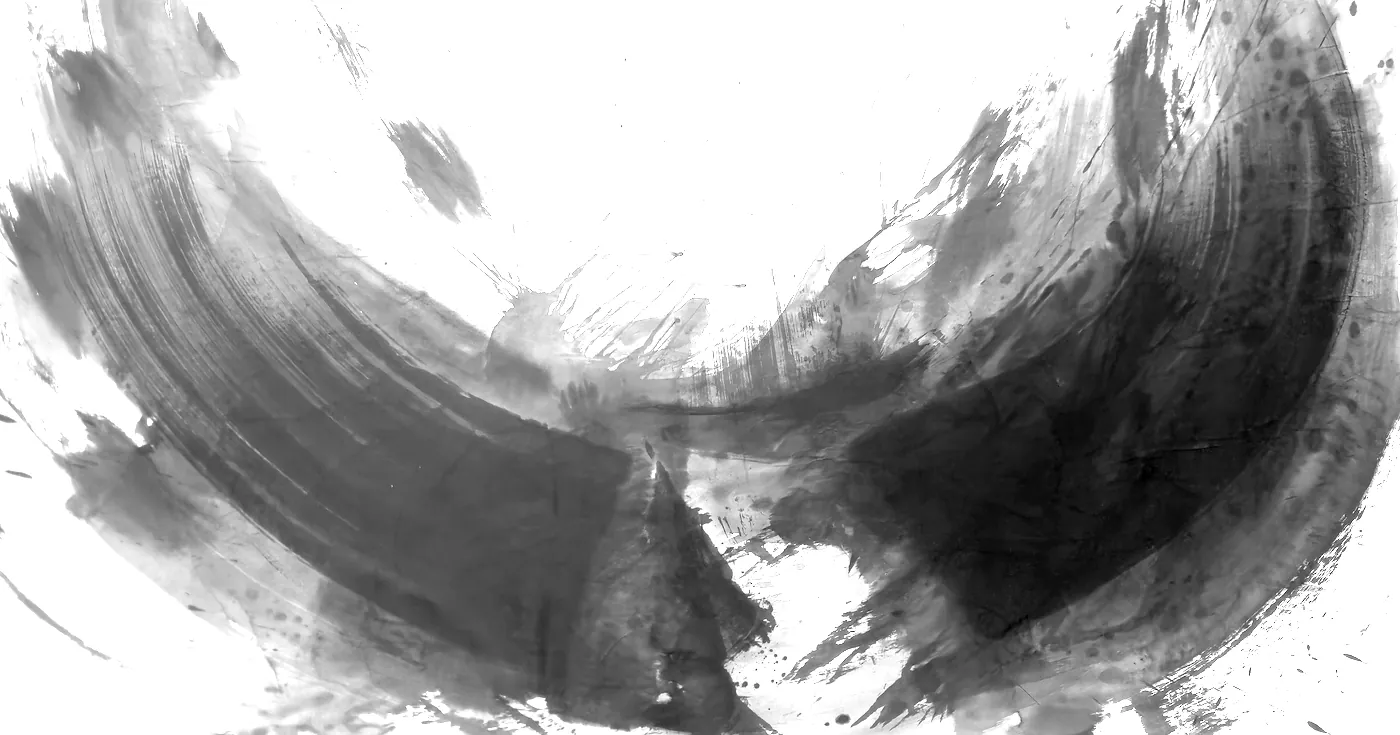
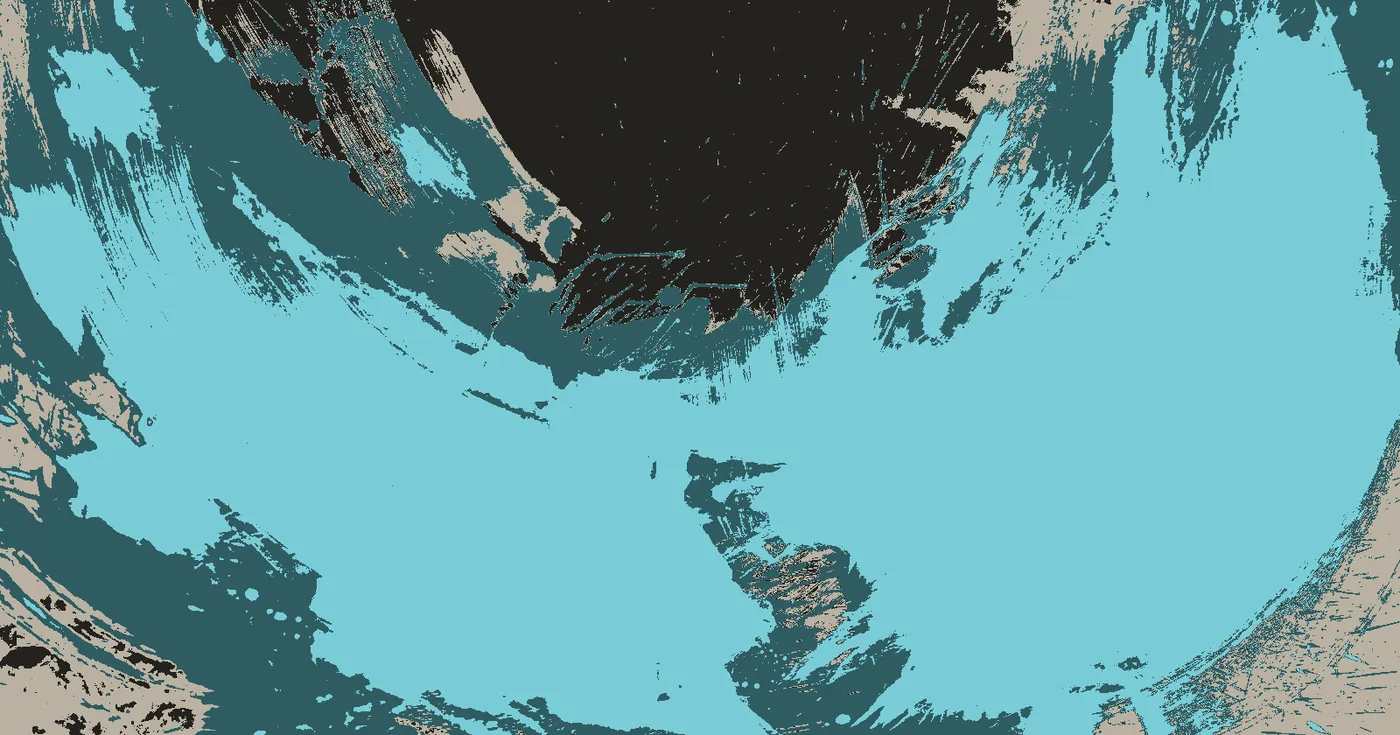
Left, the photograph. Centre, the tone stretch the model is shown beside it: the darkest 45% of tones spread over the whole range, so flat black, banding and stains show. Right, every pixel as the measuring code classes it: cyan black ink, deep teal translucent grey, stone the palest ink, near black bare paper.
5 families of tone.
Every inked pixel's brightness in 64 bins, smoothed; each circled peak holds at least 4% of the ink. Life inside the black: 0.064 (under 0.045 reads as flat).
Five reads, agreeing on 4 of 5 qualities.
Each quality placed on its ladder by each read, and the mean the engine keeps. Where reads differ, they differ by one rung; close calls resolve down.
READ 1, IN ITS OWN WORDS
“A strong bowl composition of two sweeping arcs with good dry-brush on the left. The heavy central wedge and the flat right black hold the sheet near average. There are minor droplet spots in the grey washes.”
Both arcs follow the brush's travel, left arc especially, but the central lower wedge and right dark mass are slab-like and stiff where they meet.
WEAKEST Bulky dark wedge at bottom centre, blunt joins
STRONGEST Left sweeping arc with dry-brush striations following stroke
Left arc shows arcs and stepped greys; modulation 0.064 confirms life, but right lower black mass and central wedge read largely flat inside.
WEAKEST Right dark mass interior near-uniform black
STRONGEST Left arc banded greys with striated grain
Translucent grey passes sit under black arcs, readable at edges and upper right; in the centre-bottom the later black largely covers earlier passes.
WEAKEST Centre where passes crowd into dense black
STRONGEST Grey under-washes beneath left and right arcs
Two arcs form one great bowl carrying the eye across; the empty upper paper is shaped and active. Bottom centre is crowded with splatter and wedges.
WEAKEST Busy, congested bottom centre junction
STRONGEST Bowl-shaped sweep framing shaped empty top centre
Ink controlled with good dry-brush; scattered pale/dark droplet spots in upper right grey arc and lower left wash, small and not disrupting principal blacks.
WEAKEST Pale droplet spots in upper right arc
STRONGEST Dry-brush striations in left arc
3 distinct places, 0 major.
Each read must name every flaw and where it is, in a ninth of the sheet. Here the reads named flaws in 3 distinct places, 13 mentions in all across 5 reads; the number in each ninth is how many times a flaw was named there. Reads agreeing on a place strengthen the evidence for one flaw; they do not multiply it.
Measured from the 16-bit master.
The previous engine (V22) measured this sheet's master file: 3 principal ink masses traced (cyan), 6 enclosed voids at true size in their grid cells (amber), the main gesture from start to end (red). Of 20 edge segments, 50% crisp, 25% soft or bloomed, 25% broken.
The rating these readings produce, the rules applied and the arithmetic, with Peter's own rating where he gave one, are in the Archive record.
Date
2026.05.07, day 130 of the Crucible Year, one of 19 paintings from that date (14 shown). 16 works were registered in the fourteen days before. Paintings are dated by the day their batch was registered and photographed; each was finished that day or within the few days before. Phase: P2 The Switch (working title).
T_280 among all 402
Every painting of the year by date; this one is outlined.
Materials
- Paper
- Red Star Mo She Special Effect Xieyi Edition, half-raw (June 2025 batch), China Xuan Paper Co., Ltd., made 2025.06.07
- Ink MB4
- Yi De Ge Refined Ink Juice, Yi De Ge (Beijing)
- Ink MB5
- Boku-Undo Genso, Boku-Undo
- Ink MB6
- Yi De Ge Yun Tou Yan, Yi De Ge (Beijing)
Related