
T_276
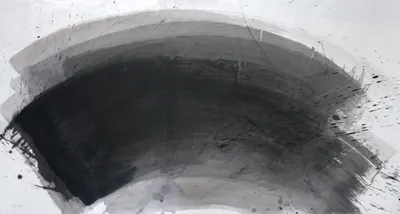
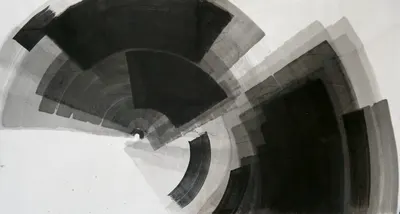
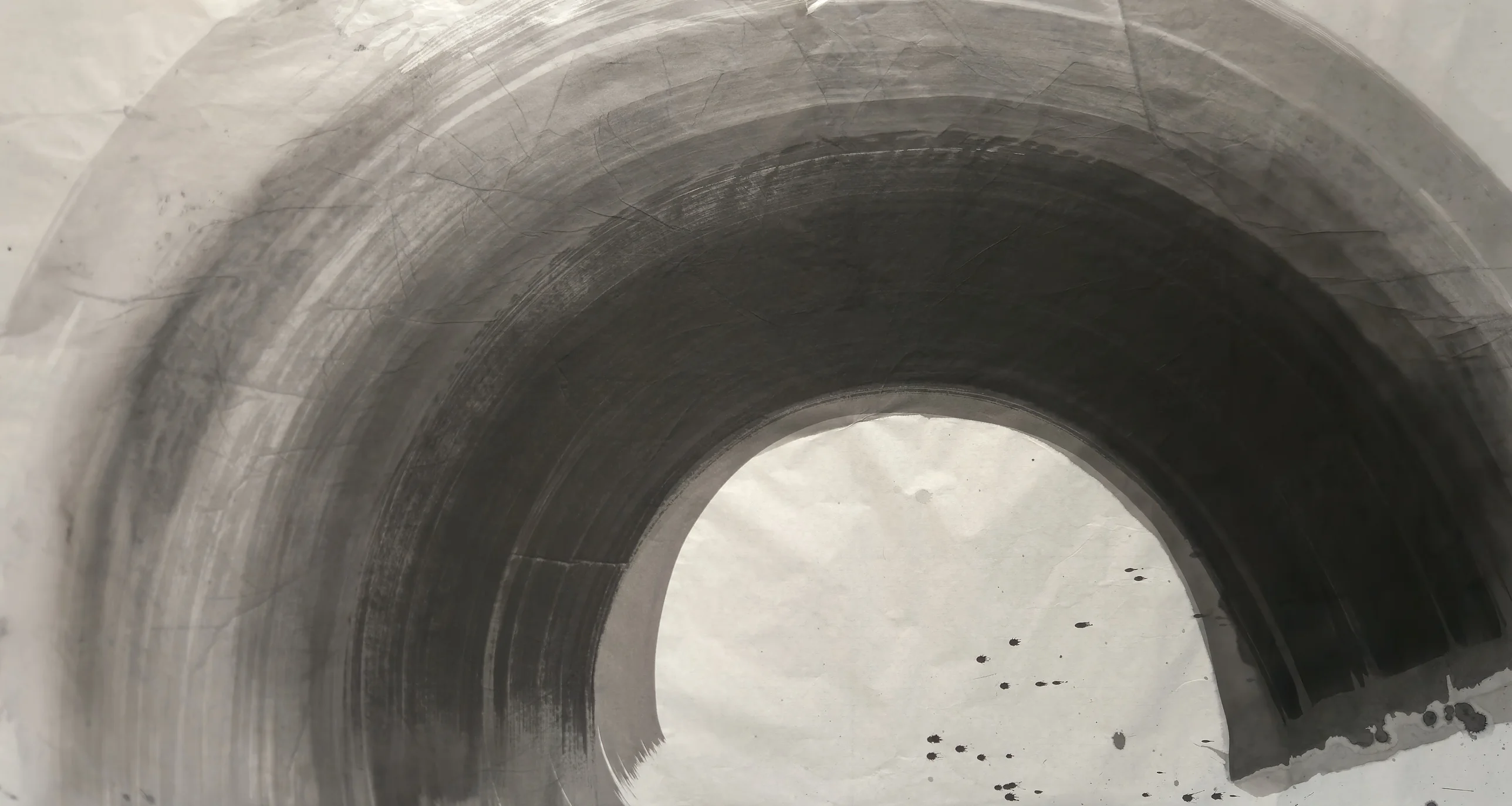
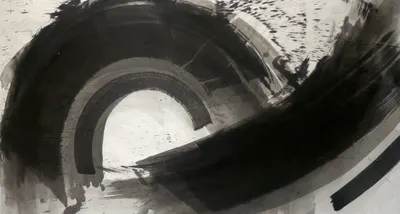
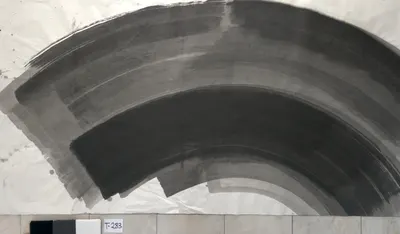
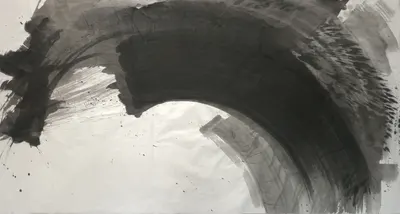
The engine's readingOne wide arc of black and grey ink rises from the bottom left, crests past the top edge, and comes down at the right around an opening of bare paper.
Record- Date
- 2026.05.07
- Dimensions
- 97 × 180 cm
- Paper
- Red Star Mo She Special Effect Xieyi Edition, half-raw (June 2025 batch)
- Ink
- Yi De Ge Refined Ink Juice, Boku-Undo Genso, Yi De Ge Yun Tou Yan
The big ones come in like this in late autumn, a grey shoulder lifting out of the swell and curling over until you can stand underneath it. Surfers have a name for the hollow: the green room. You get a second in there, maybe two, with light coming through the lip and the whole ocean deciding something above your head. Then it closes. The wave does not care how well it rose. It drops on the sand like a wet coat, leaves a scum of foam with lace for edges, and throws a handful of grit at your shins on its way back out. I stood in the room once. The next set is already standing up past the rocks, dark, patient, leaning in.
The reading
Written by the engine after the painting was rated, from the settled findings, and checked by hand before approval. It explains the numbers; it may not change them.
- Structure
- one great arc of concentric bands around a rounded opening
- Movement
- a single sweep from lower left, over the top, down to lower right
- Coverage
- ink on about four fifths of the paper
- Tone
- five tonal steps, weighted to the middle greys
- Layering
- three passes, pale, mid grey and dark, readable at the outer edges
- Edges
- crisp inner rim at the opening; soft outer halo; broken at lower left
- Feibai
- present, the lower-left run of the dark band and the grey bands on the left
- Open paper
- rounded arch of white inside the curve, lower centre right
- Chance marks
- drops in the opening; pooled tide-edged wash at the arc's right end; creases
- Frame
- ink runs off top, right and bottom left; upper-left and lower-right corners open
One arc fills the paper. It rises off the bottom edge at the left, crests past the top and comes down hard at the right: a pale halo, a band of middle grey and a dark inner band, travelling together around a rounded opening of bare paper with a clean rim.
The best of it is low on the left, where the dark band thins as the brush lifts. The hairs part into long white streaks that keep the curve, and the half-sized bark paper grips them, so each one stays sharp. Higher up, the paler passes read at their outer edges, one laid over another.
The costs sit at the crown and the foot. Across the top the dark is laid so fully that it seals what lies beneath and goes flat. At the lower right the arc stops bluntly in a pooled pale wash with tide-marked blots, and loose drops scatter through the opening.
The sweep is real and holds for most of its length. With a flat crown and an unfinished landing, it settles as capable, plain work, above the archive's run and short of the sheets that stay with you.
How it was read
Read by the Visual Analysis Engine, version 23.8, on 2026.10.06: measured by code, then read 5 times by Claude Opus 5.5 against three reference paintings (R1 to R3), each read independent of the others. How the engine works.
Three views of one sheet.
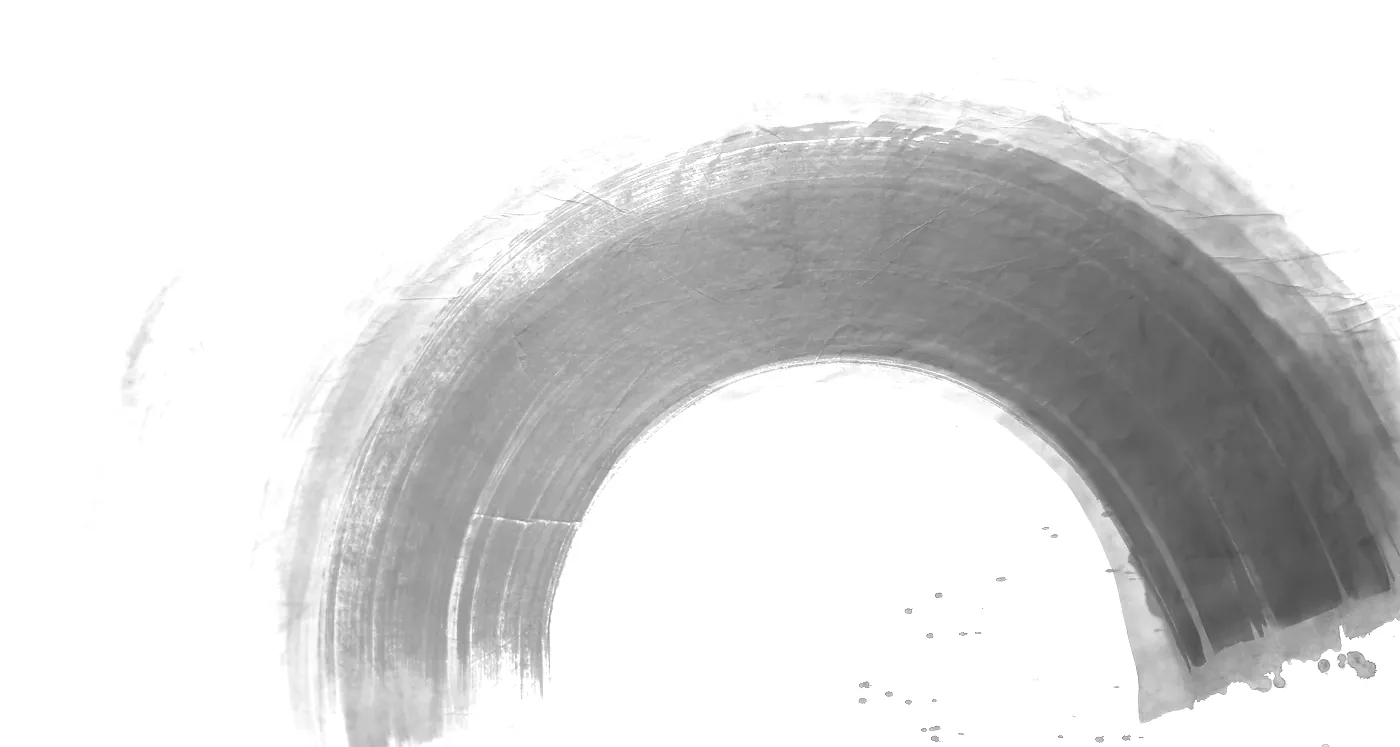
Left, the photograph. Centre, the tone stretch the model is shown beside it: the darkest 45% of tones spread over the whole range, so flat black, banding and stains show. Right, every pixel as the measuring code classes it: cyan black ink, deep teal translucent grey, stone the palest ink, near black bare paper.
5 families of tone.
Every inked pixel's brightness in 64 bins, smoothed; each circled peak holds at least 4% of the ink. Life inside the black: 0.050 (under 0.045 reads as flat).
Five reads, agreeing on 4 of 5 qualities.
Each quality placed on its ladder by each read, and the mean the engine keeps. Where reads differ, they differ by one rung; close calls resolve down.
READ 1, IN ITS OWN WORDS
“A single fluent arc built from three concentric passes, with an open white centre. The dark core is mostly flat, the passes stack rather than layer, and a blotched pooled end at the bottom right damages the surface.”
One great arc whose outline and bristle striations follow the brush's path; the inner and outer edges hold. The right terminal is squared but not clumsy.
WEAKEST Blunt cut-off right end of dark arc
STRONGEST Sweeping dark arc with bristle tracks following travel
Outer grey bands step and streak; dark arc shows striations at lower left and right. The upper core is near-flat, and modulation of 0.050 is barely above the flat threshold.
WEAKEST Upper core of dark arc, nearly uniform
STRONGEST Graded grey outer bands with dry-brush streaks
Three concentric passes (pale halo, mid grey, dark core) can be read as overlapping bands, but the dark pass mostly covers what lies under it rather than building translucent depth.
WEAKEST Dark pass largely covers mid pass beneath
STRONGEST Pale outer halo beneath grey and dark bands
The cropped arc carries the eye from left over to the bottom right, and the white opening is shaped. The lower left is leftover, and the spatter dots clutter the bottom centre.
WEAKEST Empty lower-left corner and scattered centre spatter
STRONGEST Open paper inside the arc
At the bottom right, the arc's end pools into a blotched, tide-edged pale patch with drips, visible in colour. There are faint stain spots in the white opening, and paper creases show across the greys.
WEAKEST Pooled blotchy patch at bottom-right arc end
STRONGEST Dry-brush grain at lower-left arc edge
5 distinct places, 1 major.
Each read must name every flaw and where it is, in a ninth of the sheet. Here the reads named flaws in 5 distinct places, 16 mentions in all across 5 reads; the number in each ninth is how many times a flaw was named there. Reads agreeing on a place strengthen the evidence for one flaw; they do not multiply it. A major flaw holds Material and surface at rung 1.
Measured from the 16-bit master.
The previous engine (V22) measured this sheet's master file: 2 principal ink masses traced (cyan), 3 enclosed voids at true size in their grid cells (amber), the main gesture from start to end (red). Of 21 edge segments, 24% crisp, 67% soft or bloomed, 10% broken.
The rating these readings produce, the rules applied and the arithmetic, with Peter's own rating where he gave one, are in the Archive record.
Date
2026.05.07, day 130 of the Crucible Year, one of 19 paintings from that date (14 shown). 16 works were registered in the fourteen days before. Paintings are dated by the day their batch was registered and photographed; each was finished that day or within the few days before. Phase: P2 The Switch (working title).
T_276 among all 402
Every painting of the year by date; this one is outlined.
Materials
- Paper
- Red Star Mo She Special Effect Xieyi Edition, half-raw (June 2025 batch), China Xuan Paper Co., Ltd., made 2025.06.07
- Ink MB4
- Yi De Ge Refined Ink Juice, Yi De Ge (Beijing)
- Ink MB5
- Boku-Undo Genso, Boku-Undo
- Ink MB6
- Yi De Ge Yun Tou Yan, Yi De Ge (Beijing)
Related