T_197
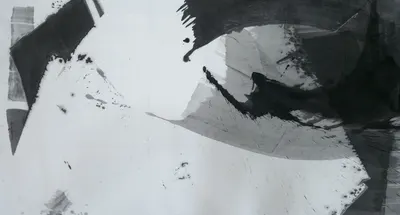
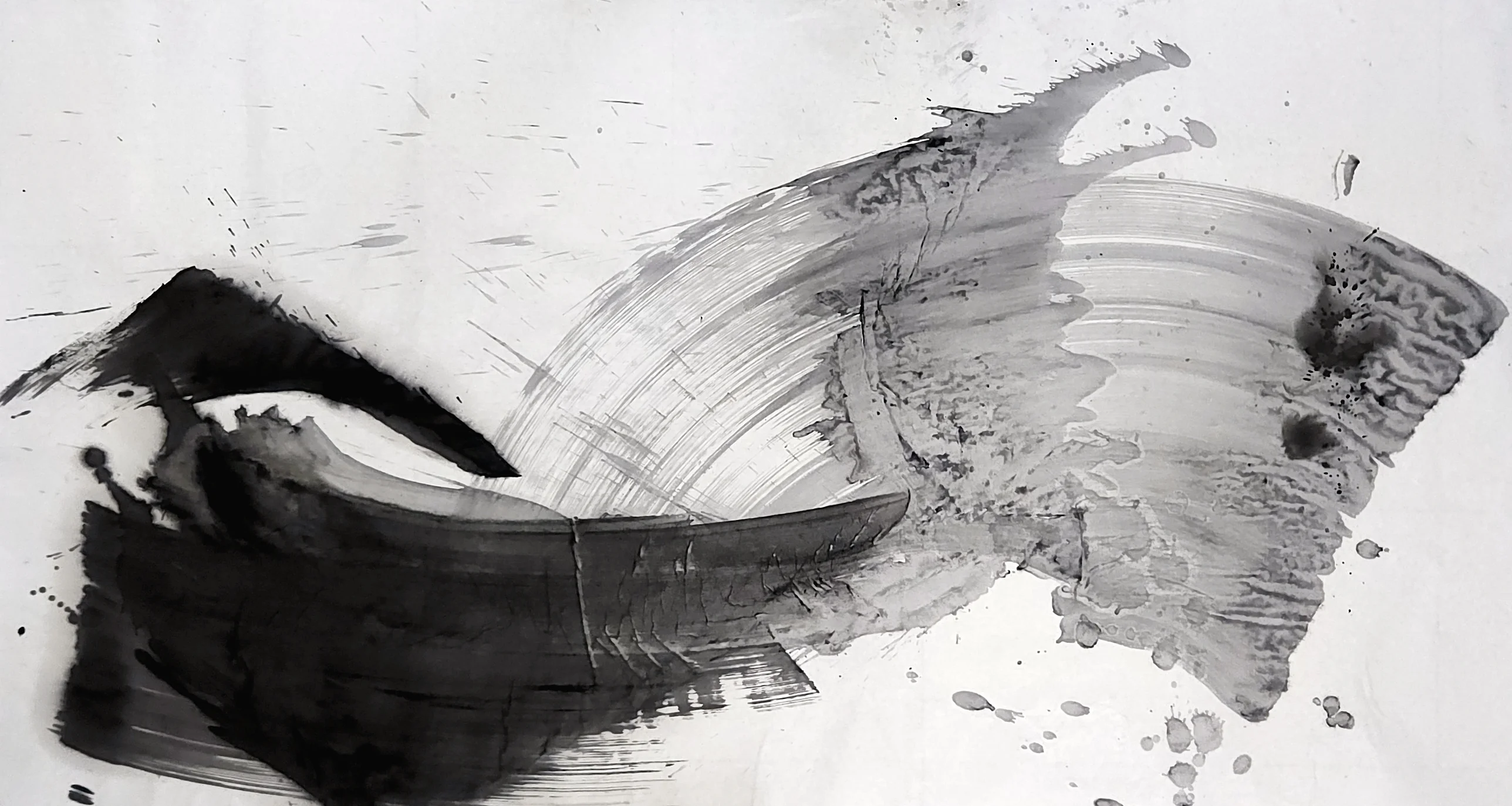
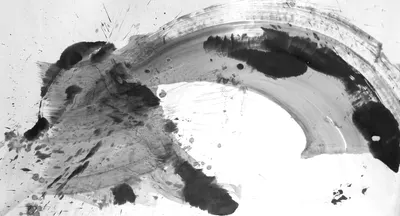
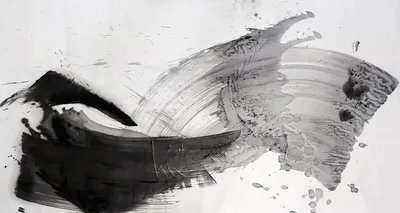
The engine's readingA black wedge and a heavy curved band at lower left throw a wide fan of streaked grey up and across the paper toward the right edge.
Record- Date
- 2026.04.08
- Dimensions
- 97 × 180 cm
- Paper
- Red Star Mo She Special Effect Xieyi Edition, raw
- Ink
- Kuretake Shogei Kiwami, Yi De Ge Zhonghua, Boku-Undo Bokkou
The black wedge over the white hollow at the left is a brow, and the hollow is the eye beneath it, wide open. Everything else is the look, flung out to the right in a grey fan, every bristle a line of sight. At the far end sit dark spots, and I know them from the inside: floaters, specks adrift in the eye's own jelly, seen only against bright sky. Turn to catch one and it slides away, keeping its distance like a gull that will not be fed. I spent a whole summer as a child chasing mine across the clouds. They never let me near. They are still out there at the edge of every blue afternoon, small and grey, swimming just ahead of where I look.
The reading
Written by the engine after the painting was rated, from the settled findings, and checked by hand before approval. It explains the numbers; it may not change them.
- Structure
- black wedge over a long curved dark band; grey arc fanning out right
- Movement
- rising sweep from lower left to upper right; the wedge's point briefly counters it
- Coverage
- ink on about half of the paper
- Tone
- three tonal steps, spread across the range
- Layering
- two kinds, black strokes over translucent grey, readable where they cross at centre
- Edges
- crisp on wedge and band; dry and broken on arc; frayed on right panel
- Feibai
- present, across the central grey arc and the dark band's lower left tail
- Open paper
- broad empty band across the top left; open wedge at lower right
- Chance marks
- two dark blooms in right panel; drops below it; light spatter upper left
- Frame
- ink nears the left and bottom edges at lower left; top and right stay open
The eye lands on the black at lower left and is thrown up and right, through a fan of grey, toward the far edge. One rising movement organises the whole sheet, and it reads from across the room.
Two passages hold it. The wedge at upper left narrows to a point as clean as a cut, aimed into the white hollow it encloses. In the centre the grey arc is all bristle. On raw bark paper this quick and this grippy, a fast brush touches only the top of the fibre, and the hairs leave long parallel lanes of bare white that keep the curve true. Where the dark band crosses the arc, black sits plainly on grey.
The costs sit at either end. Below the wedge the dark mass thickens into a slab, near-flat inside, ending blunt and ragged. On the right the grey passes run together into wrinkled tide lines, two dark blooms settle inside them, and drops scatter below, so the movement lands somewhere soft.
The sheet is reliable and well above routine: the rise, the wedge and the arc would hold up in better company. The heavy foot and the loose landing keep it from going higher.
How it was read
Read by the Visual Analysis Engine, version 23.8, on 2026.10.06: measured by code, then read 5 times by Claude Opus 5.5 against three reference paintings (R1 to R3), each read independent of the others. How the engine works.
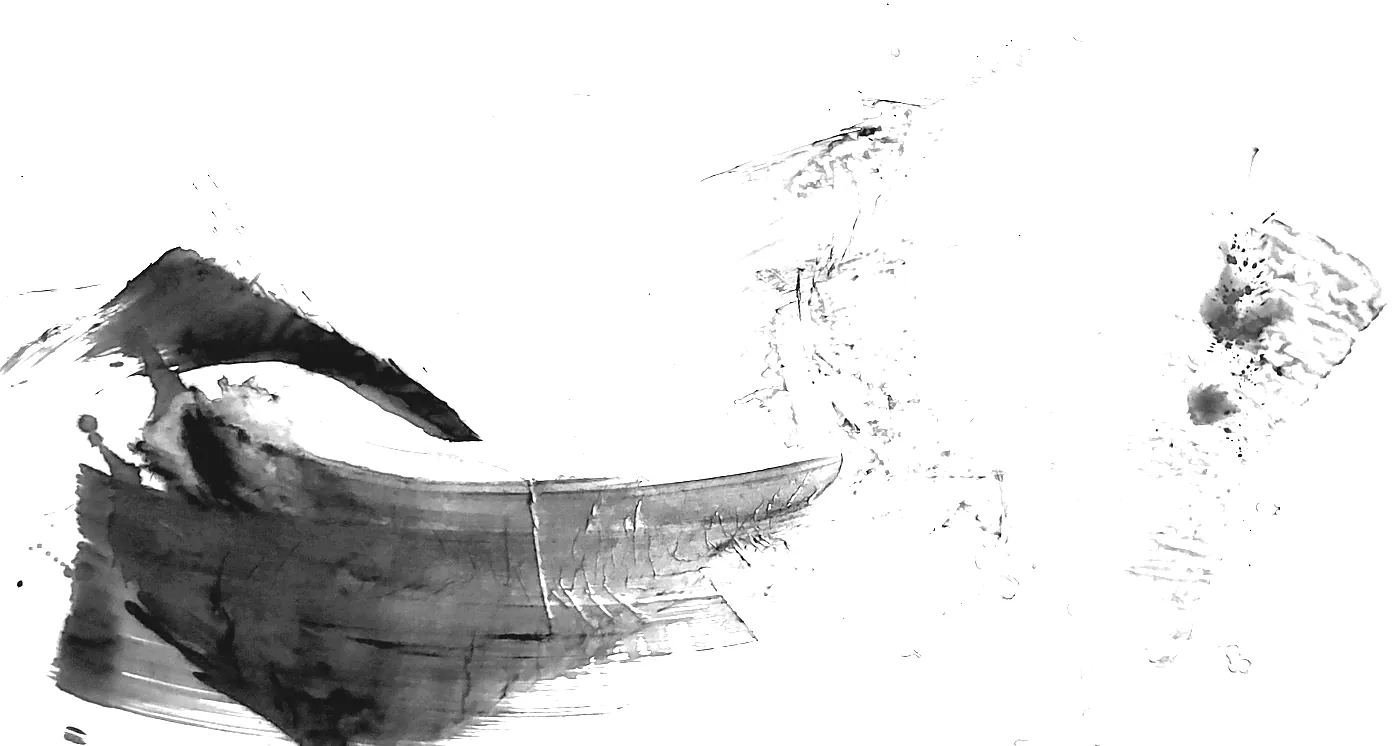
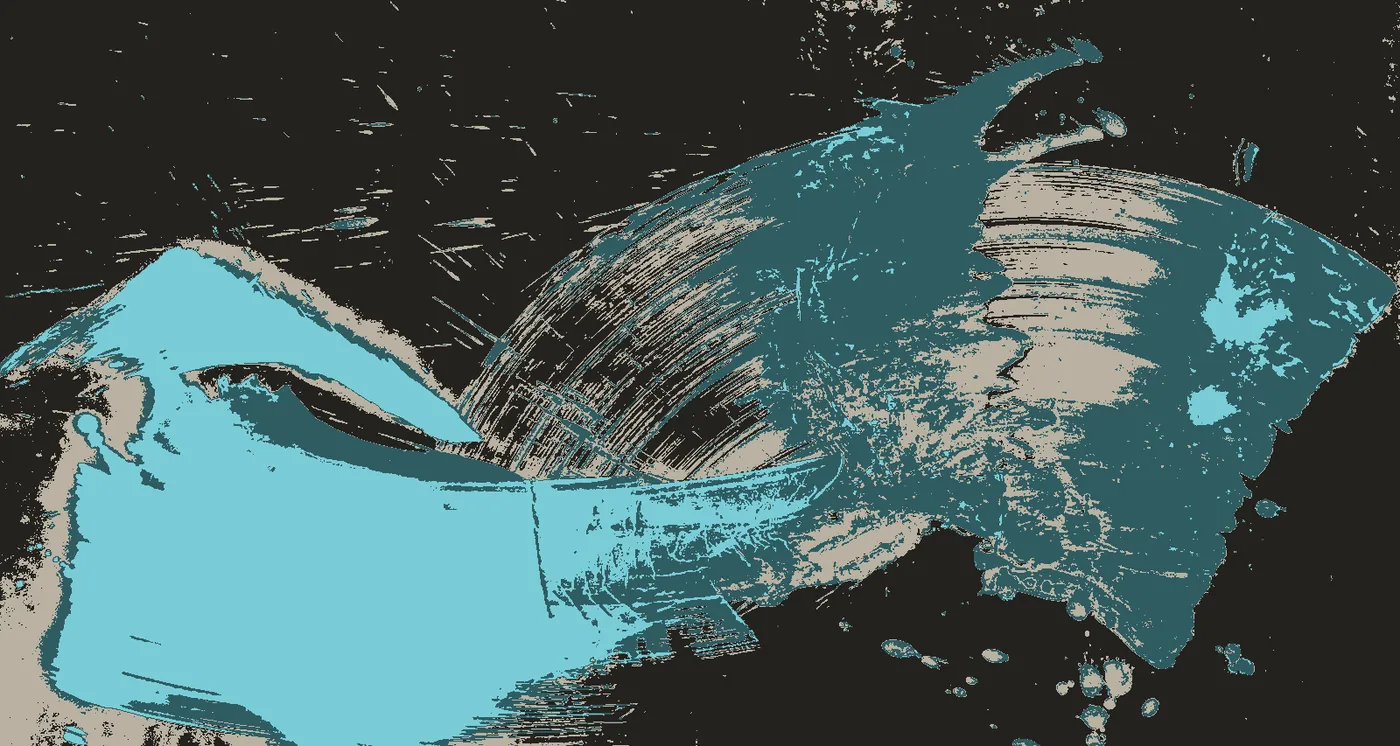
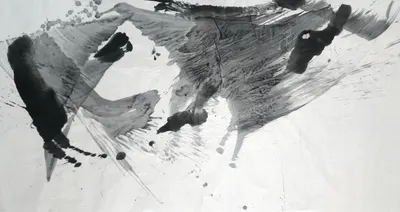
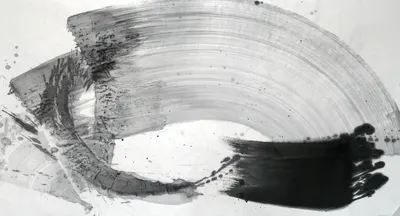
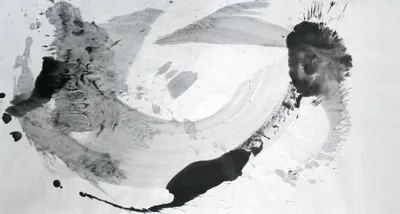
Three views of one sheet.
Left, the photograph. Centre, the tone stretch the model is shown beside it: the darkest 45% of tones spread over the whole range, so flat black, banding and stains show. Right, every pixel as the measuring code classes it: cyan black ink, deep teal translucent grey, stone the palest ink, near black bare paper.
3 families of tone.
Every inked pixel's brightness in 64 bins, smoothed; each circled peak holds at least 4% of the ink. Life inside the black: 0.051 (under 0.045 reads as flat).
Five reads, agreeing on 4 of 5 qualities.
Each quality placed on its ladder by each read, and the mean the engine keeps. Where reads differ, they differ by one rung; close calls resolve down.
READ 1, IN ITS OWN WORDS
“This is an ordinary, energetic sheet with a strong rising diagonal and a fluent wedge. A bulky lower dark mass, a cloudy mottled right panel with soft blooms, and loose spatter keep every ladder at a working average.”
Upper-left wedge tapers fluently; the long curved boat-form holds its walls but the lower-left mass is slab-like, and the right grey panel's edges dissolve into drips.
WEAKEST Bulky lower-left dark slab with ragged blunt end
STRONGEST Tapering dark wedge at upper left
Dark lower mass shows horizontal streaks and banding; the central arc has bristle grain; right panel is a mid-grey mottle without real range. Modulation 0.051, just above flat.
WEAKEST Mottled right grey panel reads cloudy, little depth
STRONGEST Dry-brush streaked grey arc sweeping centre
Black boat-form and wedge read clearly over and beside the grey sweeping arc; about two to three passes, legible where they meet, without a built sequence across the sheet.
WEAKEST Right panel's dark blots sit ambiguously in grey
STRONGEST Dark boat-form over translucent grey arc, centre
A clear rising movement carries the eye from the dark lower left up through the arc; top-left paper is shaped, but lower-right drops and the right panel feel loose.
WEAKEST Scattered spatter and drips in the lower right
STRONGEST Rising diagonal sweep from lower left to upper right
Ink is controlled in the dark masses and the dry-brush arc; the right panel has reticulated mottling and two soft dark blooms, though these sit away from the principal black mass.
WEAKEST Dark blooms inside the right grey panel
STRONGEST Dry-brush grain in the central arc
3 distinct places, 1 major.
Each read must name every flaw and where it is, in a ninth of the sheet. Here the reads named flaws in 3 distinct places, 14 mentions in all across 5 reads; the number in each ninth is how many times a flaw was named there. Reads agreeing on a place strengthen the evidence for one flaw; they do not multiply it. A major flaw holds Material and surface at rung 1.
Measured from the 16-bit master.
The previous engine (V22) measured this sheet's master file: 4 principal ink masses traced (cyan), 7 enclosed voids at true size in their grid cells (amber), the main gesture from start to end (red). Of 18 edge segments, 56% crisp, 0% soft or bloomed, 44% broken.
The rating these readings produce, the rules applied and the arithmetic, with Peter's own rating where he gave one, are in the Archive record.
Date
2026.04.08, day 101 of the Crucible Year, one of 22 paintings from that date (11 shown). 37 works were registered in the fourteen days before. Paintings are dated by the day their batch was registered and photographed; each was finished that day or within the few days before. Phase: P1 Warm-up (working title).
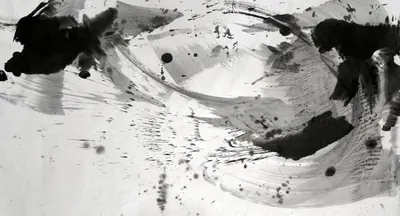
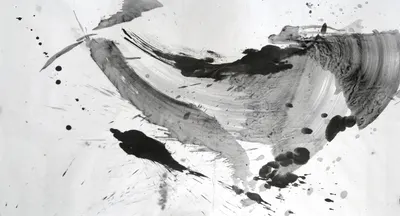
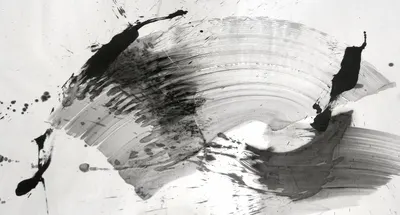
T_197 among all 402
Every painting of the year by date; this one is outlined.
Materials
- Paper
- Red Star Mo She Special Effect Xieyi Edition, raw, China Xuan Paper Co., Ltd., made 2025.12.08
- Ink MB1
- Kuretake Shogei Kiwami, Kuretake
- Ink MB2
- Yi De Ge Zhonghua, Yi De Ge (Beijing)
- Ink MB3
- Boku-Undo Bokkou, Boku-Undo
Related