T_199
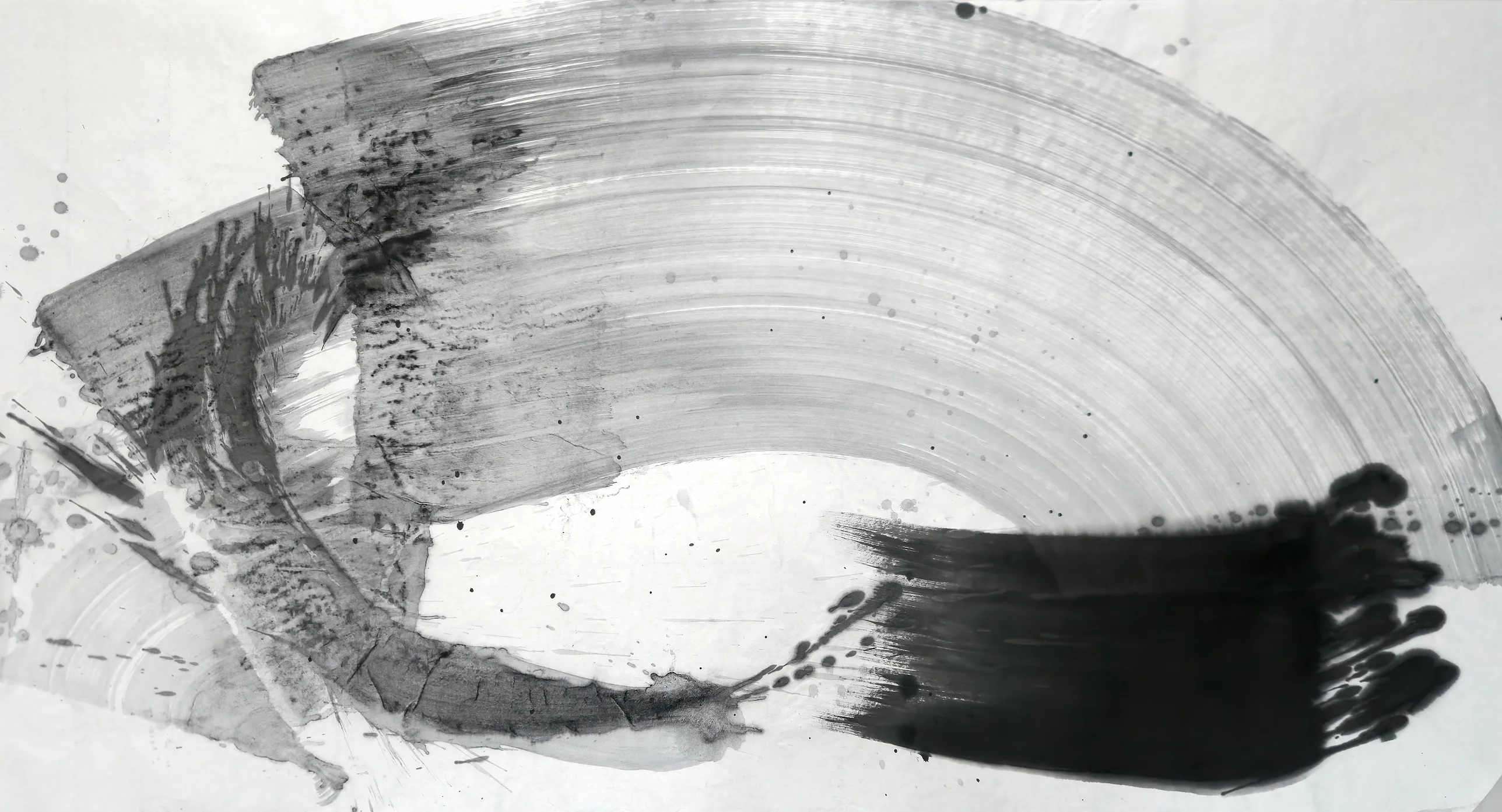
The engine's readingA streaked grey arc swings across raw bark paper and comes down into a black slab, looping around an empty white lens at the centre.
Record- Date
- 2026.04.08
- Dimensions
- 97 × 180 cm
- Paper
- Red Star Mo She Special Effect Xieyi Edition, raw
- Ink
- Kuretake Shogei Kiwami, Yi De Ge Zhonghua, Boku-Undo Bokkou
From the footbridge late at night I watch the ring road, and every car leaves a grey streak bent the same way, a lane of light curving around the dark. The streaks on this arc have that patience. Then the road arrives at the depot: one black block, no windows, its far wall leaking at the corners where the rain got in and stayed. I like the depot. It does nothing for the skyline and it is the only thing awake. To the west the old district is scaffolding and torn posters, flecked like pavement after a fight. In the middle sits a car park, white and empty, lit by nothing, and the whole road goes around it.
The reading
Written by the engine after the painting was rated, from the settled findings, and checked by hand before approval. It explains the numbers; it may not change them.
- Structure
- great grey arc over the top, curved stroke returning low left, black slab lower right
- Movement
- clockwise loop from upper left to the slab; left wedges cut diagonally across it
- Coverage
- ink on about two thirds of the paper
- Tone
- three tonal steps, spread across the range
- Layering
- three kinds of pass: pale wash, mid-grey strokes, black; readable but crowded at left
- Edges
- crisp outer rim of the arc; feathered left end of the slab; soft washes low left
- Feibai
- present, through the grey arc, opening widest along its right-hand sweep
- Open paper
- a white lens in the centre, held between the arc and the lower stroke
- Chance marks
- spatter across arc and left; pooled blobs at slab's right end; tide-ringed wash low left
- Frame
- ink grazes the left edge and the arc's crown at top; right and bottom stay narrowly open
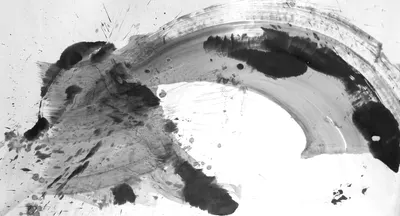
A great grey arc swings over the top of the paper and comes down at the right into a black slab. A curved grey stroke runs back along the bottom left, so the eye travels a full loop around a lens of bare paper in the middle. That white is shaped, and it holds the sheet together.
The arc is the passage to stand in front of. Raw bark paper grips a dragging brush, and the hairs split into long parallel bands of grey and white that follow the sweep from end to end. Toward the right those bands open into flying white, and the arc is still one stroke all the way round.
The slab is where the sheet weakens. It is a heavy rectangle, flat inside, and its right end breaks into blunt pooled fingers where wet ink sat on fast paper and spread. The left third crowds: wedges, flecks and spatter, and a pale wash drying to cloudy, tide-ringed edges.
The loop reads at once and the arc is fine work. The slab and the cluttered left keep the sheet solid and good, a step above the usual, with one passage that reaches past the rest.
How it was read
Read by the Visual Analysis Engine, version 23.8, on 2026.10.06: measured by code, then read 5 times by Claude Opus 5.5 against three reference paintings (R1 to R3), each read independent of the others. How the engine works.
Three views of one sheet.
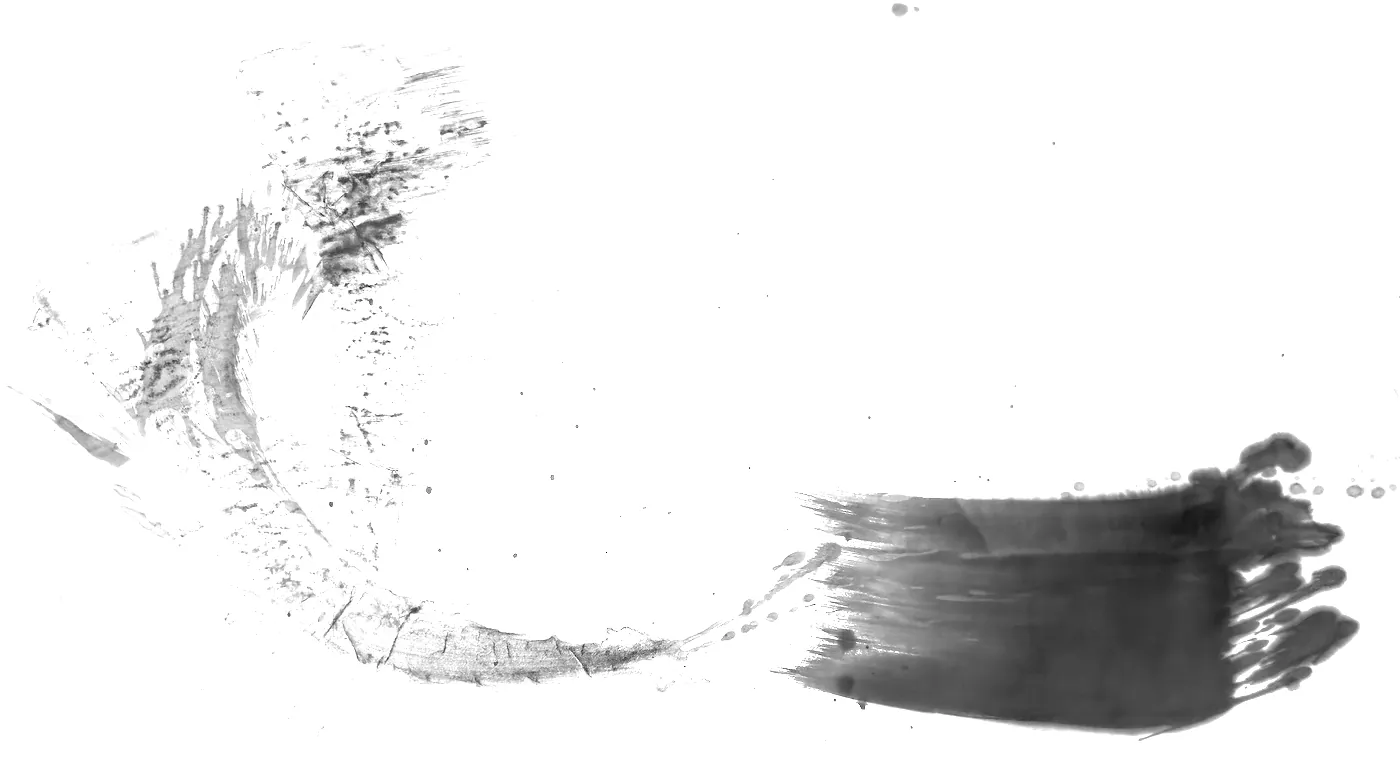
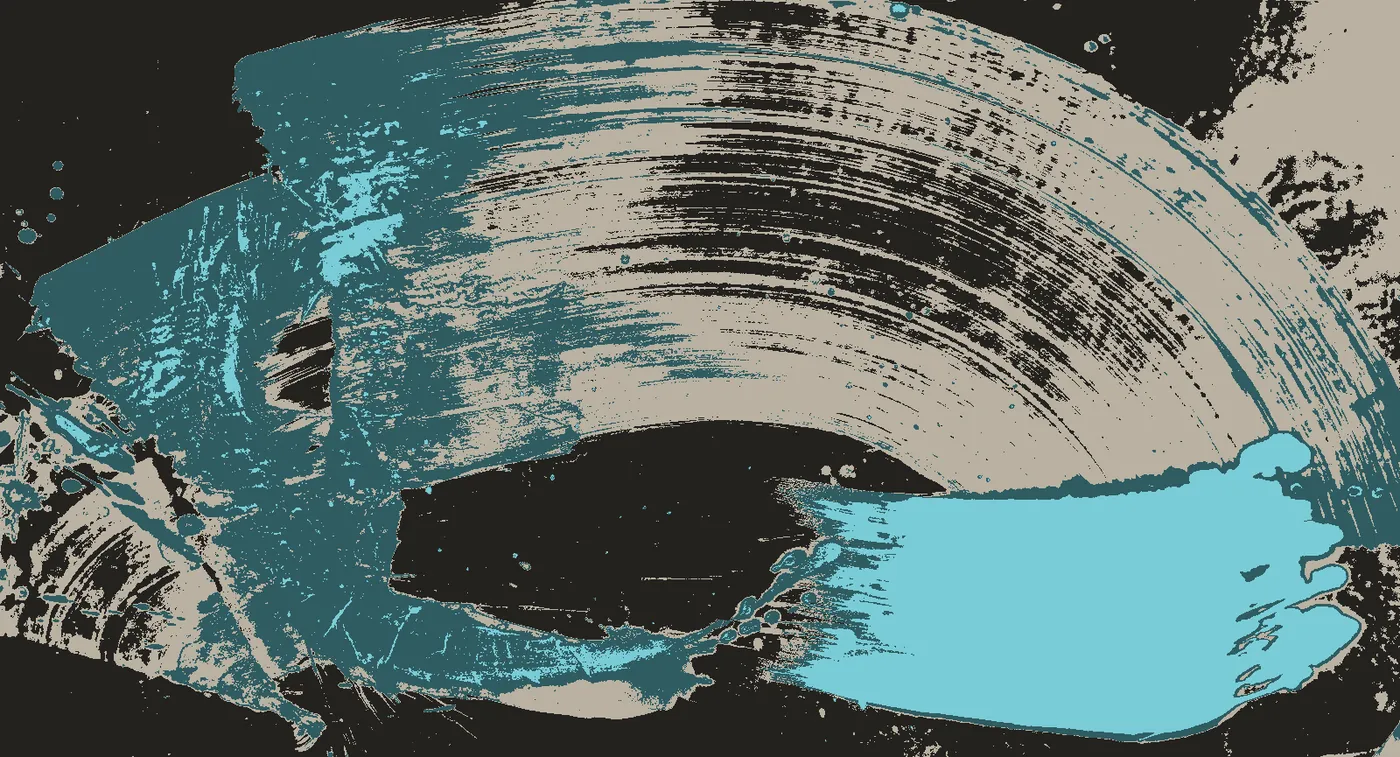
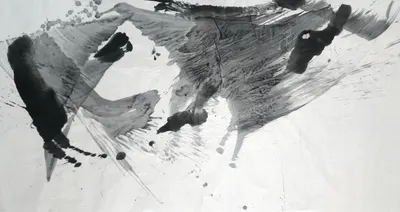
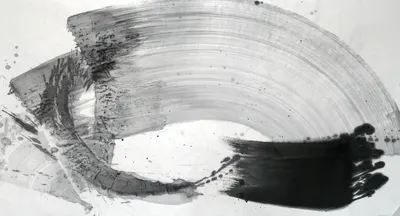
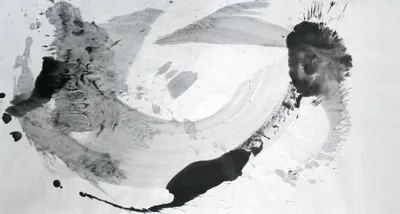
Left, the photograph. Centre, the tone stretch the model is shown beside it: the darkest 45% of tones spread over the whole range, so flat black, banding and stains show. Right, every pixel as the measuring code classes it: cyan black ink, deep teal translucent grey, stone the palest ink, near black bare paper.
3 families of tone.
Every inked pixel's brightness in 64 bins, smoothed; each circled peak holds at least 4% of the ink. Life inside the black: 0.044 (under 0.045 reads as flat).
Five reads, agreeing on 4 of 5 qualities.
Each quality placed on its ladder by each read, and the mean the engine keeps. Where reads differ, they differ by one rung; close calls resolve down.
READ 1, IN ITS OWN WORDS
“A fluent striated arc balanced against a flat, bulky black slab. The left side is crowded and the pale washes there are cloudy. An ordinary sheet overall, close to R2.”
Upper arc's outline follows the stroke's travel. Lower-left curve holds its shape. The dark slab is a heavy rectangle ending in pooled blobs, and the left wedges are stiff.
WEAKEST Bottom-right dark slab, bulky with blobby finger ends
STRONGEST Great grey arc following the brush's sweep
Bristle banding and dry-brush speckle model the arc and the left greys. The measured modulation of the bottom-right black mass is under the flat threshold. Three tonal steps.
WEAKEST Dark slab interior flat, modulation 0.044
STRONGEST Striated grey arc with bristle banding
Three passes: pale arc, mid-grey left wedges and curve, black slab. Overlaps at upper left stay readable but get busy. The black slab sits mostly alone.
WEAKEST Left cluster where grey passes crowd together
STRONGEST Pale arc passing under darker left strokes
The arc carries the eye from upper left to the black slab at lower right, and the empty paper inside the arc is shaped. The left third is cluttered and its pale passes are weak.
WEAKEST Crowded, fussy left edge cluster
STRONGEST Sweeping arc enclosing shaped white space
The dry-brush grain in the arc is used well. At bottom left, a pale cloudy wash with ringed edges sits beside the curved stroke. Pooled blobs at the slab ends. Scattered spatter.
WEAKEST Cloudy, tide-edged pale wash at bottom left
STRONGEST Dry-brush striations used across the arc
6 distinct places, 0 major.
Each read must name every flaw and where it is, in a ninth of the sheet. Here the reads named flaws in 6 distinct places, 12 mentions in all across 5 reads; the number in each ninth is how many times a flaw was named there. Reads agreeing on a place strengthen the evidence for one flaw; they do not multiply it.
Measured from the 16-bit master.
The previous engine (V22) measured this sheet's master file: 4 principal ink masses traced (cyan), 4 enclosed voids at true size in their grid cells (amber), the main gesture from start to end (red). Of 9 edge segments, 11% crisp, 78% soft or bloomed, 11% broken.
The rating these readings produce, the rules applied and the arithmetic, with Peter's own rating where he gave one, are in the Archive record.
Date
2026.04.08, day 101 of the Crucible Year, one of 22 paintings from that date (11 shown). 37 works were registered in the fourteen days before. Paintings are dated by the day their batch was registered and photographed; each was finished that day or within the few days before. Phase: P1 Warm-up (working title).
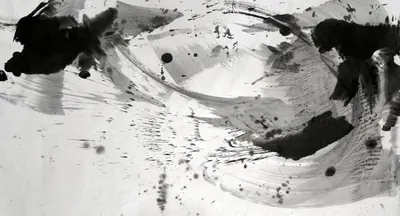
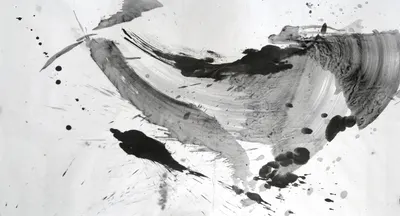
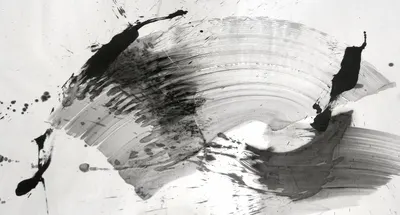
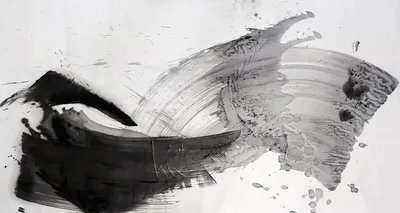
T_199 among all 402
Every painting of the year by date; this one is outlined.
Materials
- Paper
- Red Star Mo She Special Effect Xieyi Edition, raw, China Xuan Paper Co., Ltd., made 2025.12.08
- Ink MB1
- Kuretake Shogei Kiwami, Kuretake
- Ink MB2
- Yi De Ge Zhonghua, Yi De Ge (Beijing)
- Ink MB3
- Boku-Undo Bokkou, Boku-Undo
Related