T_227
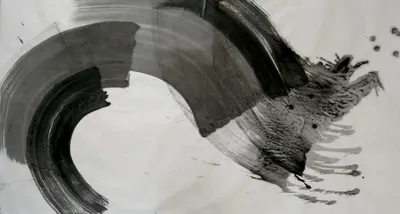
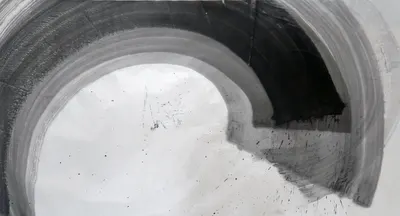
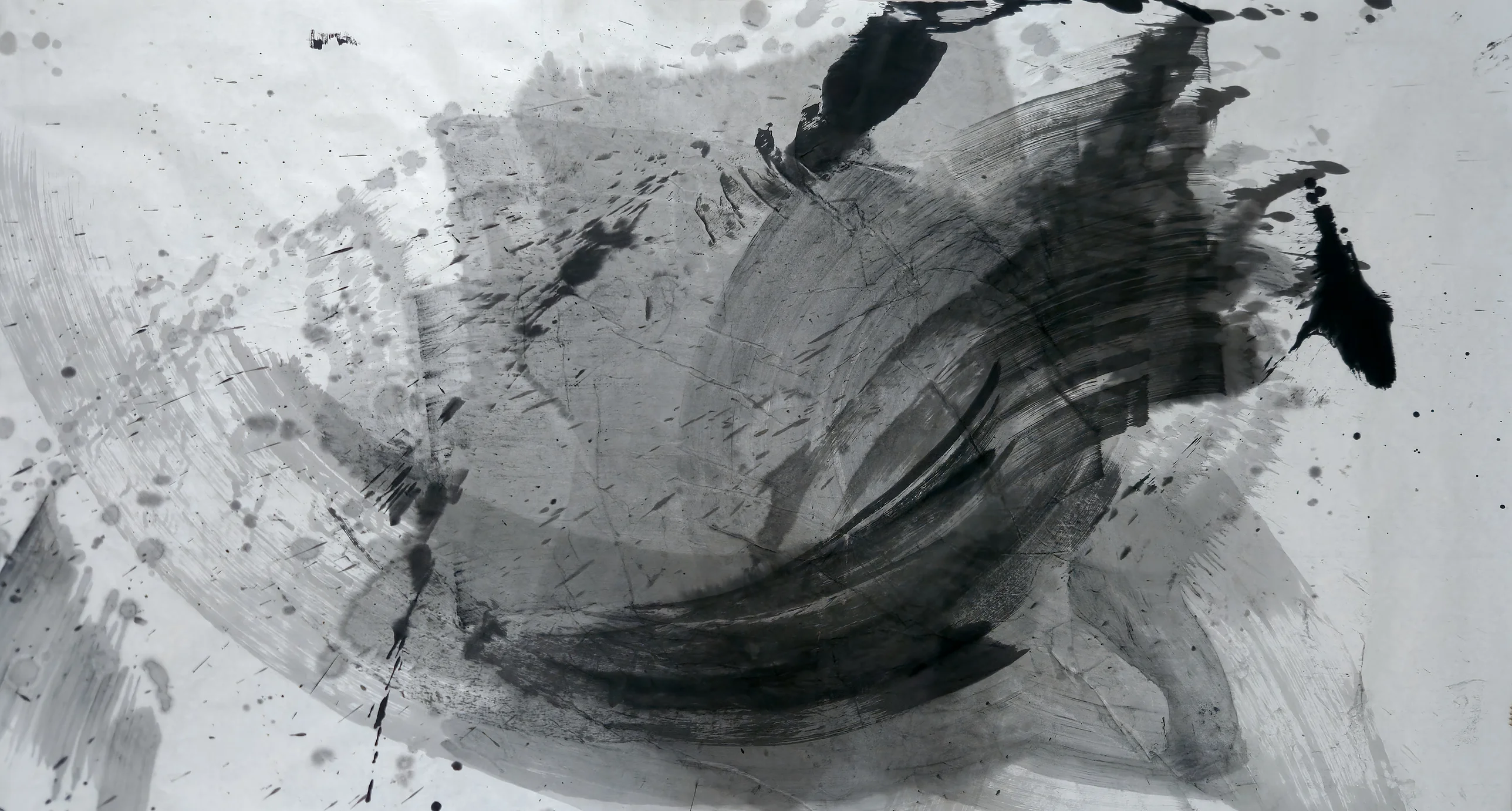
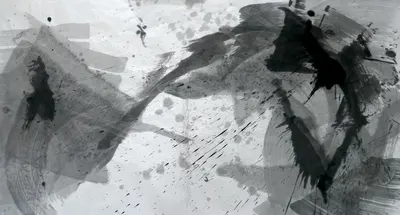
The engine's readingA broad wheel of grey and black brushwork turning across raw bark paper, with a dark dry-brush crescent low in the middle and spattered drops above.
Record- Date
- 2026.04.15
- Dimensions
- 97 × 180 cm
- Paper
- Red Star Mo She Special Effect Xieyi Edition, raw
- Ink
- Yi De Ge Refined Ink Juice, Boku-Undo Genso, Yi De Ge Yun Tou Yan
The black lump at the right has the density of something that collapsed. I give it a few billion years. Stars do this when they run out of argument: they fall in on themselves and stop letting light out, and from far off they look exactly like a dropped blot of ink. The pale drops to the upper left are the younger ones, ringed, still cooling. Below them a debris arm swings slowly round, scraping its own dust into streaks. I don't mind that the dead star is ugly. Most of the universe is lumps and leftovers, and it was never arranged for anyone's comfort. The only light out here comes from the arm going round, grinding itself thin against the dark.
The reading
Written by the engine after the painting was rated, from the settled findings, and checked by hand before approval. It explains the numbers; it may not change them.
- Structure
- pale left arc, mid-grey central washes, dark crescent and fan, two black lobes
- Movement
- rotating, lower left round to upper right; black lobes sit against the turn
- Coverage
- ink on about four fifths of the paper
- Tone
- five tonal steps, spread across the range
- Layering
- pale arc, grey wash, dark dry strokes; readable at left, clouded in centre
- Edges
- crisp at crescent tips and black lobes; soft washes; hard tide edges centre
- Feibai
- present in the lower crescent and the dark fan right of centre
- Open paper
- ragged pale band across the upper left, narrow strip down the right
- Chance marks
- spatter and ringed drops upper left, trail of drops lower left, creases centre
- Frame
- ink runs off top, left and bottom left; right edge and top right stay open
A wide wheel of ink turns across the paper. It enters as a pale grey arc on the left, drops through the bottom and rises into a dark crescent that swings up toward the right. Inside the turn, grey washes stack up, and two black masses sit at the top and at the right.
The strength lies low in the middle, in the crescent. The brush dragged nearly dry across raw bark paper, and the paper's grip split the hairs into parallel streaks of black and bare white that hold the curve all the way to its tapered tips. The dark there is built from grain, so it breathes. Beneath it, the pale left arc still reads as its own earlier pass.
The black lobe near the right edge is the reverse: heavy ink left to sit, flat and sealed inside, a shape with no travel in it. The top wedge is much the same. Where the central washes overlap they cloud, with hard tide edges, and ringed drops salt the upper left until that open paper reads as leftover.
So the turn is sound and the crescent is real brushwork. Around them, too much is weight without shape or spatter without place. This is a typical sheet with one passage worth standing in front of.
How it was read
Read by the Visual Analysis Engine, version 23.8, on 2026.10.06: measured by code, then read 5 times by Claude Opus 5.5 against three reference paintings (R1 to R3), each read independent of the others. How the engine works.
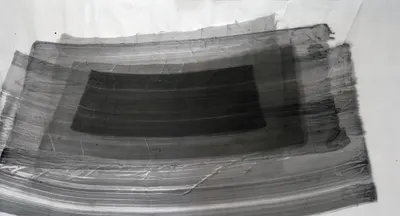
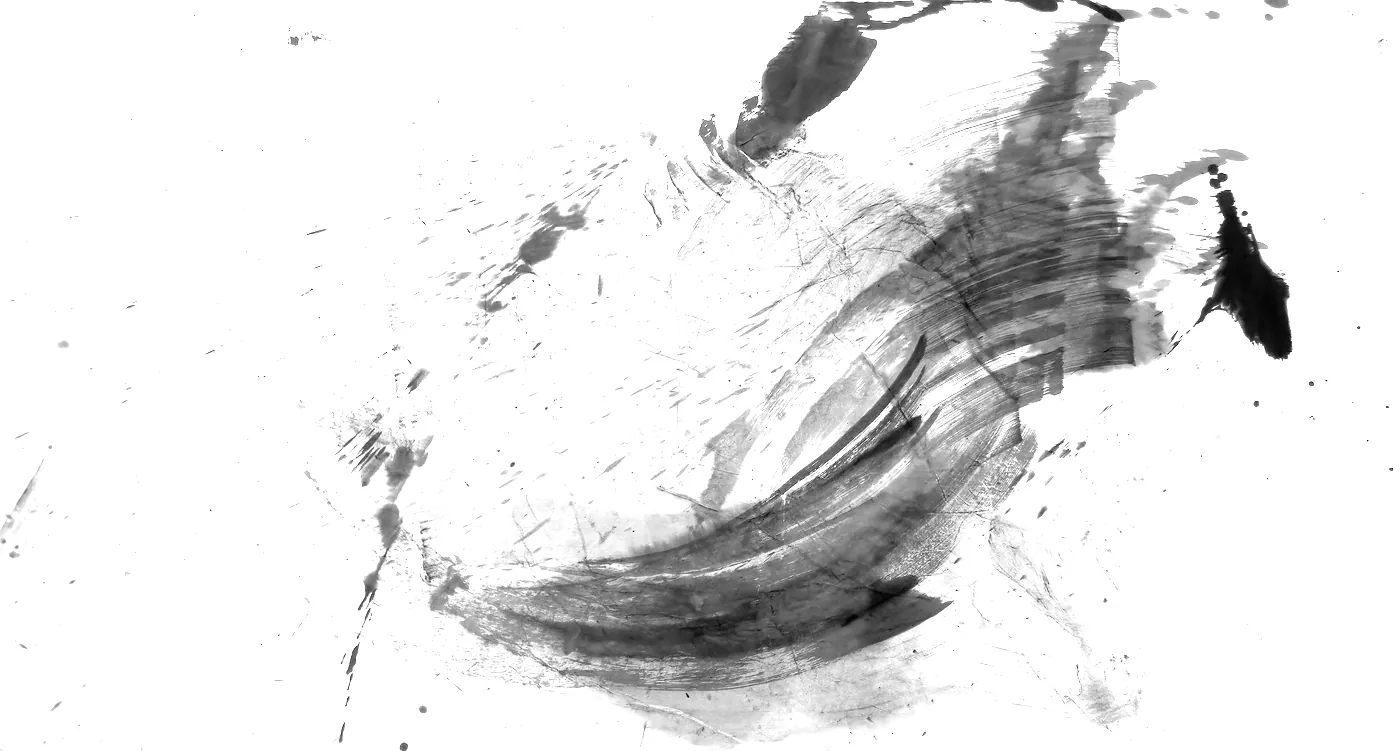
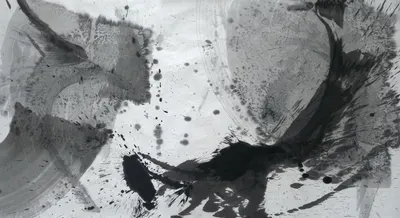
Three views of one sheet.
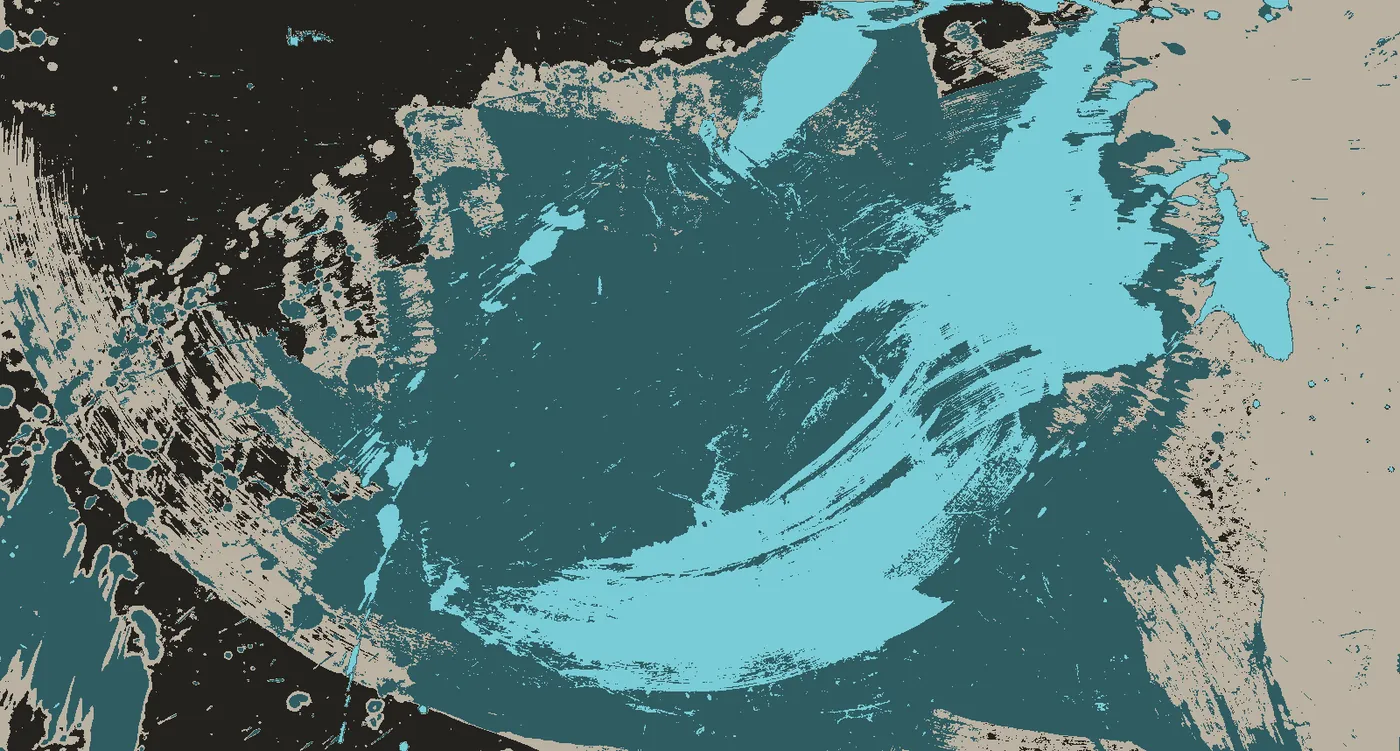
Left, the photograph. Centre, the tone stretch the model is shown beside it: the darkest 45% of tones spread over the whole range, so flat black, banding and stains show. Right, every pixel as the measuring code classes it: cyan black ink, deep teal translucent grey, stone the palest ink, near black bare paper.
5 families of tone.
Every inked pixel's brightness in 64 bins, smoothed; each circled peak holds at least 4% of the ink. Life inside the black: 0.047 (under 0.045 reads as flat).
Five reads, agreeing on 4 of 5 qualities.
Each quality placed on its ladder by each read, and the mean the engine keeps. Where reads differ, they differ by one rung; close calls resolve down.
READ 1, IN ITS OWN WORDS
“An energetic circular gesture sheet like R2. The lower dry-brush crescent is the best part. It is held back by solid black blots, cloudy tide-edged grey washes in the centre and crowded spatter.”
The lower curved sweep and the arcing grey strokes follow the travel of the brush; the top-centre black blob and right blot are bulky lobes.
WEAKEST Right-edge black blot, a shapeless dropped lobe
STRONGEST Lower centre sweeping crescent of dry-brush strokes
Five tonal steps and modulation of 0.047, just above flat. Arcs are banded and grainy; the right and top blots are dead black.
WEAKEST Right blot is flat solid black inside
STRONGEST Lower crescent with banded dry-brush grain
A pale grey arc pass, mid-grey rectangular washes and the dark sweeps can each be read, though the centre stacks get dense and cloudy.
WEAKEST Centre overlaps grow cloudy where the greys pile up
STRONGEST Pale left arc under the darker central sweep
The circular sweep sets up movement from the left arc into the lower crescent. Ink covers 82% of the sheet, so the paper is crowded and spatter clutters it.
WEAKEST Busy, crowded centre and spattered upper left
STRONGEST Large circular rotation sweeping across the sheet
Milky, cloudy grey wash patches with hard tide edges sit around the central dark masses. Scattered blotches and crease lines show in the colour view.
WEAKEST Cloudy grey washes with tide edges in the centre
STRONGEST Dry-brush grain in the lower sweep
3 distinct places, 2 major.
Each read must name every flaw and where it is, in a ninth of the sheet. Here the reads named flaws in 3 distinct places, 14 mentions in all across 5 reads; the number in each ninth is how many times a flaw was named there. Reads agreeing on a place strengthen the evidence for one flaw; they do not multiply it. A major flaw holds Material and surface at rung 1.
Measured from the 16-bit master.
The previous engine (V22) measured this sheet's master file: 2 principal ink masses traced (cyan), 9 enclosed voids at true size in their grid cells (amber), the main gesture from start to end (red). Of 14 edge segments, 79% crisp, 14% soft or bloomed, 7% broken.
The rating these readings produce, the rules applied and the arithmetic, with Peter's own rating where he gave one, are in the Archive record.
Date
2026.04.15, day 108 of the Crucible Year, one of 11 paintings from that date (8 shown). 58 works were registered in the fourteen days before. Paintings are dated by the day their batch was registered and photographed; each was finished that day or within the few days before. Phase: P2 The Switch (working title).
T_227 among all 402
Every painting of the year by date; this one is outlined.
Materials
- Paper
- Red Star Mo She Special Effect Xieyi Edition, raw, China Xuan Paper Co., Ltd., made 2025.12.08
- Ink MB4
- Yi De Ge Refined Ink Juice, Yi De Ge (Beijing)
- Ink MB5
- Boku-Undo Genso, Boku-Undo
- Ink MB6
- Yi De Ge Yun Tou Yan, Yi De Ge (Beijing)
Related