Ink painting and Western abstraction: a short lineage
From the Six Principles and Song splashed ink to Tobey, Kline, the Bokujinkai, Hong Kong's New Ink movement and Soulages: where East Asian ink and abstraction meet.
Where ink and abstraction meet.
East Asian ink painting was abstract in its means long before Western painting was abstract in its aims: its oldest criteria judge the life of the brushstroke itself. In the twentieth century the two traditions met: Western painters looked at calligraphy, East Asian calligraphers and ink painters looked at Western abstraction, and each changed the other's sense of what a mark could be.
A short lineage.
Twelve moments, chosen because they are easy to see.
- c. 500Xie He's Six Principles
Vitality through rhythm, and the bone of the brush, set the first terms for judging painting.
- c. 1200Splashed ink
Song painters such as Liang Kai let loose, wet ink carry the image.
- 1495Sesshū's haboku
The Japanese master's broken-ink landscape: forms dissolved into washes.
- 1934Mark Tobey in Shanghai and Kyoto
Calligraphy study and a stay at a Zen temple lead to his 'white writing'.
- 1950Franz Kline's black and white
Large black strokes on white, widely compared with calligraphy, a reading Kline rejected.
- 1951Henri Michaux, Mouvements
Pages of ink signs, between writing and figure.
- 1952The Bokujinkai
Kyoto calligraphers, Morita Shiryū and Inoue Yūichi among them, push brushwork toward abstraction and engage with Western abstract painting.
- late 1950sModern ink in Taiwan
Liu Kuo-sung and the Fifth Moon group argue for an abstract ink painting.
- 1960sHong Kong's New Ink Painting
Lui Shou-kwan and his circle bring abstraction into ink painting in Hong Kong.
- 1979Soulages, Outrenoir
Black worked until light itself becomes the subject.
- 2009Xuan papermaking on UNESCO's list
The craft of making Xuan paper is inscribed as intangible cultural heritage.
- 2025 to 2026The Crucible Year
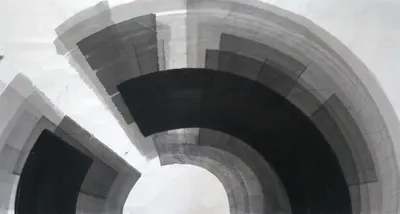
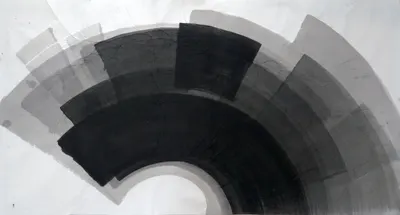
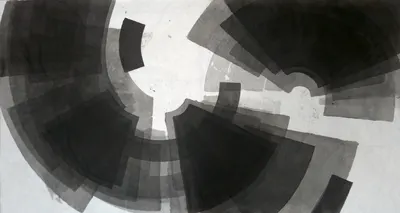
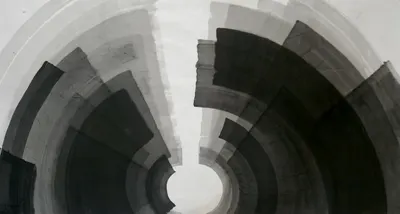
A year of large one-shot ink paintings on Chinese paper, every sheet recorded and measured.
Where the Crucible Year sits.
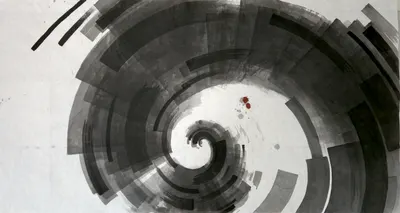
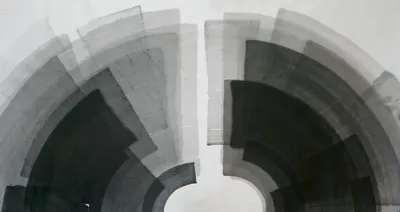
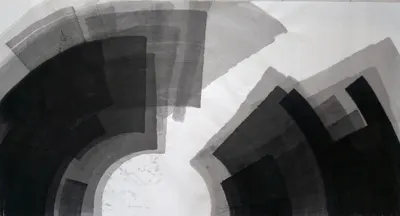
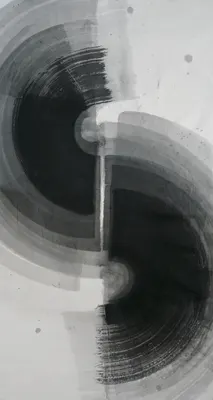
The Crucible Year uses the materials of the East Asian tradition (sumi ink, Chinese paper, the brush, the one-shot stroke that cannot be corrected) at the scale and with the full-body gesture of postwar abstraction, and adds something neither had: every painting measured, read and archived as it was made.
In the archive.
Paintings from the Crucible Year that show it.
Questions and answers.
Plain answers to the questions most often asked.
Was Abstract Expressionism influenced by Chinese and Japanese calligraphy?
Some of its painters looked closely at East Asian brushwork: Mark Tobey studied calligraphy in Shanghai and stayed at a Zen temple in Kyoto in 1934, and Franz Kline's black-and-white paintings were widely compared with calligraphy, though Kline rejected the comparison. In the 1950s Japanese avant-garde calligraphers and New York painters followed each other's work closely.
What is the Bokujinkai?
A group of avant-garde calligraphers founded in Kyoto in 1952, including Morita Shiryū and Inoue Yūichi, who pushed brushwork toward abstraction and engaged with Western abstract painting.
What is the New Ink Painting movement?
A modern ink movement centred in Hong Kong in the 1960s around Lui Shou-kwan, which brought abstraction into Chinese ink painting; in Taiwan, Liu Kuo-sung and the Fifth Moon group argued for a modern, abstract ink painting from the late 1950s.
Who are contemporary abstract ink painters?
Abstract ink painting is practised across East Asia and beyond. Peter Yuill, a Canadian painter formed over more than a decade in Hong Kong, made the Crucible Year, a year of large one-shot abstract ink paintings in Bangkok with every work measured and archived.