How to read an abstract ink painting
Five qualities to judge an abstract ink painting by, what each looks like from weak to masterful, and the flaws to look for, from 3,600 named flaws.
Five things to look at.
Abstract ink painting has no subject to check against, so it is judged by how it was made. The five qualities below are the ladders this archive's analysis engine uses. They were developed over a year of testing against the painter's own judgement, and they echo older criteria: Xie He's 'bone method', the structural strength of the brush, is close to Form.
From failed to masterful.
Each quality has five named rungs. The middle rung is what the median painting in this archive does; the top rungs need evidence that is rare in this archive.
What goes wrong.
Ink on absorbent paper cannot be corrected, so its accidents stay. Across the archive, the engine's readings named 2,232 flaws of the kinds below (and many more it could only describe), each with its place on the sheet.
a pale, cloudy patch with a soft outline where water lifted or diluted ink after it was laid.
ink that has spread past the stroke into a soft halo, out of control rather than intended.
a hard-edged circle or blot left by a drop or a resting vessel.
a dark edge left where a wash dried, marking how far the water travelled.
black so flat and heavy it has no life inside it.
layers that have blended into an undifferentiated grey.
marks laid over a passage that was already resolved, worrying it.
How the engine reads, measures and rates each painting, with its validation against the artist: Method.
In the archive.
Paintings from the Crucible Year that show it.
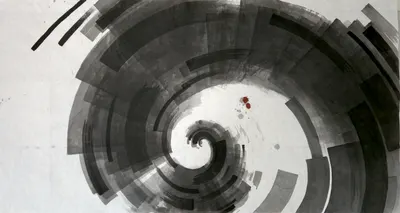
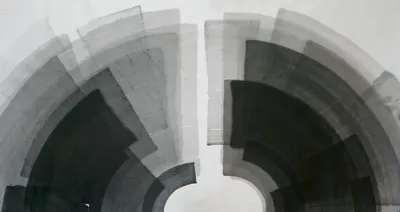
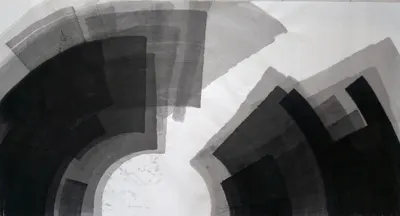
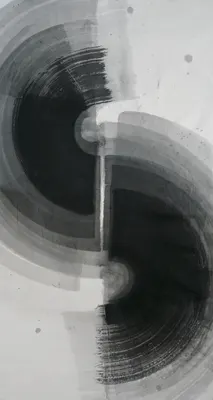
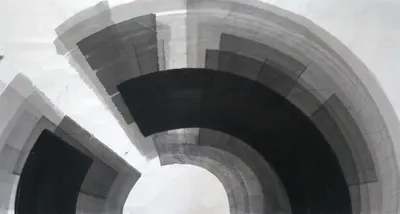
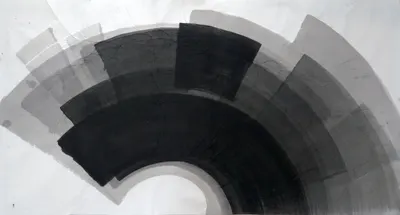
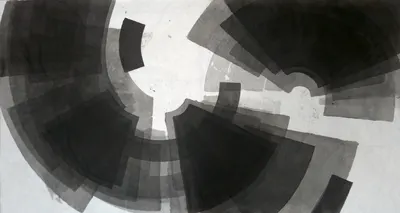
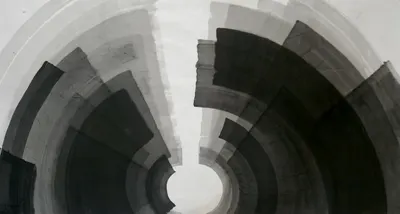
Questions and answers.
Plain answers to the questions most often asked.
How do you judge an abstract ink painting?
Look at five things in turn: the form the brush makes, the depth of tone inside the blacks and greys, whether layers stay legible, how the whole sheet is held together, and how ink and paper behaved, including accidents. Judge against other works in the same medium, not against an abstract ideal.
What makes a good ink painting?
Marks that carry the movement that made them, blacks with life inside them rather than flat fill, washes that layer without turning to mud, a composition that uses the white of the paper as actively as the ink, and a surface free of unintended damage.
What are common flaws in ink painting?
Water stains, blooms (uncontrolled spreading), rings, tide lines where a wash dried, dead flat black, muddy overlaps and overworking. In this archive's engine readings, water stains and blooms were the most frequently named.
Can a computer judge ink painting?
In part. This archive's engine measures tone and coverage exactly and places each painting on five fixed ladders through five independent readings; its ranking agreed with the artist's at 0.95 on held-out works. It judges soundness better than greatness, and it reads photographs.