Brushes for large-scale ink painting
Goat, weasel and mixed-hair brushes, how loading and pressure shape a mark, and composite brushes up to about 70 cm wide.
Soft, stiff, mixed.
Chinese ink brushes are classed by hair. Goat hair is soft and very absorbent: it holds a lot of ink and gives broad, soft-edged strokes, but springs back slowly. Weasel hair, traditionally called wolf hair, is stiff and springy: it holds less, snaps back fast, and gives crisp lines and flying white. Mixed-hair brushes wrap a soft, ink-holding core in a firmer sheath to get both. Horse and other coarse hairs are firmer still.
Loading, angle, pressure, speed.
A fully loaded brush gives a dark, even stroke; a brush dipped only at the tip fades along the stroke; a brush dipped first in water and then in ink grades from dark tip to pale belly. Upright, the tip draws a line; laid on its side, the belly lays a band. More pressure widens the mark, more speed opens the hairs into flying white.
Brushes at the scale of the body.
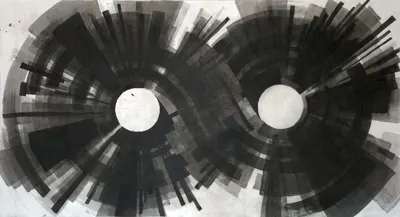
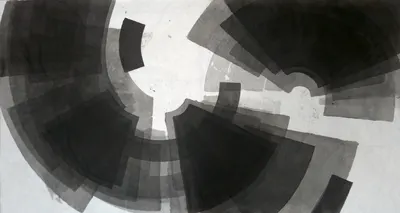
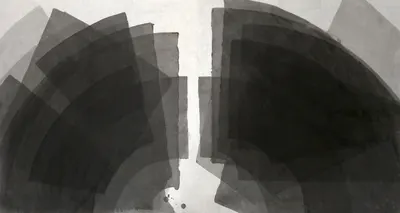
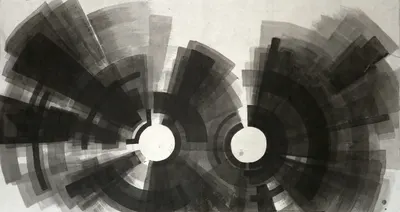
On a sheet 97 × 180 cm or larger, ordinary brushes run out mid-stroke and leave seams where a stroke is restarted. This archive's large marks come from wide flat brushes and from composite brushes Peter Yuill builds himself.
Many brushes, one stroke.
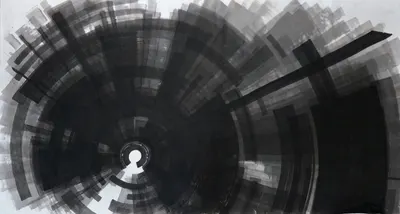
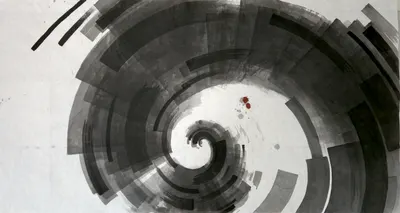
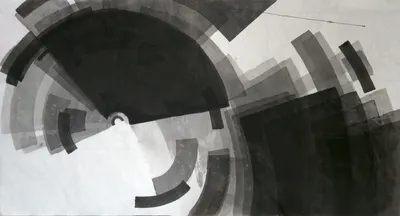
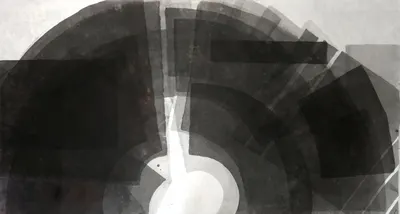
Flat brushes bound side by side to a shared spine, up to about 70 cm wide, with an offset second row behind the seams. Under a heavy wet load the bristles at the seams part first; evenly spaced stripes across a wide stroke can therefore come from how the brush is built.
In the archive.
Paintings from the Crucible Year that show it.
Questions and answers.
Plain answers to the questions most often asked.
What brushes are used for Chinese ink painting?
Brushes of goat hair (soft, very absorbent, broad soft strokes), weasel hair, called 'wolf hair' (stiff, springy, crisp lines and flying white), and mixed hair (a soft core in a firmer sheath, combining capacity and spring).
How do you paint very large ink paintings?
With brushes sized to the sheet and the body: large flat brushes, brooms or composite brushes, a long reach, ink prepared in quantity, and a surface that lets the painter work around the sheet from every side.
What is a composite brush?
Several brushes bound to one spine to make a single wide mark. Peter Yuill builds them up to about 70 cm wide from flat brushes, with an offset second row behind the seams so the stroke does not split.
Why does a wide stroke show regular stripes?
Often it is the brush: in a composite brush the seams between units can leave evenly spaced gaps. Evenly spaced stripes that match the unit width show how the brush is built; they say nothing about the hand.