T_230
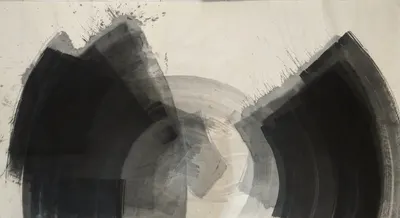
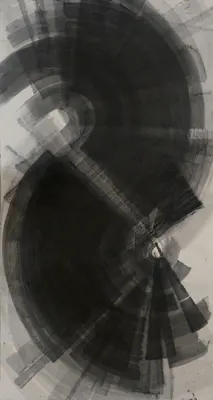
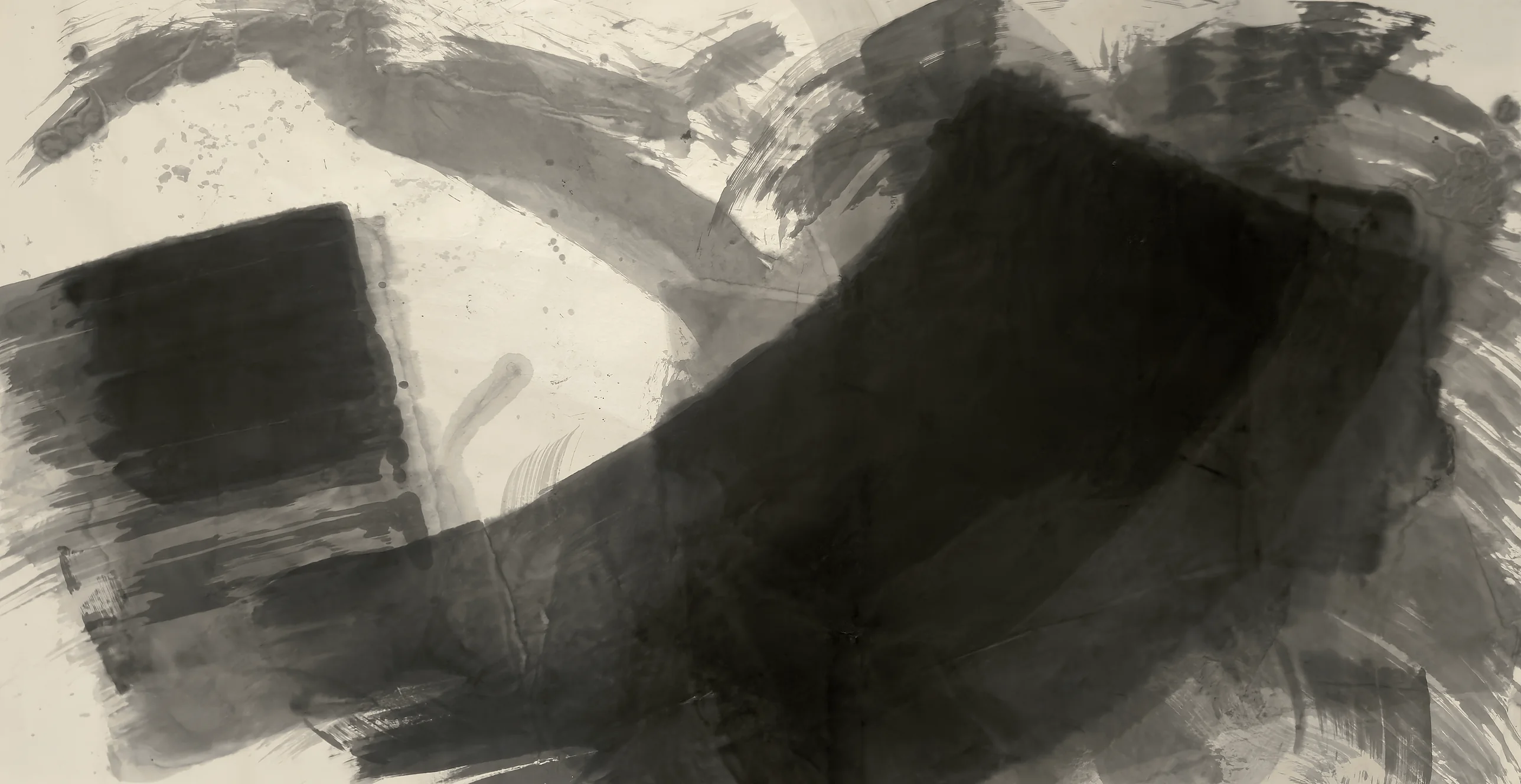
The engine's readingA black wedge climbs from lower left to upper right under sweeping grey strokes, with a square black block set apart beside a bay of bare paper.
Record- Date
- 2026.04.18
- Dimensions
- 97 × 180 cm
- Rating
- 5.1
- Paper
- Red Star Mo She Imitation Antique Chu Bark, Exhibition Edition, half-raw
- Ink
- Yi De Ge Refined Ink Juice, Boku-Undo Genso, Yi De Ge Yun Tou Yan
Low down in the dark are the creases a bed gets toward morning, when the person beside you has rolled over for the last time and taken the blanket along. The big black has the right side and most of the middle, and it is breathing evenly, and it is not sorry. I have slept in a strip that size. You learn to love it, the way you love a warm weight that will never ask whether you have enough room. You lie on the pale edge with a foot out. Grey light comes in over the top of the curtain and finds the teaspoon from last night, pale, long in the handle, lying on the bare sheet where you were meant to sleep.
The reading
Written by the engine after V23's reads, from the settled findings, and checked by hand before approval. It explains V23's numbers and may not change them.
- Structure
- square black block at left; long band rising into black wedge; grey arcs above
- Movement
- rising arc from lower left to upper right; upper grey band descends against it
- Coverage
- ink on about nine tenths of the paper
- Tone
- seven tonal steps, weighted dark
- Layering
- three kinds, grey sweeps, mid-grey bands, black slabs; readable at top right, lower centre
- Edges
- crisp along block's top; soft around wedge's crown; broken at left and right ends
- Feibai
- present, horizontal streaks off the left block; arcing streaks in upper-centre grey strokes
- Open paper
- pale rounded bay, left of centre, enclosed by grey arc and rising band
- Chance marks
- spatter upper left; rings in top greys; tide line right of wedge
- Frame
- ink runs off all four edges; upper-left and lower-left corners stay open
Dark climbs the paper from lower left to upper right, a long bent band that swells into a huge black wedge. A square black block stands apart at the left. Grey strokes sweep across the top and come down to meet the rising band, and between them a bay of bare paper opens, the only rest.
The grey is where the brush is alive. That upper sweep shows the path of the hand, and half-sized paper keeps each pass separate, so the greys stay legible under the black at the top right. At the left, the block's horizontal bands step down in density and break into streaks of flying white.
The large forms pay for this. The block is blunt and filled in. The upper core of the wedge is close to a single black, laid over earlier passes instead of building through them, and the lower right crowds with weight. Creases and cloudy wash disturb the stepped greys in the lower centre.
The arc gives direction and the bay gives air. Most of the area, though, is slab, and the good brushwork stays at the margins: a middling sheet, competent and heavy.
The rating
T_230, rated 5.1
The combined score, out of 10: V23's reading of the photograph as the read half and V24's twelve tests on the 16-bit file as the measured half, added and divided by 10. The scale is relative to this archive. How each half is made is on the Method page.
- Form
- 1.0 · blunt
- Tonal depth
- 2.0 · modelled
- Layering
- 2.0 · legible
- Composition
- 2.0 · working
- Material and surface
- 1.0 · flawed
- Mass
- 5.4 of 10
- Tone
- 10.2 of 14
- Void
- 3.2 of 8
- Flow
- 6.0 of 10
- Balance
- 4.8 of 8
How it was measured
What V24 measured.
Plain physical facts with no model involved. Across the year they track how the practice changes. On one sheet they cannot say whether a mark is any good. Millimetres read a few percent high, because the photographs are cropped just inside the paper's edge.
The width of the ink mask along its medial axis.
Optical density at the 75th percentile of the sheet.
The radius of the largest circle of open paper.
How far the marks align across the sheet. Lower means they run several ways.
Left and right asymmetry of the ink. Lower is more even.
Pixels to the millimetre in the TIFF these were measured from, with the studio light removed.
Read by the Visual Analysis Engine, version 23.8, on 2026.10.06: measured by code, then read 5 times by Claude Opus 5.5 against three reference paintings (R1 to R3), each read independent of the others. How the engine works.
Three views of one sheet.
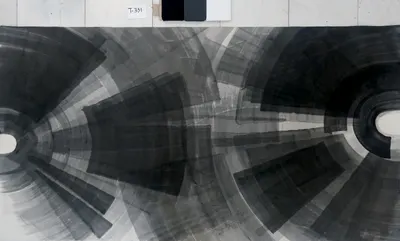
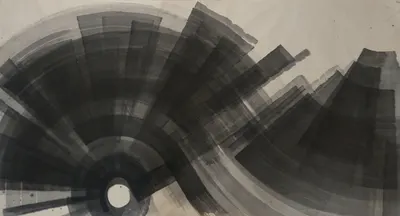
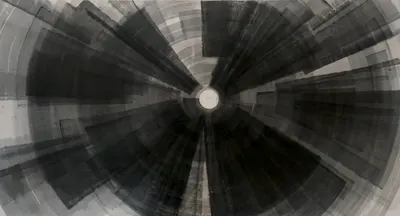
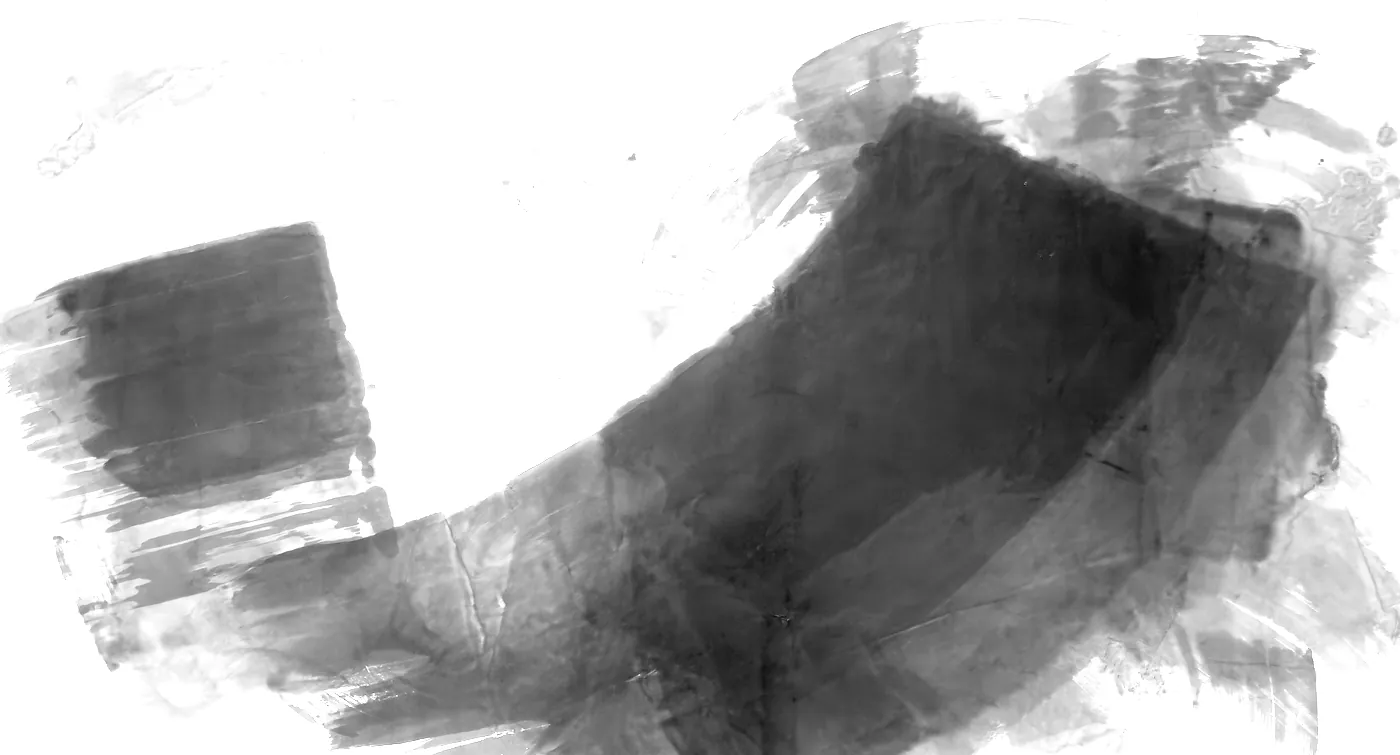
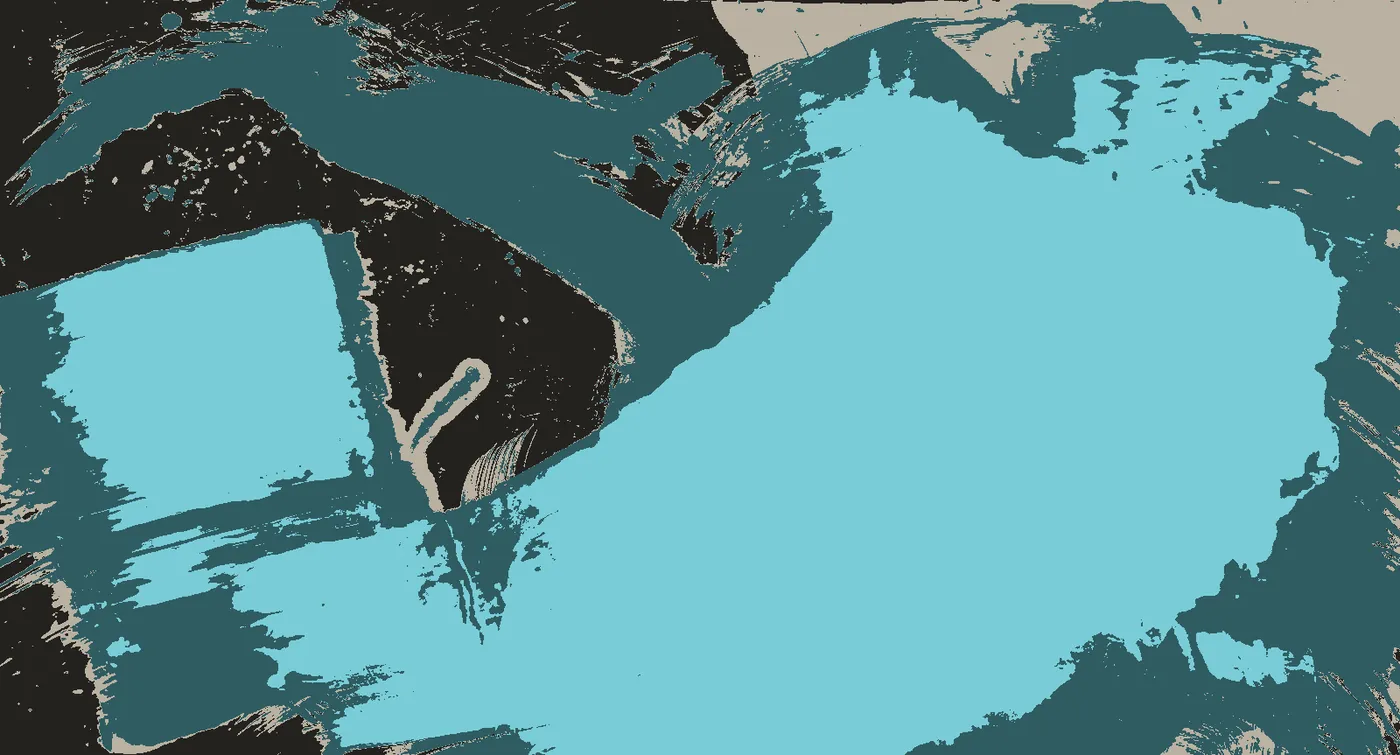
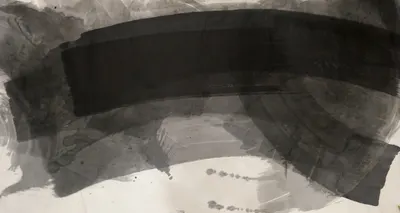
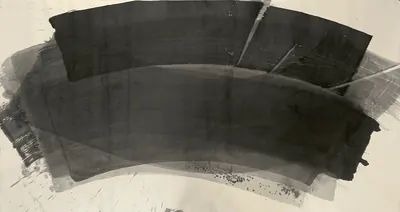
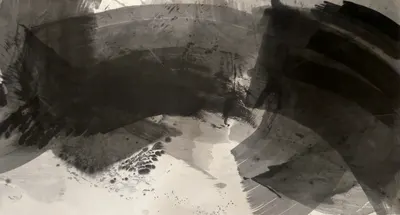
Left, the photograph. Centre, the tone stretch the model is shown beside it: the darkest 45% of tones spread over the whole range, so flat black, banding and stains show. Right, every pixel as the measuring code classes it: cyan black ink, deep teal translucent grey, stone the palest ink, near black bare paper.
7 families of tone.
Every inked pixel's brightness in 64 bins, smoothed; each circled peak holds at least 4% of the ink. Life inside the black: 0.059 (under 0.045 reads as flat).
Five reads, one answer.
Each quality placed on its ladder by each read, and the mean the engine keeps.
READ 1, IN ITS OWN WORDS
“Heavy slab masses like R1, eased by an arcing sweep and some legible grey layering. The blunt blocks, the crowded right side and the creased, cloudy lower mass keep this sheet below average to ordinary.”
Left block and big central slab are bulky, filled rectangles; the arc of the main mass hints at brush travel, but its outline stays slab-like and stiff.
WEAKEST Left rectangular slab, blunt and filled-in
STRONGEST Curving sweep of grey strokes across top
Modulation 0.0586 and seven tonal steps; the left block shows horizontal banding and the lower greys are graded, but the core of the central black is dense and flat.
WEAKEST Core of central black slab reads near-flat
STRONGEST Banded left block with horizontal stepped density
Grey sweeps sit under the black at the top right and bottom and can still be read; the central black mostly blankets earlier passes rather than building depth.
WEAKEST Black slab largely covers earlier greys
STRONGEST Grey strokes under black at top right
A U-shaped arc carries the eye from the left block to the upper right, and the pale upper-left paper is shaped. The heavy right and bottom are crowded and dense.
WEAKEST Crowded, heavy bottom-right quadrant
STRONGEST Arc from left block up to top right
Wrinkle and crease lines with cloudy mottling run through the lower-centre dark mass in both views; there are bloom edges at the top right and scattered spatter blots in the upper left.
WEAKEST Crease lines and cloudy wash in lower-centre mass
STRONGEST Dry-brush edges on the left block
7 distinct places, 1 major.
Each read must name every flaw and where it is, in a ninth of the sheet. Here the reads named flaws in 7 distinct places, 19 mentions in all across 5 reads; the number in each ninth is how many times a flaw was named there. Reads agreeing on a place strengthen the evidence for one flaw; they do not multiply it. A major flaw holds Material and surface at rung 1.
Measured from the 16-bit master.
The previous engine (V22) measured this sheet's master file: 1 principal ink mass traced (cyan), 6 enclosed voids at true size in their grid cells (amber), the main gesture from start to end (red). Of 17 edge segments, 53% crisp, 29% soft or bloomed, 18% broken.
V23's rules and arithmetic, and every figure under its own name, are in the Archive record.
Date
2026.04.18, day 111 of the Crucible Year, one of 12 paintings from that date (8 shown). 56 works were registered in the fourteen days before. Paintings are dated by the day their batch was registered and photographed; each was finished that day or within the few days before. Phase: P2 The Switch (working title).
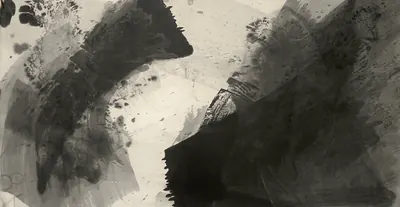
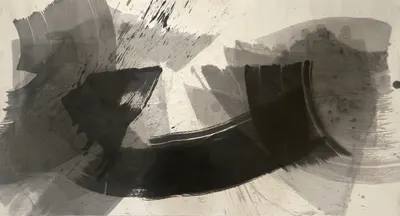
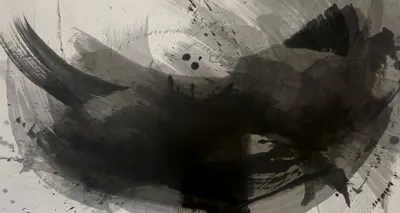
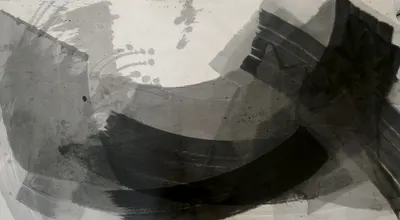
T_230 among all 419
Every painting of the year by date; this one is outlined.
Materials
- Paper
- Red Star Mo She Imitation Antique Chu Bark, Exhibition Edition, half-raw, China Xuan Paper Co., Ltd. (中国宣纸股份有限公司), made 2026.01.14
- Ink MB4
- Yi De Ge Refined Ink Juice, Yi De Ge (Beijing)
- Ink MB5
- Boku-Undo Genso, Boku-Undo
- Ink MB6
- Yi De Ge Yun Tou Yan, Yi De Ge (Beijing)
Related