T_233
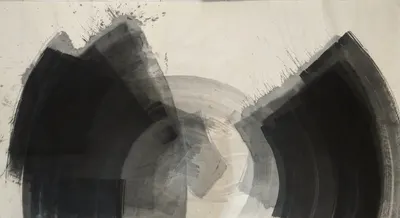
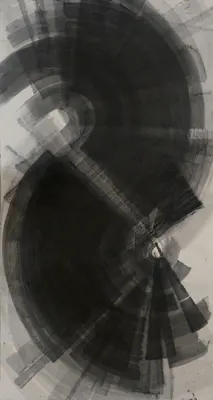
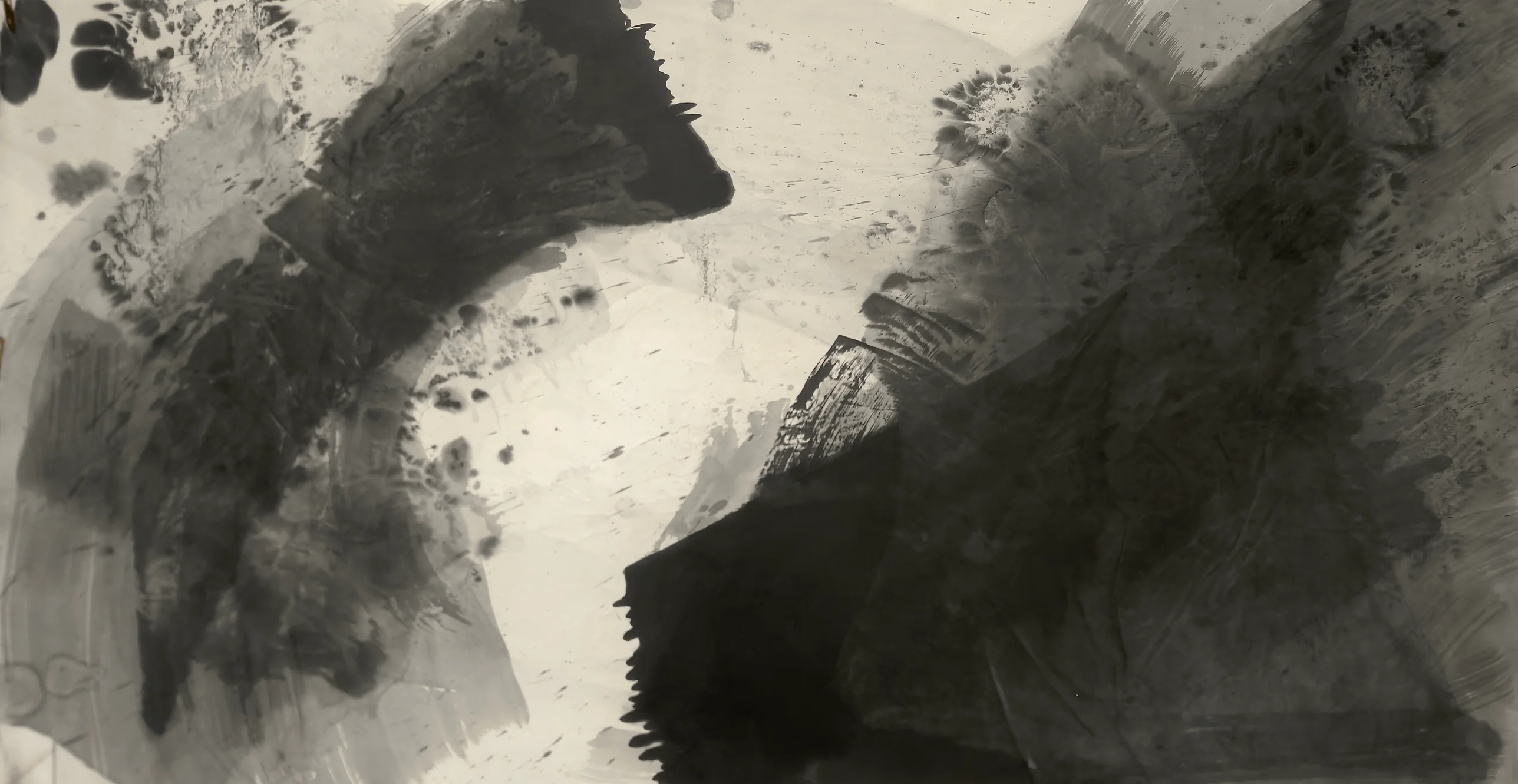
The engine's readingTwo dark masses of ink lean together across a wide sheet, and between them a narrow path of bare paper falls from the top edge to the bottom.
Record- Date
- 2026.04.18
- Dimensions
- 97 × 180 cm
- Rating
- 5.2
- Paper
- Red Star Mo She Imitation Antique Chu Bark, Exhibition Edition, half-raw
- Ink
- Yi De Ge Refined Ink Juice, Boku-Undo Genso, Yi De Ge Yun Tou Yan
The sailors had a rule for the clashing rocks: send a dove first. If the dove came through missing only a feather or two, you rowed. That pale road down the middle is that kind of strait, and I would send the dove. The rock on the right is fat with weather and in no hurry. The black one at the bottom has a lip of small teeth, like something that was promised a ship once and is still waiting on the paperwork. Apollonius sang the Argo through the clashing rocks; a strait like this gets a line at most. You get through, you lose a few oars, you tell it badly at supper. On the far side the dove sits on a rail, three feathers short, unimpressed.
The reading
Written by the engine after V23's reads, from the settled findings, and checked by hand before approval. It explains V23's numbers and may not change them.
- Structure
- left diagonal arc and bulky right mass, black wedge joining at bottom centre
- Movement
- two diagonals converging downward; the wedge's blunt mass sits against the fall
- Coverage
- ink on about nine tenths of the paper
- Tone
- three tonal steps, weighted dark
- Layering
- grey washes under black; readable on the left, clouded inside the right mass
- Edges
- crisp on left arc and wedge; serrated wedge rims; soft inside right mass
- Feibai
- present at the left arc's head, top centre, and above the black wedge
- Open paper
- tapering channel from top centre down toward bottom, between both masses
- Chance marks
- spatter across central paper; faint rings lower left; stain at left edge; blooms right
- Frame
- ink runs off left, right and bottom; top stays open at its centre
Two dark masses lean in from the sides and leave one path of paper between them, wide at the top edge and narrowing as it falls. That shaped gap is the composition. It gives the sheet its direction and keeps the heavy ink from closing over.
The left arc wins the sheet. It sweeps up toward the top, and at its head the hairs split into a feathered edge that keeps the speed of the stroke. Inside, the black is grained and streaked, brushed through, and a pale grey wash lies beneath it as a separate earlier pass. The half-sized paper does that work: it holds an edge and lets one layer rest on another without sinking in.
The right half thickens. Grey and black passes pile up and cloud into a mottled murk, their order lost, and the mass presses hard against the edge. At bottom centre a black wedge sits blunt and dense all through, a slab with nothing moving inside it. Faint rings and a stain at lower left stay quiet.
A sound stroke and a good gap, spent against a heavy, airless right side. Ordinary work, about where most of the archive lands.
The rating
T_233, rated 5.2
The combined score, out of 10: V23's reading of the photograph as the read half and V24's twelve tests on the 16-bit file as the measured half, added and divided by 10. The scale is relative to this archive. How each half is made is on the Method page.
- Form
- 1.8 · built
- Tonal depth
- 2.0 · modelled
- Layering
- 2.0 · legible
- Composition
- 2.0 · working
- Material and surface
- 1.0 · flawed
- Mass
- 7.4 of 10
- Tone
- 5.8 of 14
- Void
- 6.4 of 8
- Flow
- 4.0 of 10
- Balance
- 4.8 of 8
How it was measured
What V24 measured.
Plain physical facts with no model involved. Across the year they track how the practice changes. On one sheet they cannot say whether a mark is any good. Millimetres read a few percent high, because the photographs are cropped just inside the paper's edge.
The width of the ink mask along its medial axis.
Optical density at the 75th percentile of the sheet.
The radius of the largest circle of open paper.
How far the marks align across the sheet. Lower means they run several ways.
Left and right asymmetry of the ink. Lower is more even.
Pixels to the millimetre in the TIFF these were measured from, with the studio light removed.
Read by the Visual Analysis Engine, version 23.8, on 2026.10.06: measured by code, then read 5 times by Claude Opus 5.5 against three reference paintings (R1 to R3), each read independent of the others. How the engine works.
Three views of one sheet.
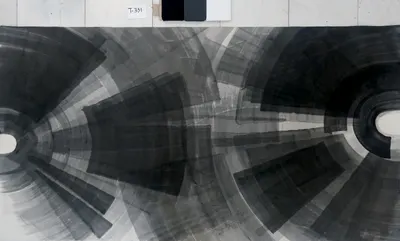
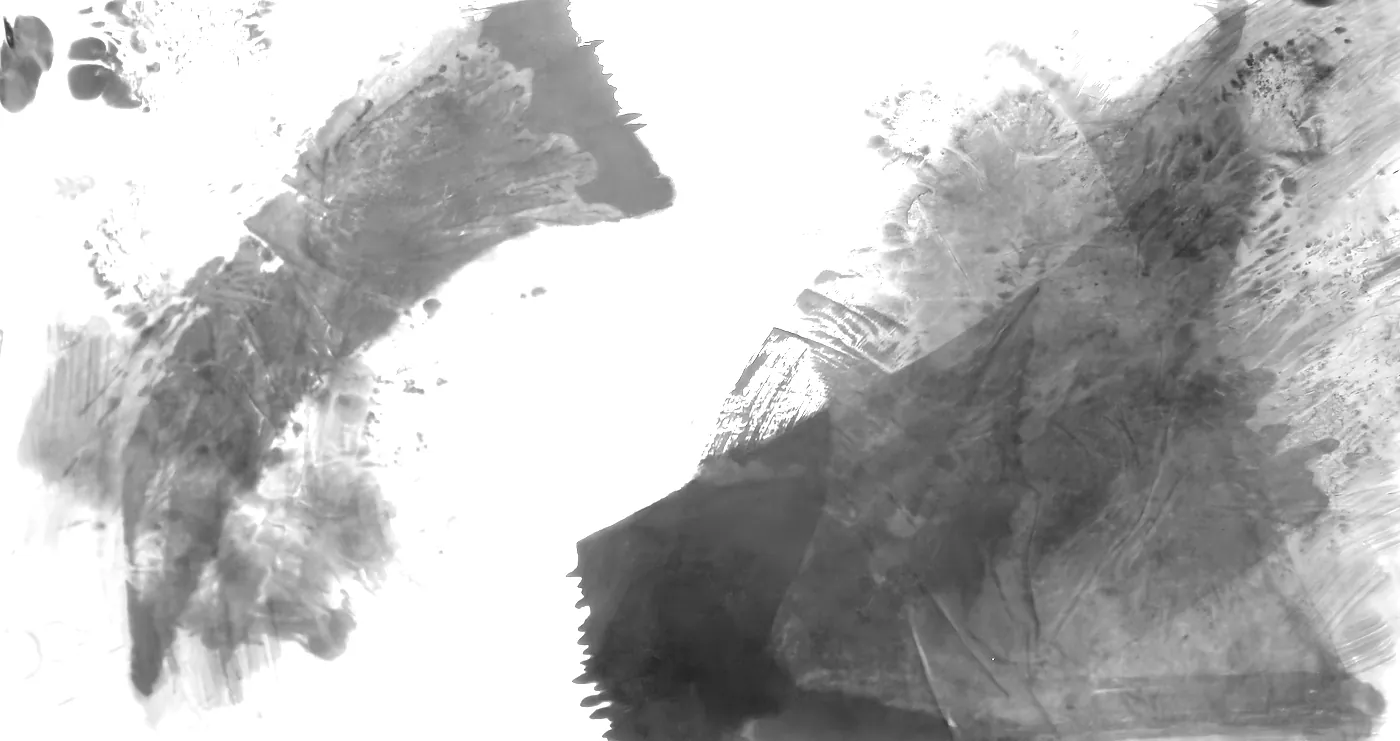
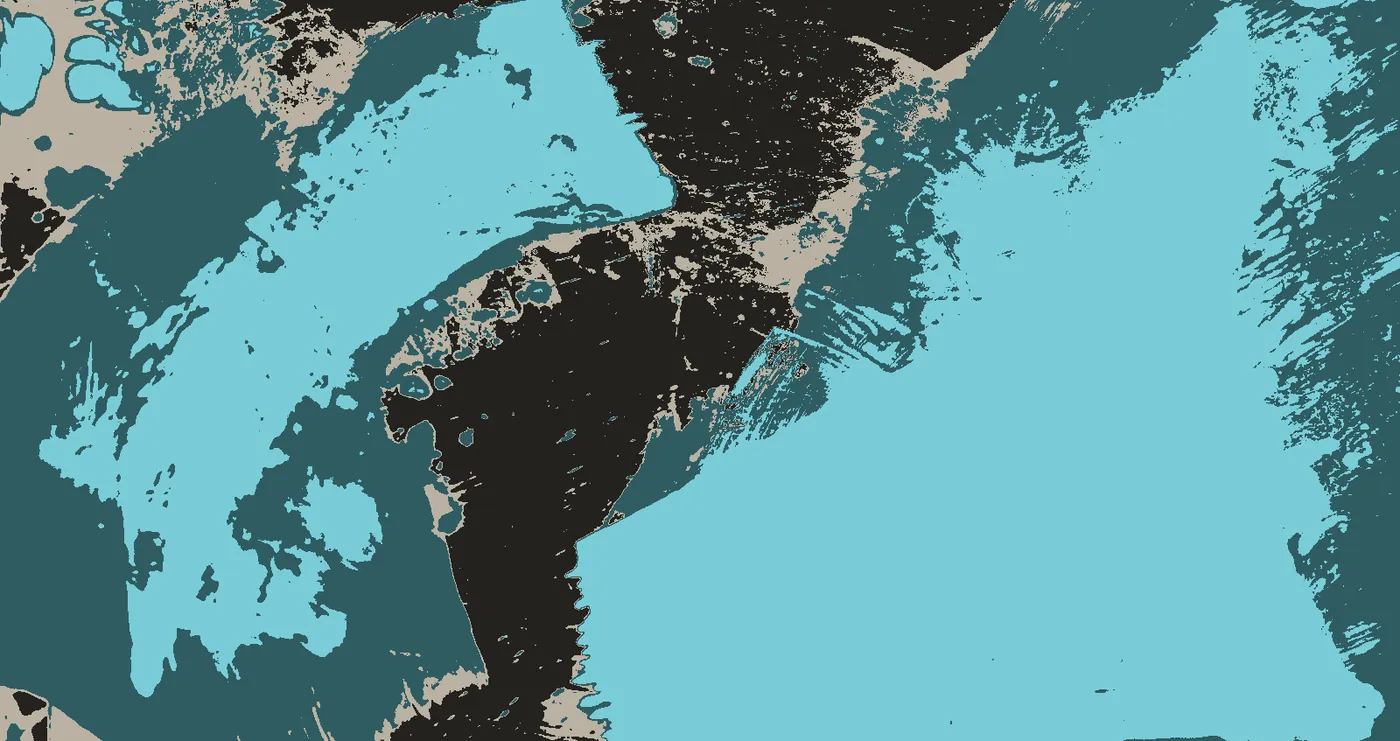
Left, the photograph. Centre, the tone stretch the model is shown beside it: the darkest 45% of tones spread over the whole range, so flat black, banding and stains show. Right, every pixel as the measuring code classes it: cyan black ink, deep teal translucent grey, stone the palest ink, near black bare paper.
3 families of tone.
Every inked pixel's brightness in 64 bins, smoothed; each circled peak holds at least 4% of the ink. Life inside the black: 0.052 (under 0.045 reads as flat).
Five reads, agreeing on 4 of 5 qualities.
Each quality placed on its ladder by each read, and the mean the engine keeps. Where reads differ, they differ by one rung; close calls resolve down.
READ 1, IN ITS OWN WORDS
“An ordinary, energetic sheet. A fluent left arc faces a bulky, cloudy right mass across a shaped central gap. The black wedge is flat inside, and blooms, rings and paper tint pull the material down.”
Left arc reads as a travelled stroke with a held wall; right mass is slab-like and diffuse; the bottom-centre black wedge is blunt with serrated edges.
WEAKEST Bulky, cloudy right-hand mass with no clear stroke path
STRONGEST Left diagonal arc with feathered dry-brush head
Left arc and right grey mass show brush grain and stepped density; the bottom-centre black wedge is near-uniform. Modulation of 0.052 is barely above flat.
WEAKEST Black wedge at bottom centre is flat inside
STRONGEST Grained, streaked interior of left arc
Pale grey sweeps sit legibly under the dark arc on the left; on the right, the grey and dark passes merge cloudily and their order is only partly readable.
WEAKEST Right mass passes blur into a cloudy fusion
STRONGEST Grey wash under the left dark arc
Two diagonal masses frame a shaped pale channel with a rising direction; the right half is heavy and crowded, with 85% ink coverage leaving little air.
WEAKEST Crowded right half heavy against the edge
STRONGEST Shaped central paper channel between the two masses
Faint ring marks at bottom left and an orange stain at the left edge; blotchy, bloomy mottling in the right mass is visible in the colour view; the paper is tinted.
WEAKEST Mottled, cloudy wash inside the right mass
STRONGEST Dry-brush feathering at the left arc's head
6 distinct places, 2 major.
Each read must name every flaw and where it is, in a ninth of the sheet. Here the reads named flaws in 6 distinct places, 20 mentions in all across 5 reads; the number in each ninth is how many times a flaw was named there. Reads agreeing on a place strengthen the evidence for one flaw; they do not multiply it. A major flaw holds Material and surface at rung 1.
Measured from the 16-bit master.
The previous engine (V22) measured this sheet's master file: 2 principal ink masses traced (cyan), 3 enclosed voids at true size in their grid cells (amber), the main gesture from start to end (red). Of 19 edge segments, 42% crisp, 53% soft or bloomed, 5% broken.
V23's rules and arithmetic, and every figure under its own name, are in the Archive record.
Date
2026.04.18, day 111 of the Crucible Year, one of 12 paintings from that date (8 shown). 56 works were registered in the fourteen days before. Paintings are dated by the day their batch was registered and photographed; each was finished that day or within the few days before. Phase: P2 The Switch (working title).
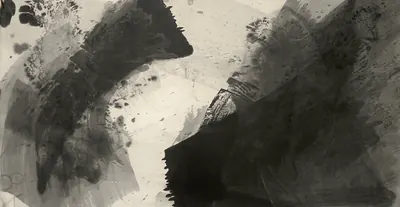
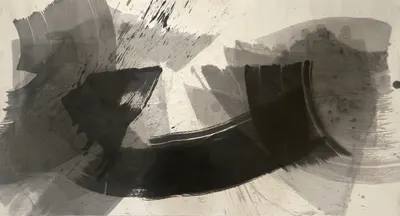
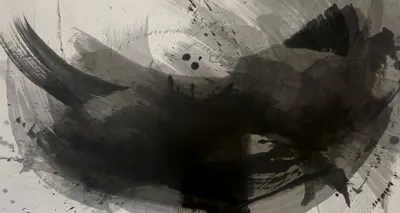
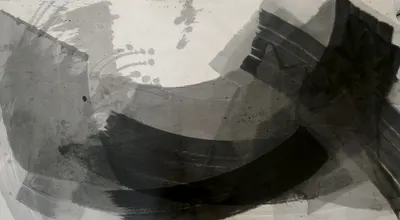
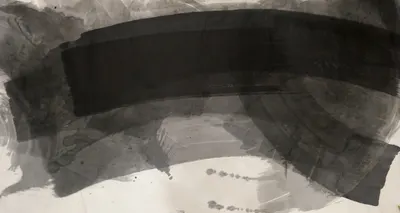
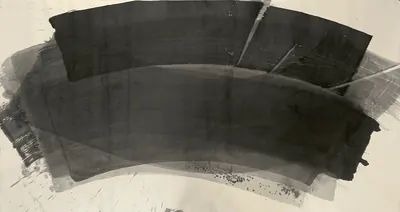
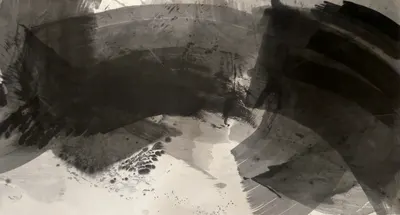
T_233 among all 419
Every painting of the year by date; this one is outlined.
Materials
- Paper
- Red Star Mo She Imitation Antique Chu Bark, Exhibition Edition, half-raw, China Xuan Paper Co., Ltd. (中国宣纸股份有限公司), made 2026.01.14
- Ink MB4
- Yi De Ge Refined Ink Juice, Yi De Ge (Beijing)
- Ink MB5
- Boku-Undo Genso, Boku-Undo
- Ink MB6
- Yi De Ge Yun Tou Yan, Yi De Ge (Beijing)
Related