T_385
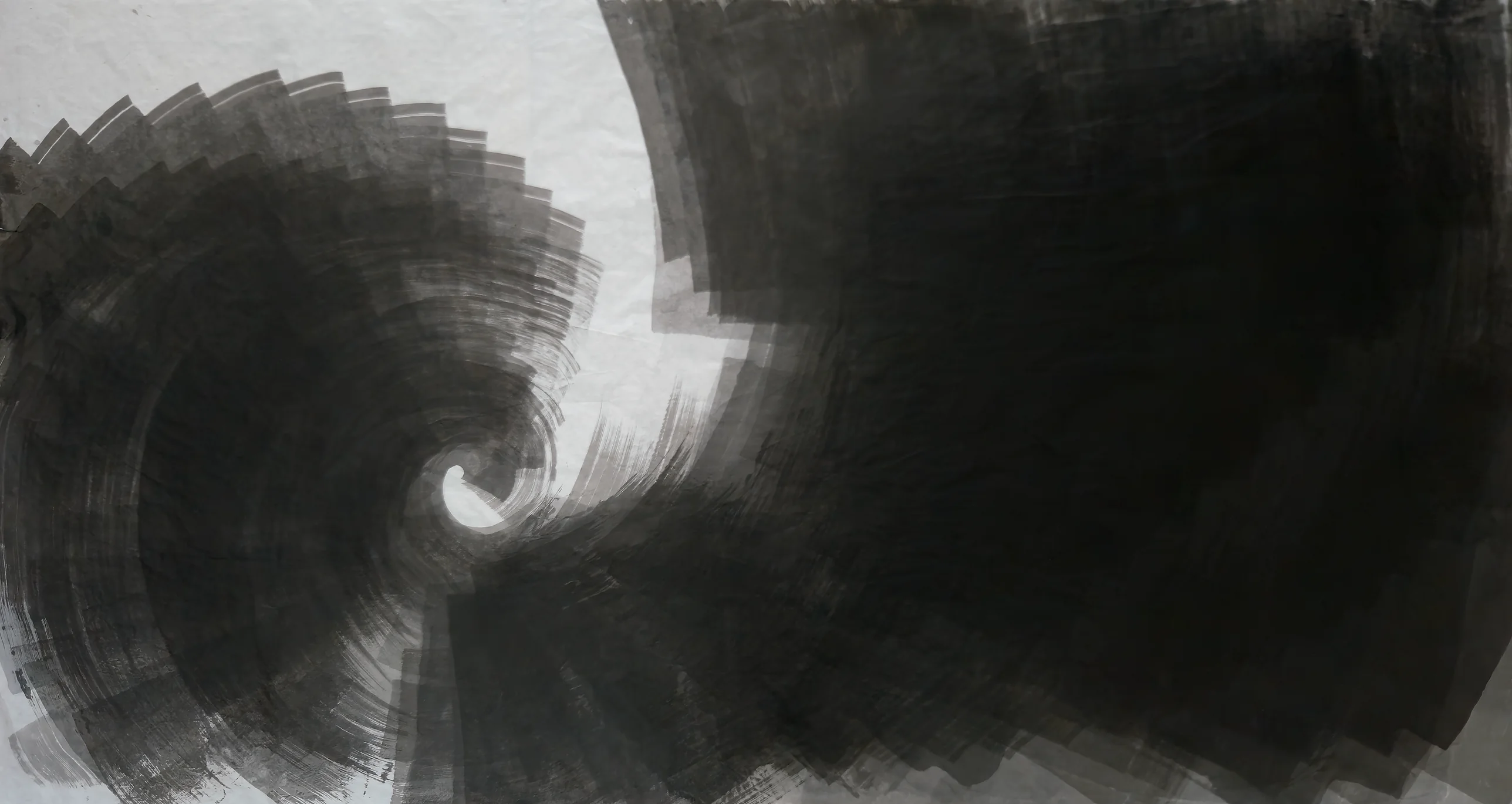
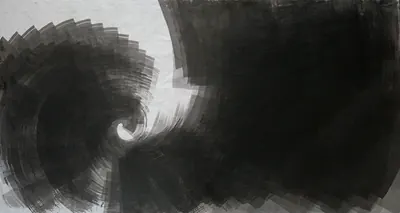
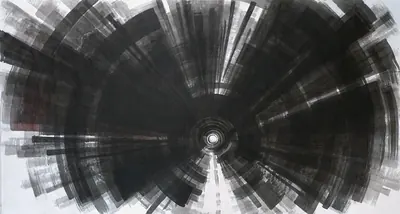
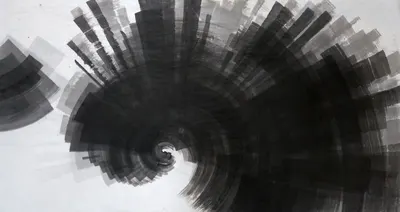
The engine's readingA stepped ink spiral wheels around a small white eye at left, pressed against a black mass that fills the right of the long sheet.
Record- Date
- 2026.10.16
- Dimensions
- 97 × 180 cm
- Rating
- 5.7
- Paper
- Half-Cooked Red Star Mo She 6-Foot Bark Xuan Paper, self-sized
- Ink
- Yi De Ge Yun Tou Yan, Boku-Undo Gentoku Super Concentrated, Yi De Ge Pine Soot Ink, Shisan Yue Calligraphy and Painting Ink
A serpent coils round the last bright thing in the country, and a giant comes down from the east to sit on the country until it is handed over. In the version I was told, the giant wins by never getting up. He brings no sword and no song, and he will not bargain, because he has never needed to. He sits. Harvests fail politely. The serpent tightens, one scale at a time, round a white pebble the size of a child's tooth, and offers him everything else: the river, the sons, the names of the dead. I like the serpent. I would back the giant. At dusk his knee is against the door of the last house, and the pebble is still warm.
The reading
Written by the engine after V23's reads, from the settled findings, and checked by hand before approval. It explains V23's numbers and may not change them.
- Structure
- stepped spiral at left, filled black block at right, joined below the white eye
- Movement
- rotation around the eye; right mass's outer arcs swing with it, its interior undirected
- Coverage
- ink on about nine tenths of the paper
- Tone
- one tonal step, weighted dark
- Layering
- translucent grey steps and dark covering passes; readable only at the outer margins
- Edges
- crisp steps at outer rims and block margins; broken feathering around the spiral's inner edges
- Feibai
- present, at the spiral's inner right arcs and lower left sweep
- Open paper
- upper left field narrowing to an S-shaped channel, ending in the small eye
- Chance marks
- no rings; paper crinkle through right mass; cloudy patch low in it; specks top left
- Frame
- ink runs off left, right, bottom, upper right; upper left and lower left corner open
Two dark masses crowd a long sheet, with a strip of white paper running between them. It falls from the top edge, narrows into an S and curls into a small bright eye left of centre. A spiral wheels out from that eye across the left side. A black block takes the rest.
The spiral is where looking pays. Its outer rim climbs in saw-toothed steps, grey passes overlapping, and the alum-sized paper keeps those translucent edges apart, so the order of strokes can be read. Toward the eye the brush dries and the arcs feather into bare paper, crisp and quick.
The block gets none of that. Later passes bury earlier ones until the right half closes into one sealed black, varied only by paper crinkle and a faint cloudy patch low down. Its top left corner is stiff, and only its stepped lower edge still moves.
The result is a good spiral beside too much black. The white channel and the left wheel reward a long look; the slab takes most of the paper and gives little back. A competent sheet, typical of its run.
The rating
T_385, rated 5.7
The combined score, out of 10: V23's reading of the photograph as the read half and V24's twelve tests on the 16-bit file as the measured half, added and divided by 10. The scale is relative to this archive. How each half is made is on the Method page.
- Form
- 2.0 · built
- Tonal depth
- 1.0 · thin
- Layering
- 1.4 · single
- Composition
- 2.0 · working
- Material and surface
- 2.0 · sound
- Mass
- 7.0 of 10
- Tone
- 10.2 of 14
- Void
- 6.4 of 8
- Flow
- 6.4 of 10
- Balance
- 4.8 of 8
How it was measured
What V24 measured.
Plain physical facts with no model involved. Across the year they track how the practice changes. On one sheet they cannot say whether a mark is any good. Millimetres read a few percent high, because the photographs are cropped just inside the paper's edge.
The width of the ink mask along its medial axis.
Optical density at the 75th percentile of the sheet.
The radius of the largest circle of open paper.
How far the marks align across the sheet. Lower means they run several ways.
Left and right asymmetry of the ink. Lower is more even.
Pixels to the millimetre in the TIFF these were measured from, with the studio light removed.
Read by the Visual Analysis Engine, version 23.8, on 2026.10.16: measured by code, then read 5 times by Claude Opus 5.5 against three reference paintings (R1 to R3), each read independent of the others. How the engine works.
Three views of one sheet.
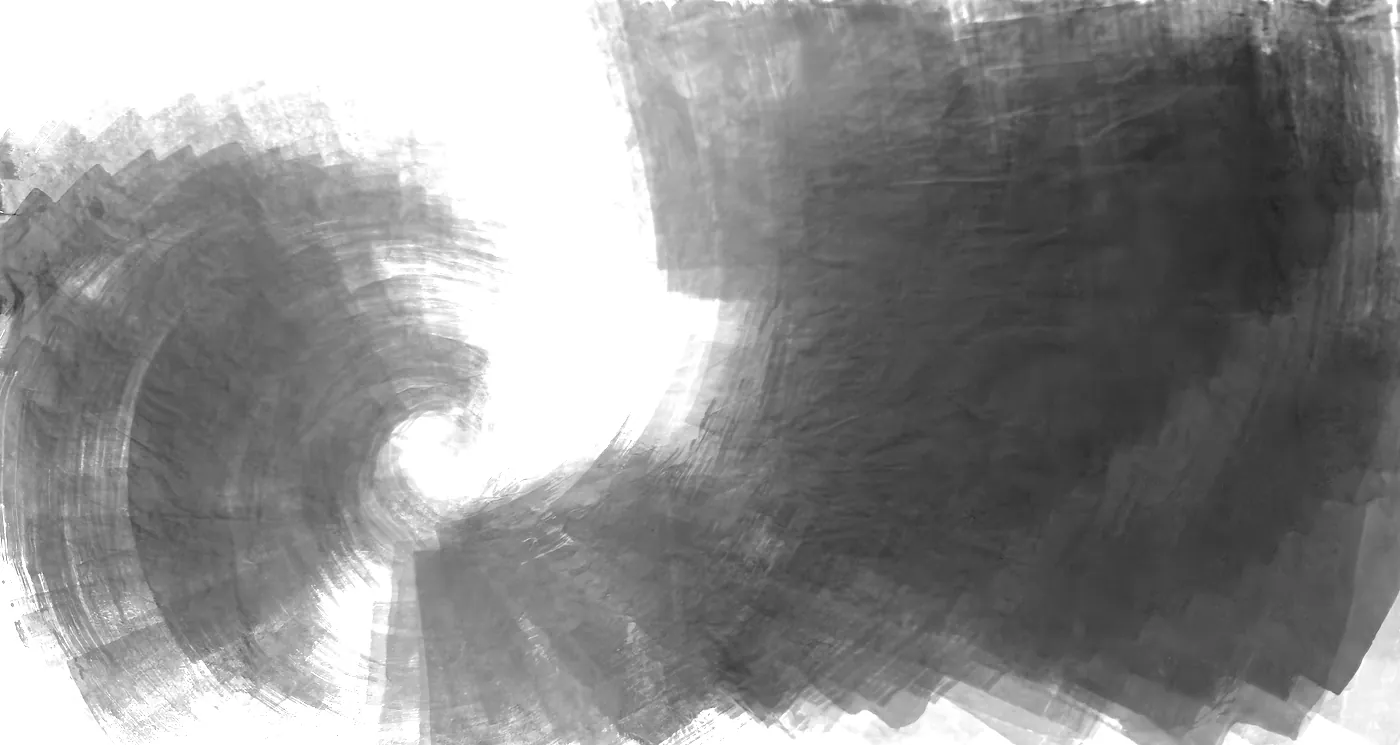
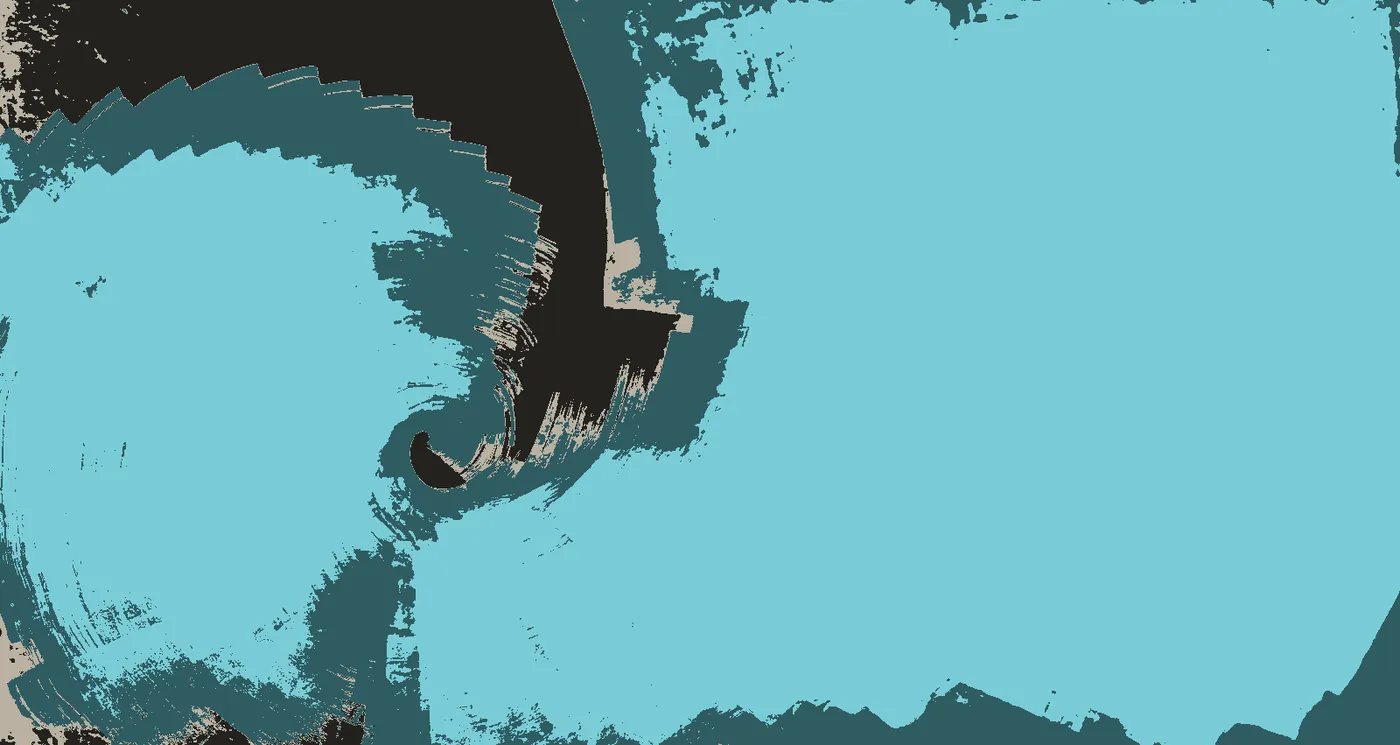
Left, the photograph. Centre, the tone stretch the model is shown beside it: the darkest 45% of tones spread over the whole range, so flat black, banding and stains show. Right, every pixel as the measuring code classes it: cyan black ink, deep teal translucent grey, stone the palest ink, near black bare paper.
1 family of tone.
Every inked pixel's brightness in 64 bins, smoothed; each circled peak holds at least 4% of the ink. Two or fewer: Tonal depth is held at the bottom rung whatever the model reads. A dense sheet of many translucent passes can count low here, so Layering is left to the reads. Life inside the black: 0.054 (under 0.045 reads as flat).
Five reads, agreeing on 4 of 5 qualities.
Each quality placed on its ladder by each read, and the mean the engine keeps. Where reads differ, they differ by one rung; close calls resolve down.
READ 1, IN ITS OWN WORDS
“The vortex idea echoes R3, but the sheet is overfilled. A dominant flat black right half, one tone family and buried passes keep it ordinary. The left spiral's stepped strokes and the white channel are its best parts.”
Left spiral is built from curved stepped strokes that hold their walls; the right half fuses into one heavy filled block with little stroke shape.
WEAKEST Right dark mass, a bulky filled slab
STRONGEST Left spiral's stepped arcing strokes following brush travel
Only one tonal step measured; modulation 0.054 barely above flat. The right mass reads as uniform black in colour view, with only faint variation when stretched.
WEAKEST Right-half black mass, near-uniform interior
STRONGEST Left spiral's arc banding toward its core
Pass edges show only at the spiral rims, top left and bottom right; inside, dark passes cover each other into a single dark family.
WEAKEST Right mass where later passes bury earlier
STRONGEST Stepped grey edges of left spiral's outer rim
The white channel from top centre to the spiral eye gives movement and shape. With 91% coverage, though, the right half is a heavy dead block.
WEAKEST Crowded, dead right half filling the frame
STRONGEST White S-channel spiralling into the vortex eye
The ink is controlled and there are no tide lines or rings. Paper wrinkling shows in the stretched view across the right mass, and there is slight cloudiness in the lower right.
WEAKEST Paper crinkle texture across right dark mass
STRONGEST Dry-brush feathering at the spiral's inner edges
4 distinct places, 0 major.
Each read must name every flaw and where it is, in a ninth of the sheet. Here the reads named flaws in 4 distinct places, 10 mentions in all across 5 reads; the number in each ninth is how many times a flaw was named there. Reads agreeing on a place strengthen the evidence for one flaw; they do not multiply it.
V23's rules and arithmetic, and every figure under its own name, are in the Archive record.
Date
2026.10.16, day 292 of the Crucible Year, one of 12 paintings from that date. 0 works were registered in the fourteen days before. Paintings are dated by the day their batch was registered and photographed; each was finished that day or within the few days before. Phase: P4 S14 (working title).
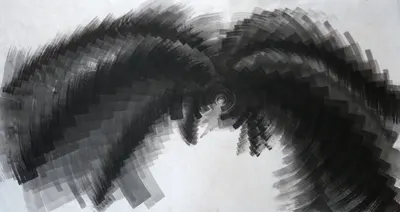
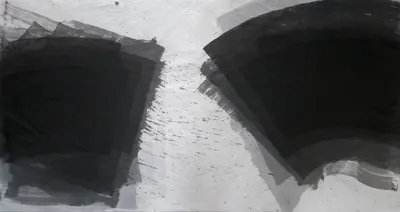
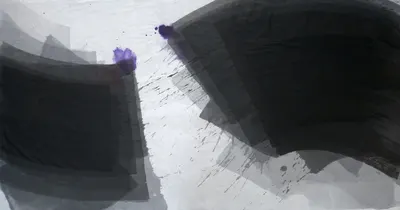
T_385 among all 419
Every painting of the year by date; this one is outlined.
Materials
- Paper
- Half-Cooked Red Star Mo She 6-Foot Bark Xuan Paper, self-sized, China Xuan Paper Co., Ltd., made 2026.04.08
- Ink MB6
- Yi De Ge Yun Tou Yan, Yi De Ge (Beijing)
- Ink MB8
- Boku-Undo Gentoku Super Concentrated, Boku-Undo
- Ink MB9
- Yi De Ge Pine Soot Ink, Yi De Ge (Beijing)
- Ink MB10
- Shisan Yue Calligraphy and Painting Ink, Shisan Yue (Thirteenth Month)
Related