T_394
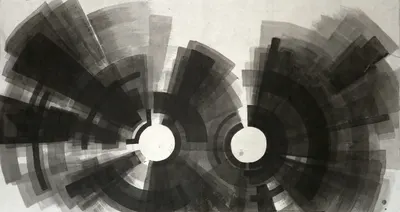
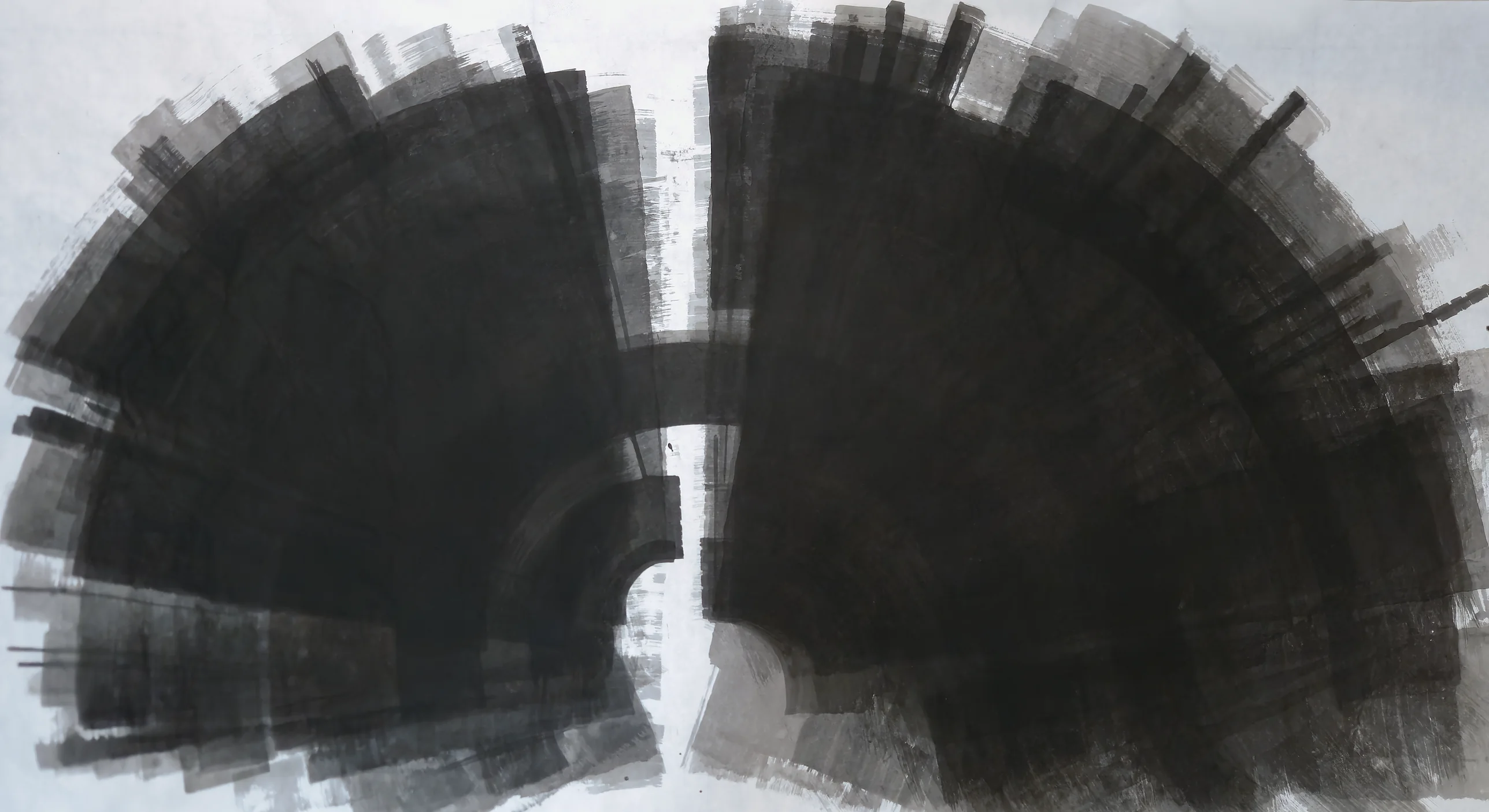
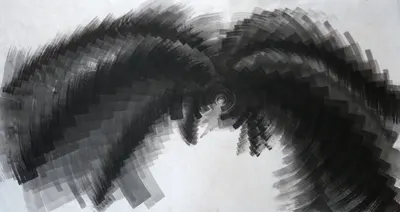
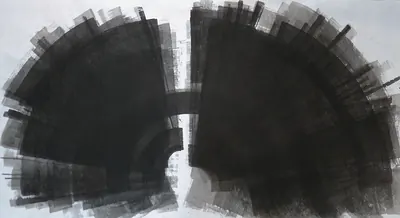
The engine's readingTwo black fans built from radiating brushstrokes, stepped with grey at their rims, swing away from a white slit and meet at one dark bridge.
Record- Date
- 2026.10.16
- Dimensions
- 97 × 180 cm
- Rating
- 5.9
- Paper
- Huiyun Tianxuan Ge "Dot Ink Becomes Gold" Master Special, semi-cooked (self-sized, aged)
- Ink
- Yi De Ge Yun Tou Yan, Boku-Undo Gentoku Super Concentrated, Yi De Ge Pine Soot Ink, Shisan Yue Calligraphy and Painting Ink
I wintered in the two kingdoms. Same black on both sides, same taxes, same pikes stuck out along the borders. By treaty a country may grow in any direction except toward the other, so between them runs a white river with no water in it, which cannot be crossed by anything that casts a shadow. They built the bridge anyway. Under it lives the troll, who is the size of a drop of ink and has never collected a toll. I brought him bread once. He asked what the weather was doing out past the fringes. Then he went quiet, small and wet and shining, with the bread between us on the white stone, going hard.
The reading
Written by the engine after V23's reads, from the settled findings, and checked by hand before approval. It explains V23's numbers and may not change them.
- Structure
- two mirrored radial fans joined by one dark bridge across a central slit
- Movement
- radial, outward from the centre; curved inner arcs cross against it
- Coverage
- ink on about nine tenths of the paper
- Tone
- two tonal steps, weighted dark
- Layering
- two kinds, translucent grey and dark covering passes; readable at rims, bridge, lower left
- Edges
- crisp at inner arc and lower scoop; blocky at rims; broken along the slit
- Feibai
- none
- Open paper
- narrow vertical slit widening to a rounded opening at lower centre; open outer corners
- Chance marks
- ink drop below the bridge, specks near top centre, crease lines inside both fans
- Frame
- ink runs off right and bottom, nearly meets left and top; corners stay open
Two black fans swing outward from a narrow white slit, and at this size they arrive first as weight. A dark bridge crosses the slit at middle height and locks them into one mass. Every stroke radiates, so the eye is pushed toward the rims and finds little reason to stay inside.
The sheet comes alive at its edges and its centre. Around the rims, broad flat strokes end in stepped grey blocks. The half-sized paper keeps those passes apart, so each can be read over the last, especially at the lower left. Below the bridge, a smaller arc band curls around a white opening, where a dark shape and a shape of paper finally answer each other.
The price is paid inside the fans, worst on the right. Pass after pass has sealed the paper, the order of the strokes is lost, and the right fan sets into a flat slab. Faint creases cross the blacks without harm. So much ink leaves little paper to shape.
Middling, then. The structure is clear, the rims are lively, the small centre is good, and two great blacks give back very little. Look at its edges.
The rating
T_394, rated 5.9
The combined score, out of 10: V23's reading of the photograph as the read half and V24's twelve tests on the 16-bit file as the measured half, added and divided by 10. The scale is relative to this archive. How each half is made is on the Method page.
- Form
- 2.0 · built
- Tonal depth
- 1.0 · thin
- Layering
- 1.4 · single
- Composition
- 1.8 · working
- Material and surface
- 2.0 · sound
- Mass
- 8.0 of 10
- Tone
- 6.6 of 14
- Void
- 6.4 of 8
- Flow
- 8.4 of 10
- Balance
- 8.0 of 8
How it was measured
What V24 measured.
Plain physical facts with no model involved. Across the year they track how the practice changes. On one sheet they cannot say whether a mark is any good. Millimetres read a few percent high, because the photographs are cropped just inside the paper's edge.
The width of the ink mask along its medial axis.
Optical density at the 75th percentile of the sheet.
The radius of the largest circle of open paper.
How far the marks align across the sheet. Lower means they run several ways.
Left and right asymmetry of the ink. Lower is more even.
Pixels to the millimetre in the TIFF these were measured from, with the studio light removed.
Read by the Visual Analysis Engine, version 23.8, on 2026.10.16: measured by code, then read 5 times by Claude Opus 5.5 against three reference paintings (R1 to R3), each read independent of the others. How the engine works.
Three views of one sheet.
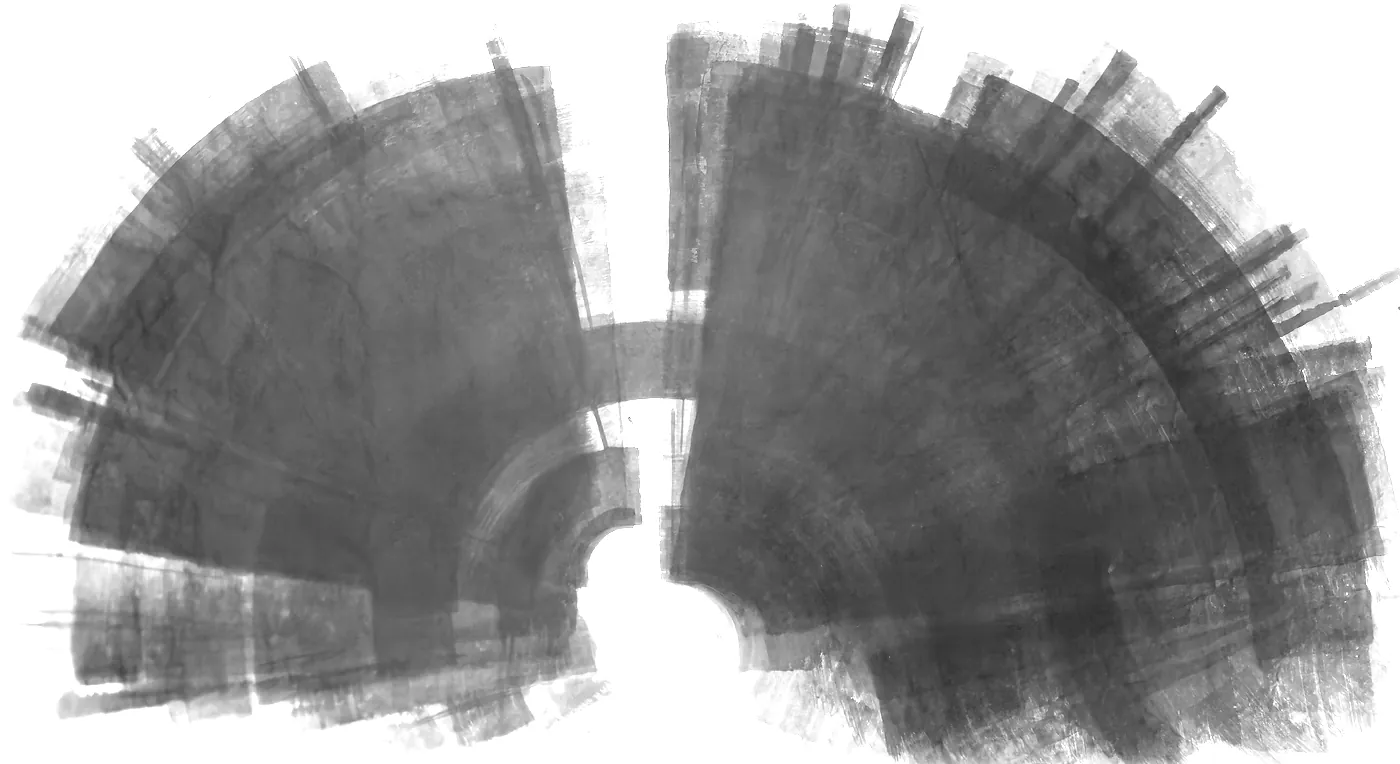
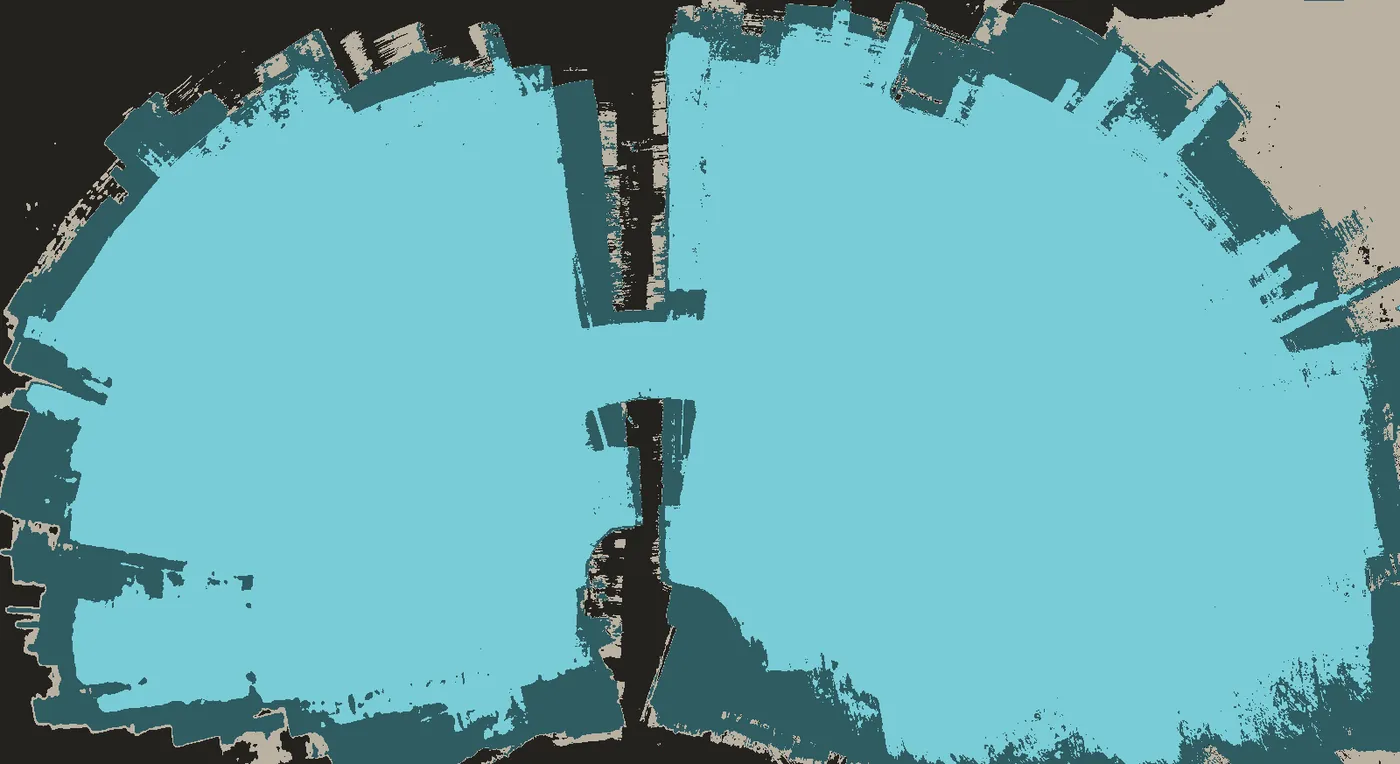
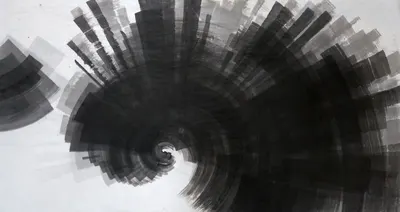
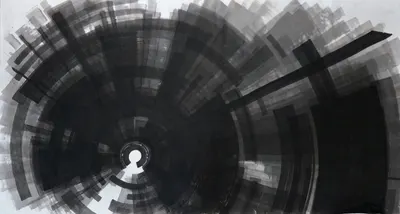
Left, the photograph. Centre, the tone stretch the model is shown beside it: the darkest 45% of tones spread over the whole range, so flat black, banding and stains show. Right, every pixel as the measuring code classes it: cyan black ink, deep teal translucent grey, stone the palest ink, near black bare paper.
2 families of tone.
Every inked pixel's brightness in 64 bins, smoothed; each circled peak holds at least 4% of the ink. Two or fewer: Tonal depth is held at the bottom rung whatever the model reads. A dense sheet of many translucent passes can count low here, so Layering is left to the reads. Life inside the black: 0.038 (under 0.045 reads as flat).
Five reads, agreeing on 3 of 5 qualities.
Each quality placed on its ladder by each read, and the mean the engine keeps. Where reads differ, they differ by one rung; close calls resolve down.
READ 1, IN ITS OWN WORDS
“A darker, denser version of R3's fan structure. Its interiors are flat black, so the layering only shows at the rims. The central cleft holds the composition, but the sheet is crowded. The surface is mostly sound, with minor creases.”
Fan forms built from radial arc strokes whose ends follow brush travel at the rims, but both interiors read as heavy filled slabs with no stroke articulation.
WEAKEST Bulky fused dark slab of right fan interior
STRONGEST Inner arc band curling around central opening
Dark interior modulation 0.038 and two tonal steps; both fan centres are uniform black, tone changes only at the ragged outer rims and lower left greys.
WEAKEST Near-black interiors of both fans
STRONGEST Translucent grey stepped rims at outer edges
Passes are legible only at the peripheries; across the main masses successive dark passes simply cover earlier ones, unlike R3's readable translucent sequence.
WEAKEST Fan centres where later passes bury earlier ones
STRONGEST Overlapping grey bars along upper right rim
Paired fans around a vertical white cleft and circular void give direction and symmetry, but 89% coverage leaves little shaped paper; masses feel heavy and crowded.
WEAKEST Crowded dark mass filling nearly whole sheet
STRONGEST Central white gap and circular opening
Ink controlled overall; paper crease lines inside dark masses and blotchy mottling lower right show mainly in tone-stretched view, not disrupting at viewing distance.
WEAKEST Mottled cloudy grey lower left fringe
STRONGEST Dry-brush rake edges at upper right rim
7 distinct places, 0 major.
Each read must name every flaw and where it is, in a ninth of the sheet. Here the reads named flaws in 7 distinct places, 14 mentions in all across 5 reads; the number in each ninth is how many times a flaw was named there. Reads agreeing on a place strengthen the evidence for one flaw; they do not multiply it.
V23's rules and arithmetic, and every figure under its own name, are in the Archive record.
Date
2026.10.16, day 292 of the Crucible Year, one of 12 paintings from that date. 0 works were registered in the fourteen days before. Paintings are dated by the day their batch was registered and photographed; each was finished that day or within the few days before. Phase: P4 S14 (working title).
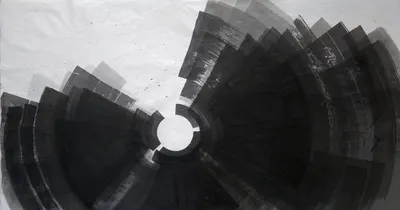
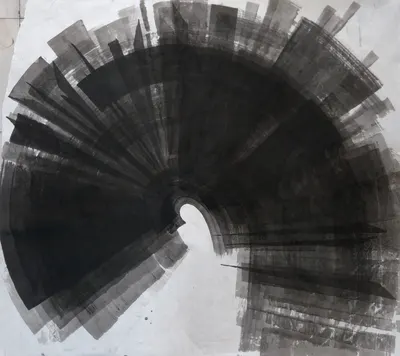
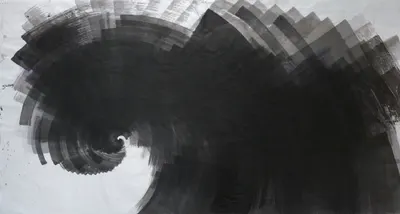
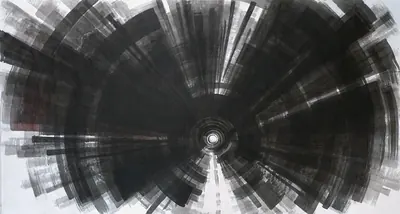
T_394 among all 419
Every painting of the year by date; this one is outlined.
Materials
- Paper
- Huiyun Tianxuan Ge "Dot Ink Becomes Gold" Master Special, semi-cooked (self-sized, aged), Anhui Jingxian Huiyun Tianxuan Ge Xuan Paper Art Products Co., Ltd. (安徽泾县徽韵天宣阁宣纸艺术品有限公司), made 2012.10
- Ink MB6
- Yi De Ge Yun Tou Yan, Yi De Ge (Beijing)
- Ink MB8
- Boku-Undo Gentoku Super Concentrated, Boku-Undo
- Ink MB9
- Yi De Ge Pine Soot Ink, Yi De Ge (Beijing)
- Ink MB10
- Shisan Yue Calligraphy and Painting Ink, Shisan Yue (Thirteenth Month)
Related