T_416
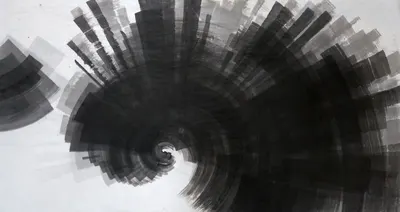
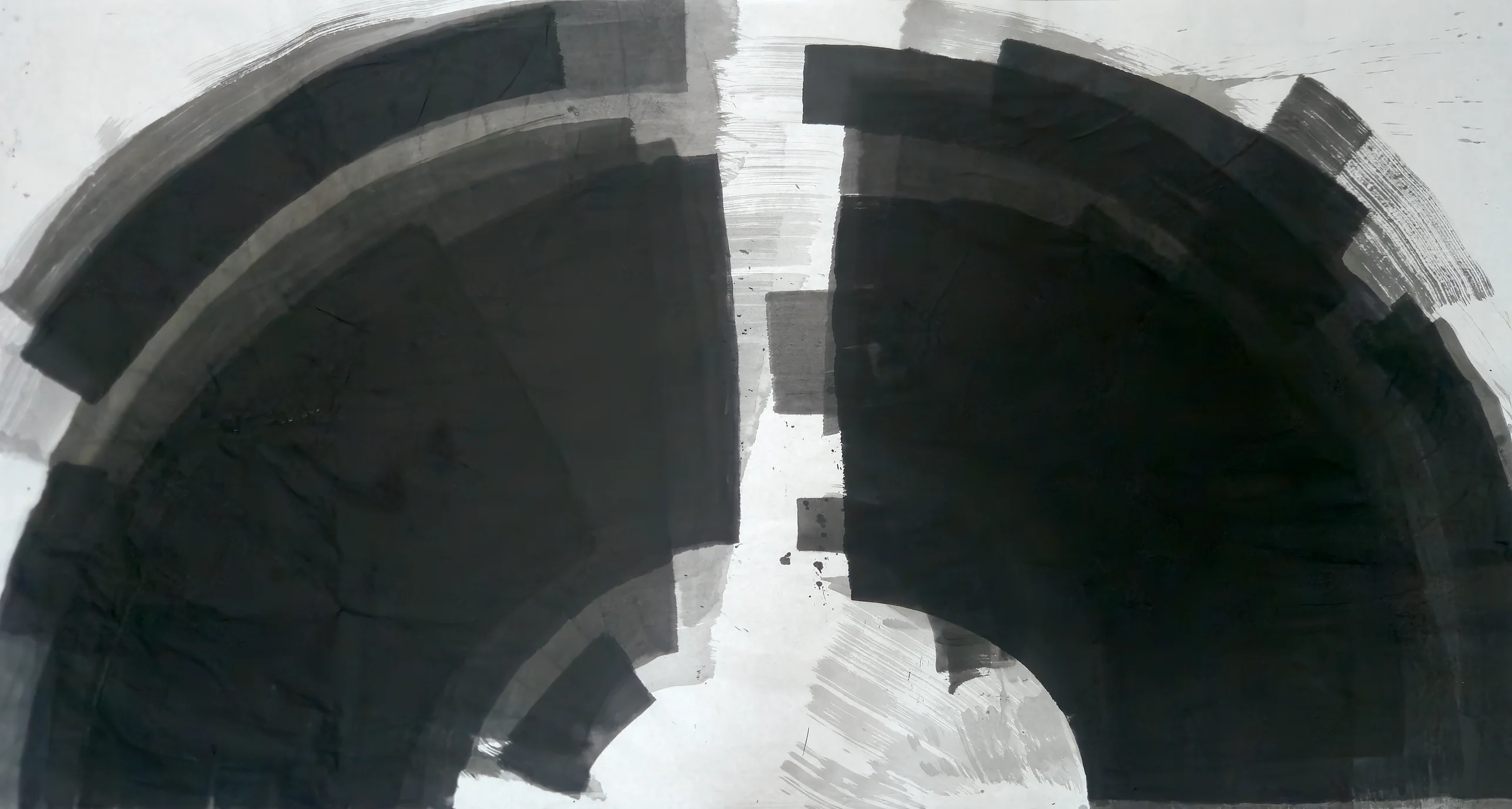
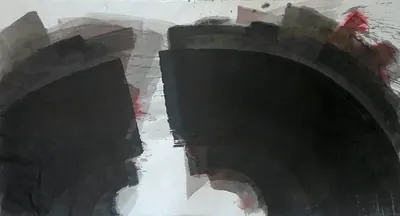
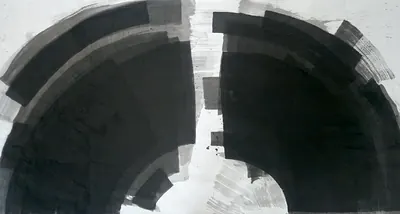
The engine's readingTwo black quarter-rings of brushed bands rise from the bottom corners and stop short of each other, around a pale channel and a half circle of bare paper.
Record- Date
- 2026.11.03
- Dimensions
- 97 × 180 cm
- Rating
- 6.3
- Paper
- Half-Cooked Red Star Mo She 6-Foot Bark Xuan Paper, self-sized
- Ink
- Yi De Ge Yun Tou Yan, Boku-Undo Gentoku Super Concentrated, Yi De Ge Pine Soot Ink, Shisan Yue Calligraphy and Painting Ink
I worked the gap. Two halves of a ring station, hauled out from separate yards, and when they came within hailing range the docking collars were the wrong size. We bolted on small grey plates anyway, and they closed nothing. For years I ran the shuttle through that slot with spare parts and letters. Each side kept its own clocks and its own bad coffee and sent me across with complaints about the other. Some coolant got out once and hung in the channel in black beads, and I learned to fly around them. At shift end the planet came up under us, white and enormous, filling the doorway below my feet.
The reading
Written by the engine after V23's reads, from the settled findings, and checked by hand before approval. It explains V23's numbers and may not change them.
- Structure
- two quarter-ring masses of concentric bands, split by a vertical gap, never joined
- Movement
- curved sweep around a lower centre, with the vertical channel dropping against it
- Coverage
- ink on about four fifths of the paper
- Tone
- three tonal steps, weighted dark
- Layering
- two kinds, grey and black; readable at band ends and outer rims, buried in quadrants
- Edges
- crisp on black panel ends and inner curves, broken at dry outer band ends
- Feibai
- present at upper right band end, lower centre fan and top of channel
- Open paper
- narrow vertical channel widening into a half circle at lower centre; both upper corners
- Chance marks
- spatter in central channel and upper right; creases lower left; faint smudge in right mass
- Frame
- ink runs off bottom, lower left and lower right, and touches top; upper corners open
A great arch, broken at the crown. Two quarter-ring masses swing up from the bottom corners and stop short of each other, leaving a pale channel that falls down the middle and opens into a half circle of bare paper. The eye goes round, then down, and the white is as shaped as the black.
The outer bands are where the sheet lives. At upper left a grey arc runs under black panels, and the order of passes reads plainly, because the half-sized paper keeps each layer from sinking into the last. At the upper right the band ends overlap, translucent, then the brush lifts into fast dry streaks with bare paper running through them.
The price is inside. The lower-right quadrant is a filled slab, almost one black from edge to edge, with little travel of the brush and every earlier pass buried. Creases crumple the lower-left mass, small but visible from where you stand.
Where that leaves it is clear: a large, legible structure, well made at the rim and overweight at the heart. A good painting, with its life at the edges and too much ink between them.
The rating
T_416, rated 6.3
The combined score, out of 10: V23's reading of the photograph as the read half and V24's twelve tests on the 16-bit file as the measured half, added and divided by 10. The scale is relative to this archive. How each half is made is on the Method page.
- Form
- 2.0 · built
- Tonal depth
- 1.8 · modelled
- Layering
- 2.0 · legible
- Composition
- 2.2 · working
- Material and surface
- 1.6 · sound
- Mass
- 10.0 of 10
- Tone
- 6.8 of 14
- Void
- 4.8 of 8
- Flow
- 6.0 of 10
- Balance
- 8.0 of 8
How it was measured
What V24 measured.
Plain physical facts with no model involved. Across the year they track how the practice changes. On one sheet they cannot say whether a mark is any good. Millimetres read a few percent high, because the photographs are cropped just inside the paper's edge.
The width of the ink mask along its medial axis.
Optical density at the 75th percentile of the sheet.
The radius of the largest circle of open paper.
How far the marks align across the sheet. Lower means they run several ways.
Left and right asymmetry of the ink. Lower is more even.
Pixels to the millimetre in the TIFF these were measured from, with the studio light removed.
Read by the Visual Analysis Engine, version 23.13, on 2026.11.03: measured by code, then read 5 times by Claude Opus 5.5 against three reference paintings (R1 to R3), each read independent of the others. How the engine works.
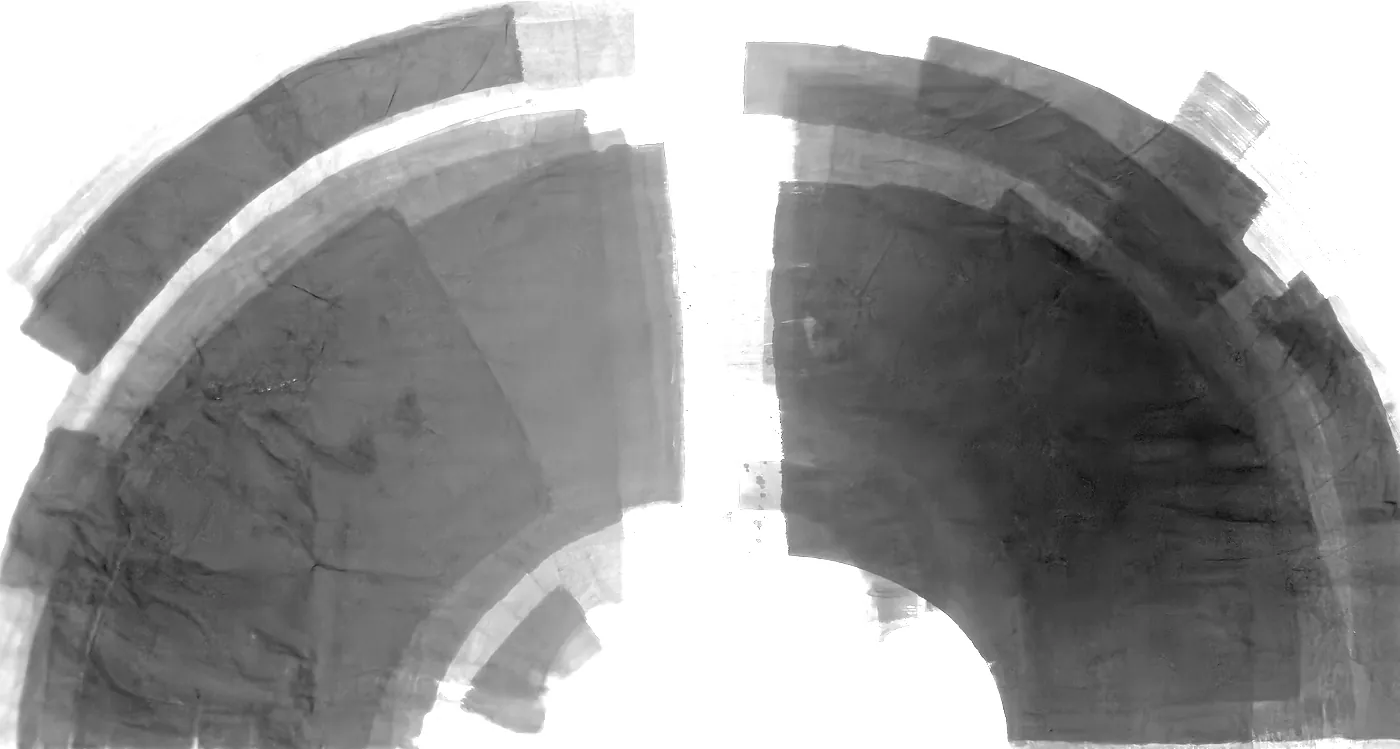
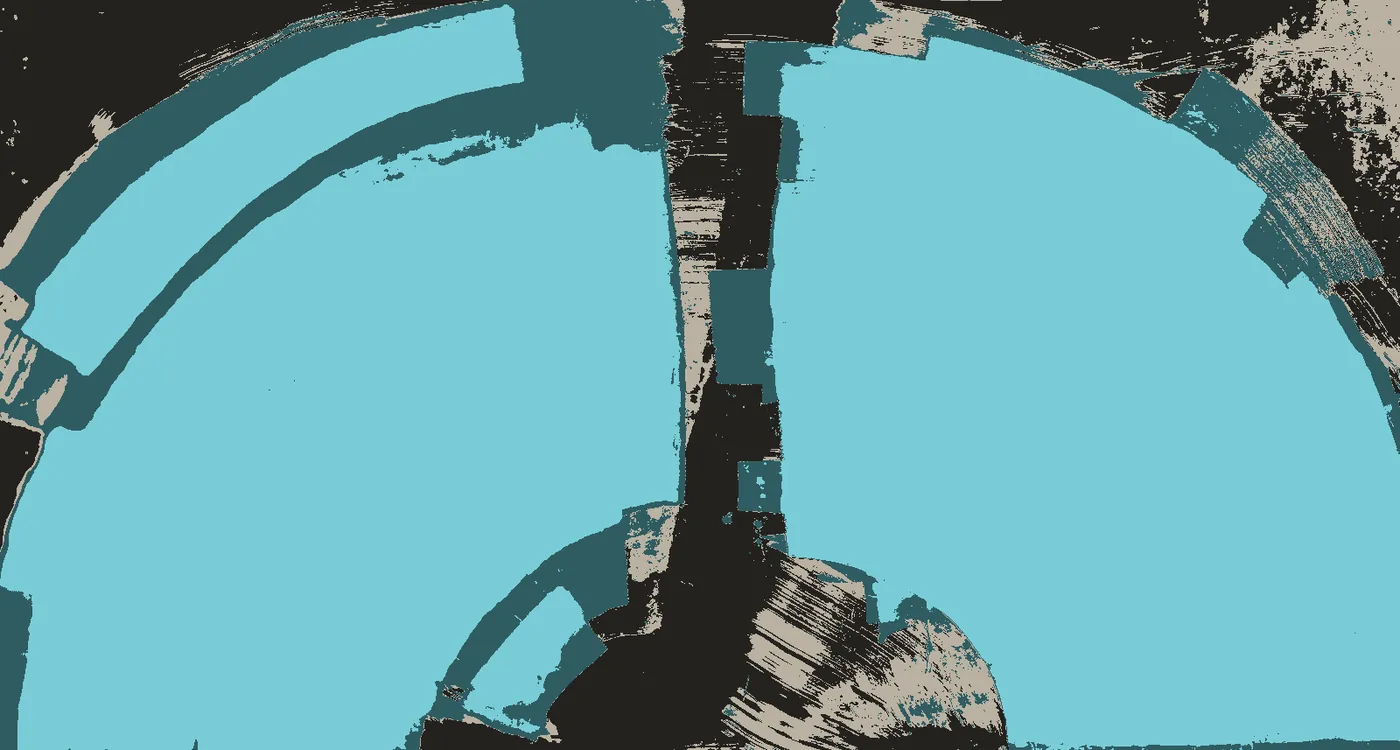
Three views of one sheet.
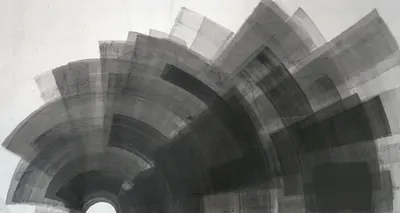
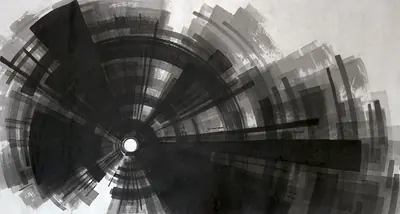
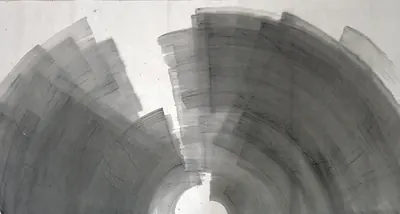
Left, the photograph. Centre, the tone stretch the model is shown beside it: the darkest 45% of tones spread over the whole range, so flat black, banding and stains show. Right, every pixel as the measuring code classes it: cyan black ink, deep teal translucent grey, stone the palest ink, near black bare paper.
3 families of tone.
Every inked pixel's brightness in 64 bins, smoothed; each circled peak holds at least 4% of the ink. Life inside the black: 0.054 (under 0.045 reads as flat).
Five reads, agreeing on 2 of 5 qualities.
Each quality placed on its ladder by each read, and the mean the engine keeps. Where reads differ, they differ by one rung; close calls resolve down.
READ 1, IN ITS OWN WORDS
“A broken ring of heavy arcs around a pale channel: clear structure and movement, but darks swallow most layering and tonal range, and creases mar the lower-left mass. Ordinary overall, with a surface weakness.”
Two quarter-ring masses and outer arc bands are coherent, with holding walls and curved travel; inner quadrants read as heavy filled slabs, and band ends are blunt.
WEAKEST Huge right quadrant fill, bulky and slab-like inside its arc
STRONGEST Outer arc bands following the sweep of the brush
Left mass steps between two dark wedges, outer bands show grey overlaps; right quadrant reads almost flat black in colour. Modulation 0.054 barely clears flat; darks dominate, few mid-greys.
WEAKEST Right quadrant interior, near uniform black in colour view
STRONGEST Stepped greys of left wedge and outer arc overlaps
Band overlaps at the top and right edges and grey under-arcs stay readable; inside the main quadrants, later black passes largely cover the earlier ones, so sequence is only partly legible.
WEAKEST Inner dark quadrants swallow earlier passes beneath them
STRONGEST Translucent overlaps at top-left and upper-right band ends
Two arcs swing around a shaped vertical channel and pale lower circle, giving clear movement; dark weight fills most of the sheet, leaving lower masses heavy and static.
WEAKEST Dark quadrants crowd the frame; small central blocks feel incidental
STRONGEST Broken ring with pale central channel opening into lower circle
Sharp crease lines cross the left dark mass and upper-left band, visible in colour and stronger when stretched; pale specks mid-left, milky smudge on right mass's inner edge.
WEAKEST Crease lines and crumpling inside lower-left dark mass
STRONGEST Dry-brush streaks at upper right and lower centre
5 distinct places, 1 major.
Each read must name every flaw and where it is, in a ninth of the sheet. Here the reads named flaws in 5 distinct places, 23 mentions in all across 5 reads; the number in each ninth is how many times a flaw was named there. Reads agreeing on a place strengthen the evidence for one flaw; they do not multiply it. A major flaw holds Material and surface at rung 1.
V23's rules and arithmetic, and every figure under its own name, are in the Archive record.
Date
2026.11.03, day 310 of the Crucible Year, one of 11 paintings from that date. 13 works were registered in the fourteen days before. Paintings are dated by the day their batch was registered and photographed; each was finished that day or within the few days before. Phase: P4 S14 (working title).
T_416 among all 419
Every painting of the year by date; this one is outlined.
Materials
- Paper
- Half-Cooked Red Star Mo She 6-Foot Bark Xuan Paper, self-sized, China Xuan Paper Co., Ltd., made 2026.04.08
- Ink MB6
- Yi De Ge Yun Tou Yan, Yi De Ge (Beijing)
- Ink MB8
- Boku-Undo Gentoku Super Concentrated, Boku-Undo
- Ink MB9
- Yi De Ge Pine Soot Ink, Yi De Ge (Beijing)
- Ink MB10
- Shisan Yue Calligraphy and Painting Ink, Shisan Yue (Thirteenth Month)
Related