T_412
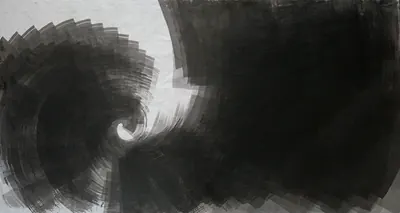
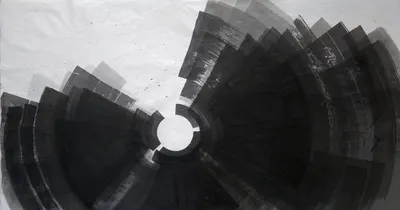
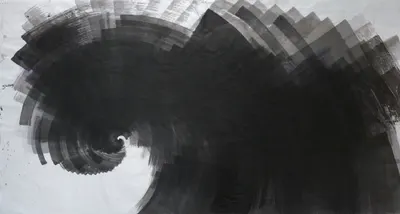
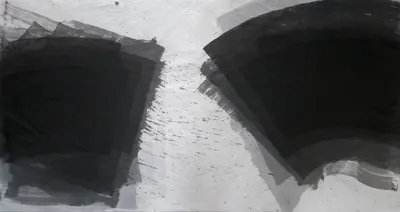
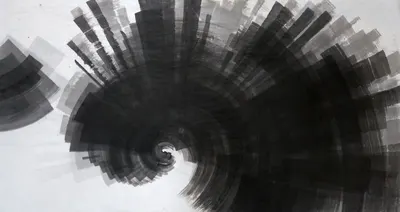
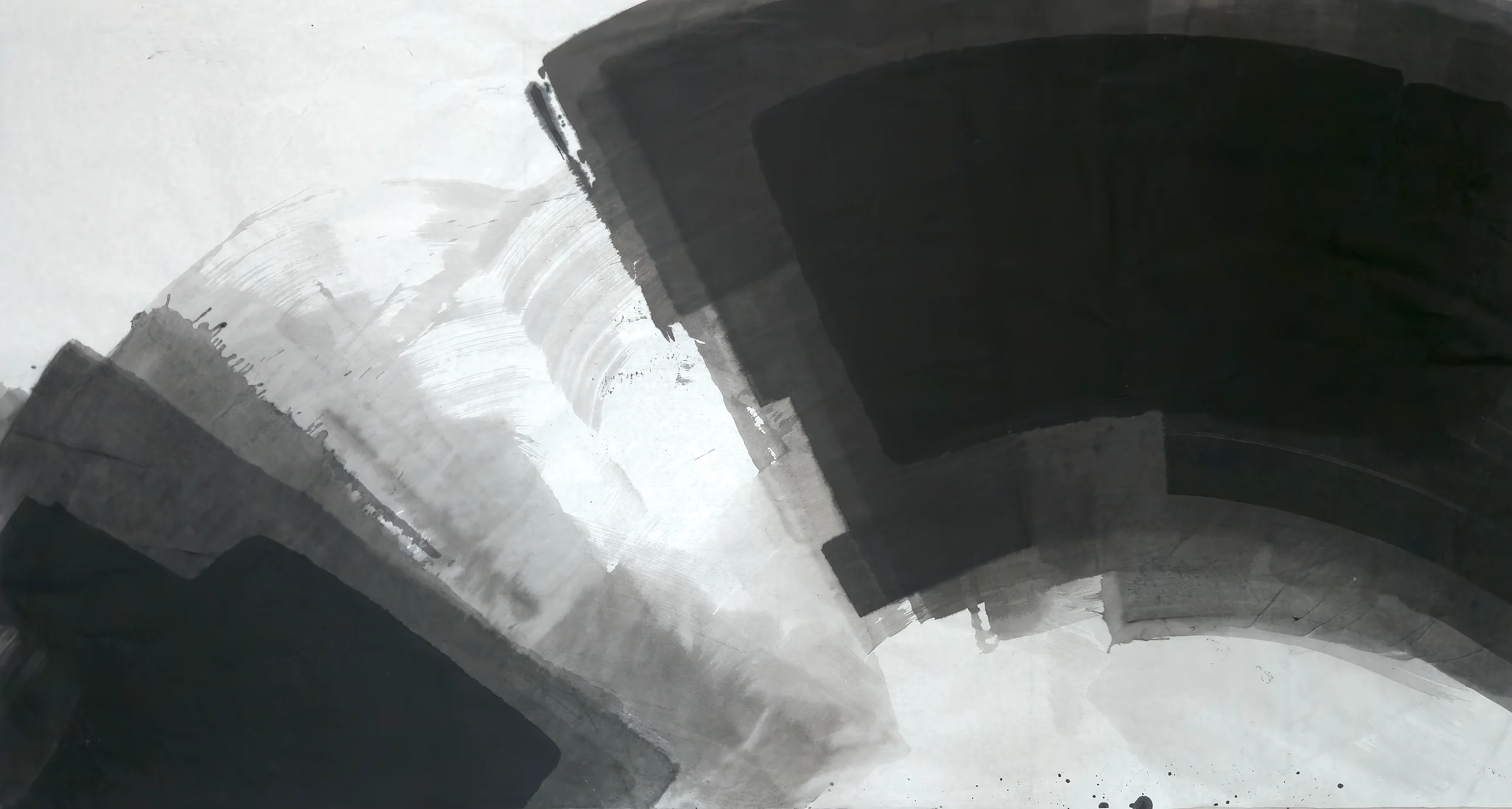
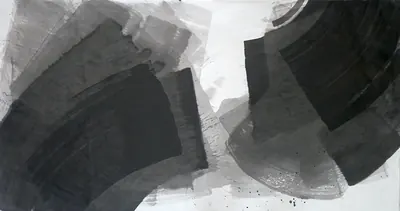
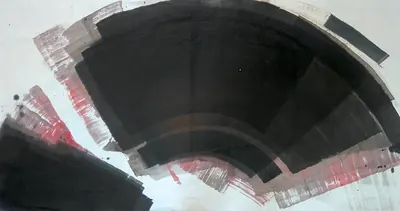
The engine's readingTwo cropped black fans, ringed in stepped grey, press in from opposite corners of a long sheet around a bright diagonal raked with dry-brush arcs.
Record- Date
- 2026.11.03
- Dimensions
- 97 × 180 cm
- Rating
- 6.1
- Paper
- Half-Cooked Red Star Mo She 6-Foot Bark Xuan Paper, self-sized
- Ink
- Yi De Ge Yun Tou Yan, Boku-Undo Gentoku Super Concentrated, Yi De Ge Pine Soot Ink, Shisan Yue Calligraphy and Painting Ink
The great black block at upper right is the front that came over the plains one Sunday in April, in the dust years, after a fine clear morning. Birds arrived first, thousands of them, flying ahead of it and saying nothing. Then the temperature fell and the air went dry enough to spark, so that cars stalled on the road and men dragged chains behind them to bleed the charge off. I stood in the pale strip that was left, the last of the afternoon, with my hat in my hand. It did not look like weather. It looked like somebody's decision. Then the white road went out from the far end toward me, fence post by fence post.
The reading
Written by the engine after V23's reads, from the settled findings, and checked by hand before approval. It explains V23's numbers and may not change them.
- Structure
- two opposed fan masses, black cores in stepped grey bands, linked by pale brushed arcs
- Movement
- one implied ring sweeping across a rising diagonal; nothing runs against it
- Coverage
- ink on about three quarters of the paper
- Tone
- three tonal steps, weighted dark
- Layering
- pale wash, greys and black; readable where they step at the masses' edges
- Edges
- crisp around black cores; broken and dripping along the central diagonal; soft in pale washes
- Feibai
- present in the pale central arcs, curving with the sweep
- Open paper
- irregular bright areas at upper left and lower right, joined by a central diagonal
- Chance marks
- drips along the central diagonal, spatter and a blot at bottom, faint ring lower right
- Frame
- ink runs off top, right, bottom and left; upper left and lower right stay open
Black comes in from opposite corners and the eye goes straight to the gap between them. A huge fan fills the upper right, a stepped wedge climbs from the lower left, and their curves suggest one great ring, cropped by the frame, turning around a bright diagonal of paper.
The life sits at the edges of those masses. Along the fan's lower side, grey passes step over one another, each keeping its border because the half-sized paper slows the ink. The arc band at lower right follows the curve of the brush's travel, its grey full of grain. In the channel, a fast dry brush drags pale arcs across bare paper, and these are the liveliest marks on the sheet.
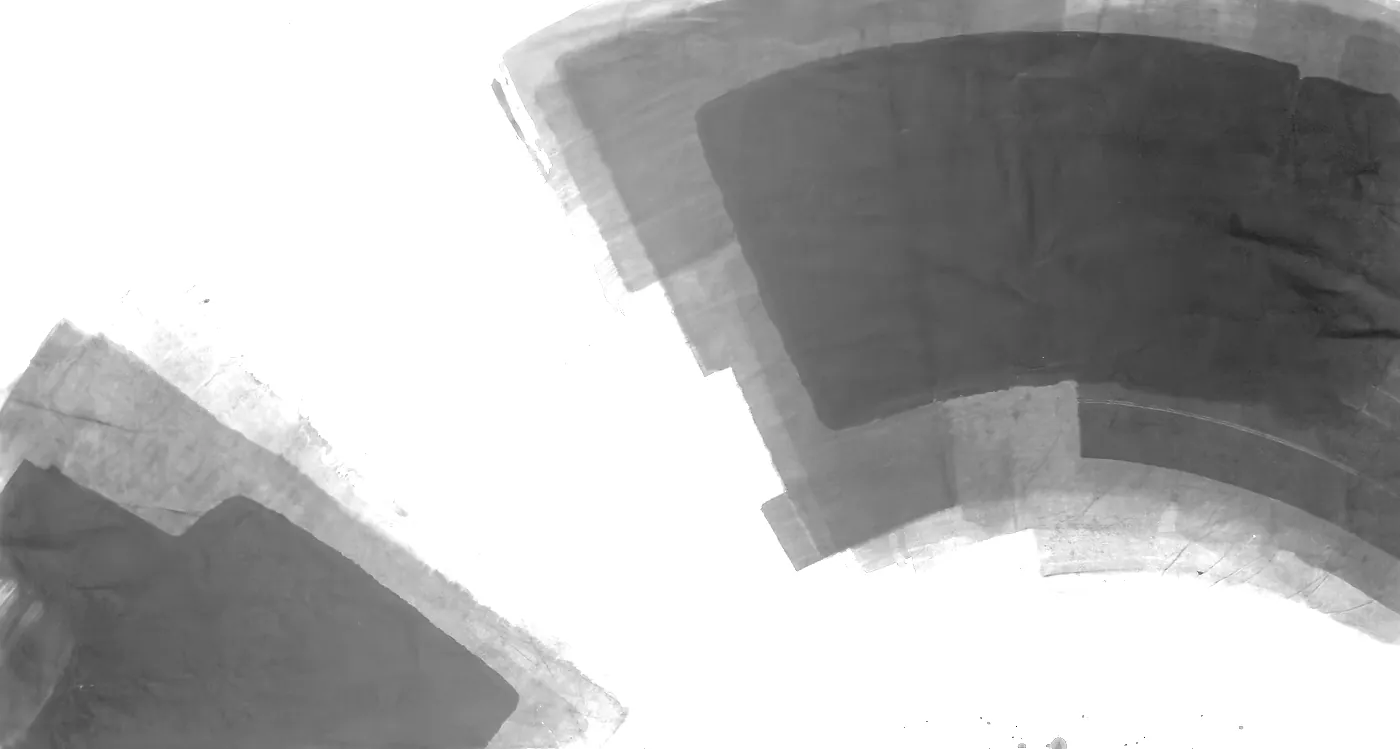
The blacks pay for all this. Both cores lie nearly flat and bury the passes beneath them. The upper-right block sits heavy and static, its notched corners stiff. Fine creases cross the grey bands and the right of the black, small events beside all that mass.
A well-built sheet, above the common run, with its interest at the margins. The black takes the most room and gives the least back.
The rating
T_412, rated 6.1
The combined score, out of 10: V23's reading of the photograph as the read half and V24's twelve tests on the 16-bit file as the measured half, added and divided by 10. The scale is relative to this archive. How each half is made is on the Method page.
- Form
- 2.0 · built
- Tonal depth
- 1.8 · modelled
- Layering
- 2.2 · legible
- Composition
- 2.2 · working
- Material and surface
- 2.0 · sound
- Mass
- 9.4 of 10
- Tone
- 10.4 of 14
- Void
- 6.4 of 8
- Flow
- 5.2 of 10
- Balance
- 0.0 of 8
How it was measured
What V24 measured.
Plain physical facts with no model involved. Across the year they track how the practice changes. On one sheet they cannot say whether a mark is any good. Millimetres read a few percent high, because the photographs are cropped just inside the paper's edge.
The width of the ink mask along its medial axis.
Optical density at the 75th percentile of the sheet.
The radius of the largest circle of open paper.
How far the marks align across the sheet. Lower means they run several ways.
Left and right asymmetry of the ink. Lower is more even.
Pixels to the millimetre in the TIFF these were measured from, with the studio light removed.
Read by the Visual Analysis Engine, version 23.13, on 2026.11.03: measured by code, then read 5 times by Claude Opus 5.5 against three reference paintings (R1 to R3), each read independent of the others. How the engine works.
Three views of one sheet.
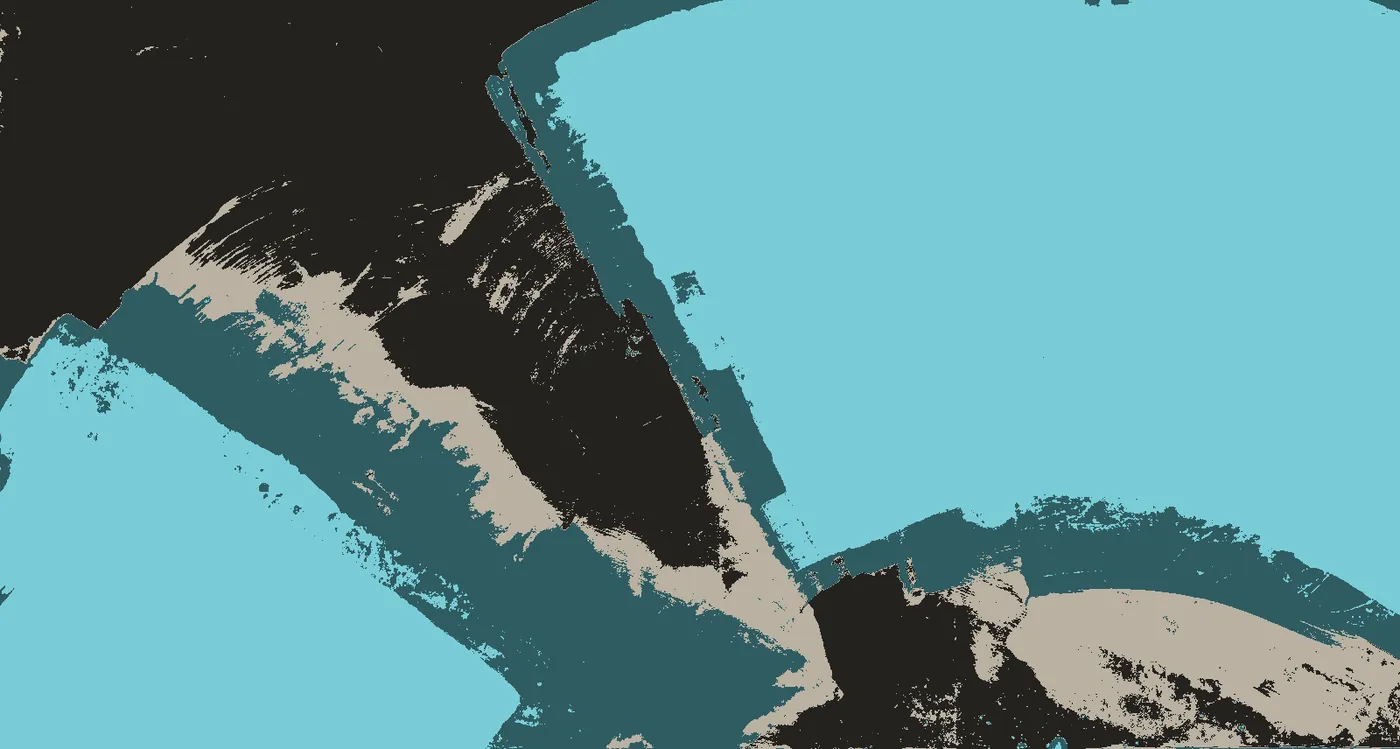
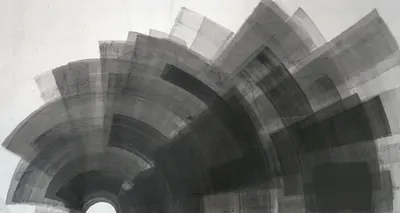
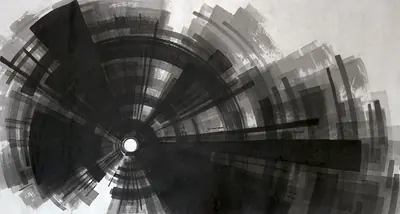
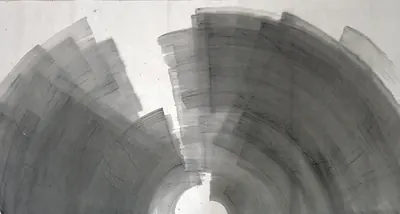
Left, the photograph. Centre, the tone stretch the model is shown beside it: the darkest 45% of tones spread over the whole range, so flat black, banding and stains show. Right, every pixel as the measuring code classes it: cyan black ink, deep teal translucent grey, stone the palest ink, near black bare paper.
3 families of tone.
Every inked pixel's brightness in 64 bins, smoothed; each circled peak holds at least 4% of the ink. Life inside the black: 0.054 (under 0.045 reads as flat).
Five reads, agreeing on 2 of 5 qualities.
Each quality placed on its ladder by each read, and the mean the engine keeps. Where reads differ, they differ by one rung; close calls resolve down.
READ 1, IN ITS OWN WORDS
“Two opposed arc masses with clearly stepped translucent passes and a strong white diagonal channel, held back by bulky, nearly flat black cores and small creases. Ordered layering is its best quality; otherwise an ordinary, working sheet.”
Two arc-segment masses have coherent, holding walls following a curved sweep, but the black cores read as filled slabs; stepped joins lower left of the right mass are stiff.
WEAKEST Bulky black fan core with clumsy stepped notches, upper right
STRONGEST Outer arc band sweeping beneath the upper right mass
Grey bands show grain and stepped density; black cores read almost flat in colour, with only faint variation when stretched. Modulation 0.054 sits just above the flat line.
WEAKEST Lower left black core, nearly flat inside
STRONGEST Grey arc bands with grain, lower right and lower left
Pale dry-brush, grey, darker grey and black passes step in clear order on both masses; overlaps at the right arc and lower left edge stay readable and build depth.
WEAKEST Opaque black cores conceal the passes beneath them
STRONGEST Stepped translucent bands around the upper right fan
Opposed arcs imply one large circular sweep, with a shaped diagonal channel between them, but the black mass sits heavy and the top left paper does little work.
WEAKEST Heavy black upper right mass dominates; top left paper is passive
STRONGEST Diagonal white channel between the two opposing arcs
Ink is controlled and edges bind cleanly; dry-brush is good but not form-shaping throughout. Small creases in the black and grey bands, plus faint cloudy wash low centre, remain minor.
WEAKEST Crease marks in the right of the black mass
STRONGEST Dry-brush drag in pale arcs, centre of sheet
4 distinct places, 0 major.
Each read must name every flaw and where it is, in a ninth of the sheet. Here the reads named flaws in 4 distinct places, 25 mentions in all across 5 reads; the number in each ninth is how many times a flaw was named there. Reads agreeing on a place strengthen the evidence for one flaw; they do not multiply it.
V23's rules and arithmetic, and every figure under its own name, are in the Archive record.
Date
2026.11.03, day 310 of the Crucible Year, one of 11 paintings from that date. 13 works were registered in the fourteen days before. Paintings are dated by the day their batch was registered and photographed; each was finished that day or within the few days before. Phase: P4 S14 (working title).
T_412 among all 419
Every painting of the year by date; this one is outlined.
Materials
- Paper
- Half-Cooked Red Star Mo She 6-Foot Bark Xuan Paper, self-sized, China Xuan Paper Co., Ltd., made 2026.04.08
- Ink MB6
- Yi De Ge Yun Tou Yan, Yi De Ge (Beijing)
- Ink MB8
- Boku-Undo Gentoku Super Concentrated, Boku-Undo
- Ink MB9
- Yi De Ge Pine Soot Ink, Yi De Ge (Beijing)
- Ink MB10
- Shisan Yue Calligraphy and Painting Ink, Shisan Yue (Thirteenth Month)
Related